Translate

Thursday, December 23, 2010

HERE COMES SANTA CLAUS!! MERRY CHRISTMAS TO ALL AND TO ALL A GOOD NIGHT!

SANTA CLAUS DROPPED OFF GIFTS AT ST. JOSEPH CATHOLIC CHURCH FOR CHILDREN IN NEED!

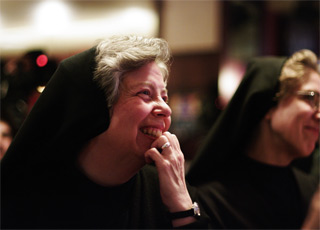
Sister Elizabeth, Daughter of Charity, Emmitsburg crowd, directs everyone

Daughter of Charity, Sister Elizabeth coordinating efforts of volunteers to give Christmas gifts to families in need


AND THAT GREAT SAVANNAH, GEORGIA CLASSIC WRITTEN AT A BAPTIST CHURCH RIGHT BEHIND THE CATHEDRAL OF SAINT JOHN THE BAPTIST ON HARRIS STREET BY A UNITARIAN! WHO WOULD HAVE THUNK?/span>

THE BISHOP WITH BACKBONE AND NOT A POLITICIAN TRYING TO PLEASE A CONSTITUENCY

News Conference at the Diocesan Pastoral Center, Dec. 21, 2010 from Diocese of Phoenix on Vimeo.

WILL THE CATHOLIC CHURCH BE PERSECUTED BY THE GOVERNMENT FOR HAVING CATHOLIC HOSPITALS THAT UPHOLD CATHOLIC TEACHINGS?


More fallout from excommunicated Catholic hospital in Tucson--will all Catholic hospitals cease to be?

New York Times, ACLU: Catholic hospitals should be forced to perform abortions
December 23, 2010


The American Civil Liberties Union has again urged the federal government to compel Catholic hospitals to perform abortions that are deemed necessary to save the life of the mother. The ACLU’s latest letter to the Centers for Medicare and Medicaid Services cites Bishop Thomas Olmsted’s decision to revoke the Catholic status of a hospital in which an abortion took place.

“This confrontation never should have happened in the first place, because no hospital-- religious or otherwise-- should be prohibited from saving women’s lives and from following federal law,” the ACLU letter said.

A New York Times editorial blasted Bishop Olmsted and supported the ACLU’s position. “This is no small matter,” the newspaper’s editors stated. “Catholic hospitals account for about 15 percent of the nation’s hospital beds and are the only hospital facilities in many communities.”

THE GRINCH WHO STOLE CHRISTMAS, NOT AT ALL A NICE HOLIDAY STORY

Our Lady of Deliverance Catholic Cathedral where attack kills almost 70 Catholics


Eastern Rite Roman Catholics in Iraq are being asked not to celebrate Christmas publicly this year. Many have already been martyred. Midnight Masses are being canceled and fear reigns supreme. Bishop Kevin Boland has asked that the second collection for Christmas be in part dedicated to a relief fund for Catholics in Iraq. Pray for them!
READ ALL ABOUT HERE!

OUR LADY OF DELIVERANCE, PRAY FOR THEM!
For the Catholics in Iraq and for your Christmas peace:

Wednesday, December 22, 2010

SAINT JOSEPH PARISHIONERS DONATE ABOUT $20,000 TOWARDS CHRISTMAS PRESENTS FOR NEEDY!

Our second collection on the First Sunday of December for the U.S. Marine Corps Toys for Tots program here in Macon garnered over $5000. Now if you look at the pictures below, you'll see our parish social hall filled with bikes, toys, clothes, food and other gifts for the needy distributed by our Family Advancement Ministries.

We also have an active Saint Vincent de Paul Society that assists those in need in Middle Georgia.


THE MASS IS ENDED, GO AND PROCLAIM AND LIVE THE GOSPEL!

I'M AFRAID THIS MESS OF AN EXCOMMUNICATED CATHOLIC HOSPITAL IS NOW GOING TO GET EVEN MESSIER! DAUGHTER OF CHARITY ENTERS THE FRAY!

Sisters of Mercy

Daughters of Charity

The National Catholic Reporter has a story on the latest breaking news. READ ALL ABOUT IT BY PRESSING THIS TO THE NATIONAL CATHOLIC REPORTER LINK.

An excerpt from the NCR article:

Daughter of Charity Sr. Carol Keehan, CHA president and CEO, said, “St. Joseph’s Hospital and Medical Center in Phoenix has many programs that reach out to protect life. They had been confronted with a heartbreaking situation. They carefully evaluated the patient’s situation and correctly applied the ‘Ethical and Religious Directives for Catholic Health Care Services’ to it, saving the only life that was possible to save.”

NCR received Keehan’s statement in an e-mail late Dec. 21. At the time it was not yet posted on the CHA Web site.

St. Joseph’s is run by the Sisters of Mercy and is part of San Francisco-based Catholic Healthcare West, a system of 41 hospitals, mainly Catholic, in Arizona, California and Nevada.

“Catholic Healthcare West and its system of hospitals are valued members of the Catholic Health Association,” Keehan said. “Their long and stellar history in the protection of life at all stages is well known.”

In a Web page responding to frequently asked questions about Olmsted’s Dec. 21 announcement that the hospital could no longer call itself Catholic, St. Joseph’s said, “At issue is whether St. Joseph’s acted correctly in terminating a pregnancy to save the mother’s life. St. Joseph’s and its parent company, Catholic Healthcare West, continue to stand by the decision, which was made in collaboration with the patient, her family, her caregivers and the hospital’s ethics committee.”


>THE DAUGHTERS OF CHARITY, EMMITSBURG, MARYLAND WEBSITE

SISTERS OF MERCY OF THE AMERICAS WEBSITE

THE BASILICA SHRINE OF THE IMMACULATE CONCEPTION AND A NEW BRANCH OF THE SISTERS OF MERCY


CNN has produced a very nice piece on the National Shrine of the Immaculate Conception. You can see it by PRESSING THIS LINK TO THEIR WEBSITE AND TO THE SHRINE.

The Sisters of Mercy have a new branch that is very true to their original charism and is in the midst of a vocation "come back." Communities like these show the Church that vocations to women's religious orders is possible when there is a good reason for joining and a distinctive lifestyle that is different than what one can do outside of the religious order.

PRESS HERE FOR THE RELIGIOUS SISTERS OF MERCY OF ALMA TO SEE THEIR WEBSITE.

EXCOMMUNICATING A CATHOLIC HOSPITAL


When the Catholic hospital in Augusta was sold to a for profit corporation, many Catholics in Augusta were dismayed that the Sisters of St. Joseph who founded the hospital in the 1950's could no longer keep this ministry going as a very powerful Catholic ministry in Augusta. It did more for ecumenism than any other ecumenical endeavor and this ecumenism began in the 1950's. At its peak, there were almost 30 sisters who lived in the hospital convent and worked in the hospital. That dwindled to one sister, who is still working for the for profit hospital.

One can imagine how the Catholics of Phoenix must feel about a viable Catholic hospital losing its Catholic status. I hope the anger is not misdirected toward the bishop, but I suspect it is. The anger should be directed toward those who are trying to dismantle traditional Catholic moral teaching and practice in the medical ethics arena.

Press here for Bishop Olmstead's letter concerning the Catholic hospital that no longer is Catholic.

Tuesday, December 21, 2010

YIKES, BISHOP STRIPS CATHOLIC HOSPITAL OF ITS CATHOLIC STATUS OR DID THE HOSPITAL STRIP ITSELF OF THAT STATUS?


St. Joseph Hospital in Augusta, Georgia was sold by the Catholic hospital corporation that owned it to a "for profit" secular corporation. This new corporation wanted to keep the St. Joseph nameplate, but the Sisters of St. Joseph of Corondolet would not allow it. The name was changed to Trinity Hospital. However, the hospital still has a full time Catholic priest-chaplain, daily Mass in the chapel with reservation of the Holy Eucharistic, statues throughout the hospital as well as crucifixes in the patients' rooms. The agreement in the sale of the hospital to this for profit corporation was that they would not provide abortions.

I wonder what it will mean for the hospital in Arizona in terms of Catholic ministry there now that it has lost its Catholic status.

Bishop strips Phoenix hospital of 'Catholic' designation
December 21, 2010

Bishop Thomas Olmsted has declared that St. Joseph’s Hospital in Phoenix, Arizona “is not committed to following the teaching of the Catholic Church and therefore this hospital cannot be considered Catholic.”


In a statement he released on December 21—the date that he had set as the deadline for assurances from St. Joseph’s Hospital and its parent corporation, Catholic Healthcare West (CHW)—Bishop Olmsted said that he planned further steps “to avoid the impression that the hospital is authentically Catholic, such as the prohibition of celebrating Mass at the hospital and the prohibition of reserving the Blessed Sacrament in the Chapel.”

Bishop Olmsted’s detailed and pointed criticism of CHW policies will raise questions for other Catholic bishops in dioceses where CHW institutions are located, in California and Nevada. The bishops’ complaints indicated that CHW institutions had been engaged in contraception, sterilization, and occasional abortions. The American Life League has released a separate report confirming the same charges against Catholic Healthcare West. [See today's separate CWN headline story.]

In a thorough public statement explaining his decision, Bishop Olmsted reveals that he has had concerns about the moral standards for care at CHW institutions for some time, and has been in discussions with CHW officials for seven years—since his arrival in the Phoenix diocese. He reported that he has made repeated demands that CHW comply with Catholic moral teaching regarding health-care policy, but “sadly, over the course of these years, CWH has chosen not to comply.”

The situation came to a head, Bishop Olmsted explains, when he learned that an abortion had been performed at St. Joseph’s Hospital last year. “When I met with officials of the hospital to learn more of the details of what had occurred, it became clear that, in the decision to abort, the equal dignity of mother and her baby were not both upheld; but that the baby was directly killed…In this case, the baby was healthy and there were no problems with the pregnancy; rather, the mother had a disease that needed to be treated. But instead of treating the disease, St. Joseph’s medical staff and ethics committee decided that the healthy, 11-week-old baby should be directly killed.”

In accordance with canon law, Bishop Olmsted said, he told Sister Margaret McBride, the administrator responsible for the decision to perform the abortion, that she had incurred the penalty of excommunication. “I did this in a confidential manner, hoping to spare her public embarrassment,” he added. Knowledge of the excommunication became public as the hospital defended its decision to perform the abortion.

Since that time, Bishop Olmsted reports, “subsequent communications with leadership at St. Joseph’s Hospital and CHW have only eroded my confidence about their commitment to the Church’s Ethical and Religious Directives for Healthcare.” Thus he felt compelled to take action.

Bishop Olmsted makes the point that the medical institutions performed many services that the Church condemns under the terms of government contracts. “CHW and St. Joseph’s Hospital have made more than a hundred million dollars every year from this partnership with the government,” he reports.

O LORD, I AM NOT WORTHY!

When we celebrate Mass, it's Christmas everyday. Christ is born anew on the altar and not only Christ, but his one sacrifice.

Lamb of God, You take away the sins of the world, have mercy on us!

Prayers before Holy Communion:

Lord, I am not worthy that you should come under my roof. Speak but the word and my soul will be healed.

Sunday, December 19, 2010

HOW ODD ORIENTEM?


Benedictines traditionally have been on the cutting edge of promoting the Liturgy well celebrated including good liturgical music and chants. Therefore,for a Benedictine to highlight the superiority of the "ad orientem" manner of celebrating the Mass is quite important. In your comments, please also include why you might find the priest facing the people during Mass to be advantageous.

Fr. Mark Kirby on Ad Orientem and the TLM

Fr. Mark Kirby is Prior of the Diocesan Benedictine Monastery of Our Lady of the Cenacle in Tulsa, Oklahoma. Bishop Edward J. Slattery of the Roman Catholic Diocese of Tulsa established the monastery in 2009 with the distinctive mission of Eucharistic Adoration for the sanctification of priests. Fr. Kirby maintains a great blog -- Vultus Christi -- on which he posted the following article on December 16, 2010:

Five Years of "Ad Orientem"

Taking the Step

December 17, 2010 will mark the fifth anniversary of my standing before the altar ad orientem for the Holy Sacrifice of the Mass. I began offering Holy Mass exclusively ad orientem at the Monastery of the Glorious Cross, where I served for a number of years as chaplain. I prepared the change in Advent 2005 with an appropriate pastoral and mystagogical catechesis.

Then Came Summorum Pontificum

After September 14, 2007, Summorum Pontificum made it much easier to celebrate the traditional rite of Holy Mass and, since undertaking my mission in Tulsa, I have offered the Extraordinary Form daily, having no desire and seeing no need, in the context of contemplative monastic life, of celebrating in the Ordinary Form.

No Going Back


That being said, after five years of offering Holy Mass ad orientem, I can say that I never want to have to return to the versus populum position. While traveling, I am, however, sometimes obliged to celebrate versus populum, notably in Ireland, in France and Italy; it leaves me with a feeling of extreme inappropriateness. I suffer from what I can only describe as a lack of sacred pudeur, or modesty in the face of the Holy Mysteries. When obliged to celebrate versus populum, I feel viscerally, as it were, that there is something very wrong -- theologically, spiritually, and anthropologically -- with offering the Holy Sacrifice turned toward the congregation.

Ten Advantages


What are the advantages of standing at the altar ad orientem, as I have experienced them over the past two years? I can think of ten straight off:

1. The Holy Sacrifice of the Mass is experienced as having a theocentric direction and focus.

2. The faithful are spared the tiresome clerocentrism that has so overtaken the celebration of Holy Mass in the past forty years.

3. It has once again become evident that the Canon of the Mass (Prex Eucharistica) is addressed to the Father, by the priest, in the name of all.

4. The sacrificial character of the Mass is wonderfully expressed and affirmed.

5. Almost imperceptibly one discovers the rightness of praying silently at certain moments, of reciting certain parts of the Mass softly, and of cantillating others.

6. It affords the priest celebrant the boon of a holy modesty.

7. I find myself more and more identified with Christ, Eternal High Priest and Hostia perpetua, in the liturgy of the heavenly sanctuary, beyond the veil, before the Face of the Father.

8. During the Canon of the Mass I am graced with a profound recollection.

9. The people have become more reverent in their demeanour.

10. The entire celebration of Holy Mass has gained in reverence, attention and devotion

A VIRTUAL TOUR OF THE SISTINE CHAPEL, BETTER THAN ACTUALLY BEING THERE!


PRESS THIS TO SEE THE SISTINE CHAPEL AS THOUGH YOU ARE THERE, COOL, NO?

Saturday, December 18, 2010

ADDING TO THE DIVERSITY OF THE CELEBRATION OF THE MASS THAT HAS ALWAYS EXISTED

The Latin Rite has always had a diversity of rites in it, meaning that the Mass in each of these rites had its own peculiarities. In addition to these are the various rites of the Eastern Church in union with Rome. These Eastern Churches are as Roman Catholic as the Latin Rite and its various "rites." You can read about the various rites by PRESSING VARIOUS RITES HERE.

In the Latin Rite even more diversity is becoming acceptable and not causing a blink of an eye. The legitimate return of the "unreformed" Mass, known as the Tridentine Mass and now the Extraordinary Form Mass may be celebrated without permission from one's bishop thanks to Pope Benedict. So many parishes today celebrate both the reformed Catholic Latin Rite Mass, known now as the Ordinary Form (regular, usual) and the Extraordinary Form to meet the pastoral needs of one's parish community.

In addition to this, the pope has allowed and is allowing the development of an Anglican Use Mass based upon the liturgies of the Anglican Church, known here in the USA as the Protestant Episcopal Church. Episcopalians and Anglicans can return to the full communion of the Catholic Church and maintain their "patrimony" of liturgy much of it going back to the time when the Anglican Church was still in full communion with the Pope. King Henry VIII's separation from the Church of Rome initially maintained all that was Catholic until he killed off the Catholic hierarchy loyal to the Pope and the Protestant Reformation began having a deleterious effect upon the Anglican Liturgy and its sacraments, including validity of Holy Orders and thus Confirmation and the Holy Eucharist.

Eastern Rite Catholic Church showing Iconostasis, behind which is the altar

Eastern Rite Catholic Byzantine Liturgy

Anglican Use Rite for Benediction also showing the Rood Screen which comes from the Eastern Rite Iconostasis

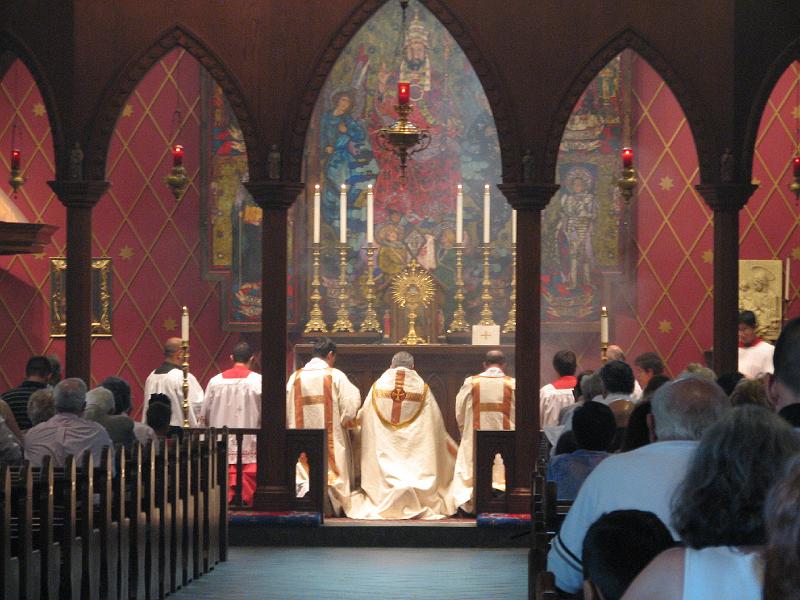
Extraordinary Form of the Catholic Mass

Anglican Use Rite of the Catholic Mass

Ordinary Form of the Catholic Mass

REVERENCE AND RESPECT FOR THE MOST BLESSED SACRAMENT RECEIVED DURING MASS AND ADORED APART FROM MASS

THE MOST PROMINENT PLACEMENT OF THE TABERNACLE IN THE SANCTUARY

Reverent celebrations of the Mass in either form, this case the Ordinary Form:

Reverent and worthy reception of the Most Precious Body of our Crucified and Risen Lord

Worthy Reception of the Most Precious Blood of the Crucified and Risen Lord

Solemn Exposition and Adoration of the Most Blessed Sacrament

Preaching the homily as integral to the Liturgy of the Word

APOSTOLIC LETTER
MANE NOBISCUM DOMINE
OF THE HOLY FATHER
JOHN PAUL II
TO THE BISHOPS, CLERGY
AND FAITHFUL
FOR THE YEAR OF THE EUCHARIST
OCTOBER 2004–OCTOBER 2005


There is a particular need to cultivate a lively awareness of Christ's real presence, both in the celebration of Mass and in the worship of the Eucharist outside Mass. Care should be taken to show that awareness through tone of voice, gestures, posture and bearing. In this regard, liturgical law recalls—and I myself have recently reaffirmed(15)—the importance of moments of silence both in the celebration of Mass and in Eucharistic adoration. The way that the ministers and the faithful treat the Eucharist should be marked by profound respect.(16) The presence of Jesus in the tabernacle must be a kind of magnetic pole attracting an ever greater number of souls enamored of him, ready to wait patiently to hear his voice and, as it were, to sense the beating of his heart. “O taste and see that the Lord is good!” (Ps 34:8).

In Pope John Paul II's above exhortation, he along with Pope Benedict strive to reinforce the traditional piety, reverence and respect we should have for Mass and the moment of Holy Communion as well as adoration of the Most Blessed Sacrament apart from the celebration of the Mass. Here are my suggestions:

1. During Mass, there should be full, conscious and active participation, which also means active contemplation and sacred silence. This type of participation is both interior and exterior. One could mouth all the words of the Pledge of Allegiance and not care one iota for the content of what is pledged. The same is true for Mass, mouthing the responses while important needs also an interior conviction about the words uttered.

2. This active participation during Mass, means also actively listening to the Word of God proclaimed and taking it to heart interiorly which then manifests itself once of is "commissioned" to "Go in Peace to love and serve the Lord."

3. The moment of receiving Holy Communion should be filled with awe and wonder and the intense desire to be free of all sin and in particular mortal sin. When one looks at the Easter Vigil which has recaptured the original order of the Sacraments of Initiation, that of Holy Baptism, Sacred Confirmation and the Most Holy Eucharist, one realizes that the reception of Holy Communion takes place after the washing away of sin in Holy Baptism and the gift of the Holy Spirit received in Baptism and "signed and sealed" in Confirmation. The newly initiated do not dare approach the altar for Holy Communion without their sins washed away and thus fully united to the Church in its three expressions, "militant, suffering and triumphant." Thus how much more should Catholics recover the forgiveness of their Baptism prior the Holy Communion through Sacramental Confession or the Sacrament of Penance?

4. The actual reception of Holy Communion should follow the norms of the USA's adaptation of the General Instruction of the Roman Missal.
a. One should bow before receiving either form of the Sacred Species
b. personal piety should be restrained, but the Sign of the Cross made before or after or both receiving is a long custom in the Church
c. When receiving on the tongue, one should stand very still, open mouth and extend tongue slightly for the convenient placement of the host on the tongue
d. When receiving with the hand, one should be a throne with one hand clearly under the other, stand still, and then place the host in the mouth before departing. One should never place the host in the mouth while walking or ever take the host to the pew or to someone else
e. I personally think we should return to kneeling for Holy Communion or it should be a clear option that is not seen as disobedient to the norms of the General Instruction of the Roman Missal


5. The afterglow of the Real, substantial and magnificent gift of the Presence of the Lord in the Most Holy Eucharist remains in the Most Blessed Sacrament reserved in the tabernacle for the sick, dying and for adoration of the faithful. There are specific actions that accompany our belief in the Real Presence of the Most Blessed Sacrament:

a. sacred silence in the Church out of respect for the awesomeness of this Presence
b. genuflection to our Lord when passing directly in front of the tabernacle
c. prayer and adoration kneeling before our Lord in the tabernacle
d. periodic Solemn Exposition and Adoration of the Most Blessed Sacrament and Benediction
e. Perpetual Adoration chapels with 24 hour adoration of our Lord in the monstrance


6. Prominent placement of the tabernacle in the Church where all can see it and all can adore before and after Mass. While we understand that one should not be adoring the Most Holy Eucharist which is the Risen Lord under the species of the consecrated Bread during the celebration of the Mass, one should also be aware that Christ cannot be divided. He is Who He is.."I AM"! So there is no conflict in the various aspects of how Christ reveals Himself to us in the actions of the sacramental signs. It is He Who is! I AM!

Friday, December 17, 2010

CLERICALISM ISN'T JUST ABOUT THE CLERGY

Pictures are worth a thousand words


Real TV's "Vortex" can find the host being rather shrill and angry. He seems to find his energy in anger, so I 'm reluctant even to link him to my blog. But if you can get through the anger and resentment of the presentation, I think you will actually discover the bottom line that has true validity. It is the "clericalism" of some female religious orders.

Clericalism when it is applied to the clergy, refers to the the abuse of or the promotion of a privileged lifestyle with no accountability to those who are served, meaning the laity. What no lay person could get away with at home or on the job, the clergy in some of the most egregious acts they commit are given a pass and seem to think they deserve it, have a right to it.

For the most part, clergy have acknowledged this dark tradition in the priesthood and have been striving to overcome it, although it will always be with us to a certain extent.

What this video that I link shows is that within a minority of very liberal religious orders, most of which are on the verge of collapse anyway, there is a mentality of being above everyone else and not accountable to anyone, whether the laity or the hierarchy of the Church.

The most manipulative aspect of this feminine clericalism is the claim that "their anger and hurt" is not appreciated or acknowledged.

No one and certainly not I, begrudge or berate the religious orders of the past that opened schools and staffed them, opened hospitals and staff them, promoted vocations not only to their religious orders but in a very profound and special way to the priesthood. But that style of religious order in those who have undergone what is called a "post Vatican II" reorientation is long gone. Some of the more notoriously liberal religious orders of today are a mere shadow of their former self and the glorious days of being the backbone of the Church and more influential on generations of laity than any pope, bishop or priest ever was.

Today hospitals are being closed, schools are being closed and those that are open are too expensive for those who need them the most. There should be some righteous anger over this and prayer that new religious orders can recover what was lost and that there will be a new springtime of renewal for those orders that have the potential for it.

PRESS TO SEE THE VORTEX VIDEO HERE.

Thursday, December 16, 2010

CONFESSION WASN'T GOOD FOR THIS PRIEST! BUT NORMALLY IT IS GOOD FOR THE SOUL!

One of my favorite movies, Alfred Hitchcock's "I Confess" starring Montgomery Clift


Tonight, Thursday, December 16, St. Joseph Church is having our Advent Penance Service.

A couple of years ago as I flipped through the television stations, I landed on a Mega Church's pastor preaching up a storm, using props, wearing really cool, casual clothes and the whole "I'm just like you and really with it routine."

But he said something that has stuck with me. It is a sound bite, but very good.

Now his sermon that day was on SEX. He wanted to emphasize that unlike other Churches, his mega church saw sex as a gift. (News flash, so does the Catholic Church.) But then he went on to highlight the different types of sexual sins.

But this is how he described sexual sins: "USING A GOD GIVEN GIFT, IN A GOD FORBIDDEN WAY."

You know, that's cool and I like that description and I think you could use it to refer to sin in general, not just the abuse of the gift of sexuality.

Sin in general is using the gifts of God in a God forbidden way. Our life is a gift from God. Do we use God's gift of life to us in a God forbidden way?

I ask you decide.

Wednesday, December 15, 2010

FATHER RICHARD FRAGOMENI GIVES LITURGICAL TALK IN THE MACON DEANERY ON TUESDAY


A priest from the Albany Diocese, Father Fragomeni currently teachers at Catholic Theological Union, Chicago. He has done extensive work in parish renewal, diocesan liturgy and liturgical music.

The last time I saw Fr. Fragomeni was in the early 1980's when I attended a workshop on the RCIA put on by the North American Forum on the Catechumenate. Both of us, I think, were more imbued with the "spirit" of Vatican II at that time than either of us are today.

To make this point, Fr. Fragomeni said yesterday, that in line with what is now being calling the "reform of the reform" or what the Holy Father calls, the "hermeneutic of reform within continuity" that liturgists can no longer appeal to just liturgical theologians, either past or present to make authoritative claims on the nature of the liturgy today, but rather we must appeal to papal teaching since the Second Vatican Council. We must look to Rome. I never thought that Fr. Fragomeni would be an "ultramontanist." But he said it out loud.

In his talk to us, he highlighted one papal document in particular, written by Pope John Paul II and released on October 7, 2004 in time for the "Year of the Eucharist." One can be sure that Pope Benedict as Cardinal Ratzinger had a hand in writing this also. The title of the Apostolic letter (and thus more than mere opinion of a particular pope) is MANE NOBISCUM DOMINE and you can down load it by pressing that title.

I'm paraphrasing Fr. Fragomeni, but one of the highlights of this Apostolic letter is that the Holy Father indicates that the presence of Jesus Christ is eternal and has always been in this world as a part of salvation history, past, present and to come. He is an Eternal Event. Thus the Holy Father expands the awareness of the Real Presence of Christ in a letter dedicated to the Holy Eucharist to include all times and places. This does not diminish the Lord's Real Presence in the Eucharistic Elements, but expands our understanding to see the Holy Eucharist, the Mass in general as well as its particular components as "focused moments" on the presence of Christ already manifest, but hidden or veiled in sacramental signs.

He then emphasizes that the Mass has two tables, the Table of the Word and the Table of the Eucharist. Personally, while I don't like disagreeing with a pope, I would prefer one table with two courses. At Mass we are fed with the Word of God and the Most Holy Eucharist from the one table or one altar. I think the unreformed Mass captures this a bit better and needs to be recovered, just my two cents.

Then the Holy Father speaks of the Holy Eucharist as meal. "There is no doubt that the most evident dimension of the Eucharist is that it is a meal. The Eucharist was born, on the evening of Holy Thursday, in the setting of the Passover meal. Being a meal is part of its very structure...As such it expresses the fellowship which God wishes to establish with us ad which we ourselves must build with one another."

But the Holy Father also adds this important codicil: "Yet it must not be forgotten that the Eucharistic meal also has a profoundly and primarily sacrificial meaning. In the Eucharist, Christ makes present to us anew the sacrifice offered once for all on Golgotha. Present in the Eucharist as the Risen Lord, He nonetheless bears the marks of his passion, of which every Mass is a "memorial" as the Liturgy reminds us in the acclamation following the consecration, "We announce your death, Lord, we proclaim your resurrection..." The Eucharist makes present what occurred in the past, it also impels us towards the future, when Christ will come again at the end of history." Sounds like the season of Advent doesn't it?

Finally, Fr. Fragomeni spoke of Pope John Paul's description of the Eucharist as a "Mystery." It is in the "obscurity" or the "hiddeness" of the signs and symbols used, that Jesus makes known His real presence. We speak of the Real Presence of Christ in the elements of bread and wine, not to indicate that other presences of Christ are "unreal" but rather to show forth that the Eucharistic Presence is Real Presence "par excellence." "Because Christ thereby becomes substantially present, whole and entire, in the reality of His Body and Blood. Faith demands that we approach the Eucharist fully aware that we are approaching Christ Himself."

I was intrigued personally by the concept that the Eucharist shows forth the Real Presence of Christ in an obscure, veiled, hidden way that demands the gift of Faith developed in the Church and the individual believer to see this Real Presence. This led me to ask Fr. Fragomeni about the long tradition in the East of the Eucharist being celebrated ad orientem and behind an Iconostasis or Icon Screen, and also the long tradition in the West or the Latin Rite of the Mass celebrated Ad Orientem, which in a sense hides or obscures the veiled presence of Christ but all the more makes it intelligible to the faith senses in an ironic, confounding way.

He acknowledged this as true and that even in the west, the Rood Screen served the same function as the Iconostasis, as well as celebrating Mass Ad Orientem.

He went on to say that today we must allow for a variety of celebrations of the Mass just as Summorum Pontificum allows for the older form of the Mass. This is not to undo the reforms of the post Vatican II Mass, but to adjust it to be in continuity with what did in fact precede it and for centuries. In other words, the "hermeneutic of flexibility" is necessary in our liturgical world today and even the same parish might have a great diversity of celebrations all within the context of "reform within continuity."

In other words, I liked Fr. Fragomeni's talk and hermeneutic, especially looking to the popes since Vatican II for authoritative teachings on this. That's a huge change from the 1970's until this century when we looked to liturgical theologians especially modern ones and mimicked on the parish level every silly suggestion they taught and modeled.

Tuesday, December 14, 2010

*BRAND NEW VESTMENT FOR THE EXTRAORDINARY FORM OF OUR MASS

*In the Middle Ages, the Gallic Rooster was widely used as a religious symbol, the sign of hope and faith. The color blue is for our Blessed Mother. On the Solemnity of the Blessed Virgin Mary, Mother of God, I will don this new vestment which also has the rooster on the ad orientem side. How do you like it? I think this will attract people of all liturgical stripes to our Masses, ad orientem and pro populum. What do ya think?

On some blogs I sense a real discomfort with priests who wear lace albs and brocade chasubles. I suspect those who have a real antipathy toward those kinds of vestments will really embrace this vestment as not exciting any prejudices or repressed, passive aggressive, projectionary tendencies in terms of those who are attracted to this type of vesture.

*This post tongue in cheek.

MY DECEMBER NEWSLETTER ARTICLE FOR OUR PARISH ON ADVENT AND LITURGICAL CHANGES


The Church's Advent season is all about preparing for the coming of Christ by celebrating His birth and anticipating is Second Coming at the end of time and the General Judgment of the living and the dead. Like the Lenten season, Advent is a penitential season although not as severe. Unfortunately, the commercialization of Christmas makes Advent a confusing season. Many of us are so swept up in shopping, baking and singing Christmas carols at home and other gatherings that the Church’s austere approach to Advent strikes us as a disconnect from what society is doing. Then, just as the Church starts to sing Christmas carols on the Solemnity of the Nativity of Our Lord, (Christmas) everyone else quits. Some people even throw out the Christmas tree and decorations on Christmas Day.

Of course as Catholics we know that Advent ends the morning of December 24 and Christmas begins the Vigil of December 24th or Christmas Eve. This year the Christmas season concludes in the Ordinary Form Roman Calendar on January 9, the Solemnity of the Baptism of the Lord. In the Extraordinary Form Roman Calendar, the Christmas/Epiphany Season normally concludes on February 2, the Feast of the Presentation of the Lord in the Temple. This includes blessing of liturgical candles and thus is also known as “Candlemas.” Some people keep the manger scene or some remnants of their Christmas decorations up until February 2. Your choice, you decide, but please don’t take things down before New Year’s Day. The eight days beginning with December 25th and concluding with January 1st is known as the “Octave of Christmas (8 Days) and extends Christmas Day for eight days, making eight days one big day to celebrate this wonderful feast. We do the same with Easter and its Octave.

We are making some minor changes to our parish custom of celebrating the Mass. No longer will we pray before Mass the Prayer for Stewardship and the Diocesan Prayer for Vocations. These will remain in the hymnal and I ask that you pray them on your own. Rather, we will pray the Diocesan Prayer for Vocations as the last petition of the General Intercessions and include an intercession for our Stewardship intentions based upon the prayer in the hymnal. The reason for this is that we shouldn’t be adding things to the Mass prior to the Mass beginning. The Processional Hymn begins the Mass as well as the official Entrance Antiphon. We need silent prayer before Mass begins.

In terms of the official texts and music of the Mass did you know that the hymns we sing from our hymnal are not the official prayers or music of the Mass? The official words and music of the Mass are the following:

1. Official Entrance Antiphon (Introit)
2. Kyrie
3. Gloria
4. Responsorial Psalm
5. Gospel Acclamation
6. Credo
7. Official Offertory Antiphon
8. Sanctus
9. Mystery of Faith
10. Great Amen
11. The Our Father
12. Agnus Dei
13. Official Communion Antiphon

All the metrical hymns and anthems that we sing, such as the processional hymn, offertory anthem, communion hymns and recessional hymn are chosen solely at the discretion of the music director with the approval of the pastor. They may be incorporated into the Mass, but are not essential, but we’ll continue to sing these in addition to the official chants.

Thus, beginning the First Sunday of Advent, our choir or cantor will chant every Sunday the official Entrance Antiphon (Introit) after the processional hymn, once the celebrant is at his chair. The same will occur at the offertory. We will continue the custom already established for chanting the Communion Antiphon. This way, we will begin to hear the actual preferred chants for the Mass, which most of us haven’t heard for 40 years.

I pray that you have a very blessed Advent Season. Our Lord Jesus Christ is the reason for this season. It’s not “Seasons’ Greetings” but Merry Christmas! God so loved the world that in the fullness of time He sent us His only begotten Son, not to condemn the world but to save it. God bless you and Merry Christmas and a Blessed New Year of 2011 in the Year of our Lord.

Sunday, December 12, 2010

A MASS OF ANOTHER COLOR

This is our All Souls' Mass where our combined choirs sang Faure's Requiem. I was in Bismarck, North Dakota so Fr. Daniel Firmin, our Diocesan Chancellor was the celebrant, Fr. Justin Ferguson the sub-deacon and Deacon Don Coates the Deacon, talk about a demotion for Fr. Justin! I only got these today. By the way, I just looked at the temperature in Bismarck. The current temperature was -8 degrees and the high will be 0 degrees. Oddly, though, it said it felt like only -7, so go figure! All I can say is "Thank you Jesus for Macon!"

Click on any picture to explode it if you are opposed to this form of the Mass!