Translate

Saturday, October 3, 2026

HAS AMORIS LAETITIA CHANGED ANYTHING ANYWHERE?


Press title for Associated Press take on the closed door meeting Pope Leo will have concerning Amoris Laetitia:

Pope Leo seeks status update of Francis’s divisive look at divorced and remarried Catholics

|Associated Press

My Comments:

To be honest with you, apart from that viral footnote, I thought Pope Francis’ Amoris Laetitia was very good. 

However, apart from the footnote controversy, I don’t think Amoris Laetitia has been implemented in any noticeable way anywhere in the world or at least in the Province of Atlanta. Am I wrong?

The viral footnote, though, eclipsed all the good in the document. This was typical of Pope Francis’ reign. His Holiness would go on beautiful pilgrimages and do great things and say great things and then on the way home gave his famous “high altitude” off-the-cuff press conferences, often disjointed and incoherent and always controversial which then eclipsed all the good that happened on the pilgrimage. 

I think the bottom line of the “footnote” was that Catholics in what is considered to be an adulterous sexual relationship could be accompanied by the pastoral ministry of the Church and in the process of that they could be admitted to the Sacraments of the Church, in particular Holy Communion, if that adulterous relationship is “good” apart from the adultery. 

But!

That has been going on for decades. It’s called the “Internal Forum.” Often the “internal forum” was used illicitly by priests. It could only be used if the external forum was non-conclusive (meaning there wasn’t sufficient evidence to declare a previous bond as annulled, not because there wasn’t sufficient evidence for an annulment but there were no witnesses apart from the spouses to corroborate what was being said. Maybe witnesses had died or refused to cooperate). 

In those cases, within the context of Confession, and the spouse in an illicit marital union initiating it, not the priest, the priest could give them a pastoral solution—if in good conscience they believed that their first marriage was illicit and the illicit marriage they are now in isn’t, they could go to Holy Communion apart from an annulment. But no formal blessing of that union was to take place.

That’s an art and not a science and the onus is on the penitent. They have to accept the punishment due their sin if in fact they are in an adulterous relationship in the eyes of God and are unrepentant about it and also making sacrilegious Communions.

But, the abuse of the internal forum went further at times. Priests and deacons would preside at a ceremony to “validate” an illicit marriage without an external, formal annulment decree. That is forbidden but it was/is done nonetheless. 

Pope Francis was not advocating in Amoris Laetitia, convalidating illicit marriages without a formal external annulment decree.

Of course, today, with civil same sex “marriages” and the LGTBQ+++ ideologies demanding that the Church bless same sex marriages too, Amoris Laetitia’s viral footnote creates new challenges and certainly there are priests giving permission to those in illicit homosexual sexual unions, civil marriages, to receive Holy Communion or not refusing Holy Communion to those in these unions. There are also formal blessings given in Church that resemble weddings, also forbidden. 

The other way around opening Holy Communion to anyone in an illicit “marriage, is if the couple is living together in a sibling relationship, i.e. not having any kind of sex, they may receive Holy Communion. And yes, this is common that so-called spouses are no longer having sex but support each other and care for each other by living and sleeping together. 

Finally, those in a state of mortal sin, non repentant and never going to confession, are coming up to receive Holy Communion any time, even if infrequently, they attend Mass. That’s a whole “nother” can of worms that no one is addressing and it happens at almost every Mass everywhere in the world. 

Why are we so worried about one segment of those receiving Holy Communion sacrilegiously and not the majority? 


IS IT OKAY TO BREAK A PONTIFICAL SECRET? I’VE BEEN PLACED UNDER IT A COUPLE OF TIMES AND NEVER BROKE IT. SHOULD I HAVE?

Given the fact that Pope Francis refused to elevated bishops of historically cardinalate sees, am I the only one who finds it scandalous that Pope Francis elevated Cardinal Gambetti to the rank of bishop/archbishop on November 22, 2020 and then on November 28th of the same year, less than a week later, named him a cardinal? 

Fortunately the good Cardinal’s meteoric rise is match by a similar demise. 

This is the headline from Sileri non possum:

Leo XIV ousts Gambetti from the Vatican. The friar breaches pontifical secrecy

Leo XIV ousts Gambetti from the Vatican. The friar breaches pontifical secrecy

The cardinal leaves St Peter’s and the Fabric for Chieti-Vasto. After months of gradually diminishing influence, the Pope brings one of the most controversial chapters of the Francis era to a close.

 And this is Pope Leo’s headline the next day despite the pontifical secret being broken:

Resignations and Appointments, 03.10.2026

Resignation and appointment of the Archbishop of Chieti-Vasto (Italy)

The Holy Father has accepted the resignation from the pastoral governance of the Metropolitan Archdiocese of Chieti-Vasto (Italy) presented by H.E. Msgr. Bruno Forte.

The Holy Father has appointed His Most Reverend Eminence Cardinal Mauro Gambetti, O.F.M. Conv., as Metropolitan Archbishop of Chieti-Vasto (Italy), transferring him from the offices of Vicar General of His Holiness for Vatican City, Archpriest of the Papal Basilica of Saint Peter in the Vatican, and President of the Fabbrica di San Pietro.

Curriculum vitae

H.E. Card. Mauro Gambetti, O.F.M. Conv., was born on October 27, 1965, in Castel San Pietro Terme (Bologna). After obtaining a degree in Mechanical Engineering from the University of Bologna, he began his journey in the Order of Friars Minor Conventual in 1992. He made his temporary vows in 1995 and his perpetual vows in 1998. After completing a Baccalaureate in Theology at the Theological Institute of Assisi (Perugia), he obtained a Licentiate in Theological Anthropology from the Theological Faculty of Central Italy in Florence.

He was ordained a priest on January 8, 2000, in Longiano (Forlì-Cesena). He held the following positions: coordinator of youth and vocation ministry for Emilia-Romagna (2000–2009) and head and animator of the religious community (Guardian) (2005–2009) at the Friary of the Most Holy Crucifix; Provincial Minister of the Bolognese Province of Saint Anthony of Padua (2009–2013); and Custos General of the General Custody of the Sacred Convent of Saint Francis in Assisi (2013–2017). Concurrently, the Bishop of Assisi-Nocera Umbra-Gualdo Tadino appointed him Episcopal Vicar for the pastoral care of the Papal Basilica of Saint Francis and other places of worship administered by the Conventual Franciscan Friars within the same diocese.

In 2017, he was elected President of the Inter-Mediterranean Federation of Provincial Ministers of the Conventual Franciscan Friars. He was subsequently reconfirmed as Custos General of the General Custody of the Sacred Convent of Saint Francis in Assisi for the 2017–2021 term, a role he held until October 31, 2020.

On October 30, 2020, he was assigned the titular see of Tisiduo with the personal title of Archbishop, and he received episcopal ordination on November 22, 2020, at the Basilica of Saint Francis in Assisi. Pope Francis created him a Cardinal—assigning him the deaconry of the Most Holy Name of Mary at the Trajan Forum—during the Consistory of November 28, 2020, and on February 20, 2021, appointed him Vicar General of His Holiness for Vatican City, Archpriest of the Papal Basilica of St. Peter in the Vatican, and President of the Fabric of St. Peter. Furthermore, on June 2, 2023—effective January 1, 2024—Pope Francis appointed him a Judge of the Court of Cassation of Vatican City State.

He is a member of the Dicastery for Institutes of Consecrated Life and Societies of Apostolic Life.

Friday, October 2, 2026

MICHAEL SEAN WINTERS OF THE NcR HAS FOUND SOMETHING IN POPE LEO THAT HE DIDN’T FIND IN POPE FRANCIS: CLARITY AND PRECISION AND AUGUSTINIAN THEOLOGY!


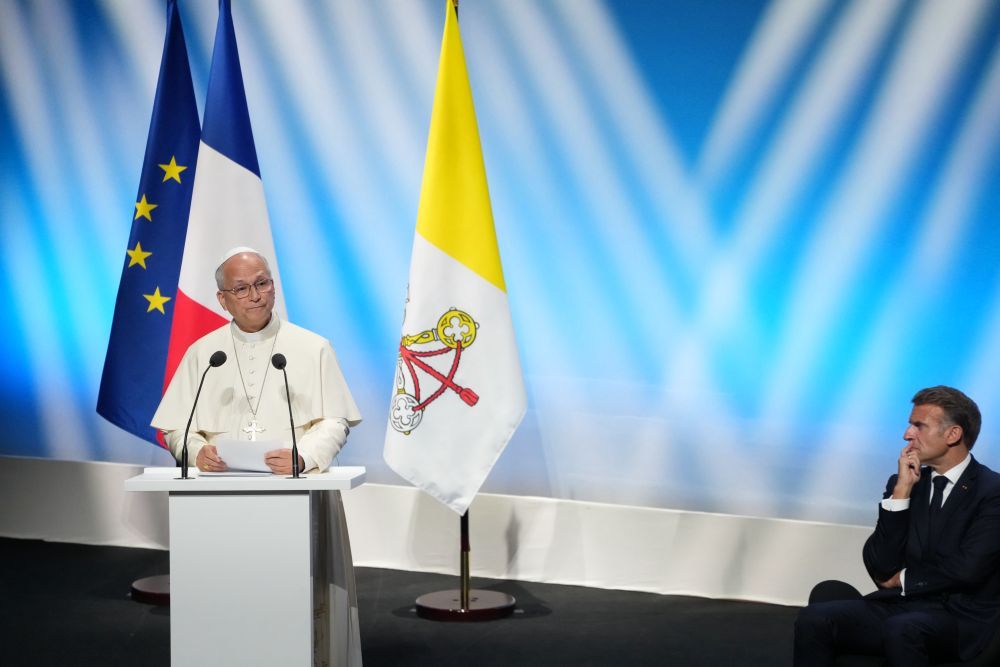
French President Emmanuel Macron, right, listens to Pope Leo XIV delivering his speech at the meeting At the Roots of Europe for Peace and Unity, Monday, Sept. 28, 2026, in Metz, France. (AP/Gregorio Borgia)

French President Emmanuel Macron, right, listens to Pope Leo XIV delivering his speech at the meeting At the Roots of Europe for Peace and Unity, Monday, Sept. 28, 2026, in Metz, France. (AP/Gregorio Borgia)

Below are excerpts from an article in the National catholic Reporter by Michael Sean Winters. You can read the full article here!

I am glad the grace of God is breaking through to Michael Sean and he’s exhibiting growth in his Catholic Faith as he moves away from the NcR’s more schismatic-fomenting ways. 

Here are the excerpts: 

Catholics are still processing Pope Leo XIV's amazing trip to France. The images of the crowds lining the Champs-Élysées, of the excited young people at the Stade de France and the thousands singing the "Salve Regina" outside Notre Dame cathedral, of the Holy Father at the grotto in Lourdes, all these form a profound impression of the continued significance of Catholicism to French culture and of this pope's ability to harness that 

Leo's religious sermons emphasized spiritual themes. At the huge Mass at the Place de la Concorde, the Holy Father's theme was a very Augustinian one: God as the answer to human restlessness and desire. 

"What is my deepest thirst? What am I really seeking in life? We all long for happiness, love and fulfillment. But from what source do we seek to quench our thirst?" the pope asked. "Are we content with material goods, immediate satisfactions, the countless little idols that promise us everything but leave our hearts empty? We have been baptized and received the living water of which the Gospel speaks, but have we truly encountered Christ personally? In essence, the human person is a being of desire, and only God can fill the emptiness within us."

In his sermon at Lourdes, Leo highlighted another side of his Augustinian roots. In speaking of the promise of eternal life of which the Blessed Mother spoke to St. Bernadette, Leo said, "For the obstacle to grace and eternal life — the only obstacle to this love — is sin, whereby we turn in upon ourselves, refusing God and shutting ourselves up in our own darkness. … We must therefore use our freedom to say yes to Christ, relying on his grace, like Mary. This is a yes that we renew until our final breath — 'now and at the hour of our death' — as we say in the Hail Mary." He devoted several paragraphs to the theme of repentance, but always linked it to the ongoing call to conversion and the hope of eternal life. 

When Leo spoke about assisted suicide, which was recently legalized in France, his words were strong and condemnatory, rightly labeling the practice an example of "false compassion." One wishes he had been in Paris before the vote to legalize assisted suicide. He might have tipped the balance against it.

The crowds were massive and the excitement palpable. Leo was never an actor, like his predecessor St. John Paul II, and he lacks the Polish pontiff's dramatic sense of timing and connecting with a crowd. Yet connect he did. Why? As one Parisian said to my colleague Justin McLellan at the Mass in Paris: "He is a pope who is young, 71, and he moves the young people forward; he is calm, a good listener and he has very precise ideas and is able to express them clearly and in an engaging way — all the young people and the crowds here show that." 

In a noisy and confusing culture, Leo's clarity and precision, as well as his obvious authenticity, break through. The response he received in France gives hope at a time when the world so desperately needs hope.

BISHOP OLSON OF FORT WORTH, TEXAS LIMITS THE USE OF THE COMMON CHALICE AT MASS—THANK YOU VERY MUCH

 The only thing I wish that the good bishop would have highlighted is that the common chalice shared with multiple communicants, many of whom allow backwash from their mouth to pour forth into the chalice, as well as deadly germs and viruses, like the herpes virus, can be left on the rim of the chalice and thus can be an epidemic and, of course, a pandemic creating event, should no longer be allowed.

Rather, the use of intinction, described in the GIRM of the 2012 Reform of the Reformed 1970 Roman Missal, indicates that intinction is perfectly acceptable. And it lessens all the concerns about epidemics and pandemics of the common chalice, as well as abuse of the Precious Blood as described in Bishop Olson letter.


Pastoral Letter on the Distribution of Communion Under Both Species


To the Priests, Deacons, Seminarians, Religious, and Lay Faithful of the Diocese of Fort Worth
October 1, 2026

Dear Friends in Christ,

In recent years, the Church in the United States has given renewed attention to the mystery of the
Most Holy Eucharist. As your Bishop, I write to you to reflect briefly on this great sacrament and
to provide clear direction regarding the distribution of Holy Communion under both species
within the Diocese of Fort Worth. The Eucharist is the heart of the Church’s life, and it is my
responsibility to ensure that it is celebrated with reverence, doctrinal clarity, and fidelity to the
Church’s discipline.

The Mystery of the Eucharist


The Most Holy Eucharist is the Church’s greatest treasure. In it, Christ Himself is truly present—
Body, Blood, Soul, and Divinity—under the appearances of bread and wine. In every celebration
of the Mass, the one sacrifice of Christ in his passion, death, and resurrection is made present
sacramentally so that his saving grace may be given to us here and now.
The Eucharist is also the sacred banquet in which the faithful are nourished with the Body and
Blood of the Lord. In receiving Holy Communion, we are united more closely to Christ and with
each other in the bonds of charity. It must be clearly understood that, by the doctrine of
concomitance, Christ is received whole and entire under either species alone. For this reason,
nothing is lacking when Holy Communion is received under the species of bread alone or the
species of wine alone.

The Eucharist and the Unity of the Church

The Eucharist is the sacrament of unity. It both signifies and brings about communion with
Christ and with one another as members of His Body, the Church. Each celebration of the Mass
is not a private act but an act of the whole Church, Head and members, offered in communion
with the diocesan bishop and the Roman Pontiff.

Since the Eucharist expresses the unity of the Church, its celebration must also reflect that unity
in both faith and discipline. The Church’s liturgical norms serve this purpose. They are not
arbitrary but exist to safeguard the dignity of the sacrament and to ensure that what we celebrate
truly reflects what we believe.

The Responsibility of the Bishop

As the Bishop of the Diocese of Fort Worth, I have been entrusted with the responsibility to
regulate the celebration of the sacred liturgy. This responsibility includes determining when Holy
Communion may be distributed under both species (See GIRM #283).
The Church permits the faithful to receive under both species in certain circumstances as a fuller
sign of the Eucharistic banquet. At the same time, she teaches clearly that this is not the ordinary
manner of reception. The faithful must always remember that reception under one species alone
is complete participation in the Eucharist.
In exercising this responsibility, I must ensure that the Eucharist is treated with the reverence it
deserves and that its distribution does not give rise to confusion or diminish its dignity.

The Times When Communion Under Both Species Is Permitted

After consultation and careful consideration of the Church’s norms, I have determined that
within the Diocese of Fort Worth the distribution of Holy Communion under both species will be
limited to specific occasions.
Accordingly, Communion under both species may be offered only on the following occasions:

• Priestly or Diaconal Ordinations
• The Chrism Mass
• The Mass of the Lord’s Supper on Holy Thursday
• The Easter Vigil.

At Mass where adults are confirmed and receive first Eucharist (for the newly confirmed)

• The Mass of Holy Matrimony (only for the Catholic bride and Catholic groom)
• Masses of Religious Profession
• The Solemnity of the Most Holy Body and Blood of Christ (Corpus Christi)
• Masses at convents and retreat centers within the Diocese
• 
At newly ordained priests’ first Mass

• Other celebrations of similar solemnity only with my explicit approval

Even on these occasions, the distribution of the Precious Blood is to take place only when it can
be done reverently, when there are sufficient ministers, and when there is no danger of
profanation or disorder. If these conditions cannot be met, Communion is to be distributed under
the species of bread alone. Outside of these occasions, Holy Communion is to be distributed
under one species. Deacons assisting at Mass should receive the Precious Blood from the Chalice
(See GIRM 160-164).

The Church’s discipline regarding the manner of distribution is to be observed in all cases. The
Precious Blood is to be administered by an ordinary minister, if sufficient number are not
available, then by extraordinary ministers. Practices such as self-service, passing the chalice, or
self-intinction are not permitted. In keeping with the rubrics and norms for the Liturgy, only
priests, deacons, and instituted acolytes are to purify the vessels. Deacons and instituted acolytes
are to purify vessels away from the altar and at the credence table only. Vessels are not to be
purified in the sacristy even if purification takes place after Mass (See GIRM 160-164, Norms
for the Distribution and Reception of Holy Communion #28).

Catechesis and Formation

Proper catechesis is essential. Clear teaching and instruction on the doctrine of the Real
Presence, on the meaning sacramental character conferred at priestly ordination, the meaning of
the Eucharist as sacrifice and banquet, and the truth that Christ is fully received under either
species is to take place at all parishes.
Please remember that reception from the chalice is not required and that no one should feel
obliged to receive under both species. Additionally, catechesis is to lead to reverence due to the
Blessed Sacrament, both during the liturgy and outside of it.
Those who assist in the distribution of Holy Communion, especially extraordinary ministers,
must be properly formed so that their service is carried out with care, dignity, and fidelity to the
Church’s norms.

Conclusion
The Eucharist is the source and summit of our Christian life. In it, Christ gives Himself to us
completely. Our response must be one of faith, reverence, and gratitude.
As we continue to deepen our devotion to the Blessed Sacrament, let us remain faithful to the
Church’s teaching and discipline so that the dignity of this Sacred Mystery is preserved and the
Communion of the Church is strengthened.

Entrusting you to the intercession of the Blessed Virgin Mary, I am,
Sincerely yours in Christ,

Most Reverend Michael F. Olson, STD, MA
Bishop of Fort Worth

POPE FRANCIS APPOINTED CARDINAL GAMBETTI OUT AT SAINT PETER’S BASILICA AND MY CLAIRVOYANCE BASED UPON EVIDENCE ABOUT WHO THE NEW CARDINAL AT ST. PETER’S WILL BE—HINT: I’VE ALREADY APPOINTED HIM IN A PREVIOUS POST

A couple of weeks ago Pope Leo met with Cardinal Rolandas Makrickas. 

Thus, with evidence, I predict Cardinal Rolandas Makrickas will be replacing Cardinal Gambetti. Do I hear an Amen?

He is the head of the Major Basilica of Saint Mary Major in Rome and is very friendly to private Masses celebrated there as well as the TLM. In fact the Summorum Pontificum Pilgrimage in Rome in a couple of weeks will have its Mass there on the main altar, which, of course, and everyone knows, has the Mass celebrated ad orientem since the time of Constantine—meaning when the celebrant celebrates at the altar, although facing the nave, he is facing the geographical east as does every major basilica in Rome except for the Basiilica of St. Paul outside the wall which has the celebrant facing toward the papal altar in St. Peter’s, which itself faces the geographical east. 

This is a google translation of Infovaticana’s article printed in Spanish on Pope Leo’s ouster of Cardinal Gambetti to a practically unknown lesser See in Abruzzo:

On Friday, Cardinal Mauro Gambetti informed the canons of the Vatican Chapter—during a meeting he himself convened—that the Holy See would announce his appointment as archbishop of a diocese the following day, Saturday, October 3. The cardinal, who appeared with a noticeable bandage on his head following a minor recent procedure to remove a mole, declined to name the see "out of respect for protocol and the Holy Father," though no one in Rome has the slightest doubt: it is the Abruzzo archdiocese of Chieti-Vasto. Nor did he mention who would succeed him as Archpriest of St. Peter's Basilica—details reported by *Il Tempo* Vatican correspondent Francesco Capozza on his X account and echoed by the Abruzzo press, such as *Abruzzo Popolare*.

The news puts an end to months of rumors and confirms what Capozza himself had long been predicting. On Tuesday, September 30, the Roman journalist stated on X that Gambetti’s removal as Archpriest of the Vatican basilica was a "matter of hours" and that his destination was the one Capozza had revealed months earlier: Chieti-Vasto, which might also be united *in persona episcopi* with the archdiocese of Lanciano-Ortona. This morning, hours before the meeting with the canons, Capozza reiterated his claims with an unequivocal message: the appointment would be announced on Saturday "barring surprises or further attempts to cling to the seat," adding that the Pope has decided to send the current Vicegerent of Rome, Monsignor Renato Tarantelli Baccari, to Pescara. What *Il Tempo* has been reporting since the summer of 2025

The Rome-based newspaper was the first to publicly link Gambetti to the new pontiff's dissatisfaction. In an extensive analysis published on August 25, 2025, titled "Pope Leo: The Prevost Era Begins (Now) with a Silent Revolution," Capozza described Leo XIV's intention to dismantle the network of Jesuits and Franciscans that Francis had installed in the Vatican. This process began with the Archpriest of St. Peter's—"summoned to Rome directly from Assisi and having transitioned with lightning speed from the humble habit to the cardinal's purple." The article noted that the Franciscan—"widely criticized for his lackluster management of the most important church in the Catholic world"—had been under the Pope's scrutiny since the very first ceremonies held in the basilica. It further stated that after the replacement of his protégé, Father Enzo Fortunato, as head of the Committee for World Children's Day, Gambetti himself would be the next to go. A telling message arrived from Assisi, the Vatican expert concluded: "We do not want Gambetti back here."

Criticism intensified in October 2025, when a man managed to bypass basilica security and urinate on the Altar of the Confession, which is reserved for the Pope. *Il Tempo* reported at the time that Leo XIV had met privately with Gambetti to express his "dismay" over the incident and had ordered him to hold a penitential rite of reparation as soon as possible. This was just one of several sacrilegious episodes during his tenure, a period in which the basilica became associated with security lapses and a management style more concerned with administrative reorganization than with preserving the temple's sacred and traditional character—as *InfoVaticana* had reported the previous July.