Translate

Friday, October 8, 2010

THE SCHIZOPHRENIC APPROACH TO SAVING BABIES AND KILLING THEM--A PRO-LIFE LESSON EARLY THIS MORNING


Early this morning at 2:30 AM, I was called to the hospital. A pre-mature baby, born five months into the pregnancy was on life support. She had all kinds of internal deformities and had been on life support in the neo-natal care unit following several surgeries.

After I met with the child's family, the baby, although on life support, began to code, that is to die, her heart rate plummeted. The family had already made the decision to take the child off of life support, but the doctor had to be contacted first before this procedure could take place.

As the child's heart rate plummeted, the nursing staff, to the objection of the mother, began manual CPR on this pre-mature baby. They could not follow the family's direct request to allow nature to take its course without the doctor's consent.

As I watched the medical team do their "heroic" work to save this baby's life or at least pro-long it until the doctor told them to remove life support from her, I thought to myself that this baby, although 5 months into her development in the womb, looked like a fully formed baby.

In another venue and in other circumstances, this baby could have been aborted. Rather than heroic measures to save this baby's life, a medical team would have killed the baby acting as if this was just some glob of genetic material, a mere fetus with no human value.

In both cases, the medical team was following the letter of the law. In the first, they had to do everything possible to save the baby's life, although they were waiting word from the doctor to terminate life support. Until they got that, they could not allow the child simply to die a natural death. How odd!

In the second case, that of abortion on a baby this far along in a pregnancy, the law allows the mother to make the decision to kill the child directly. This gives license to the medical team to kill the child without being charged with negligence, murder or man slaughter or infanticide.

I'm not sure the lesson I learned this morning other than human life is sacred and we have no right to play God.

Thursday, October 7, 2010

THE FEAST OF OUR LADY OF THE MOST HOLY ROSARY


Today is the Feast of Our Lady of the Most Holy Rosary. We had a wonderful Solemn recitation of the Holy Rosary last night within the context of Solemn Exposition and Benediction of the Most Blessed Sacrament. It was awe inspiring if I do say so myself. In attendance were our second graders preparing for First Penance and First Holy Communion and our 9th graders preparing for the Sacrament of Confirmation. Both of these groups were recognized and received a special blessing as they continue in their faith formation and sacramental preparation. Their families were present as well as many others. We videoed it and when it is ready I will post it on this blog in a few days.

THE PROBLEM WITH CRY ROOMS? YES, BUT ALSO WITH CHURCHES! YIKES!


I saw this post on another blog and reprint it here. It concerns the "problem" with cry rooms, but if that isn't enough, look at the picture of the cry room above, but then look at the interior of the Church and then think, "THE PROBLEM WITH MODERN CHURCHES!" Can you detect the altar? Look for the tabernacle, I think it is to the far left of the picture, but off the "platform" where the altar is located. Look at all the music stands and microphones and the placement of the choir--these have more prominence than the altar, if one could see it. Actually, compared to the church, the cry room is magnificent and allows adults to cry out loud after looking into this mangled church! Also note what the writer below says about the number of young adults and well-behaved children at the Extraordinary Form of the Mass that he attends, but I suspect not in this Church.

The Problem with Cry Rooms
by: Laurance Alvarado

Today is the one year birthday of my youngest foster child. Over the past five months, I've marveled at her growth, her vice-like grip on anything I'm trying to read, and her amusement as she's discovered how to walk. And even though she's become far more vocal over the past few weeks, I've also really enjoyed attending Mass with her.

During a retreat several years ago, the retreat master dedicated time on the "family and the Mass." One thing that still stands out was his perspective on cry rooms, which is that they've done more harm than good regarding the acceptance of the family in our Church. In addition, allowing children to have carte blanche behavior in a partitioned, dedicated room tacitly condones poor manners and lack of respect for the Eucharist.

We attend the Traditional Mass and there's no cry room in the space to which we're relegated. Even if there was, there wouldn't be enough room for all the kids and babies in attendance. But, what's remarkable about this Mass -- and we may be unique -- is that there's rarely a need for a parent to step into the foyer with a screaming or ill-mannered child. I continued to be impressed with the respectful behavior of all the children in attendance -- which includes my 5 year old, who normally acts like every waking hour is "open mic night."

I'm sure there are strong feelings pro and con regarding cry rooms. I'm just now at the point where I can appreciate the discipline instilled in children by requiring them to pay attention at Mass. This is far more important than a little peace and quiet.

Of course, I may completely change my mind as the little one enters her terrible twos...

Wednesday, October 6, 2010

WHAT IT MEANS TO BE CATHOLIC--RCIA

Many thanks to Lynn O'Connor who tapes our RCIA sessions, abbreviates it for Youtube and has the full session on "blip." This is on the nature of humans and God's love for us as experienced through the sacramental principle of the Church.

Controversial teachings of the Church on "BLIP" you can fast forward if you wish!
http://blip.tv/file/4198381

But after I viewed this I noticed in the sidebar a tour of our little old humble church which we did not put on you-tube. Someone visited our Church back in February I guess, as there is a very rare glimpse of snow on the ground at the Church--we had a one day wonder I think this past February. The video is a bit jerky, but you get to see the outside of the Church and a grand tour of the inside and the magnificent stain glass windows we have. The Jesuits built this Church which was completed in 1903. There is a superabundance of depictions of Jesuit saints in the windows. I know that's an oxymoron (just kidding!).

Tuesday, October 5, 2010

THE VIGIL OF OUR LADY OF THE HOLY ROSARY


On Wednesday night at 7:00 PM we will celebrate our annual Solemn Recitation of the Holy Rosary in honor of Our Lady of the Holy Rosary. It is prayed within the context of Solemn Exposition and Benediction of the Most Blessed Sacrament. We recognize our second graders who are preparing for First Penance and First Holy Communion and our 9th graders who are preparing for the Sacrament of Confirmation. They will receive a special recognition and blessing during this service.

Our combined choirs will sing anthems between each of the Glorious Mysteries of the Holy Rosary including "Felix namque es", "Magnificat"; and "O Gloriosa Virginum". These will be interspersed with traditional congregational Marian hymns.

The Catholic Encyclopedia has a summary of the history of the Feast:

It is believed that Heaven has on many occasions rewarded the faith of those who had recourse to [the Rosary] in times of special danger. More particularly, the naval victory of Lepanto gained by Don John of Austria over the Turkish fleet on the first Sunday of October in 1571 responded wonderfully to the processions made at Rome on that same day by the members of the Rosary confraternity. St. Pius V thereupon ordered that a commemoration of the Rosary should be made upon that day, and at the request of the Dominican Order, Gregory XIII in 1573 allowed this feast to be kept in all churches which possessed an altar dedicated to the Holy Rosary. In 1671 the observance of this festival was extended by Clement X to the whole of Spain, and somewhat later Clement XI after the important victory over the Turks gained by Prince Eugene on 6 August, 1716 (the feast of our Lady of the Snows), at Peterwardein in Hungary, commanded the feast of the Rosary to be celebrated by the universal Church.

Under St. Pius V, it was called “Our Lady of Victory.”

THE CAPPA MAGNA, WHAT DO YOU THINK? SILLY OR MAJESTIC, ARCHAIC OR RESPLENDENT?

This is a brief video of the entrance procession of the EF Solemn High Mass at the Basilica of the National Shrine of the Immaculate Conception in the spring. The commentary is very interesting and spot on. What do you think of what you see?

Monday, October 4, 2010

45 years ago today, the Feast of St. Francis of Assisi, Pope Paul VI Visited New York City!

On October 4, 1965, the Feast of St. Francis of Assisi, Pope Paul VI made his historic trip to New York City and celebrated Mass at Yankee Stadium.

The following is an Italian retrospect on Pope Paul VI. It is in Italian but with good English subtitles.

Sunday, October 3, 2010

TODAY IS PRO-LIFE SUNDAY, BUT EVERYDAY SHOULD BE PRO-LIFE FOR CATHOLICS


The following is the article I wrote for St. Joseph Church's October newsletter:

While every day of every month should be pro-life for all Catholics, we use the month of October to remind ourselves of the necessity of protecting human life from conception until natural death.

Our focus begins with the innocent unborn. In today’s permissive culture and through law, the child in the womb is the most vulnerable. Legally killing a pre-born child has the protection of the law. The unborn have fewer rights than your pet dog or cat. In the United States alone, the number of abortions since the legalization of it by the Supreme Court is staggering. No war or acts of terror, not the death penalty or euthanasia have taken more lives of the innocent than abortion.

It is important, though, to remember that women who experience what is termed a “crisis pregnancy” sometimes are pressured by family and friends and the easy availability of abortion to procure one. They later regret this decision. We must be conscious of those who are in pain over past decisions. In some cases, the father of the child is equally responsible for the decision and feels much guilt and pain later in life too. The Church has ways to counsel those with post-abortion traumatic disorder. We want to offer God’s healing and reconciliation along with any penance that is due.

As Catholics, we must realize that it is immoral to be pro-choice. How would you feel if I publicly stated that I was personally opposed to the sexual abuse of minors by priests, but I wouldn’t take that choice away from any priest? There would be moral outrage! And rightfully so! A child is always victimized in abortion and the victimization is death. The child can’t sue you; the mass media won’t castigate you and your enablers the politicians, political parties and judicial systems. You won’t be thrown into prison for this crime, but it is a heinous moral offense before God and humanity.

Our pro-life efforts also extend to those who are born and not so innocent. We want to help alleviate the plight of the poor, injustices against people and comfort the aging and the dying. The Church is not opposed to natural death at the end of life or withdrawing extraordinary means to keep someone who is dying alive a bit longer. The Church is opposed to active euthanasia and withdrawing the ordinary means to keep someone alive like food and hydration.

And finally, the Church is becoming more aware that the death penalty is no longer needed to protect society from criminals. Although the Church is not opposed to the death penalty in every case for the protection of society, there is a movement to find alternative ways to punish the guilty and keep society safe apart from killing the convicted guilty. The Church, however, does not place this theological belief on the same level as protecting the innocent unborn.

I hope you are pro-life and actively encourage those who are pro-choice and even pro-abortion, pro-euthanasia, pro-death penalty to reconsider their positions. Stand up for Christ and Christ’s teachings revealed to us through the Church. Be pro-life in all ways. God bless you.

Saturday, October 2, 2010

MONTHLY EXTRAORDINARY FORM MASS SUNDAY AT 2:00 PM, ST. JOSEPH CHURCH, MACON, GEORGIA! OCTOBER 3, YA'LL COME!


October Third is the 19th Sunday after Pentecost in the Extraordinary Form of the Roman Calendar. Next Sunday is Christ the King Sunday!
INTROIT
I am the salvation of the people, saith the Lord: in whatever tribulation they shall cry to Me, I will hear them; and I will be their Lord for ever. -- (Ps. 121. 1). Attend, O my people, to My law; incline your ears to the words of My mouth. V.: Glory be to the Father . . . -- I am the salvation of the people . . .

COLLECT - O almighty and merciful God, graciously keep us from all things that may hurt us: that we, being set free both in body and soul, may willingly fulfill those things that Thou wouldst have done. Through our Lord Jesus Christ, Thy Son, who liveth and reigneth with Thee in the unity of the Holy Ghost . . .

EPISTLE
Ephesians 4: 23 - 28
Brethren: Be ye renewed in the spirit of your mind, and put on the new man, who according in God is created in justice and holiness of truth. Wherefore, putting away lying, speak ye the truth every man with his neighbor, for we are members of one another. Be angry, and sin not. Let not the sun go down upon your anger. Give not place to the devil. He that stole, let him now steal no more; but rather let him labor, working with his hands the thing which is good, that he may have something to give to him that suffereth need.

GRADUAL
Psalms 140: 2
Let my prayer be directed as incense in Thy sight, O Lord. V.: The lifting up of my hands as evening sacrifice.

Alleluia, alleluia. V.(Ps. 104. 1). Give glory to the Lord, and call upon His Name: declare His deeds among the Gentiles. Alleluia.

GOSPEL
Matthew 22: 1 - 14

At that time, Jesus spoke to the chief priests and the Pharisees in parables, saying: The kingdom of heaven is likened to a king, who made a marriage for his son; and he sent his servants, to call them that were invited to the marriage, and they would not come. Again he sent other servants, saying: Tell them that were invited: Behold, I have prepared my dinner; my oxen and fatlings are killed, and all things are ready: come ye to the marriage. But they neglected; and went their way, one to his farm, and another to his merchandise; and the rest laid hands on his servants, and having treated them contumeliously, put them to death. But when the king had heard of it, he was angry; and sending his armies, he destroyed those murderers, and burnt their city. Then he saith to his servants: The marriage indeed is ready, but they that were invited were not worthy. Go ye therefore into the highways, and as many as you shall find, call to the marriage. And his servants going forth into the ways, gathered together all that they found, both bad and good; and the marriage was filled with guests. And the king went in to see the guests, and he saw there a man who had not on a wedding garment: and he saith to him: Friend, how camest thou in hither, not having on a wedding garment? but he was silent. Then the king said to the waiters: Bind his hands and feet, and cast him into the exterior darkness: there shall be weeping and gnashing of teeth. For many are called, but few are chosen.

OFFERTORY
Psalms 137: 7
If I shall walk in the midst of tribulation, Thou wilt quicken me, O Lord: and Thou wilt stretch forth Thy hand against the wrath of my enemies; and Thy right hand shall save me.

SECRET - Grant, we beseech Thee, O Lord, that these gifts, which we offer in the sight of Thy Majesty, may be unto us for salvation. Through our Lord Jesus Christ, Thy Son, who liveth and reigneth with Thee . . .

PREFACE (Preface of the Most Holy Trinity) - It it truly meet and just, right and for our salvation, that we should at all times, and in all places, give thanks unto Thee, O holy Lord, Father almighty, everlasting God; Who, together with Thine only-begotten Son, and the Holy Ghost, art one God, one Lord: not in the oneness of a single Person, but in the Trinity of one substance. For what we believe by Thy revelation of Thy glory, the same do we believe of Thy Son, the same of the Holy Ghost, without difference or separation. So that in confessing the true and everlasting Godhead, distinction in persons, unity in essence, and equality in majesty may be adored. Which the Angels and Archangels, the Cherubim also and Seraphim do praise: who cease not daily to cry out, with one voice saying:

COMMUNION
Psalm 118: 4, 5
Thou hast commanded Thy commandments to be kept most diligently: O that my ways may be directed to keep Thy justifications!

POST COMMUNION - May Thy healing grace, O Lord, mercifully free us from our perverse inclinations, and make us ever to cleave to Thy commandments. Through our Lord Jesus Christ, Thy Son, who liveth and reigneth with Thee in the unity of the Holy Ghost . . .

RICK SANCHEZ OF CNN FIRED FOR DARING TO REPORT THE TRUTH ABOUT CNN AND THE SECULAR MEDIA HIERARCHY!

Rick Sanchez, a victim of the HIERARCHY of Media Giant Time-Warner and CNN! What journalistic secular media will investigate this hierarchy and report the truth in an hour long documentary on this hierarchy's corruption and religious bigotry? We're waiting!

By GLENN GARVIN

Miami Herald

CNN fired Miami homeboy anchor Rick Sanchez Friday, a day after he said on a radio show that Jews control U.S. television networks. ``Rick Sanchez is no longer with the company,'' a CNN spokesman said. ``We thank Rick for his years of service and we wish him well.''

Sanchez's outburst about Jews came during a rant against Jon Stewart, who often makes fun of Sanchez on his Comedy Central show. Sanchez was being interviewed on comedian Pete Dominick's XM Sirius Radio show when the conversation went off the rails.

It started relatively innocently, with Sanchez expressing irritation at being lumped in with other Hispanic TV journalists by a CNN boss. Racist attitudes aren't rooted on the political right, he added, but also extend to ``elite, Northeast establishment liberals.''

``Deep down, when they look at a guy like me, they see a guy automatically who belongs in the second tier, and not the top tier,'' Sanchez continued. Then he said: ``I think to some extent Jon Stewart and [Comedy Central comic Stephen] Colbert are the same way. I think Jon Stewart's a bigot.''

How's that? asked the puzzled Dominick. ``I think he looks at the world through his mom, who was a school teacher, and his dad, who was a physicist or something like that,'' replied Sanchez, speaking of Stewart. ``Great, I'm so happy that he grew up in a suburban middle class New Jersey home with everything you could ever imagine.''

``What group is he bigoted towards?'' pressed Dominick.

``Everybody else who's not like him. Look at his show, I mean, what does he surround himself with?'' said Sanchez. When Dominick seemed surprised that Sanchez could level a charge of bigotry against Jews, who themselves have been subjected to discrimination, Sanchez dismissed the idea.

``I'm telling you that everybody who runs CNN is a lot like Stewart, and a lot of people who run all the other networks are a lot like Stewart, and to imply that somehow they, the people in this country who are Jewish, are an oppressed minority?'' Sanchez said, then added with sarcastic emphasis: ``Yeah.''

Transcripts and audio clips of the exchange began popping up on the Internet Friday morning, and at 6 p.m. CNN issued its terse statement dismissing him. Sanchez, a wildly popular if controversial anchor at WSVN-Fox 7 during the 1990s, joined CNN in 2004 after bombing first as an MSNBC anchor and then as a talk-show host on WTVJ-NBC 6.


MY COMMENTS:

It is interesting to me that Rick Sanchez is fired in a week in which CNN reported old, discredited news from New York Times reporter Laurie Goodstein about Pope Benedict when he was Cardinal Ratzinger in a so called documentary called "What the Pope Knew."

As well, the same network as gone after the black baptist Bishop Eddie Long, pastor of a Baptist Mega Church outside of Atlanta, as though CNN is a pit bull. The back story on Bishop Long is that he has also been a conservative religious voice opposing same-sex marriage.

When a reporter, even unwittingly reports the truth about media outlets like CNN, the New York Times, NBC and others, he gets fired rather than congratulated for reporting the truth which should be the job of every reporter.

When will these same media outlets do a documentary on the bigoted, slanted and Anti-Catholic, anti-Christian, anti-religion bigotry that the hierarchy of these news chains and media giants exhibit and promote? The reporter, Rick Sanchez, reports the truth on a radio program that a small minority of people actually hear and the truth of his reporting, which is his job as a reporter, got him fired by the hierarchy of CNN of TIME-WARNER.

Friday, October 1, 2010

ANOTHER OUT OF THE "MOUTH OF BABES" MOMENT YESTERDAY!

SOME SIX YEAR OLDS WHO KNOW THEIR LATIN!

Yesterday while visiting our elementary school, I taught the First grade class of six year olds. I wanted to review my lesson from the previous week about the changes in our English Mass. I had written on the board the priest's greeting with the new response, "And with your spirit."

So I asked the class before we practiced the new response, what the old response was? A six year old raised his hand, stood up and said, "Et cum spiritu tuo!"

I KID YOU NOT! He actually said that!

Now for a word of explanation. I was actually seeking the answer, "and also with you." But for more than a year now, at all our school Masses aS well as at all our daily and Sunday Masses, we have been saying and singing the Latin response for these greetings. This six year old only remembers "et cum spiritu tuo" from his experience here for more than a year! He really thinks as do all of the first graders that "et cum spiritu tuo" is our old response. Of course they are right but not as most of us in our 50's would think.

With that said, today is the 50th anniversary of the first Flintstone's cartoon which was aired on Friday's in prime time beginning on this day and date on October 1, 1960! And yes, I was a six year old, but in the second grade, the child prodigy that I was and yes the priest prodigy that I am now!, and yes I loved and still love the Flintstones. I saw that first episode and every subsequent episode and loved most the season when for the first time in cartoon history a character, Wlima, got pregnant, carried her child to term and the TV viewers could submit names for what the child would be named. The person who submitted "Pebbles" won!

Listen to the theme song. For most of my life I could not actually understand the line, "Let's ride with the family down the street through the courtesy of ....? This was somewhat garbled. Listen to the song and I'll have what was garbled written below the video:


"Lets ride with the family down the street through the courtesy of Fred's two feet!" Who would have thought!

Thursday, September 30, 2010

KIDS SAY THE DARNDIST THINGS!

The old Creed in English says that Jesus became Man at this point! That's heretical and leads people to think some strange things about humans in the womb!

If Jesus did not become Man at the Incarnation, just what was Jesus? What are we if we are not completely human at our conception? Opens the door to abortion for many, if we're not human before we're born!

Art Linkletter had this famous saying concerning kids he interviews on his daily and nightly show called "House Party."

Well, today it happened to me as I was teaching our 6th graders about the changes that will occur in our English Mass. We were going over the Creed. We said the old together and then the new. Then I highlighted some of the major changes, such as each of us saying "I believe" rather than "We believe" and "visible and invisible" rather than "seen and unseen". They understood something could be quite visible and unseen because of it being hidden behind a rock or whatever, whereas visible and invisible means exactly that, you can't see it, period!

We got to "consubstantial" and they understood it for what it is worth and that the only time we would ever use this word is in context of the "nature" of Jesus (God the Son) to the nature of God the Father. Of course, we could say that we are one in being with our parents, our twin if we had one, or with our brothers and sisters. But only Jesus, God the Son is consubstantial with the Father, no one or nothing else is that way except God the Father and God the Son. They got it!

But here's where a 6th grade girl said the "darndist" thing. We went over the old Creed where it says that Jesus was "born of the Blessed Virgin Mary and became Man" and the new which says, "and by the Holy Spirit was incarnate of the Virgin Mary and became Man." I explained that Jesus did not become Man or Human at His birth, but 9 months earlier when He was conceived when the Angel Gabriel announced the the Blessed Virgin Mary that she would conceive a Son and call Him Emmanuel. The old Creed is radically wrong, even heretical in having us say Jesus became Man at His birth. That's a lie! It was nine months earlier at the INCARNATION!

The 6th grade girl then raised her hand and stated, you mean that we're completely human before we are born? Is that why abortion is wrong? She gets it! Maybe praying the Creed wrong for over 40 years has led many people to believe we don't become human until we are born, if Jesus became Man at His birth! The way you pray is the way you believe!

WOULD THE HOLY FATHER'S WAY OF CELEBRATING THE MASS LEAD TO MORE AWE AND REVERENCE IN THE ORDINARY FORM OF THE ENGLISH MASS?


In the blog below where Cardinal Ratzinger responds to criticism about his approach to the Liturgy and his outreach to traditionalist Catholics, I pick two things that I think are still a part of Pope Benedict's hermeneutic of "reform of the reform within continuity."

...liturgical reform, the way it has been implemented, and the crisis deriving from some of the tendencies hidden in it, such as desacralization.

I repeat that which was said in my speech: the difference between the Missal of 1962 and the Mass faithfully celebrated according to the Missal of Paul VI is much smaller than the difference between the various, so-called ”creative” applications of the Missal of Paul VI. In this situation, the presence of the earlier Missal may become a bulwark against the numerous alterations of the liturgy and thus act as a support of the authentic reform.--Cardinal Ratzinger, February 1999


What I have learned from the Holy Father since his election over five years ago and what I have learned since I began celebrating the Extraordinary Form of the Mass as it pertains to the "resacralization" of the Ordinary Form of the Vernacular Mass:

1. Fewer options make for better celebrations. The OF currently has too many options especially as it regards Mass with music and Mass without music. Each priest, music minister or worship committee decides what is appropriate. The EF Mass has three choices, Low Mass (that could have hymns sung at the procession, offertory, communion and recessional, but nothing else); Sung Mass which has everything being Sung that is prescribed and Solemn Sung which would also include the use of deacon and sub deacon and more choreography for the altar boys, extra candles, etc.

2. The singing or saying of the Introit, Offertory Antiphon and Communion Antiphon, these are required in the EF Mass but optional in the OF Mass in the sense that metrical hymns can be substituted. This was an unfortunate development as it regards the General Instruction of the Roman Missal of 1970 and 2002.

3. Kneeling for Holy Communion and receiving on the tongue in the EF Mass has shown me that the return to these simple two gestures by the entire Latin Rite would have the most impact on promoting more reverence and respect for Holy Communion, especially children. There is a tendency today in the OF Mass to make the moment of receiving Holy Communion an "eat and run" experience as well as a "grab and walk off" moment rather than a more measured, slower and reverent moment of receiving. The Holy Father models this in all of his Masses, in fact requires it. Will he mandate that the American norm of standing and the option of receiving in the hand be made option and kneeling the norm as well as Holy Communion on the tongue. I think the Holy Father could legislate this return to a much longer tradition in the Latin Rite.

4. Encouraging the option of ad orientem for the celebration of Mass or at least the "Benedictine altar arrangement" for Mass facing the congregation will help the priest and the congregation to realize that spoken prayers with the priest looking at the congregation as he prays these sends a mixed signal concerning to Whom these prayers are actually directed. Simply having a crucifix on the altar facing the priest allows him to focus there rather than on the congregation as though he's reading these prayer to them. However, the greatest advantage of ad orientem is that it reduces the role of the personality of the priest in the celebration of the Mass.

WHAT IF THE PRESIDENT OF THE UNITED STATES OR A FORMER PRESIDENT OR A POTENTIAL PRESIDENT SAID THE FOLLOWING?


WHICH STATEMENT OUTRAGES YOU THE MOST?

He might have said this:

“Now, with respect to the sex abuse issue, I actually think-- I mean, there are laws both federal, state and constitutional that are in place,” he said later. “And I think that this is an area where I think Bill Clinton had the right formulation a couple of decades ago, which is sex abuse should be safe, legal, and rare.

Or he could have said this:

“Now, with respect to the killing of children issue, I actually think-- I mean, there are laws both federal, state and constitutional that are in place,” he said later. “And I think that this is an area where I think Bill Clinton had the right formulation a couple of decades ago, which is killing of children should be safe, legal, and rare.

This is what he actually said:

“Now, with respect to the abortion issue, I actually think-- I mean, there are laws both federal, state and constitutional that are in place,” he said later. “And I think that this is an area where I think Bill Clinton had the right formulation a couple of decades ago, which is abortion should be safe, legal, and rare.

President Obama the other day spoke the last statement! All three are equally outrageous! Who in their right mind would spew forth such nonsense and think that it isn't outrageous? And for whom is abortion ever safe? A child always dies!

Wednesday, September 29, 2010

THE ORDINARY FORM OF THE CATHOLIC MASS, WHICH IS THE ODD LITURGY OUT?

All three of these images are the Ordinary Form of the Mass, which one is the odd man out?


The web site Rorate Caeli has something quite interesting. A priest writes a letter to Cardinal Ratzinger criticizing him for promoting the older form of the Catholic Mass. Cardinal Ratzinger writes back! The future pope shows his hand in 1999 and what he will eventually accomplish with Summorum Pontificum.

This is long, but read the first letter and then read Cardinal Ratzinger's response. I've darkened the area that I think is most significant and certainly very true.

Letter from Fr. Matias Auge to Joseph Cardinal Ratzinger:

Rome, 16 November 1998

Most Reverend Eminence,

I beg you to excuse me for venturing to write this letter. I do it in humble simplicity and also with great sincerity. I am a professor of liturgy at the Pontifical Liturgical Institute of Sant’ Anselmo and at the Theological Faculty of the Pontifical Lateran as well as Consultant of the Congregation for Divine Worship. I have read the conference that you gave some time ago on the occasion of the ”Ten Years After the Motu Proprio ’Ecclesia Dei’” ("Dix ans du Motu Proprio ‘Ecclesia Dei’”). I must confess that its content left me deeply perplexed. In particular I was struck by the response you gave to the objections made by those who do not approve of "the attachment to the old liturgy”. It is on this that I would like to pause a little in this letter to you.

The accusation of disobedience to Vatican II is fended off by saying that the Council did not itself reform the liturgical books but only ordered that they may be revised. This is true enough, and the affirmation cannot be contradicted. However, I want to draw your attention to the fact that not even the Council of Trent reformed the liturgical books, as they only occupied themselves with the very general principles. To execute the reform as such, the Council asked the Pope to do it, and Pius V and his successors implemented it in a most loyal way.


Therefore, I cannot understand how the principles of the Second Vatican Council concerning the reform of the Mass, presented in Sacrosanctum Concilium, nos. 47-58 (thus not only in nos. 34-36 as cited by Your Eminence), may be in harmony with the re-instatement of the so-called Tridentine Mass. If on the other hand we consider the affirmation of Cardinal Newman mentioned by you, namely that the Church has never abolished or prohibited ”orthodox liturgical forms”, then I ask myself if, for instance, the admirable changes introduced by Pius X in the Roman Psalter (Breviary – CAP) and by Pius XII in the (ceremonies for) Holy Week have abolished the old Tridentine orders or not. The above mentioned principle could make some people think – for example, in Spain – that it is permitted to celebrate the old Spanish rite – the Visigothic, (which is) orthodox, and return it to its place after Vatican II. To say that the Tridentine Rite is something different from the rite of Vatican II does not seem accurate to me: I would say that it is contrary to the notion of what is meant here by rite. Therefore the Tridentine Rite and the present one are one and the same rite: the Roman Rite, in two different phases of its history.

The second objection was that the return to the old liturgy is likely to break the unity of the Church. This objection is met by you in distinguishing between the theological and the practical side of the problem. I can share many of the considerations made by you in this respect, except some that are not historically sustainable, as for instance the claim that until the Council of Trent there existed Mozarabic Rites (of Toledo and other places), which were then suppressed by the same. The Mozarabic Rite was in fact suppressed already by Gregory VII, with the exclusion of Toledo, where it still remains in force. The Ambrosian Rite, on the other hand, has never been suppressed. Thus I cannot understand why it has been forgotten what Paul VI says in the Apostolic Constitution of April 3,1969, with which he promulgated the new Missal, namely: “We are confident that this Missal will be received by the faithful as a means of testifying to and confirming the unity of all, and that through it, in a great variety of languages, to our heavenly Father will rise one sole and identical prayer.” Paul VI desired that the new Missal should be an expression of unity for the Church. He then adds in conclusion: “What we have here established and ordained, we wish to remain valid and effective now and in the future, despite what may be contrary to it in the Constitutions and the Apostolic Decrees of our predecessors, as well as other provisions also worthy of mention and exception.”

I know the subtle distinctions made by some persons who are legal specialists or considered as such. I believe, however, that these are mere “subtleties” not meriting much attention. One could cite several documents that clearly show the intention of Paul VI in this respect. I can only remember the letter of October 11, 1975, which Cardinal J. Villot wrote to Monsignor Coffy, president of the French Episcopal Commission for Liturgy and the Sacraments (Secretariat of State, no. 287608), in which he said, inter alia: ”By the Constitution Missale Romanum, the Pope prescribes, as you know, that the new Missal should replace the old one, notwithstanding the Apostolic Constitutions and Ordinances of his predecessors, which consequently includes all the dispositions made in the Constitution Quo primum and which would have permitted the preservation of the old Missal [...] In short, as mentioned in the Constitution Missale Romanum, it is to the new Roman Missal and nowhere else that the Catholics of the Roman rite should look for the signs and the instrument of the mutual unity of all ... .”

Your Eminence, please let me say, that being a professor of liturgy, I find myself in the position of teaching facts that seem to me different from those expressed by you in above mentioned conference. And I believe that I have to continue on this road of obedience to the Pontifical Magisterium. I also lament the excesses with which some people after the Council have celebrated and still celebrate the reformed liturgy. But I cannot understand why some eminent Cardinals, not only yourself, think it opportune to call into question a reform approved, after all, by Pope Paul VI and to open the doors more and more to the use of the old Missal of Pius V. With humility, but also with apostolic frankness, I feel the need to state my opposition to such an outlook. I prefer to say openly that which many liturgists and non-liturgists, feeling themselves to be obedient sons of the Church, say to each other in the corridors of Roman universities.

Your most devoted [servant] in Christ,

Matias Augé, CMF


Response of Joseph Cardinal Ratzinger to Matias Auge

February 18 1999

Reverend Father
P. Prof. Matias Augé, CMF
Istituto “Claretianum”
L.go Lorenzo Mossa, 4
00165 Rome

Reverend Father,

I have attentively read your letter of November 16, in which you express some criticism in respect to the conference I held on October 24, 1998, on the occasion of the 10th anniversary of the motu proprio “Ecclesia Dei.”

I understand that you do not share my opinions on the liturgical reform, the way it has been implemented, and the crisis deriving from some of the tendencies hidden in it, such as desacralization.

However, it seems to me that your criticism does not take into consideration two points:

The first one being that the Pope John Paul II, with the indult of 1984, under certain conditions, granted the use of the liturgy preceding the Pauline reform; thereafter the same Pope in 1988 published the motu proprio “Ecclesia Dei”, manifesting his wish to please the faithful who are attached to certain forms of the earlier Latin liturgy; and furthermore he asks the bishops ”by a wide and generous application” to allow the use of the liturgical books of 1962.

The second one is that a considerable number of the Catholic faithful, especially those of French, English, and German nationality and language remain strongly attached to the old liturgy, and the Pope does not intend to repeat what happened in 1970 when the new liturgy was imposed in an extremely abrupt way, with a transition time of only six months, whereas the prestigious Liturgical Institute in Trier had rightly proposed a transition time of ten years (if I am not mistaken) for such an undertaking, one that touches in a vital way the heart of the Faith.

Thus, these two points, namely the authority of the Supreme Pontiff and his pastoral and respectful concern for the traditionalist faithful, that must be taken into consideration.

I, therefore, take the liberty to add some answers to your criticism of my speech.


1. Regarding the Council of Trent, I have never said that it should have reformed the liturgical books; on the contrary, I have always emphasized that the post-Tridentine reform, situating itself in the continuity of liturgical history, did not wish to abolish the other Latin orthodox liturgies (which existed for more than 200 years); neither did it wish to impose liturgical uniformity.

When I said that even the faithful who use the indult of 1984 must follow the decrees of the Council, I wanted to show that the fundamental decisions of Vatican II are the meeting point of all liturgical trends and are therefore also the bridge for reconciliation in the area of liturgy. The audience present actually understood my words as an invitation to an opening to the Council, to the liturgical reform. I believe that those who defend the necessity and the value of the reform should be completely in agreement with this way of bringing Traditionalists closer to the Council.


2. The citation from Cardinal Newman means that the authority of the Church has never in its history abolished with a legal mandate an orthodox liturgy. However, it is true that a liturgy that vanishes belongs to historical times, not the present.


3. I do not wish to enter into all the details of your letter, even if I would have no difficulties meeting your various criticisms against my arguments. However, I wish to comment on that what concerns the unity of the Roman rite. This unity is not threatened by small communities using the indult, who are often treated as lepers, as people doing something indecent, even immoral. No, the unity of the Roman rite is threatened by the wild creativity, often encouraged by liturgists (in Germany, for instance, there is propaganda for the project Missale 2000, which presumes that the Missal of Paul VI has already been superseded). I repeat that which was said in my speech: the difference between the Missal of 1962 and the Mass faithfully celebrated according to the Missal of Paul VI is much smaller than the difference between the various, so-called ”creative” applications of the Missal of Paul VI. In this situation, the presence of the earlier Missal may become a bulwark against the numerous alterations of the liturgy and thus act as a support of the authentic reform. To oppose the Indult of 1984 (1988) in the name of the unity of the Roman rite, is – in my experience – an attitude far removed from reality. Besides, I am sorry that you did not perceive in my speech the invitation to the ”traditionalists” to be open to the Council and to reconcile themselves to it in the hope of overcoming one day the split between the two Missals.

However, I thank you for your courage in addressing this subject, which has given me the occasion – in an open and frank way – to discuss a reality which is dear to both our hearts.

With sentiments of gratitude for the work you perform in the education of future priests, I salute you,

Yours in Christ

+ Joseph Card. Ratzinger

YOUR MUGS HAVE ARRIVED FR. Z AND I HAVE POSTED PICTURES OF THEM BELOW

Fr. Z of What Does the Prayer Really Say? fame, sent Fr. Justin and me one of his cups which I've photographed by a screen saver that Fr. Justin surprised me with on my return from Panama City, my face superimposed on the body of the main character of the rat movie "Ben!"

Fr. Z From WDTPRS blog sent Fr. Justin and me one of his mugs. Thanks so much!

Tuesday, September 28, 2010

MY CHARISMATIC JOY AT ONE MORE DEAD RAT!

My elation at a conquered rat has led me to uncharacteristic charismatic joy at Panama City!

Fr. Z. Picks Up My Rats! Not Really!

Fr. Z has put some of my posts on the rats in the rectory on his famous blog. I've been told that I should buy a "ratzinger" to get rid of these pests! He is sending Fr.Jusin and me two of his coffee mugs! Others may send coffee! You can read Fr. Z.'s blog WDTPRS at this address which the computer I'm using won't let me hyperlink for some reason: http://wdtprs.com/blog/. I think people around the world read his blog and now little old Macon's rats, in rectory and out, have made it big time! Thanks Fr. Z!

Monday, September 27, 2010

RATS R US!

Dead rat killed Saturday morning in my rectory's living quarters!

Well, I got access to a computer to update you on the continuing saga of "As the Rat Turns" or if you like, "Another Rat!" I post this as I look out of the window of my hotel overlooking the magnificent Gulf. In fact in the post below, I'm in the high rise hotel that is horseshoe shaped. It is wonderful. But I digress!

When I departed the rectory as we had a missionary priest preach this weekend for Mission Coop Sunday, I told Fr. Justin to call the priest who is from Viet Nam and tell him of our rat problem and that we would put him up in a hotel if he felt uncomfortable staying in our rectory that is hospitable to priests and rats alike. He said he was from Viet Nam and rats don't bother him--he said it not me so don't castigate me--he has a sense of humor too!

At any rate, on Saturday morning, Fr. Justin awoke to go downstairs and at the bottom of the first flight of stairs he noticed a rat trap that wasn't there and he noticed that a rat trap that was under a curio in our bedroom hallway was gone! This is by the bedroom door of our Vietnamese visitor! So he went down and found a dead rat attached to the trap. The rat struggled with the trap around his neck and got all the way down the stairs from the hallway upstairs!

This is rat number five that we've executed and he is a big one!!!!!!!!!!!! This is the stuff of my current nightmares. He was in my bedroom pooping! He could have attacked me in my sleep! He was enjoying himself in our living quarters! He knew hisway around all three floors of our rectory! I saw him alive twice, coming into the kitchen as I was breakfasting! What kind of martyrdom is this? How do I promote vocations under these circumstances?

I pray this is the last one (he ate some decon that we had placed on the third floor two days earlier and he is still around. In fact, he transferred the entire contents of the decon tray from the tray to under a nearby couch for later eating!!!!! And he was still alive and happy! Well, no more!

More to come as information about other wanderings filters into me here in Panama City!

Many thanks to Fr. Pat Foley for bringing his lap top so I can post this. His blog is www.fatherpat'spage.blogspot.com He has pictures of our Ireland excursion!

Friday, September 24, 2010

OFF TO PANAMA CITY BEACH! NO MORE BLOGGING UNTIL NEXT WEDNESDAY OR THURSDAY!


I have a very difficult weekend starting tomorrow, I have to go to Panama City Beach for some rest and relaxation. But how can I enjoy what you see above? What a difficult place to go and relax! It should be a crime!

DO YOU THINK POPE BENEDICT'S TRIUMPH IN ENGLAND WILL GALVANIZE THE SECULARISTS WHO FEAR MORE THAN ANYTHING A GALVANIZED CATHOLIC CHURCH?

Well wishers?

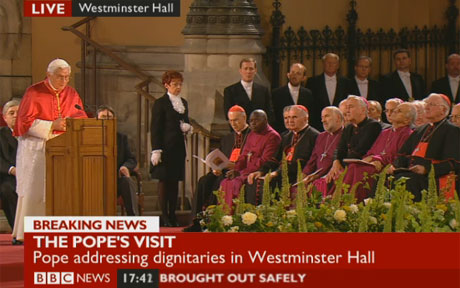
Pope speaking to politicians and other leaders in Westminster Hall where St. Thomas More was condemned to death for his fidelity to the Pope!

All the fears and anxieties that the pope would be humiliated in Great Britain and possibly arrested proved false. He won them over and never budged once on his message and the need for Christianity in general and Catholicism in particular to be active in the social and political process of that country and all of Europe.

The protests were a side show to the actual "gig" as some called the pope's various venues.

His soft spoken demeanor betrayed the rock solid message that he unflinchingly proclaimed. He took a razor to the rampant secularism of Great Britain and all of Europe and cut it to shreds without once blinking and none of the secularists saw the blood spewing forth from their smug ideological agendas.

But will this galvanize the powerful secular media, those in high politics and sadly enough the Judas Iscariots in the Church who truly hate the Catholic Church's traditional teachings in general and truly hate Pope Benedict in particular because he is such a threat to the secularists' domination of Europe. Stay tuned to the news media, maybe even CNN on Saturday night. Let's see how far they will go in discrediting the Holy Father.

SOME IN THE ARENA OF LITURGY WON'T LIKE THIS SO DON'T READ IT!

Click on image twice to enlarge, do you like it?

Who's the star of this talk show?

A Filipino Archbishop describes his feelings about Liturgical renewal. Liturgists of a particular ideology are not going to like it! The article originally appeared HERE but I've copied it below. I have a few comments below the reproduced article.

The Liturgical Renewal I Would Like To See
by Archbishop Jesus Dosado of Ozamiz


Looking back, some of the culprits for me for the gradual loss of the true reform of the liturgy were the so-called “liturgists” who were more like technicians and choreographers rather than pure students of liturgy.

They had a peculiar affinity for refined liturgical celebrations coupled with disdain for the old rites and devotions. Unfortunately, some bishops, not pure students of liturgy either, gave in to their terrorist proclivities.

A search for creativity and community were dominant projects in “reform-minded” Catholic circles in the 1960s and beyond. In itself, this might not have been bad. But the philosophy that the community was god, and that “God” was not fully “God” without the community was the source of ideas that have done most damage to the Church.

This secular notion of community made its way into the liturgy to gradually supplant the inherited Christian tradition.

These self-appointed arbiters of the reform were, and I hate to say this, liturgical hijackers who deprived ordinary parishioners – and bewildered pastors – of their right to the normative worship of their own Church. Hence, there was the need for a reform of the reform.

A major goal of Pope Benedict XVI is the restoration of our Catholic identity. Liturgy is a key component of such an endeavor.

Benedict’s broad liturgical approach can be described in terms of “continuity,” i.e. recovering elements of the liturgical tradition which he believes were too hastily set aside or downplayed in the immediate period after the Second Vatican Council.

The idea of a new liturgical movement came with strength from his book, Spirit of the Liturgy.

A relevant section: “I am convinced that the crisis in the Church that we are experiencing today is to a large extent due to the disintegration of the liturgy … in that it is a matter of indifference whether or not God exists and whether or not he speaks to us and hears us. … Such circumstances will inexorably result in a disintegration. This is why we need a new Liturgical Movement, which will call to life the real heritage of the Second Vatican Council.”

Pope Benedict XVI in his Pastoral Letter to Catholics in Ireland situated the sexual abuse of children in the wake of fast-paced social change and a decline in adherence to traditional devotional and sacramental practices.

To his priests in the Diocese of Rome he said, “In the Eucharist we do not invent something, but we enter into a reality that precedes us, more than that, which embraces heaven and earth and, hence, also the past, the future and the present. … Hence, the liturgical prescriptions dictated by the Church are not external things, but express concretely the reality of the revelation of the body and blood of Christ and thus the prayer reveals the faith according to the ancient principle ‘lex orandi – lex credendi.’” (“the law of praying establishes the law of believing.”)

To be sure, the Pope has great regard for the Novus Ordo. He issued a Letter to the Bishops on the Occasion of the Publication of Summorum Pontificum where he narrated why he wanted to expand the use of what is now called the Extraordinary Form of the Roman Rite and, in so doing, he deliberately responded to the fear that this expansion was somehow intended to demote the Novus Ordo or undermine the Vatican Council’s call for liturgical reform, saying it was unfounded.

For the former Cardinal Joseph Ratzinger, (now Pope Benedict XVI) the liturgy is of its nature an inheritance, a space we inhabit as others have inhabited it before us. It is never an instrument we design or manipulate. Self-made liturgy is a contradiction in terms, and he distrusts liturgies that emphasize spontaneity, self-expression and extreme forms of local inculturation.

In his own book, Spirit of the Liturgy, Cardinal Ratzinger scathingly compared such liturgies to the worship of the Golden Calf, “a feast that the community gives itself, a festival of self-affirmation. Instead of being worship of God, it becomes a circle closed in on itself: eating, drinking and making merry … It is a kind of banal self-gratification … no longer concerned with God but with giving oneself a nice little alternative world, manufactured from one’s own resources.”

In his view, the liturgy is meant to still and calm human activity, to allow God to be God, to quiet our chatter in favor of attention to the Word of God and in adoration and communion with the self-gift of the Word incarnate.

The call for active participation seems to Benedict XVI to have “dumbed” down the mystery we celebrate, and left us with a banal inadequate language (and music) of prayer.

The “active participation” in the liturgy for which Vatican II called, he argues, emphatically, does not mean participation in many acts. Rather, it means a deeper entry by everyone present into the one great action of the liturgy, its only real action, which is Christ’s self-giving on the Cross.

We can best enter into the action of the Mass by a recollected silence, and by traditional gestures of self-offering and adoration – the Sign of the Cross, folded hands, reverent kneeling.

For the Pope, therefore, liturgical practice since the Council has taken a wrong turn, aesthetically impoverished, creating a rupture in the continuity of Catholic worship, and reflecting and even fostering a defective understanding of the Divine and our relationship to it.

His decision to permit the free celebration of the Tridentine liturgy was intended both to repair that rupture and to issue a call to the recovery of the theological, spiritual and cultural values that he sees as underlying the old Mass.

In his letter to the bishops of July 2007, he expressed the hope that the two forms of the one Roman liturgy might cross-fertilize each other, the old Missal being enriched by the use of the many beautiful collects and prefaces of Paul VI’s reformed Missal, and the celebration of the Novus Ordo recovering by example some of the “sacrality” that characterized the older form.

It is just like Anglicanorum Coetibus, the Apostolic Constitution providing for personal ordinariates for Anglicans entering into full communion with the Catholic Church, about which the Pope talked to the Bishops of England and Wales in their ad limina visit.

“It helps us to set our sights on the ultimate goal of all ecumenical activity: the restoration of full ecclesial communion in the context of which the mutual exchange of gifts from our respective spiritual patrimonies serves as an enrichment to us all,” Anglicanorum Coetibus reads.

Despite Summorum Pontificum, Pope Benedict himself has only celebrated the ordinary form of the Mass in public, “facing the people” in the manner of the Novus Ordo, using modern languages, all as stipulated in the Liturgical Books of the different countries where he celebrated.

Many people, for example, were waiting for him to use “for many,” instead of “for all” in the United States, but he did not do so.

The Pope celebrated ad orientem (to the east) once more at the newly renovated Pauline Chapel, whose altar was repositioned so that it could be used to celebrate both ways – and the Pope chose the traditional direction in the Mass he celebrated with members of the International Theological Commission.

Small changes to the accessories, vestments and ritual rubrics point to the Pope’s Reform of the Reform. On Corpus Domini of 2008 he began to give Communion exclusively on the tongue to the kneeling faithful.

In November of that year with a new master of pontifical liturgical ceremonies, the Crucifix and candle holders returned to the papal altar, from which the post-Conciliar liturgical reform had taken them away putting the Cross to the side and replacing the candelabra, if at all, by little temple lights.

On the Feast of the Epiphany last year, the Pope wore the guitar-shaped so-called Philippine chasuble instead of the post-Conciliar flowing chasuble, to underscore the continuity between past and present, manifested through liturgical vestments.

Then there are the ritual silences during the liturgies, observed after readings, after psalms, after the homily, and most especially, after Communion.

With these silences, the Pope is starting to educate the faithful who follow papal liturgies to a better, more appropriate attitude of concentration and meditation.

What is the Pope up to? In the words of Monsignor Guido Marini, “I think what the Holy Father is trying to do is to wisely bring together traditional things with the new, in order to carry out, in letter and spirit, what Vatican II intended, and to do it in such a way that papal liturgies can be exemplary in all aspects. Whoever takes part in, or watches, a papal liturgy should be able to say, “This is the way it should be done. Even in my diocese, in my parish!”

And that is how I would like the direction of the liturgical renewal to take with the Mass to be recast, yes, but in order to remain what it is, Calvary and the Upper Room.


My comments:

One cannot downplay the significant role that "liturgists" played in the initial reform of the Mass immediately following Vatican II and well into the 1990's if not later. These "theologians" were elevated by many in the Church both clergy and laity and not a few bishops, to the level of a parallel magisterium. What they said, what they modeled at workshops and all of their suggestions about liturgical renewal were taken as gospel truth to be obediently and immediately implemented on the parish level.

What are some of the fruits of these "liturgists" that still linger with us today?
1. The stripping of traditional art, architecture and music from our churches and liturgies
2. Building churches in the round or semi-round so people can see each others faces while celebrating Mass
3. Music that is faddish and won't stand the test of time; disdain for Gregorian Chant and the actual music of the Mass, i.e introit, offertory antiphon and Communion antiphon
4. Kneeling forbidden for any part of the Mass, kneelers removed from churches in a Gestapo act to prevent those who want to kneel to have any comfort in doing so (Remember Mother Angelica making portable kneelers that you could carry with you to church?)
5. Any sense of private or traditional devotions either a part of Mass or during Mass frowned upon, for example beating one's breast at the Confiteor, Agnus Dei, bowing at the "incarnation" during the Credo, etc. Eucharistic adoration was truly disdained as well as Benediction of the Most Blessed Sacrament and other popular devotions. God forbid that the tabernacle be central in the Church, best for it to be in a closet somewhere independent of the interior of the Church!

Thursday, September 23, 2010

THE VERDICT IS IN, MIKEY LIKES IT!


I taught our 2nd, 3rd and 4th graders this afternoon at our school. I had copies of the new greeting, Confiteor, and Gloria. I also had the old version side by side with the new.

We started with the new greeting and their response "and with your spirit." I explained to them the reason for the change and even the second graders got it and are excited about this change.

Then we recited the old Confiteor and the new one, especially emphasizing "through my fault, through my fault, through my most grievous fault! All of the classes, especially the 4th graders said it really did make them feel bad for their sins with such a strong emphasis on their personal culpability! They like it!

Next we recited the old and new Gloria. I asked the 4th graders what they noticed was the biggest change. One raise her hand and said that the new one had added a four line sentence that wasn't in the old. I explained to them that 40 years ago those who translated the Mass tried to make things simple and in doing so made things dumb. They got it and even laughed.

I think these kids are as excited about the new English translation as I was as a 7th grader when the Latin Mass went to English for the first time. It was thrilling back then. I can't say the kids are as thrilled, but they are excited and want to start doing it right away. But alas, I said, in humble obedience to my bishop, I'll wait until we all do it together throughout our diocese!

They think the new is better or new and improved and I must agree with the children on this one! I can hardly wait for it to be implemented! This is exciting folks!

EULOGIES AT FUNERALS, FORBIDDEN?


Below is an article by Bishop Thomas Tobin of the Diocese of Providence on the celebration of funerals. He dislikes eulogies and shows that the liturgical norm is opposed to these. In our parish we do allow by request a person to speak after the prayer after Holy Communion. However, our parish norm is that this person must be a Roman Catholic who practices their faith (attends Sunday Mass is the minimal expectation). Their talk must be written and submitted to the priest who celebrates the Mass for review. It can be no longer than 3 to 4 minutes.

For those families who would like additional persons to offer reflections, our parish policy is that the family arrange this and any sort of "celebration of life" that they wish after the "Vigil for the Deceased" has been prayed. This, of course, takes place in the funeral home. This is in addition to but not part of the Vigil for the Deceased. If the family wants someone to speak at the place designated in the Vigil for the deceased, this person must be a practicing Catholic, only one person and the same criteria as for the Funeral Mass.


WITHOUT A DOUBT
Let’s Bury the Eulogies


BY BISHOP THOMAS J. TOBIN
9/16/10


According to the dictionary, a eulogy is “a speech or piece of writing that praises someone or something highly, typically someone who has just died.” Sounds simple enough, doesn’t it? In the context of a Catholic funeral, however, eulogies can be problematic for several reasons.

The first is that Catholic liturgical norms do not permit a eulogy during the funeral Mass. The Order of Christian Funerals states, “A brief homily based on the readings should always be given at the funeral liturgy, but never any kind of eulogy. The homilist should dwell on God’s compassionate love and on the paschal mystery of the Lord as proclaimed in the Scripture readings.” (#27, #141) The instruction goes on to say that the homily should give consolation and strength to the community mourning the death of one of its members.

The point here is that the funeral liturgy is public worship for the Church – with its own expectations and limitations – and not primarily a memorial service for the one who has died. The homily, therefore, should focus on Jesus Christ and His saving death and resurrection, and not become a testimony – as well-deserved as it might be – to the deceased.

Obviously it’s fitting, even during the homily, to offer sympathy and support to the grieving community, and to say good things about the deceased, to highlight their positive virtues and contributions. But that personal tribute should never be the primary focus of the homily.

Another emphasis of the liturgical norms is that the homily be “brief.” Now, “brief” is a relative term and what might be brief to one might be excessive to another. In light of our common liturgical experience, however, it seems to me that a funeral homily generally shouldn’t exceed ten to fifteen minutes. The homily should apply the Word of God, simply and clearly, to the reality of death and resurrection, and avoid the temptation to recall, year-by-year, the deceased’s life story and accomplishments.

Now, having said all of that, the Church certainly recognizes the more personal consequences of death. For that reason, the funeral liturgy provides an option for the conclusion of Mass: “A member or a friend of the family may speak in remembrance of the deceased before the final commendation begins.” (#170)

Even these “words of remembrance,” popularly called eulogies, create real pastoral problems, however, and like many priests I’ve witnessed abuses of this accommodation. On one occasion, the eulogy was presented by a relative of the deceased, a fallen-away Catholic, who used his time at the microphone to lambaste the Catholic Church and its traditions. In another case, the nephew of the deceased took the occasion to praise his uncle’s rather profligate life style, emphasizing how he was really good “at picking-up chicks.” Another time the eulogy rambled on and on, becoming almost as long as the rest of the funeral Mass.

Sometimes the person chosen to offer the remembrance isn’t adept at public speaking and their words are presented in vain, unable to be heard or understood by the congregation. I remember one eulogist so overwhelmed by grief that she stood at the pulpit weeping uncontrollably for several minutes, imposing her intense private grief upon a very uncomfortable congregation, until someone finally came forward and gently led her back to her pew.

Whether or not to permit words of remembrance is the sole discretion of the pastor who is responsible for the spiritual care of his parish and the liturgy that takes place there. If words of remembrance are permitted they should be very brief, not competing with or replacing the homily, and they should be appropriate in tone, keeping in mind the sacred time and place.

There may be some special situations – for example when the deceased is well-known in the community, or there are unusual circumstances in the death of the individual – when words of remembrance at the end of Mass may be more fitting, but these too must be limited in scope and appropriate in content.

It seems to me that the funeral rites of the Church provide much better times for a personal remembrance of the deceased than during the sacred precincts of the Holy Sacrifice of the Mass – for example, during the vigil, or at the graveside, or at the social event that follows the liturgy when family and friends gather together.

You can see, I hope, why the Church prohibits eulogies during the funeral Mass. They don’t fit well in a liturgical setting, and they are filled with pastoral minefields. The poor parish priest who prohibits eulogies is sometimes viewed as an uncaring, insensitive ogre, while really, all he’s trying to do is follow the law of the Church and provide for a dignified and prayerful funeral.

“In the face of death, the Church confidently proclaims that God has created each person for eternal life and that Jesus, the Son of God, by his death and resurrection, has broken the chains of sin and death that bound humanity . . . Christians celebrate the funeral rites to offer worship, praise and thanksgiving to God for the gift of life which has now been returned to God . . . The Church through its funeral rites commends the dead to God’s merciful love and pleads for the forgiveness of their sins.” (#1, #5, #6)

May all of our funeral celebrations seek to maintain and promote this holy understanding of a death of a Christian.

Wednesday, September 22, 2010

TIME FOR "AS THE RAT TURNS" SOAP OPERA


This is rat central and I have an update for you on the rectory wanderings of Ben and Socrates. The last straw two weeks ago has led us to put poison out. Have they eaten it? Maybe, but they are immune evidently! It must be like crack to them!

The latest terror is that our parochial vicar, Fr. Justin ate some Zaxby's chicken on Monday night, my day off when I go to Augusta for rat respite! He placed his bones (the chicken's) in the carry out Styrofoam container, closed it, place that in its plastic bag and tied it shut and placed that in a open kitchen plastic garbage can in the TV room which is in our living quarters on the top floor of the rectory. The office is on the main floor, our kitchen and dining room are the ground floor.

Yesterday, Fr. Justin noticed that the bag of discarded chicken bones had been opened, a hole had been eaten through the Styrofoam container of bones and that every bone including a used pack of blue cheese was missing. The light weight garbage container was still upright!

Fr. Justin moved the couch and behind it was strewn the chewed on chicken bones and the blue cheese packet licked clean. All that was left were rat droppings marking the stash of bones. It was quite shocking to see!

Last night we placed all kinds of traps and poisons on the third floor, only to discover this morning that of the four traps we set, all had the food removed from them and the traps not sprung!

This is diabolical. I suffer now from current and post traumatic stress syndrome. I don't sleep well at night and dread going to the kitchen in the morning to fix breakfast. I go to my mother's house in Augusta and hear a sound there and think she has rats too! I go on retreat and the same thing occurs.

This is war and I think I'm losing it!