Translate

Friday, January 11, 2013

ARCHDIOCESE OF BOSTON SUSPENDS LAITY'S COMMON CHALICE AND HANDSHAKE OF PEACE OUT OF FEAR OF DEADLY CONTAGION! MAY THE LIE THAT THERE IS NO DANGER IN TRANSMITTING A DEADLY CONTAGION OR AT LEAST ONE THAT WILL MAKE THE COMMUNICANT SICK BE PUT TO REST ONCE AND FOR ALL!

UPDATED, THE NBC NIGHTLY NEWS STORY ON THE FLU AND THE BOSTON ARCHDIOCESE PROHIBITING THE HANDSHAKE OF PEACE AND THE COMMON CHALICE, LISTEN TO HOW THE REPORTER DESCRIBES THE CATHOLIC PRACTICE OF DOZENS OF PEOPLE DRINKING FROM "COMMUNION WINE SERVICES!"

Visit NBCNews.com for breaking news, world news, and news about the economy

NBC NIGHTLY NEWS reported on Friday night's newscast that the Archdiocese of Boston is asking parishioners to stop shaking hands at the Sign of Peace and to bow instead. That seems like a grand solution to out of control signs of peace, doesn't it? But the reason is not liturgical, it is out of concern for health and spreading the flu virus by hand to hand combat, I mean, contact! Also since the flu, other viruses and deadly germs can be transmitted by the common chalice, the use of it is suspended. Now, I must query, who out there in progressive liturgy land (PI) and in their right mind still contends that no deadly germs and viruses can be transmitted by drinking after others? Is liturgical correctness more important than the life and health of our laity? Like those in the hierarchy and rank and file Catholics in denial of the sex abuse scandal before that was made clear by the media, especially in Boston and the scope of it, are these liturgists in complete denial too and will it take the media and lawsuits from laity who get sick and some who die from drinking from the common chalice that someone with a deadly disease has transmitted to others because that person chose to drink from that same chalice? As I've said before, if the city had to license us as it does a restaurant and saw our practice of the common chalice given to the laity, we'd be written up and ordered to stop and if we didn't we'd be shut down. Think about it. Liturgists and others in the Church of goodwill (I include myself here, from the dreary past of course) brainwashed the laity into thinking it is okay for several dozen people to drink from the same chalice all out of concern that liturgists shoved down out throats, quite literally I might add, that the Holy Eucharist is an action of "eating and drinking" and that we must provide for the laity the means by which they can do what Jesus told them to do. Of course that is a lie! Jesus told the apostles, the first priests to do it at the Last Supper. Eating and drinking should be changed to "receiving" or "partaking" in our Lord's sacrifice and in His Body, Blood,Soul and Divinity! The only sanitary way to make sure our people can receive our Lord under both forms of His Real and complete Presence is by way of intinction properly administered. Finally, some of us in the Church have asked that people who come to Mass feeling ill, should not drink from the common chalice. This in and of itself is an absurdity that most people would have heard this instruction or remembered it and that people will self-police themselves. On top of that, there are laity who think that God will protect others from such contagion as it concerns His Most Precious Body, Blood, Soul and Divinity and that it is an act of faith to drink after someone who is well or sick because God will protect you. This is how silly all this has gotten to be and how the Church throws out in reckless abandon common sense concerning abuse of people and their health!

DO I LOOK LIKE THE CAT THAT SWALLOWED THE CANARY?

This photo was taken with the altar boys right after our Reform of the Reform of the Ordinary Form of the Mass within continuity which was celebrated today at 11:00 AM and featured the Church Music Association of America singing in the most splendid way possible, Gregorian Chant for all the Propers and other parts of the Mass.

The Mass was sung in its entirety from start to finish and even the Epistle was chanted by a CMAA member and then in place of the Responsorial Psalm, the Gradual was chanted and how splendid to meditate upon it as it was. And then the Gospel was chanted flawlessly in simple tone by me and in front of these professional chanters! That takes nerves of steel!

It was a hybrid of Latin and English, Scriptures in English, homily in English, although I was tempted to give an extemporaneous Latin one! :)

The Liturgy of the Eucharist was ad orientem, but the Introductory Rite and the Concluding Rite were at the Celebrant's Chair.

We videoed it and it will take about a week to get it digitized and placed on my blog and I'm sure on the Chant Cafe Blog.

Others took photos during the Mass and as soon as I get them I'll post them.

We had a local television station videoing some of it and if they post it on their website I'll get it to mine.

It was absolutely splendid. We had about 300 people present with many driving down from Atlanta! We had our own parish school kids as well as Mt. de Sales Academy Middle School and High School kids.

I was in muted spiritual ecstasy thanks to Gregorian Chant. If we could only do it this way each and every Sunday at our principle Mass and if this was the way we celebrated the revised Tridentine Mass for the last 50 years, I think we'd still have 70 to 80% of Catholics attending Mass.

There is absolutely no way to say the the Reformed Mass has been well received when nearly 80 to 85% of Catholics absent themselves from it every Sunday.It could have been well received if celebrated as we did today not the banal, folksy way it has been done with folk music, contemporary music and now the worship and praise genre which prepares our kids for the non-denominational Protestant sects!

For those 20 to 30% who do attend, what is it they like and do they like the right stuff or the vapidity of bar room sounds or Broadway ditties that set sacred words to secular music that is foreign to the best of our Catholic tradition and with a rock concert type of "Rocky Mountain High" being sought based not on depth of character of the music and words, but a narcotic-like stimuli?

Do they like the spiked Kool Aid of contemporary sounds that jar the spirit rather than lift it to God in a meditative, contemplative way? Just wondering?

Perhaps when advertising properly sung Mass, the following logo should be used:
FOR THE BONUS PRIZE, CAN ANYONE DETECT AN UNUSUAL VESTMENT WORN FOR AN ORDINARY FORM OF THE MASS WHICH IS SELDOM IF EVER WORN BY PRIESTS TODAY IN THE ORDINARY FORM. HINT: IT IS KIND OF LIKE THE FANON IN ITS RARITY!

SAINT JOSEPH CHURCH, MACON, GEORGIA HOSTS CHURCH MUSIC ASSOCIATION OF AMERICA "CHANT INTENSIVE"

I was pleased to find on the front page of the metro section of the Macon Telegraph this morning a very nice article and large pictures on "Macon Hosts Chant Workshop" written by the Telegraph's reporter Liz Fabian (great name!) and a parishioner here at St. Joseph Church.

This is from the web version of the story which includes a video of one of the sessions!


Move over monks. Gregorian chant is not just for monasteries these days.

Melodies that pre-date the Middle Ages are becoming more mainstream in modern Catholic Masses.

This week, dozens of musicians from across the country have been studying the ancient art in a conference at St. Joseph Catholic Church in Macon.

With men and women sequestered in different buildings, instructors have been going over the basics and beyond.

“It’s challenging,” said instructor Richard Rice, a composer and music director for the Archdiocese of Washington, D.C. “The melodies do strange things.”

With its origins in the first century, chant is not metered. The familiar music staff and metered measures came a couple of centuries later.

“The problem with this music is it’s not all there on the page for you,” Rice said. “You have to have an organizational system.”

Singers at the conference are learning a rhythm technique developed in the late 19th century during another chant revival at the Abbey of Solesmes in France.

“We don’t know what it sounded like in 800,” instructor Arlene Oost-Zinner of Auburn, Ala., said. “Some don’t adhere to the method. They think it’s artificial.”

Her students made their own notations on the music to help set the rhythm.

“Don’t ever say beat with chant,” Oost-Zinner told her female students Wednesday. “It’s pulse -- (like) the beats of the heart, waves of the ocean, the flapping of angels’ wings.”

In the men’s session, Rice spent about 20 minutes working on three Latin words of a Psalm translated “Arise, shine Jerusalem.”

“We spend a lot of time figuring out the music,” Rice said.

The singers sound several notes in a singular vowel sound for just one syllable.

“Arise. We linger on that word 15 seconds,” Rice told his students of varying ages. “You’ve meditated on one word of scripture, and that’s an amazing thing.”

Chant enthusiasts say the slower pace and fewer words allow people to engulf themselves in worship.

Father Jonathan Venner, a 30-year-old priest from South Dakota, said there is a resurgence in chanting among people of the younger generation.

“Young people are looking for anything that has depth,” Venner said.

At St. Joseph, a Latin Mass is chanted the first Sunday of each month at 2 p.m. in a much simpler form than traditional Gregorian chant.

Five years ago, Pope Benedict allowed for the older form of the Mass to be celebrated with the priest facing the altar.

“I seized the opportunity,” said Father Allan McDonald, St. Joseph’s pastor.

Although the Second Vatican Council of the 1960s encouraged chanting to remain in the liturgy, the focus shifted to English hymns instead, McDonald said.

Latin was intended to remain the language of the Mass, but the council allowed for some English.

“But it almost went to all-English overnight,” McDonald said.

There was criticism that non-Latin speaking congregations were too passive in the Latin Mass and let the priest do the worship, he said.

Those who attend the voluntary Latin Mass at St. Joseph enjoy it, McDonald said.

“If I did one of those Masses at 9:30 (a.m.), there would be a riot,” he said.

The conference concludes Friday at 11 a.m. with a special Mass incorporating Gregorian chant. The public is invited.

Does lingering on one word for 15 seconds evoke greater spiritual meditation?

Rice said that’s a question the faithful have to decide for themselves.

“Clearly the writers of chant thought it was important to meditate on a word or two of scripture for that amount of time,” he said. “I don’t think it’s so far away from people’s sensibilities of what is spiritual, really, this idea of meditation, of stopping in our busy world to refuel, reflect on one moment, one beautiful thing.”

To contact writer Liz Fabian, call 744-4303.

Read more here: http://www.macon.com/2013/01/10/2311690/macon-hosts-gregorian-chant-conference.html#storylink=cpy

Thursday, January 10, 2013

SUNDAY CELEBRATIONS IN THE ABSENCE OF A PRIEST


In 1994 there was a book prepared by the Committee on the liturgy of the National Conference of Catholic Bishops and approved for use in the Dioceses of the USA by the NCCB. It is entitled, "Sunday Celebrations in the Absence of a Priest."

It is a liturgical book that gives options for parishes when no priest is available on a Sunday. The expectation in the norms of the "General Instruction or Introduction" of this liturgical book is that the bishop be very much involved in the decision making process of the necessity of such a celebration in particular parishes in the absence of a priest on Sunday and that preference be given first to deacons to conduct such celebrations or in their complete absence to qualified and well trained laity.

The preference is that Morning or Evening Prayer be the means by which Sunday Celebrations in the absence of a priest take place. The allowance of Holy Communion from the tabernacle is included in this form.

The second choice is a Liturgy of the Word celebration with Holy Communion. There is also a liturgy for Benediction of the Blessed Sacrament by a deacon of course without the distribution of Holy Communion.

The thrust of this liturgical book is that these kinds of celebrations should be very much regulated and a last resort, especially if other priests can be sent to the parish or the parishioners themselves can go to nearby churches that have a priest.

I suspect this is for more rural areas where there in no other close by Catholic Church for people to conveniently attend when they have no priest in their parish on a Sunday.

There is no Liturgical Book and thus no norms for the distribution of Holy Communion in the absence of a priest during the week when no priest is available for daily Mass, although it is quite common in my parish and in one other parish in the city to have them. In my parish it is only for the most rare of circumstances, in the other parish it is a regular occurrence on the pastor's day off which is Friday.

Thus, and I only render an opinion here, and I hope canonists could chime in, since there is no obligation for the laity to attend Mass during the week that there is no need for celebrations in the absence of a priest where Holy Communion is distributed.

However, in lieu of that, in my most humble opinion, there could be Morning or Evening Prayer from the Liturgy of the Hours celebrated by a deacon or qualified lay person or even Benediction of the Most Blessed Sacrament by a deacon in place of a daily Mass.

In other words, there is no consideration given by the bishops of the United States of America that Holy Communion be distributed at Communion Services during the week when a priest is not available for Mass. This consideration is only given to Sunday celebrations in the absence of a priest.

Am I wrong and do I need to adjust my most humble opinion in this regard?

FEEL GOOD RELIGION: THE BIBLE LEADS ME TO WANT TO DO THIS!

MY FIRST COMMENT: Make no mistake about it; those in the Catholic Church who are opposed to the Reform of the Reform in Continuity are opposed to it because they know that the Catholic Church when faithful to her traditions and to the tradition of Sacred Scripture, Tradition and Natural Law, will never, ever ordain women, jettison divine law revealed in Scripture, Tradition and Natural Law and will never call fornication, adultery, sodomy and other unnatural forms of sex anything but what they are, disordered and if knowingly committed, realizing these are sins and doing so with full consent of the will, are mortally sinful and thus if one dies unrepentant and unreconciled to God and His Holy Church, one is condemned into the everlasting fires of Gehenna. (Is that too harsh and not feel good religion enough?)

What "spirit of Vatican II" Catholics fear most about the reform of the reform in continuity is authentic authority and the liturgy that supports it. They much more prefer their bogus form of authority and the liturgy that supports that. We could say as St. John's Letters that we read during the Christmas/Epiphany weekday readings for Mass that in them lies the heart of the anti-Christ. It is also anti-Church, anti-pope. It is a new form of gnosticism and as ugly as the original condemned heresy of the Church. You can see it at work in the Episcopal Church and it is certainly at work in many post-Catholics in the Church today:

SAME SEX MARRIAGE CEREMONIES WILL TAKE PLACE AT WASHINGTON, DC'S NATIONAL CATHEDRAL, (PROTESTANT EPISCOPAL CHURCH OF AMERICA).

Longtime same-sex marriage advocate the Very Rev. Gary Hall took over as the Washington Cathedral's dean in October (Protestant Episcopal Church of America).

He said, "I read the Bible as seriously as fundamentalists do," Hall told the AP. "And my reading of the Bible leads me to want to do this because I think it's being faithful to the kind of community that Jesus would have us be."


My final comments: At least in the Catholic Church, infallibility is only accorded to one man alone, and that is the pope and even then he must act in continuity with the authentic faith of the Church and her tradition of Scripture, Tradition and Natural Law.

Protestants on the other hand, have had a creeping infallibility accorded to almost every believer, thus if you believe it and it makes you feel good, it must be true. And thus you can have an Episcopal dean say within his Protestant tradition of creeping infallibility of every person, "And my reading of the Bible leads me to want to do this because I think it's being faithful to the kind of community that Jesus would have us be."

Case closed, infallibility triumphs. Ecumenism is dealt a deadly blow. God must not want ecumenism.

Wednesday, January 9, 2013

THE LITURGICAL CLIFF (CLIFFS?)

The following is a link to a very good article on the Reform of the Reform in continuity but from the perspective of pastoral concern and not dividing parishes and pushing people away from the parish or the liturgy of the Church as off of a cliff!

YOU CAN READ IT BY PRESSING THIS. IT IS ENTITLED, The Liturgical Cliff
DAVID G. BONAGURA, JR


In the light of the article, MY COMMENTS NOW:

1. We do need to prepare people. I freaked out prior to the "imposition" of the new and gloriously improved English translation of the Mass, that my congregation would be like those who despised Humanae Vitae and there would be protests in the aisles of the Church. It never materialized either in my parish or the 99% of parishes in this country. Only about .1% complained vociferously and those 100 or so people were on the progressive blog and the NCR.

2. The first step in avoiding the Liturgical cliff is to start celebrating the EF Mass regularly, but not replacing any other Mass with it. Then do special Masses that are EF that will have broad appeal, like Faure's Requiem for All Souls and special feasts, like Holy Day of Obligation Mass as a EF Mass at a very convenient time.

3. Once people get use to it and begin to love the solemnity and God-centeredness of the EF Mass, then one might on occasion celebrate an Ordinary Form Mass ad orientem with some Latin or no Latin but at a convenient time.

4. One should also start to chant the propers, but not eliminate good metrical hymns, but by all means get a good traditional hymnal to help in that transition.

5. Then after about five years, make one of your Sunday Masses, not the principle one, but a well attended one Ad Orientem for the Liturgy of the Eucharist only. Put kneelers out for people to choose to stand which is the norm, to kneel, which is the exception and make clear the choice is the communicants, knowing what the norm and the exception are and that both are allowed.

This helps avoid the Liturgical cliffs, but formation and catechesis are necessary starting with the Mass itself and enhancing it without an radical changes other than music and reverence.

WHO CALLS THE SHOTS AND TO WHOM DO WE OWE OBEDIENCE WHEN IT COMES TO THE LITURGY?

"spirit" of Vatican II Catholics have been trying to turn things upside down for the past 50 years, especially how authority is exercised in the Church, but they have failed and are failing and they are mad as hell and won't take it anymore and so we say, get over it, you lost and by the power of the Holy Spirit.

The spiritual battle the Church has experienced for the past 50 years since Vatican II is one of authority and who exercises it and who obeys it. The Catholic Church has many levels of authority and some of it based upon the very sound principle of subsidiarity. That means that some decisions need to be made on the local level.

For example a bishop has a great deal of flexibility in terms of how he will teach, rule and sanctify. Yes, he must follow canon and civil law (but not civil law that compromises the teachings of the Church). He can be a micro manager or delegate his authority to others. The same it true of pastors. Within parameters there is a great deal of flexibility and diversity as to the manner in which a pastor pastors a parish.

On the higher levels of the Church, many who were and are deconstructionists of traditional Catholic authority centered in Rome with the pope in union with the bishops of the world, wanted and want many decisions of a universal nature relegated to the local level, either to the bishop himself or the more novel approach of bishops' conferences. This they thought and think would lead to a better form of subsidiarity and enable the Church to deal with problems on the local level.

This can be applied to many aspects of the Church's life, but when it is applied to the liturgy the following could happen.

1. Each bishops' conference comes up with its own translation of the liturgy into the vernacular. This then enables others who claim authority in this or that aspect of the liturgy to politicize the process of translation and put forward their own perception of what is best for the rest of us. Gone totally viral, it allows each priest to translate the Mass on his own, to make it up as he goes as we have seen so often in the post-conciliar liturgy, a crass clericalism where the priest treats the liturgy has it own creative playground with creativity and manipulation. Or the priest could delegate this to committees in the parish that do it also creating what I call "laityism" as it concerns lay people seizing authority all in the name of the spirit of Vatican II. We've actually experienced this in many places in the spirit of Vatican II especially in the 1970's. This dying breed is trying mightily to keep this spirit alive especially in academic institutions where the young are molded or brainwashed in this method of thinking.

2. An example of the irritation the spirit of Vatican II Catholics have is their contempt for Pope Benedict and Pope John Paul in re-centralizing authority in Rome especially with regard to guarding orthodoxy, calling a heresy a heresy and promoting the reform of the reform in continuity by seizing control once again to the process of re-translating the Mass into the vernacular, bringing back things that were excluded to the Mass and sacraments and liberalizing the ability to celebrate the Tridentine Mass.

This group use to use the word "patriarchy" to describe the "mean old men" in the Vatican, usually the pope, his cardinals and bishops and those who work for them at the Vatican. These men are viewed as pariah.

The post-modern term in the 21st century is "monarchy" to describe the Holy Father and the bishops that surround him. Some of this use of the word monarchy centers especially on the turn of events in the translation of the Mass where Pope John Paul II and probably at the behest of Cardinal Ratzinger changed the rules for translating the Mass with the document Liturgicum Authenticum and reorganized ICEL and created another organ call Vox Clara.

Those who lost the battle of their method of translating the Mass were quite angry and still are and some were fired for their vociferous objections to the new way of doing things because their hard work was tossed aside. Like little children, they didn't want to play by the new rules, so their either pouted in the most public way or disengaged in the most angry way. This is quite understandable and often happens in other venues of life. People quit when they think they are not appreciated or their work is tossed aside.

So there is an extremely small group of liturgical and linguistic theologians and academics that got burned and seriously so. Their hermeneutic was successfully challenged and derailed by others who had the pope's ear. They lost in other words.And in losing they are trying to rally their side in the most vociferous political way and continue the divisiveness this group has promoted in the Church for the last 50 years.

It is all based on authority and who exercises it and who is in control. Make no mistake, those who are liturgically,linguistically and musically inclined tend to have controlling personalities and what to control and when they lose control they get not only rabidly angry, they want to get even.

That is what we are seeing in the two liturgical camps of the Church.The first has the ear of the pope as he promotes the reform of the reform in continuity and brings back that was lost in the post-conciliar era.

And of course the Holy Father has an authority in the Church that is legitimate backed by Scripture, Tradition and Canon Law. His authority is authoritative not authoritarian for he has the legitimate right to exercise it, which means he can also interpret Vatican II in light of Tradition and continuity with it.

The ones who want to seize control of authority on all levels of Church life especially the liturgy do so by exerting influence and manipulating others with their bravado and expertise on this or the other subject.

Their authority though is bogus, not based in Scripture, Tradition or canon law, but merely on the spirit of what they think Vatican II in a very narrow way teaches implicitly but not explicitly.

Their authority since it is bogus is authoritarianism, not authoritative. No one owes them allegiance of obedience, no one.

So, I recommend that we follow our Holy Father and the bishops in union with him and enjoy the new way in which Vatican II is now being implemented especially as it regards the liturgy. It will lead to a new "Pentecost" in the Church and a new "springtime" of renewal. Thank God! God is Good!


Tuesday, January 8, 2013

HOW DO YOU LIKE YOUR LITURGY PERFORMED? "PERFOMATISM"

The reform of the reform in continuity is seeing some of what was discarded for a brief 40 years or so making its way back into the liturgy. Spirit of Vatican II "performists" are startled if not shaking to see the following return to parishes and cathedrals, not to mention basilicas:

1. Lace albs (although these never truly disappeared altogether).

2. Roman Chasubles also known as Fiddle backs--these practically did disappear and are now ascending especially in Rome of all places. As with any style or cut of chasuble these can be quite simple and sparse or very elaborate and decorated.

3. Gregorian chant and polyphony are definitely making a come back and the questioning of some genre of music for the celebration of the Mass as inappropriate is at a fever pitch in some circles.

4. The return of the Tridentine Mass, now known as the Extraordinary Form with its precise rubrics and narrow parameters

5. The exclusion of some from the formal ministries of the altar--boys and men only in other words and the avoidance altogether of Extraordinary Ministers of Holy Communion

6. The return in English to a Latin sounding or "sacral" sounding translation as well as a return to more Latin

7. The one "vestment" that causes the most consternation and seething is the Cappa Magna which only a bishop uses and only for a Pontifical Mass and only as a prelude to actually placing the liturgical vestments on his body.

I don't know if my list is exhaustive.

I think "performatist" refers to a "look at me" form of celebrating the Mass that is retro by centuries but could also be retro by a few decades. We all know the 1970's look for style and even liturgy and some wish for us to return to that dreary period of liturgy and life.

It also means "performing" certain rituals in a precise, rubrical manner and excluding some things from the performance of the liturgy whether that be females in official roles and I guess even in choirs or making the laity more passive rather than active from their congregations. Of course I think this would be a caricature. Just as there are only a few "clown" Masses these days, the worst kind of performatism, there are only a few parishes that are like what I described in terms of keeping the laity from their rightful and liturgical place in the assembly.

So I post some pictures for you to compare various types of performatism. Which do you prefer and as a "performist" which would you exclude outright from the Liturgy?


Press here for another performatist liturgy if you can stomach it!

MY FINAL COMMENT: Give me reform of the reform within continuity "performatism" any day over the post-modern performatism that so many think is superior. Make no mistake the radical ordinariness and dreariness of pseudo-incarnational theology these people promote is meant to lead to the complete deconstruction of the Catholic Mass, sacraments and Church and make it more Unitarian, or worse yet, Episcopalian, meaning transgendered people in ministry, no distinction of roles between male and female and all kinds of moral absurdities. That's the bottom line with the "performatists" lost in the 1970's and Post-Catholic banalities and desconstruction.


Monday, January 7, 2013

INTINCTION, KNEELING FOR HOLY COMMUNION, GOOD AND BAD PRACTICES OF MC'S AND COW LICKS

From our choir director/organist, Nelda Chapman's iPhone at Pope Benedict's Epiphany Mass. AH, AWE ORIENTEM!

This is the Rite of Holy Communion. Please note that our Holy Father distributes Holy Communion to the deacons kneeling and by way of intinction so dreaded by some Catholic elitists. Please note also that most of the congregation are receiving Holy Communion on the tongue even when they present their hands and one priest is making the sign of the cross with the Host before he gives it to the communicant.

In fact at all papal Masses at St. Peter's the common sense approach to receiving both the Sacred Host and Precious Blood is for the deacons to receive by intinction and the concelebrating bishops to approach the papal altar and self-intinct. They don't drink after one another, a very safe and healthy practice!

Please note one other thing the Holy Father has in common with me, a cow lick. My hair in the same place does the same thing when cut too short! :) A good MC should have a clean comb and should have patted that down discreetly of course.

Please note that the Holy Father drops a Host as he distributes to the congregation and the one with the paten does not notice it or attempt to catch it. Tisk, tisk, but the good MC Msgr. Marino see it laying on the kneeler and places it in the ciborium the Holy Father is holding. The choir is singing the official Communion Antiphon.


And someone forgot to tell the men who place the Holy Father's chair in front of the altar after he incenses it, that the Holy Father would not go around the altar to incense it as he has in the past, thus discombobulating these men and delaying the seating of the Holy Father. MC's fault I'd say!

Sunday, January 6, 2013

EPIPHANY MAKES ME NOSTALGIC

Exactly a year ago last Epiphany, I was on vacation in California and happened to be in Santa Monica, quite a splendid place to visit, west of Los Angeles.

I went to Mass for the Vigil of the Epiphany at Santa Monica's name sake Catholic Church, Saint Monica which is a beautiful edifice but very Hollywood when it comes to being Catholic, or shall I say some variation of Catholicism or at least of the Roman Liturgy in a very spirit of Vatican II Hollywood incultruation.

This is their style of worship. I'll let the video speak for itself! I lived to tell about it though!

Watch live streaming video from randomhouze at livestream.com

JUST HOW HARD ARE THESE PRAYERS FOR PRIESTS, CONGREGATIONS AND, OF COURSE, FOR THE ONE FOR WHOM THESE ARE INTENDED, ALMIGHTY GOD?

Does the new English translation of the Mass make the Mass sound like a Babel Fish?


Even when the Mass was in Latin, we encouraged people to have a translation of the Latin Mass, especially the changing parts, so that they might know the prayers. But some are complaining about how poorly the following prayers are translated from the original Latin or these are phrased in English as they would be in Latin thus making it too hard for the priest to read and pray and for the congregation to hear and understand thus making those in the congregation extremely mad at Mass.

I'm not a linguist but I do know from my Italian that there are many ways to translate it into English. I've always preferred the more literal translation of Italian into English with the necessary adjustment of course. When I would translate my mother's Italian into English, I would do it as I went, translating first as I heard it, but making quick corrections for proper English syntax or grammar or actual wording.

So how offended are you by these recently prayed prayers and how hard are they for you to understand and how befuddled are you by them and how angry do these new translations of the Latin prayers into English make you? Just wondering.

A recent weekday Collect:

May your people, O Lord,
whom you guide and sustain in many ways,
experience, both now and in the future,
the remedies which you bestow,
that, with the needed solace of things that pass away,
they may strive with ever deepened trust for things eternal.
Through Christ our Lord.


And Epiphany's Prayer over the Offerings at Mass during the Day:

Look with favor, Lord, we pray on these gifts of your Church, in which are offered now not gold or frankincense or myrrh, but he who by them is proclaimed, sacrificed and received, Jesus Christ. Who lives and reigns for ever and ever.

Does that one make you scream for help and make you helpless in prayer? Just wondering.

I recognize there could be better translations but someone had to make the determination of what would be used and in what style. Good for them, for too many chefs and not enough cooks spoils the broth, or something like that!

HOW SHOCKING AT A PAPAL MASS IN THE ROMAN RITE, ROMAN CHASUBLES!

Of course those who despise Pope Benedict's signature leadership in the reform of the reform in continuity will be seething to see the following, which has become the new normal at many papal Masses: 1. The return of the glorious fannon and 2. The use of Roman Chasubles at a Papal Roman Liturgy, How novel! And of the five bishops ordained at this Epiphany Mass this morning with St. Joseph Church Choir and our parochial vicar, Fr. Dawid Kwiatkowski and choir director, Nelda Chapman and assistant organist Harold McManus present, the Holy Father ordained his personal secretary too, picture below. Please note that the new bishop is also wearing the deacon dalmatic under the Roman Chasuble, called the fiddle back in this country, although our fiddlebacks are not as full as the true Roman Chasuble:


WHEN IT COMES TO BOTH FORMS OF THE ONE ROMAN RITE, WHAT IS ALLOWED AND WHAT ISN'T

The right side of this architectural rendering shows how the altar area will look when the new altar railing is installed. The left side shows how the Church is now and how far the first step will be extended into the nave and toward the current set of pews. As is very clear in the drawing a place for wheel chairs and handicapped persons remains as it is now and exactly and the three step ascend and decline will be much safer for persons with knee and leg issues and more so at the side chapels which these people may use, especially descending the altar which is more of a challenge currently with the three and four steps we currently have. This is all about safety also.
The restoration of the altar railing at Saint Joseph Church is needed for the Extraordinary Form of the Mass that is celebrated here regularly. The Ordinary Form of the Mass will have distribution of Holy Communion as it is normally done already and strictly in accord with the revised General Instruction of the Roman Missal in English and for America in 2012, at stations, where the communicant is instructed that in the Ordinary Form of the Mass, the norm in the USA is to stand to receive Holy Communion, kneeling is the exception, both are allowed and the choice is the communicants.

The same is true of Holy Communion on the tongue or in the throned hand--both options are equal and the choice is the communicants, not the ordinary or extraordinary minister's. The Extraordinary Form of the Mass does not allowed for EMHC's nor for Holy Communion in the hand, the the norm is to kneel unless there is a physical reason for the exception of standing. There is no option to receive in the hand but one should not be denied this given the fact that it is allowed in the Ordinary Form, but some liturgical instruction or correction should be given to those who approach to receive Holy Communion in the hand at an EF Mass.

Extraordinary Ministers of Holy Communion are appointed at the discretion of the pastor and he alone determines the need liturgically and must follow the norms for them at Mass. We will continue to have four host stations at every Mass here, necessitating at least two to three EMHC's. At our 9:30 AM principle Mass of the parish, we have an additional six chalices necessitating ten to eleven EMHC's when there is only a priest present and no deacon or installed acolyte. This follows strictly the GIRM as well as what is allowed to me in the privileged place of being a pastor in terms of making these decisions. Folks its canon law, we are not a lawless Church and we are not ruled by mob!

Saturday, January 5, 2013

ARE YOU GUILTY OF CAFETERIA CONCILIARISM? READ ON TO FIND OUT!

The blog, Chiesa has an interesting article which you can read here where the author describes a new term for us,"a cafeteria conciliarism." Here are some excepts:

My comments are in BOLD and the article excerpts from Father Robert Imbelli are italicized.

Is this a new hermeneutic for us and my blog where I can challenge not only progressives but retro, neo-traditionalists?:

Hence, in my view, the Council’s deepest “ressourcement” was a re-Sourcement: a recovery of the Church’s and humanity’s foundational identity in Christ. This “return to Christ” is far deeper than the social moralism of the “progressives” or the invariant propositionalism of the “traditionalists.” Rather, it is the invitation to enter into a life-giving and life-changing relationship with the living Lord, Jesus Christ.

Are we more preoccupied with the roles of laity and clergy and miss the role of the Head?

...mysticism is proclaimed in chapter one of "Lumen Gentium" on “The Mystery of the Church.” This first chapter is the too often neglected matrix of the subsequent chapters on the “People of God” and on the “Hierarchical Structure of the Church.” We can become so preoccupied and fixated upon the respective roles and responsibilities of lay people and ordained that we forget that we are only branches of the vine who is Christ. The Church, as chapter one of "Lumen Gentium" proclaims, is “sign or sacrament of unity” with God and all humankind only to the extent that it is “in Christ.” Otherwise it is a lifeless de-capitated body, detached from its Head.

As I have repeatedly said, we as Catholics are obliged to receive the documents of the Second Vatican Council as the Magisterium interprets them, especially the living Magisterium of any period along with the Holy Father. Of course, Pope Benedict interprets the Second Vatican Council documents through the powerful, corrective lens of reform in continuity, which of course makes perfect sense!

In receiving the Council, then, it is imperative to appropriate the documents in a comprehensive way, with pride of place given to the four Constitutions. They must each be given their due, both in their entirety and in their connections with one another. Otherwise, we will fall into “a cafeteria conciliarism,” choosing only those aspects which accord with our pre-determined agenda.

However, in line with what I have said above, of the four Constitutions I suggest that "Dei Verbum" serves as “prima inter pares.” For, if God has not revealed himself fully in Christ, then there is no basis for either the Church’s doctrinal claims or its social teaching. Only in Christ do these take on compelling coherence, not as programs, but as a Way of life in ongoing and transformative relation with the living Lord.


Finally, it is Jesus Christ who saves us as mediated through the Church and her liturgy and teachings. The danger in Catholicism in meltdown is that other things replace God and His Word incarnate, such as debates on the liturgy and its correct expression and what Vatican II actually taught or worse yet making Vatican II into a false god which the progressives of the Church are prone to do. Growing up I actually heard the word Vatican II more than I heard the word Jesus Christ in homilies.

I don't worship the Magisterium, the Pope or Vatican II and no one else should either. We worship God through Jesus Christ and by the power of the Holy Spirit. Let's fixate on Him and His true identity in Whom we find our true identity and then maybe we will celebrate the Liturgy of Vatican II in a way that is worthy of the One who give us our identity. And of course that Liturgy in the Latin Rite has two forms, Extraordinary and Ordinary!


In "Novo Millennio Ineunte," the magnificent Apostolic Letter written at the conclusion of the Great Jubilee Year 2000, Blessed John Paul II wrote: “We are certainly not seduced by the naïve expectation that, faced with the great challenges of our time, we shall find some magic formula. No, we shall not be saved by a formula but by a Person, and the assurance which he gives us: I am with you!”

Such is the conviction and the challenge posed by the Year of Faith which occurs not merely this year, but every year. That conviction and challenge is the ever new realization that “the Mystery is this: Christ in you, the hope of glory” (Col 1:27). This is the truly Good News we seek to share with all people.

Friday, January 4, 2013

OUR CHOIRS ARE ON TOUR IN ITALY WITHOUT ME BUT WITH FATHER DAWID AND EVIDENTLY HAVING A GOOD TIME WITHOUT ME!

Having just sung at St. Peter's Basilica's Thursday's 5:00 PM Mass at the "Altar of the Chair" which is directly behind the main papal altar:
Nelda Chapman our choir director writes: "Yes those are looks of great relief on our faces having just finished singing 5PM Latin Mass at the Altar of the Chair of St. Peter. Found out when we got there that we had been given the wrong Latin Mass setting to learn--fortunately, the one they were using was known by most of us. Fr. Dawid was able to concelebrate.

A RENDERING OF HOW THE ALTAR RAILING WILL BE REINSTALLED AT SAINT JOSEPH CHURCH, MACON, GEORGIA

The two renderings below show how the vintage altar railing we will acquire will be placed in our church. The first step from the nave of the church to the altar will be extended all the way across the church to accommodate this railing. This will require the removal of one complete set of pews across the front so that the same width of an aisle in front of the first step will be maintained. You can see this on the right side of each photo. Once the first step is extended, making for a wide landing, then there will be three more steps up to the altar itself, the side chapels will have two additional steps to climb. This will make it less threatening to descend these steps from the point of view of the eye's perception. The current four steps appear as a dangerous cliff to the eye, but three steps do not for some odd reason. This will allow us to remove the ugly hand railings and if a lector or communion minister finds the three steps difficult, they can depart the sanctuary by the side chapels which will only have a two step decline to the wider new landing.

Someone sent me this sermon from the blogs, Father Ryan's Sunday Sermons/The New Theological Movement. It shows the Jewish antecedents to our Catholic Mass and priesthood and has a tiny bit on altar railings too.

Sunday, August 14, 2011
The Jewish heart of Christian prayer, Sermon of August 14th


The Jewish heart of the Mass
by Father Ryan Erlenbush


20th Sunday in Ordinary Time, Year A
August 14th, 2011
Romans 11:13-15,29-32


For if their [i.e. the Jews’] rejection is the reconciliation of the world, what will their acceptance be but life from the dead? For the gifts and the call of God are irrevocable.

The three readings of today’s Mass bring to the fore this relationship between the Jews and the Gentiles. In the first reading from Isaiah, the Lord tells us my house will be a house of prayer for all peoples. He asserts that all nations and all peoples (that is, the Gentiles) will be incorporated into the covenant which God has formed with the Jews. Again, in the Gospel, our Savior heals the daughter of the Canaanite woman – and we have to recall that the Canaanites were not Jews, but were pagan Gentiles. Here the good Jesus first says that he was sent only to the lost sheep of the house of Israel, but then he grants the prayer of this Gentile woman. The Lord is helping us to learn that the Gentiles will be united to the Jews and become one chosen people with them.

The Letter of St. Paul to the Romans is certainly one of the most theologically complex portions of the Scriptures, and this is seen especially in his discussion of the relation between the Jews and the Gentiles. The Apostle tells us that the Gentiles will not be saved without the Jews – that the Jewish people have, for a time, stumbled; but that they will not fall and be left behind. No, rather, the Jews (as a people) will turn again to the Lord, and this will bring about the final redemption of the whole world.

In a very real sense, Gentile Christians are “spiritual Semites” or “spiritual Hebrews”, as Pope Pius XI stated. We are “spiritual Semites” in the sense that we have been incorporated into the covenant which God established with Abraham and which he made new in Christ Jesus.

Remember, the Savior did not come to abolish the Law and the Prophets, but to fulfill it. And so, the Old Covenant is not so much thrown out, as it is made New!
The Christian faith comes from Judaism and is the fulfillment of that Covenant which God had made with his Chosen People.

So, this is the cosmic dimension of the relation between the Jews and the Gentiles; but what does it mean for us on a more personal level? We can say that Christianity ought to have a Jewish heart. In particular, I would like to point out that all true Christian Prayer has a Jewish heart.
Now, you might be thinking to yourselves – “How can my prayer have a Jewish heart? I don’t speak any Hebrew? What is Jewish about my prayer?”
To that I would respond that we might not even just how Jewish our prayer already is.

The Rosary, it seems to me, is the best example of a common Christian prayer that has a Jewish heart. Many don’t realize it, but the Rosary is a deeply Jewish prayer.
Consider that there are three sets of mysteries and that each set is made up of five decades. That means that, in the core of the Rosary, there are one-hundred fifty “Hail Mary” prayers said. And why do we have this number, one-hundred fifty? It is a commemoration of the one-hundred and fifty Psalms which the Jews would pray every week.
The Psalms were the heart of Jewish prayer, they were at the heart of Jesus’ own prayer – and the Rosary is one very important way that we recall the Jewish roots of our prayer.

What is more, the mysteries of the Rosary are extremely “Jewish” insofar as they remind us of the simple historical fact that Christ was a Jew. Consider the “presentation of Jesus in the Temple” or the “finding of Jesus in the Temple” – these mysteries remind us that our Savior was born a first century Jew.

If we all prayed the Rosary every day – something we most certainly should be doing, especially this month which is dedicated to the Immaculate Heart of Mary – if we all prayed the Rosary every day, we would be much more mindful of the Jewish heart of our prayer.

Now, today, there are certain forms of “Eastern Mysticism” which have become popular even among Catholics – I refer especially to things like “centering prayer” and “yoga”. What should we say about these things?

This is what I will say: These “eastern” forms of prayer are not Christian, they’re not even Jewish. What is more, they are not Christian, precisely because they are not Jewish!

Enough of all this fascination with “eastern” prayer or with “nature worship” – we simply must return to our Jewish roots, and this means especially the Rosary and meditation on the Scriptures.

We also should point out that our public prayer in the Liturgy, should have a Jewish heart. The Mass has a deeply Jewish heart.

When people today, and even some Catholics, try to make the Mass more about “community” than about worship; they are denying the Jewish roots of the Mass. The Jews understood worship to be primarily a matter of offering sacrifice, and the traditional Catholic approach to the Mass emphasizes this point. The Mass is a sacrifice; first and foremost, the Mass is a sacrifice of worship, the sacrifice of the Cross.

A first century Jew would be scandalized by the way many Catholics approach the Mass today – as though it is a casual meal. Not at all! Let it not be so! We are losing the Jewish roots of the Mass.

Let’s look at a couple of particulars: Almost everything we do at the Mass comes from the Jewish worship. Consider the whole structure of the Church – there is the nave (the part of the church building where the people sit) and there is the sanctuary (where the altar is, where the Mass is offered). This corresponds to the structure of the ancient Jewish Temple. There was the place of the people and there was the Holy of Holies which was set apart by a wall and a veil. There was a clear distinction between the place where the people gathered and the place where the altar was – and yet, both priest and people were united in one common prayer.

Now, I know this might be a bit controversial, but it must be said: It was a mistake to remove the altar rails from the churches. Taking out the altar rail was one step in utterly destroying the Jewish roots of the Liturgy, because it denies the connection between the Jewish “Holy of Holies” and the Catholic sanctuary.

Again, there was a time when people wanted to make the altar in the church look more like a table – removing the beautiful stone altars and replacing them with altars that looked more like wooden dinner tables. This was a mistake, it was a denial of the Jewish roots of the Mass. There wasn’t a wooden table in the Jewish Temple, there was a stone altar! It is a place of offering sacrifice, and a sacrifice requires an altar.

Now you might say, “But, Father, the Mass is a supper and a meal!” And I say, “It is no mere supper, it is the ‘Wedding Feast of the Lamb’ – happily, the new translation will correct this common error.” The Mass isn’t a casual meal or a common supper; it is a feast, a wedding feast! This is the difference between a lunch and a feast: A feast if filled with all sorts of solemnity, everyone has their proper roles and all respect the traditions. The Mass is a feast and a sacrifice, and the only way we are going to understand the Jewish heart of the Mass is if we regain the sense of the sacred and the sense of solemnity which was so honored in our tradition.

Remember, Jesus was not born as the son of a Roman Emperor, and he was not born as a 21st Century American; no, he was born a first century Jew. It is far time for us to recall this fact, to return to the Jewish heart of worship – then we will come to understand that all of history rests with the Jews.


Thursday, January 3, 2013

WHY DO NEW MOVEMENTS PROVIDE MORE VOCATIONS TO THE PRIESTHOOD AND RELIGIOUS LIFE THAN THE GENERAL, RUN OF THE MILL PARISHES?

This photo is recent, not pre-Vatican II, what two things are notable about it?
This is a recent photo too, anything unusual about it?

Prior to the Second Vatican Council and prior to the sexual revolution of the 1960's there was an abundance of vocations to the priesthood and religious life. But there was also an abundance of children to be sent to the seminary, convent or monastery. It was not unusual for Catholic families to have four to ten children and no one thought it odd that so many children were born into Catholic families. Catholics were known for their big families.

Of course that would change with the advent of the "pill" that helped pave the way to the sexual revolution and sex that would be impotent.

Today, it is most rare for Catholics to have four or more children. Usually it is only two or three. And those Catholic who are profoundly fecund, are often mocked by the larger culture, including fellow Catholics, for having so many children.

As well the post Vatican II, spirit of Vatican II confusion and loss of Catholic identity as well as a profound loss of priestly identity and the identity of religious both externally and internally, hastened the shortage of vocations to the priesthood and religious life and exacerbated it. It will take another generation to fully recover from this malaise of identity.

However, if you go worldwide, you will see that vocations are being produced in abundance by intentional communities whether it be the charismatic covenant communities of the USA or around the world or the other new movements of Europe, such as the Neo-Cathecumenal way and even the "suspended" SSPX.

In Augusta, Georgia, the Alleluia Community which is a covenant community where most of their members live in the community of a single neighborhood and thus like the traditional parish of "ghetto" Catholicism of the northeast and elsewhere up until relatively recently and where traditional, conservative values and morals are taught and lived and accountability is a factor, there are vocations in abundance and out of the ordinary from this community. The Alleluia Community members also tend to have four and more children rather than just two or three.

Sadly though, what the Alleluia Community has contrived in their experience since the early 1970's was common place in most parishes up until the malaise of the 1960's that still afflicts most parishes today.

The Reform of the Reform in Continuity that is going to be Pope Benedict's XVI's legacy needs to re-examine Catholic life of the 1950's, especially parish life, and learn from it again the recipe to more vocations to the priesthood and religious life.

Of course the key factor in this recovery will be the recovery of a strong Catholic identity built upon traditional values of Sacred Scripture, Tradition and Natural law and a profound respect for little "t" traditions of faith, devotion and spirituality as well as exalting the place of canon law in one's life and community which leads to accountability and encouragement in leading the difficult Catholic life of picking up one's cross and following in the footsteps of Jesus Christ.

Wednesday, January 2, 2013

UPHOLDING THE SANCTITY OF MARRIAGE AND THE CATHOLICS IN THE UNITED KINGDOM BEING A LIGHT ON A LAMP STAND ILLUMINATING THE WAY JUST LIKE CHRIST'S LIGHT DOES WHEN WE DON'T COVER IT!

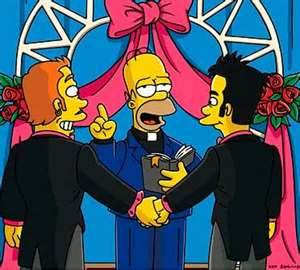
And if I am not wrong, didn't Homer become a Catholic in one of the episodes of the past?
BRIEFING PAPER ON 'SAME-SEX MARRIAGE’

01/01/2013


MY COMMENTS FIRST: Below my comments is a paper written on the topic from England and offers us some very good insights as to how to proceed in this country as Catholics who actually believe what the Church teaches about sexual morality and the divine institution of marriage all of which is based upon Scripture, Tradition and Natural Law (and all three must be held together for the full teaching).

Same sex marriage is now legal in nine states and Illinois will be next. The Supreme Court more than likely will either confirm it and thus case closed or delay it or allow it to be a state matter rather than a federal one.

My clairvoyance says that more than likely it will be the law of the land and in less years than we think. I hope I am wrong, but I don't think so.

Now, the question is, how do we uphold the sanctity of traditional marriage without becoming homophobic or trying to control people's sex lives, although civil law has tried to do that with some forms of sex in the past, namely sodomy, as well as rape and child exploitation and sex abuse. Is same sex marriage in those categories? I simply pose the question.

It seems to me if the Church's primary mission is the salvation of souls to which everything else we do is relegated, such as helping the poor, educating the young and not so young, forming community and support groups as well as the liturgical and sacramental life of the Church, should we not cooperate in Christ's light to illuminate, as a lamp on a stand, the darkness of sin and the dread of eternal punishment when the world rejects Divine Law revealed in Scripture, Tradition and Natural Law?

Let's face it, as same sex marriage becomes legal and more and more homosexuals are married to each other, we will be like the frog slowly cooked in the crock pot and before we know it, it will not in any way faze us. We will of course have family members who are homosexual getting married. Do we shun them, kick them out of the family and the Church?

How do we treat our relatives and friends who are heterosexual and live in a sexual union or are divorced and remarried outside the Church?

And what about our Catholic politicians who support same sex marriage and worse yet are pro-choice and support a women's right to kill their child prior to that child being born, children who will never go to school and will never really be missed except by the mother who later is convicted in conscious over the intrinsic evil and mortal sin she has committed with the help of the law and an abortionist and others who supported her decision to "take out" her child?

The following from England I think is a very good way to support traditional marriage from a political point of view, although it is written by Catholics who live in the United Kingdom where the same issues is being faced also.

What are the reasons for this paper?


The Government proposes legislation to allow for same-sex marriage. The Catholic Church, with many others, strongly and unequivocally opposes such plans both for religious reasons (based on Scripture and Tradition) and because they are against the natural law which applies to everyone regardless of their faith commitment. Marriage, as the lifelong union of one man and one woman ordered for the procreation and upbringing of children, is rooted in human nature itself. Put simply, no government has the authority to change that. Any attempt to do so is harmful to society and constitutes a threat to freedom of conscience and the Church’s ability to function within civil society.


Why does it matter that marriage is between a man and a woman?

Marriage is as old as humanity itself. Men and women are complementary, equal in dignity but different. The very reason for this sexual distinction is to bring new life into the world. Since the beginning of humanity, marriage has been viewed as the proper environment for this, providing children with the context of permanent, committed love in which they can best flourish. Studies consistently highlight the importance of a stable family, of a mother and a father, for the best results for raising the next generation. But marriage concerns more than parents and children. It is the basis of a stable society and of civilisation itself and, therefore, requires legal recognition and protection.


But the Prime Minister says marriage is so important that everyone who wishes should be allowed to marry. Shouldn’t we be supporting him?

The basis of the Prime Minister’s argument seems to be that, if two adults in a committed loving relationship wish to enter marriage, then they should be allowed to do so, regardless of the fact they are of the same gender. With respect, the Prime Minister is misrepresenting the nature of marriage. It is not, nor ever has been, about just any loving, committed relationship. We might have a loving committed relationship with our parents or our best friends, but marriage with them would be neither possible nor appropriate. Only the natural complementarity between a man and a woman can lead to marriage. Only this loving union, by definition, is open to bringing forth and nurturing children. Even in old age and infertility a husband and wife still preserve, like no other relationship, the elements of complementarity. That is why marriage is only possible between a man and a woman.


So isn’t the Church just discriminating against gay people?


Absolutely, not. The Church holds that every human being is created equal by God and is to be respected accordingly. The Church strongly opposes unjust discrimination against people with homosexual inclinations. In fact, the proposed legislation is not directly linked to the issue of same- sex attraction. The issue is about the meaning of marriage. Being pro-equality does not mean that everything is the same, nor that distinctions between things are unjustified. To say that everyone is equal is not the equivalent of saying they are the same. To say that a man cannot be a mother, and a woman cannot be a father is not against equality. To state this is simply to recognise an obvious fact of nature. It is in no way discriminatory. The same is true of marriage. Marriage is intrinsically linked to the procreation of children and makes no sense apart from this.


OK so same-sex marriage isn’t possible according to Christian belief, but the Prime Minster has given you assurances that you won’t have to marry same-sex couples in church if you don’t want to. Why can’t you accept they can marry elsewhere?

This is not merely a matter of religious belief and practice. It regards the future of society as a whole. It is called a matter of natural law which is something common to all regardless of personal religious belief. Tampering with such a fundamental natural institution as marriage is fraught with danger. Society ceases to flourish when it fails to cherish the family and the authentic understanding of marriage which makes the family possible. The experience of other countries where same-sex marriage has been introduced clearly indicates that the proposed change is only the beginning of a process of social engineering with tragic consequences. In Canada, since same-sex marriage was legalised, the courts have ruled that a child can legally have three parents. In the Netherlands also three-way relationships are now given a measure of legal recognition. Do we really want the UK to go down this route with all the consequent harm to children? Furthermore, with good cause, we have no confidence in the assurances offered by the Prime Minister. We recall how Catholic adoption agencies were closed because they refused to participate in a state permission for same-sex couples adopting children. If exclusion of same-sex couples from marriage is defined by equality law as discriminatory, toleration of such exclusion will not last long. Any attempted safeguard would be vulnerable to a future government, to a British court giving precedence to equality considerations and to the European Court of Human Rights.


Isn’t this a matter primarily for priests and other professionals in the Church?


Sadly, not. There is a real possibility that the Catholic Church will not be allowed for much longer to perform state recognised marriage registration in church because of its opposition to same-sex marriage. But leading human rights lawyer Aidan O’Neill QC has given his legal opinion that NHS Chaplains, teachers and foster parents could all be vulnerable. The rights of parents over their children’s education is also at threat. Mr O’Neill’s legal opinion is that any school, including a faith school, could legally dismiss a teacher for refusing to use educational material promoting same-sex marriage. Catholics must be aware of this threat to schools and teachers, and resist it with every means at their disposal. Similarly, if an institution is deemed discriminatory, can its charitable status be maintained? Legal cases would inevitably follow the passing of such legislation as in Canada.


So what are you encouraging us to do?

The Confraternity of Catholic Clergy is united in defending marriage and joins wholeheartedly the campaign of the Catholic Archbishops. We urge everyone who cares about upholding the meaning of marriage in civil law to make their views known to their MPs clearly, calmly and forcefully, and without impugning the motives of others. We urge all parties to ensure their Members have a free vote. It is not too late to stop this Bill. The Church calls on every Catholic, in conscience, to a clear and emphatic opposition to such proposals, and a refusal of any formal co-operation should such laws be passed. All this must be conducted in a spirit of charity. The Church defends the absolute dignity of every human being in the same way that she defends marriage and the family, that is, in proclaiming the truth with love. In this Christmas season, under the patronage of the Holy Family, let us all pray and work to ensure that the centrality of marriage and freedom of conscience which we have so long enjoyed continue to be defended by the laws of our country.


1st January 2013

Solemnity of Mary, Mother of God

Tuesday, January 1, 2013

MORE LITURGICAL MUSINGS AND HAPPY NEW YEAR IN OUR LORD, 2013 AND A BIT OF A GOOD RIDDANCE TO 2012!

Yes, Virginia, this is the Ordinary Form of the Mass, completely in the vernacular which is the manner in which St. Joseph Church in Macon celebrates its Ordinary Form 12:10 PM Mass each Sunday, what we call "the new normal." The photo below was last Sunday's 12:10 PM Mass for the Feast of the Most Holy Family of Jesus, Mary and Joseph:
Now I realize there are some out there that think we should get rid of the free-standing altar, which I love very much, BTW, which of course I have to vociferously disagree. The old high altar is unseen in the side transepts of the church, the new altar is seen by all, even by those on the front pews in front of the side altars.

Rather, the sophisticated eye should see the free standing altar and the old altar as one unit and the old altar now becoming the reredos to the new altar. So it is quite appropriate to treat the old altar as a complete reredos for candles, decorations, flowers and the like. This photo by Dr. Buck Melton may become next year's Christmas card sent to all parishioners by yours truly.

Now for some musing on 2012, Annus horribilis but not completely.

It started with a very nice vacation to California in January and went down hill after that. The most horrible aspect being the death of my mother on September 18th one month shy of her 93 birthday. When you have a family member living that long, you start to think they'll be with you forever. I am grateful to God though that my mom was able to live in her little townhouse all the way up to September 1st and on her own. I am very grateful to my sister who took special care of her and made sure all was okay everyday and I am grateful I could come home each Sunday night and leave early each Tuesday to return to Macon. I was able to spend quality vacation time in Augusta with her, two weeks worth, in July. That was and is a blessing to me and she was doing quite well at that time.

There is a relief though, although the relief brings a bit of guilt. You begin to wonder how it will all end and anxiety builds about that. Would it be a fall that breaks her neck, her hip or her head? Will it be long, drawn out and painful? My mom died of congestive heart failure in bed and I think unaware of what was happening and it was relatively quick. And in her three weeks in the hospital and rehab I thought she would recover and get back home.

There were many very lucid times and she fought with determination, forcing the nurse at rehab to get her out of bed so she could walk to the toilet and fighting with her until it happened, and that was the last time she would get up for less than 48 hours later she was gone--that's my Italian mom! Her last words to me were "take care of my cat." I took that to mean in the sense that Vito Corleone in The Godfather would have meant it. And her cat and my mom were buried together, the first Catholic Requiem that I know of that I've had with such an arrangement! My mom was worried about her 16 year old monster cat that bit her constantly and brought her to the emergency room more than once and one time requiring surgery on her hand because of an infection where the doctors told us that if the infection was in the bone, she might lose her hand. But she loved that mad cat!

I would tell her when she worried about what would happen to that cat when she passed that the cat would go with her. She said, that's a good idea!

In August, another Italian in my life, Cheti Warner, died much too soon. She had been my parishioner in Augusta, our hospitality person, cooking marvelous meals for the rectory's special events and all of our major receptions, some full meals for hundreds of people.

She cut my hair for the past 20 years too and revived an Italian custom my non-Italian father had forbidden in our American home, La Befana who is a good witch who fills the stockings of good children with candy, toys, nuts, fruits and the like on Epiphany. Bad children would get a lump of coal. I always got the goodies! This will be my first Epiphany in about 15 years without La Befana!

Sometimes friendships too come to an end and like a death can be unexpected, sad and out of the blue.

But 2012 was a special year of grace too and what a gift the Catholic Mass is and our Catholic faith which includes hope and love.

The liturgical highlights are all the special Masses we've had here, Shubert's OF and EF Mass for St. Joseph and Annunciation; the Clergy Conference with our bishop where our choir sang a splendid Solemn Sung Evening Prayer the night before our Solemn Mass for Christ the High Priest with our bishop and all his priests. While we videoed the Mass, I failed to have the Solemn Sung Vespers videoed which was a grand mistake, although our choir sang Solemn Sung Vespers for our Bishop's ordination, the night before at our Cathedral which was videoed. I would say this clergy conference was a highlight for me for the year.

Of course we had our annual Faure's Requiem as an EF Mass for All Souls, truly splendid and uplifting. We celebrated the Nativity of Saint John the Baptist as a hybrid of Latin and English in the Ordinary Form Mass at our regularly scheduled 12:10 PM Mass and with the Liturgy of the Eucharist ad orientem and as a precursor to this Mass being celebrated ad orientem each Sunday which began in October and is pictured above.

Finally as I look forward to 2013, one of the highlights of this New Year in our Lord will be my sabbatical which will be from September through November and at the North American College in Roma, Italia. This will include a tour of the Holy Land in late October. It will be a full regimen of theology and Church history, Bible history classes. I'm very excited and can't wait to spend this amount of time in my country of birth and to improve my Italian. I hope to get it from a 5 year old level to at least a 10 year old's! As well, since my mother was an Italian citizen at the time of my birth in Napoli, Italia in 1953 I hope to seek "dual citizenship" by seeking citizenship in Italy while I am there. I actually have an Italian birth certificate, although technically I became an American citizen at the time of my birth because my army father was an American citizen, but naturalized too. I actually have naturalization papers also that were given to me when I was six years old, with a picture of me when I was six to prove that I am American. But I've always felt Italian for some odd reason.

A blessed 2013 to all of you in this Holy Year of Faith!