Translate

Tuesday, October 11, 2022

60 YEARS AGO TODAY, OCTOBER 10, 1962, THE SECOND VATICAN COUNCIL BEGAN….

 The Vatican Mass today:

60th ANNIVERSARY OF THE BEGINNING OF THE SECOND VATICAN ECUMENICAL COUNCIL

HOLY MASS

HOMILY OF HIS HOLINESS POPE FRANCIS

Saint Peter’s Basilica
Tuesday, 11 October 2022
Memorial of Saint John XXIII, Pope

[Multimedia]


“Do you love me?” These are the first words that Jesus speaks to Peter in the Gospel that we have just heard (Jn 21:15). His final words are: “Feed my sheep” (v. 17). On the anniversary of the opening of the Second Vatican Council, we can sense that those same words of the Lord are also addressed to us, to us as Church: Do you love me? Feed my sheep.

First: Do you love me? It is a question, for Jesus’ style is not so much to offer answers as to ask questions, questions that challenge our lives. The Lord, who “from the fullness of his love, addresses men and women as his friends and lives among them” (Dei Verbum, 2), continues to ask the Church, his Bride: “Do you love me?” The Second Vatican Council was one great response to this question. To rekindle her love for the Lord, the Church, for the first time in her history, devoted a Council to examining herself and reflecting on her nature and mission. She saw herself once more as a mystery of grace generated by love; she saw herself anew as the People of God, the Body of Christ, the living temple of the Holy Spirit!

This is the first way to look at the Church: from above. Indeed, the Church needs first to be viewed from on high, with God’s eyes, eyes full of love. Let us ask ourselves if we, in the Church, start with God and his loving gaze upon us. We are always tempted to start from ourselves rather than from God, to put our own agendas before the Gospel, to let ourselves be caught up in the winds of worldliness in order to chase after the fashions of the moment or to turn our back on the time that Providence has granted us, in order to retrace our steps. Yet let us be careful: both the “progressivism” that lines up behind the world and the “traditionalism” – or “looking backwards” – that longs for a bygone world are not evidence of love, but of infidelity. They are forms of a Pelagian selfishness that puts our own tastes and plans above the love that pleases God, the simple, humble and faithful love that Jesus asked of Peter.

Do you love me? Let us rediscover the Council in order to restore primacy to God, to what is essential: to a Church madly in love with its Lord and with all the men and women whom he loves; to a Church that is rich in Jesus and poor in assets; to a Church that is free and freeing. This was the path that the Council pointed out to the Church. It led her to return, like Peter in the Gospel, to Galilee, to the sources of her first love; to rediscover God’s holiness in her own poverty (cf. Lumen Gentium, 8c; chapter 5. Each one of us also has his or her own Galilee, the Galilee of our first love, and certainly today we are all called to return to our own Galilee in order to hear the voice of the Lord: “Follow me”. And there, to find once more in the gaze of the crucified and risen Lord a joy that had faded; to focus upon Jesus. To rediscover our joy, for a Church that has lost its joy has lost its love. Towards the end of his life, Pope John wrote: “This life of mine, now nearing its sunset, could find no better end than in the concentration of all my thoughts in Jesus, the Son of Mary… a great and constant friendship with Jesus, contemplated as a Child and upon the Cross, and adored in the Blessed Sacrament” (Journal of a Soul). This is our view from on high; this is our ever-living source: Jesus, the Galilee of love, Jesus who calls us, Jesus who asks us: “Do you love me?”.

Brothers and sisters, let us return to the Council’s pure sources of love. Let us rediscover the Council’s passion and renew our own passion for the Council! Immersed in the mystery of the Church, Mother and Bride, let us also say, with Saint John XXIII: Gaudet Mater Ecclesia! (Address at the Opening of the Council, 11 October 1962). May the Church be overcome with joy. If she should fail to rejoice, she would deny her very self, for she would forget the love that begot her. Yet how many of us are unable to live the faith with joy, without grumbling and criticizing? A Church in love with Jesus has no time for quarrels, gossip and disputes. May God free us from being critical and intolerant, harsh and angry! This is not a matter of style but of love. For those who love, as the Apostle Paul teaches, do everything without murmuring (cf. Phil 2:14). Lord, teach us your own lofty gaze; teach us to look at the Church as you see her. And when we are critical and disgruntled, let us remember that to be Church means to bear witness to the beauty of your love, to live our lives as a response to your question: Do you love me? And not to act as if we were at a funeral wake.

Do you love me? Feed my sheep. With that second verb, feed, Jesus expresses the kind of love that he desires from Peter. So let us now reflect on Peter. He was a fisherman whom Jesus made a fisher of men (cf. Lk 5:10). Jesus assigns him a new role, that of a shepherd, something entirely new to him. This was in fact a turning point in Peter’s life, for while fishermen are concerned with hauling a catch to themselves, shepherds are concerned with others, with feeding others. Shepherds live with their flocks; they feed the sheep and come to love them. A shepherd is not “above” the nets – like a fisherman – but “in the midst of” his sheep. A shepherd stands in front of the people to mark the way, in the midst of the people as one of them, and behind the people in order to be close to the stragglers. A shepherd is not above, like a fisherman, but in the midst.

This is the second way of looking at the Church that we learn from the Council: looking around. In other words, being in the world with others without ever feeling superior to others, being servants of that higher realm which is the Kingdom of God (cf. Lumen Gentium, 5); bringing the good news of the Gospel into people’s lives and languages (cf. Sacrosanctum Concilium, 36), sharing their joys and hopes (cf. Gaudium et Spes, 1). Being in the midst of the people, not above the people, which is the bad sin of clericalism that kills the sheep rather than guiding them or helping them grow. How timely the Council remains! It helps us reject the temptation to enclose ourselves within the confines of our own comforts and convictions. The Council helps us imitate God’s approach, which the prophet Ezekiel has described to us today: “Seek the lost sheep and lead back to the fold the stray, bind up the injured and strengthen the weak” (cf. Ezek 34:16).

Feed: the Church did not hold the Council in order to admire herself, but to give herself to others. Indeed, our holy and hierarchical Mother, springing from the heart of the Trinity, exists for the sake of love. She is a priestly people (cf. Lumen Gentium, 10ff.), meant not to stand out in the eyes of the world, but to serve the world. Let us not forget that the People of God is born “extrovert” and renews its youth by self-giving, for it is a sacrament of love, “a sign and instrument of communion with God and of the unity of the entire human race” (Lumen Gentium, 1). Brothers and sisters, let us return to the Council, which rediscovered the living river of Tradition without remaining mired in traditions. The Council rediscovered the source of love, not to remain on mountain heights, but to cascade downwards as a channel of mercy for all.  Let us return to the Council and move beyond ourselves, resisting the temptation to self-absorption, which is a way of being worldly. Once more, the Lord tells his Church: feed! And as she feeds, she leaves behind nostalgia for the past, regret at the passing of former influence, and attachment to power. For you, the holy People of God, are a pastoral people. You are not here to shepherd yourselves, or to be on the climb, but to shepherd others – all others – with love. And if it is fitting to show a particular concern, it should be for those whom God loves most: the poor and the outcast (cf. Lumen Gentium, 8; Gaudium et Spes, 1). The Church is meant to be, as Pope John put it, “the Church of all, and particularly the Church of the poor” (Radio Message to the faithful worldwide a month prior to the Second Vatican Ecumenical Council, 11 September 1962).

Do you love me? The Lord then says: “Feed my sheep”. He does not mean just some of the sheep, but all of them, for he loves them all, affectionately referring to them as “mine”. The Good Shepherd looks out and wants his flock to be united, under the guidance of the Pastors he has given them. He wants us – and this is the third way of looking at the Church – to see the whole, all of us together. The Council reminds us that the Church is a communion in the image of the Trinity (cf. Lumen Gentium, 4.13). The devil, on the other hand, wants to sow the darnel of division. Let us not give in to his enticements or to the temptation of polarization. How often, in the wake of the Council, did Christians prefer to choose sides in the Church, not realizing that they were breaking their Mother’s heart! How many times did they prefer to cheer on their own party rather than being servants of all? To be progressive or conservative rather than being brothers and sisters? To be on the “right” or “left”, rather than with Jesus? To present themselves as “guardians of the truth” or “pioneers of innovation” rather than seeing themselves as humble and grateful children of Holy Mother Church. All of us are children of God, all brothers and sisters in the Church, all of us making up the Church, all of us. That is how the Lord wants us to be. We are his sheep, his flock, and we can only be so together and as one. Let us overcome all polarization and preserve our communion. May all of us increasingly “be one”, as Jesus prayed before sacrificing his life for us (cf. Jn17:21). And may Mary, Mother of the Church, help us in this. May the yearning for unity grow within us, the desire to commit ourselves to full communion among all those who believe in Christ. Let us leave aside the “isms”, for God’s people do not like polarization. The people of God is the holy faithful people of God: this is the Church. It is good that today, as during the Council, representatives of other Christian communities are present with us. Thank you! Thank you for being here, thank you for your presence!

We thank you, Lord, for the gift of the Council. You who love us, free us from the presumption of self-sufficiency and from the spirit of worldly criticism. Prevent us from excluding ourselves from unity. You who lovingly feed us, lead us forth from the shadows of self-absorption. You who desire that we be a united flock, save us from the forms of polarization and the “isms” that are the devil’s handiwork. And we, your Church, with Peter and like Peter, now say to you: “Lord, you know everything; you know that we love you” (cf. Jn 21:17).


GREATER AND LESSER MORTAL SINS OF POLITICIANS AND POLITICAL IDEOLOGIES…


Hershel Walker is being accused by pro-abortion politicians (even the murder of the child in the birth canal after a 9 month gestation) of lying about helping his girlfriend get an abortion. 

To these pro-abortion, pro-genocide, pro-murder of children politicians, that Hershel Walker may have actually provided money for an abortion of a child of his, isn’t the immoral act. No, to them, this is great. 

What they decry in the most self-righteous way is that he says he is pro-life and that he is lying about not having assisted his girlfriend into having an abortion.

There you have it. For those advocating the murder of children, murder of children isn’t the problem, lying about being pro-life and lying about not paying for an abortion should disqualify him from being Georgia’s next senator.

I don’t know if Hershel Walker is lying or not, if he is pro-life or not. God knows. But in the hierarchy of morality and sin, I would think that assisting in killing a child is the graver evil rather than lying. 

In other words, I would say that murderous ideologies and those who promote them in all truth, are the ones who should not be in political office. 

Sunday, October 9, 2022

WHST DOES THIS SILLINESS SAY ABOUT THE STSTE OF ART AND LITURGY TODAY?


 Press the title below for Facebook Video. UGH!

POP UP JESUS!

ANECDOTAL EVIDENCE, TRUE OR FALSE?


My Richmond Hill parish from which I retired June 30th, is an ordinary form parish with an extremely young demographic and many of the young married couples are having more than two children, sometimes up to six or more!

That demographic was angry about the shut-down of parishes and were the first to return to in-person Masses. 

St. Gregory the Great in Bluffton is a large parish with a majority of retirees given the fact that Bluffton is a retirement Mecca. There are young people there too, but the majority are 60+++++. 

Last night I was visiting friends from Augusta. They seem to think that older Catholics are the ones returning to Mass after the pandemic but not so much the younger ones. 

We know that younger Catholics are leaving the Church in significant numbers, some to other denominations, especially the non-denomination sects, but maybe a majority to nothing, called “nones”. 

As we see from the shallow comments from the synodal walking together, that people want pablum rather than meat when it come to Church. They want a civic organization that enables them to meet people and feel community like the Rotary Clubs do.

Young people are turned off by sexual morality and clarity of genders and what Scripture says about the two genders, that God created them in His image, male and female He created them. 

Gender lies at the root of Catholicism and her sacramental system, male, female, mother, father, sister, brother, wife and husband and the fecundity  necessary for both new bodies and souls, male and female. 

The sacramental priesthood is based upon Christ as High Priest (not priestess) as the Bridegroom of the Church described as the Bride of Christ. Souls are classified as feminine for both men and women and thus the Church as “souls” is feminine, open to being impregnated with God’s sanctifying and actual graces. 

So, is it true that more elderly Catholics have returned to Mass and mostly younger ones have yet to return and may not return? 

I ask; you answer.

Saturday, October 8, 2022

THE CURRENT IDEOLOGY OF WALKING TOGETHER AND MOVING FORWARD CAN ONLY TAKE PLACE BY GOING BACKWARDS TO THE TIME PRIOR TO JOHN PAUL II AND BENEDICT XVI (AND ALSO JOSEPH RATZINGER) ERASING THEM AND THEN WALKING TOGETHER FORWARD AS IF THE TIME BETWEEN 1978 AND 2013 NEVER EXISTED…

 I continue to believe that the wild card in our times, the truly revolutionary force, the God of surprises is that Pope Emeritus XVI is still living to see first hand how his papacy and that of Pope St. John Paul II are being erased in order to move forward again from 1978. It’s almost like a good movie, “Back to the Future” but in this case we go back to 1978, murder Joseph Ratzinger and John Paul II and erase the ensuing years and return in 2013 as though only one year had passed. 

Pope Emeritus Benedict XVI can stop it all and bring sanctity back to the Church. That is what I call the “wild card.” This will cause an actual schism in the Church. But is that any worse than the apostasy at hand which Cardinal Mueller so eloquently describes as well as Cardinal Koch?

The synod on synod listening sessions have become a joke to support a pre-conceived conclusion, not a new Church, not a different Church, but a Church in apostasy. It can happen, but a remnant of the true Church will remain even if any reigning pope is in apostasy as the gates of hell will not prevail against the true Church. That gives me hope

Here is a long article/commentary. This guy has to be my age, because he describes what I experienced first hand in the late 1970’s seminary I attended in Baltimore. Press his title for the full commentary. I post two sound bytes below the title and I agree with both of the paragraphs I post:

Orwellian Synodality 

CRISIS IN THE CHURCH


There was a strange and ironic ecclesiolatry going on as well since all of the emphasis was upon the Church as the generator of truth, and in this case, new truths, and not on the Church as the preserver of truths that had been gifted to her by God in Revelation. 

Pope Francis says many wonderful things but his actions indicate a desire to tack the barque of Peter with the cultural winds instead of against them.  And the few bishops that are resistant tend to be easily dismissible traditionalist blunt instruments like Bishop Strickland and Athanasius Schneider whose answer to the crisis seems to be little more than a call to return to the very Tridentine form of the Church that got us into this mess in the first place.  As I have said before, lace surplices under fiddleback chasubles can mask just as much lunacy as denim Disney vestments over your Nehru jacket.  My point here is that the dynamic within the episcopacy we see today is the same dynamic we saw all those decades ago and we can therefore say that we cannot look to the episcopacy for much help in the current crisis any more than we did then.  It is “woke” episcopal insanity to the Left of me and tinfoil hat wingnuts to the Right of me.  And so by all means, let’s have a synod with these folks leading the way.

Friday, October 7, 2022

THE PILLAR HAS AN INTERESTING TAKE ON CARDINAL GRECH WHO, THE PILLAR HAS HEARD, THINKS HE CAN BE THE NEXT POPE IN ORDER TO CONFIRM THE RADICAL NEO-GNOSTIC SYNODAL WAY TO APOSTASY, READ THEIR COMMENTARY:


FROM THE PILLAR: Super Mario?

Cardinal Mario Grech is a fascinating character who is now, in the words of one curial official I spoke with this week, “in the middle of everything.”

The secretary general of the permanent secretariat of the Synod of Bishops isn’t technically part of the Roman curia at all — the synod is something formally apart from the Vatican, and isn’t even listed in the curia constitution.

But, thanks to the global synod on synodality, Grech is now at the heart of the biggest conversation in the global Church. And, as I explained in an analysis yesterday, Grech is much more than just a coordinator or administrator of a process. He has become the leading champion of the concept of a “synodal Church.”

It’s a controversial concept. The cardinal insisted this week that the synodal process is the “mature fruit” of Vatican Council II, of which he also set himself out as the authentic interpreter: “A correct reception of the Council’s ecclesiology,” Grech said, is “to open up scenarios that not even the Council had imagined.”

Given the current stand-offs between the Vatican and the bishops of Germany and Belgium on issues like church blessings for same-sex unions, intercommunion with Protestants, and the ordination of women, the unimaginable is becoming an ever more central part of preparations for next year’s final synodal session, and it will be Grech, more than any other person, who can shape the final text sent to the pope when it concludes.

All this has meant that Grech is increasingly seen, including by himself I’ve been told more than once, as the natural heir to Pope Francis in the event of a conclave.

As one friend in Rome put it to me, the cardinal is being positioned so that “voting for Grech will be like voting for the synod itself.”

There’s no doubt Grech is becoming ever-more obviously papabile, and he has come to outshine the other names often mentioned as potential Francis II’s, like Cardinal Matteo Zuppi, president of the Italian bishops’ conference.

But his viability may hinge on his ability to bring the synod in to land. Bishops in places like Germany and Belgium appear set on taking the Church in a radical new direction, and they have been accused of using the synod’s somewhat anemic participation rates of around 1% as some kind of new doctrinal revelation.

If Grech can bring them back into line with the Vatican and the rest of the Church through the synod’s final text, he could stand himself up as the architect of a grand compromise. But if the whole idea of a “synodal Church” becomes synonymous with permanent crisis, it might be Grech who gets the blame.

You can read my whole analysis here.

WE NEED MORE CARDINALS LIKE KOCH, KASPER, SARAH AND MUELLER TO CALL OUT THE IMPOVERISHMENT OF THE CATHOLIC DEPOSIT OF FAITH COMING FROM THE VATICAN AND INFLUENCED BY THE GERMANS…

 Good for Cardinal Mueller and other cardinals, progressive and otherwise, for naming the apostasy into which the SYNODAL way is spiraling:

Wednesday, October 5, 2022

O MY, WHAT IS THAT HERESY WHERE A PERSON OF GROUP OF PEOPLE THINK THAT IT ALL HINGES ON THEM AND WHAT THEY DO WHICH BRINGS ABOUT CHANGE AND VIGOR?

 People in the Church, both clergy and laity, have lamented the lack of intelligent academic thought in the Church since 2013. 

This video, just one more of many cliches bantered about concerning the Church, since about 2013, is simply embarrassing. I don’t find it inspiring whatsoever and I wonder who does, except those who are into esoteric nothingness. 

In a previous parish, I had a parishioner, who would have been a borderline street person, if not for family members who house him, who thought he was an intellectual. It took me a while to figure out he was a borderline personality. But he could talk up a storm, sound interesting and academic but in the end, I realized he had said nothing, but said it brilliantly. 

I would not even call this nothing video on the synod, put on the Vatican New website, brilliant sounding. It is shallow and empty and filled with cliches.  If they think this will keep the Church young, then they are delusional borderline personalities!

Please offer a legitimate critique of this Vatican video, without being ugly, critique its theology and intellectual integrity:

Tuesday, October 4, 2022

WOW! READ THIS PILLAR COMMENTARY WITH LINKS TO ARTICLES ON THE GERMAN SYNODAL WAY’S THEOLOGY WHICH IS OF THE NAZI-ERA CHRISTIAN SECT

 The ‘Hitler card?’Vatican cardinal and German bishop are clashing after ‘Nazi’ remark; schism making bishop is going to complain to Pope Francis that Cardinal Koch told the truth about the German schismatic synodal way…ouch!


CARDINAL KOCH HAD TO CANCEL A PLANNED PASTORAL VISIT TO GERMANY THIS WEEKEND AFTER RECEIVING THREATS FROM NAZI-ERA TYPE CHRISTIANS WHO ARE UPSET THAT HE SPOKE THE TRUTH ABOUT THEM!!!

FROM THE PILLAR:

The president of the German bishops’ conference has spilled a lot of ink in the past few days, calling repeatedly for an apology, after the Swiss Cardinal Kurt Koch compared theological currents in the German synodal way to the theology of a Nazi-era Christian sect.

What Koch actually said - and how Bishop Georg Bätzing took the remarks - have been widely misreported in the press — especially after Bätzing said that without an apology, he’d file a complaint with the pope. 

So on Friday, we put together an explainer on what Cardinal Koch actually said, why Bätzing’s demanding an apology — and why Koch says he’s sticking to his words.

You can read that here.

And you can expect that this situation isn’t going to die down quietly - in fact, as the German bishops prepare to begin their ad limina visit to the Vatican, Cardinal Koch canceled a planned pastoral visit to Germany this weekend — after reportedly receiving threats related to his remarks.

That’s right, the cardinal didn’t go to Germany after “threats of violence against the Schönblick conference center,” where he was scheduled to speak.

If you read The Pillar, you know already that Germany has become ground zero for a lot of controversy in the Church right now — and this situation will likely heighten the growing tensions between the German bishops and some of Europe’s most senior Churchmen. 

Here’s what’s happened.

THERE IS NO SUCH THING AS A RETIRED PRIEST

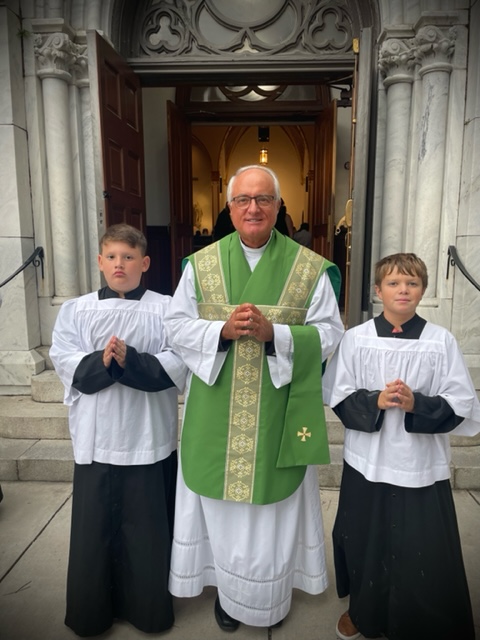
 On Sunday, I had the 9 AM Modern Roman Mass at St.Gregory the Great parish in Bluffton, SC. It is the largest parish in the Diocese of Charleston, where I live and work, but I am a priest of the Diocese of Savannah, where I do not live but I do work.

St. Gregory’s demographic is mainly an older one due to the nature of Bluffton, SC as a humongous retirement community. There are no crying babies at the packed Masses I have celebrated there.

Then at 1 PM, I celebrated the Traditional Latin Mass at Sacred Heart Church in downtown Savannah.

It is a young demographic with crying babies galore, who choose to do so at my brilliant homilies, which would be meaningful to these babies if they would only stop crying, and at the consecrations. 

Here are some photos of the TLM for the 17th Sunday after Pentecost, not in any particular order:


Monday, October 3, 2022

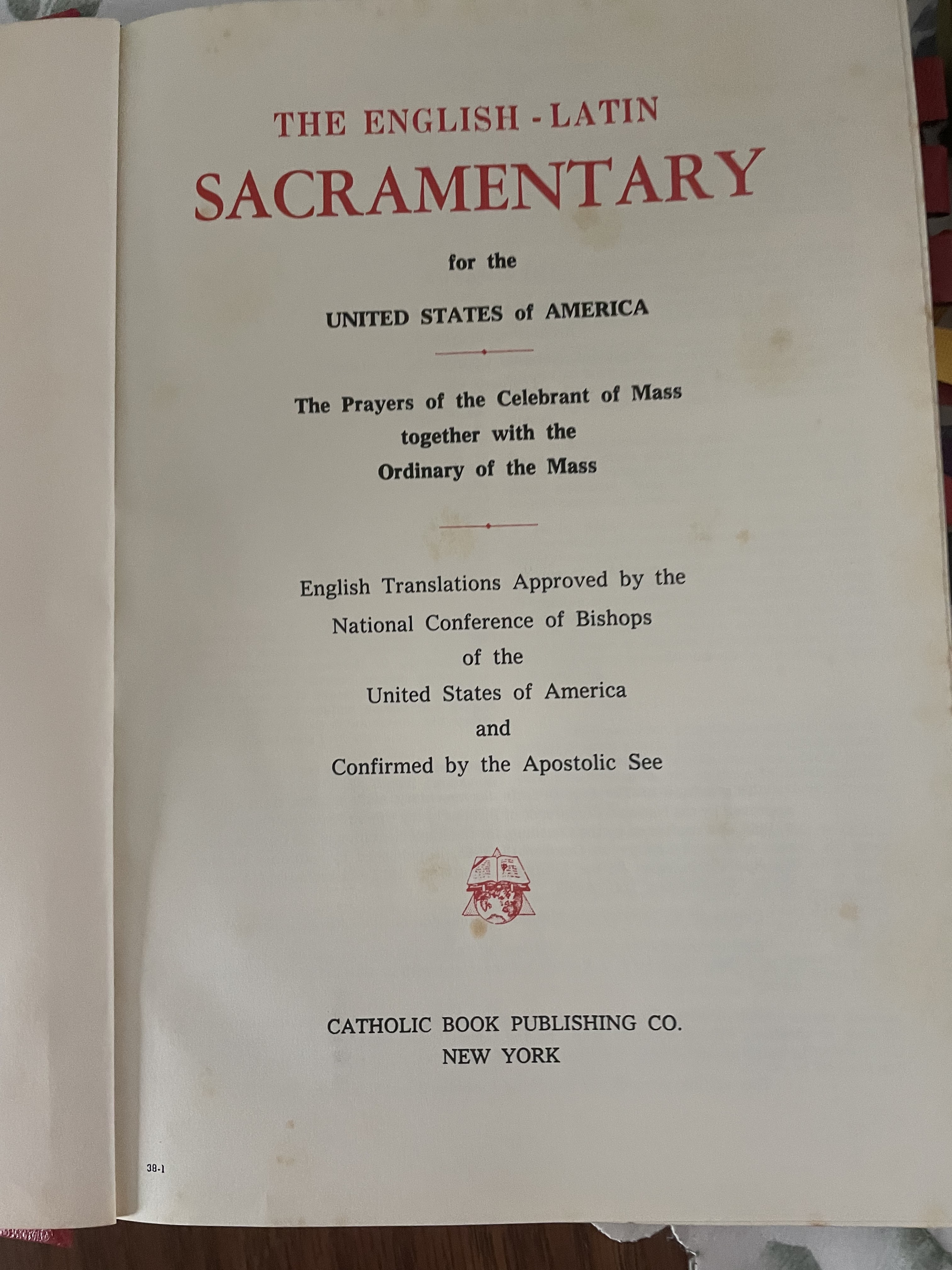
THE POST VATICAN II ROMAN MISSAL OF 1966: IF ONLY, IF ONLY, IF ONLY, THIS ORDER OF THE MASS HAD BEEN MAINTAINED; WHAT A BETTER AND MORE IN CONTINUITY WITH WHAT THE 1962 ROMAN MISSAL WE WOULD HAVE TODAY AND PERHAPS NOT AS MANY LITURGICAL WARS EITHER ; SOMETIMES WHEN YOU TAKE THE WRONG FORK IN THE ROAD, YOU HAVE TO BACKUP AND GO BACK TO THE FORK AND GO FORWARD ON THE RIGHT FORK!

Please note that this post took a great deal of time for me to take pictures of the Missals I used, to edit those pictures and then input them into my blog and in order to have them in order, I had to input them individually, which took a lot of my precious retirement time to do! And then I added commentary in between the photos, so please read those as you read what the 1966 Missal had!

These are photos from the official 1966 Roman Missal, basically the 1962 Roman Missal, but with a more literal interpretation of Sacrosanctum Concilium meaning a more conservative reform of the 1962 Roman Missal: conservative interpretation of “noble simplicity”; “maintaining Latin and Gregorian Chant but some English, but Roman Canon in Latin, with very conservative revision of rubrics. This Missal is a post-Vatican II Missal and should have remained the Order of Mass even if the Lectionary we currently have was applied to it. But the original Lectionary, at least for Sundays and particular daily feasts could have been maintained as year A with a new B, C, and D.


This is quite important! Please note toward the bottom of this page which says this Roman Missal approved by the American bishops and approved by the Vatican’s Consilium (who was charged with revising the Missal) according to Sacrosanctum Concilium, “for the implementation of Vatican II’s “Constitution on the Sacred Liturgy”! We all thought at the time, this was what Vatican II requested and in fact it was approved explicitly saying that!!!!:

The Maryknoll pew or laity missal used the official translation of the 1965 Roman Missal and provided all that the laity needed for full, conscious, active and actual participation. In this case it is for the 17th Sunday after Pentecost. Please note the propers, even for the offertory, as well as the Liturgy of the Word:
The PATFOTA was simplified, omitting Psalm 42 and the Gloria Patri. In other words, the Requiem PATFOTA became the only version, Requiem or not:


Please note how the English translation of 1966 is closer to the revised English translation we now use:

Please note the fuller prayer (as in the 1962 Missal) prior to the Gospel:

The Offertory was left untouched. The current Missal’s Offertory is a mere shadow of this:


And with your spirit! In a short three years, we went from all Latin, to this translation of English, which was rather good, to the horrible, truncated English translation which last over 30 years! Please note too, that the Sanctus is almost identical with our new and glorious English translation:

The Roman Canon was required to be prayed in Latin. The rubrics for it had a minor, very minor revision. This is from the Maryknoll hand missal:


Please note that the words of consecration are left unchanged. The 1970 Latin Roman Missal, changed the formula for the actual consecrations of both the bread and wine:


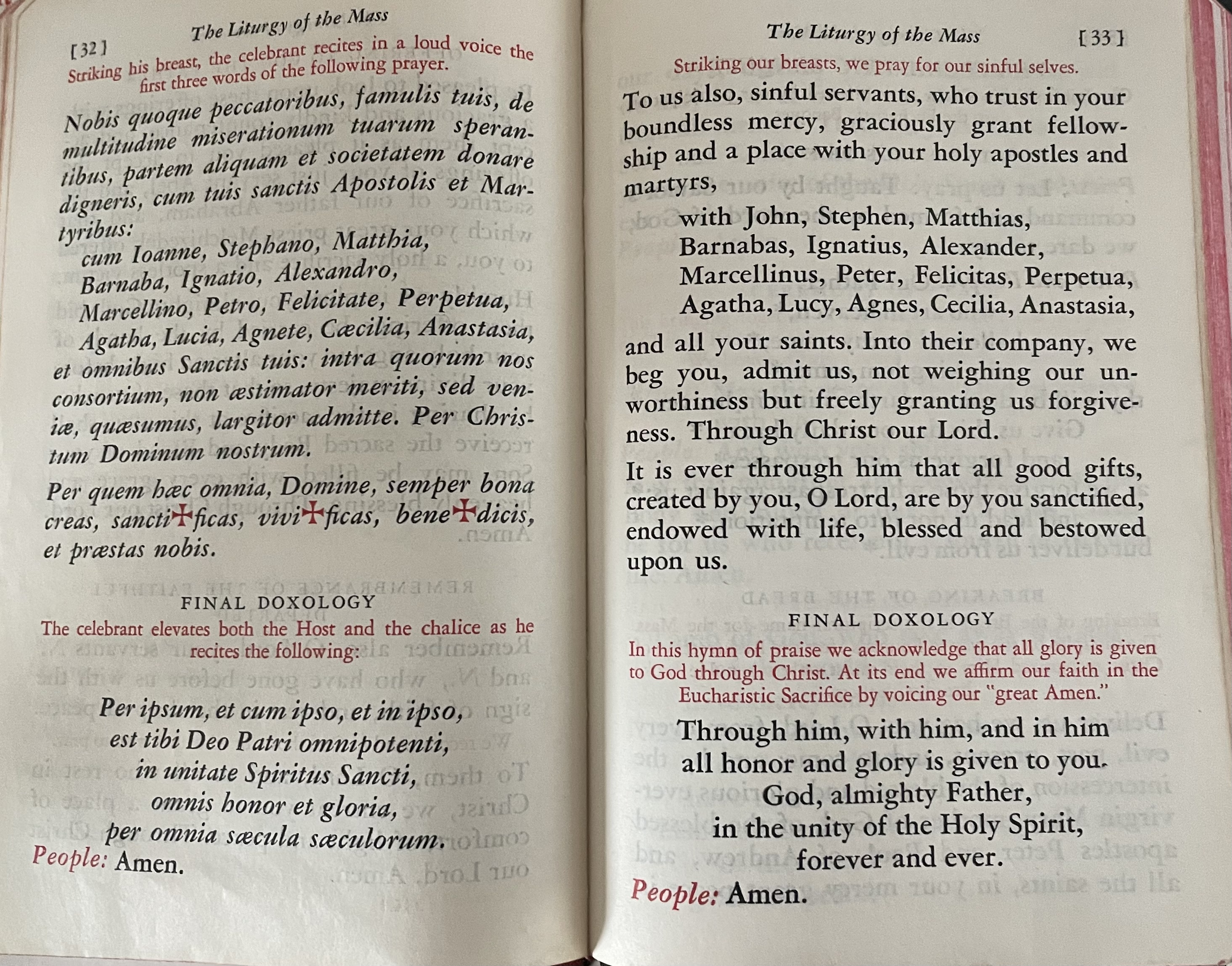
The Per Ipsum did have a minor rubrical change, which is what we have today in the modern Missal:

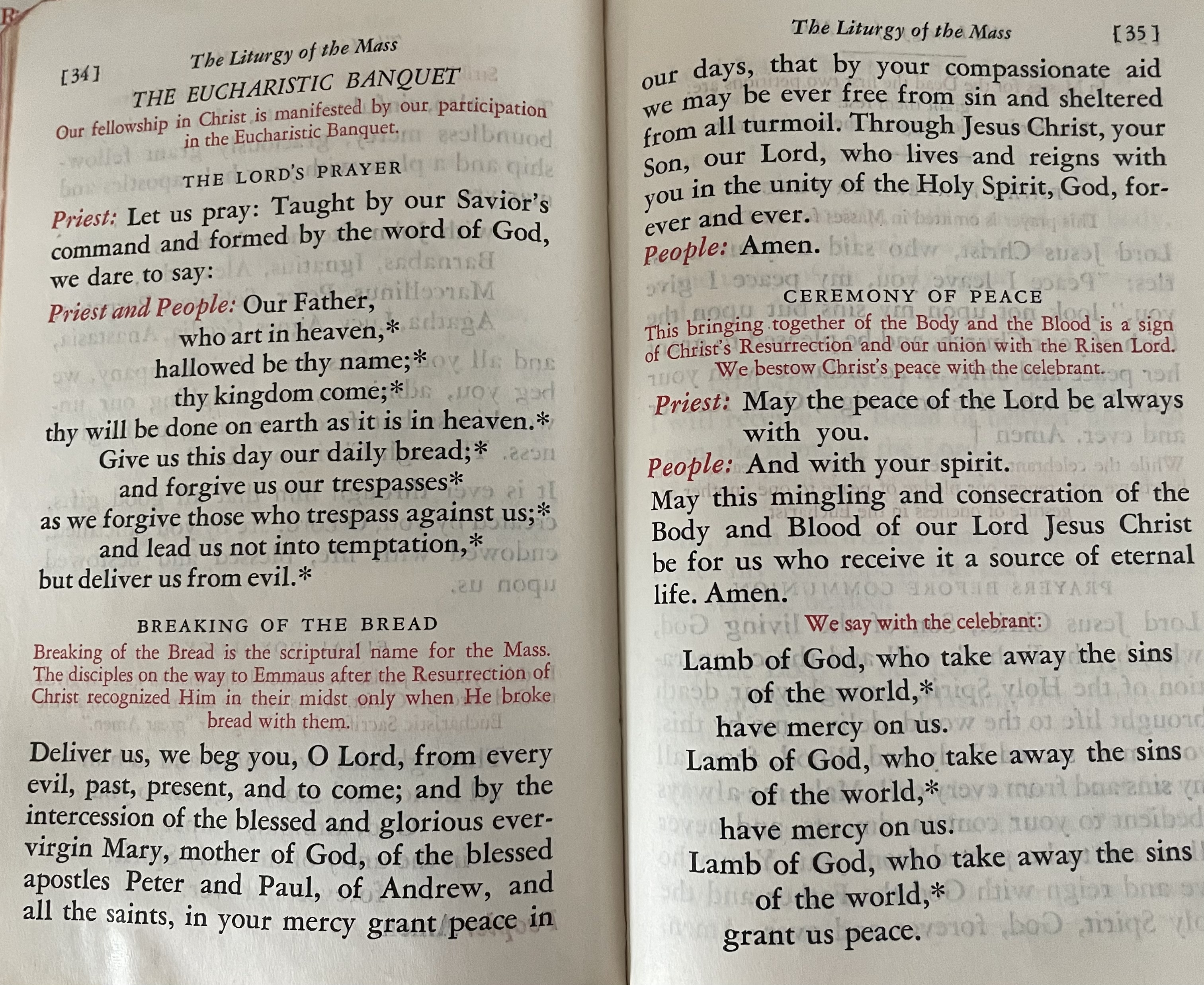
I like the usage of “Eucharistic Banquet” instead of “Rite of Holy Communion”. But no matter the name, it is the same as in the 1962 Roman Missal. Please note the fuller “embolism” after the Pater Noster which includes the intercessions of Mary and some of the saints (the Ordinariate’s Missal maintains this today!):

The 1966 Missal maintained the separate sacerdotal Holy Communion with the thrice said “Lord, I am not worth…” It also maintains the prayer prior to consuming the Precious Blood, completely expunged in the modern Missal! Please note too, the prayer “I will receive the Bread of heaven…” prior to the “Lord I am not worthy…” now omitted in the Modern Roman Missal:

Please note that the Rite of Holy Communion for the laity is included in this 1966 Roman Missal. This is new and never was in any preceding Roman Missal! This was a wonderful addition. What we do with the 1962 Roman Missal is custom but not written in the Missal as it is in this one. Please note too, the purification of the chalice has the fuller prayer and the use of wine first, then wine and water. Today we only use water in the modern Roman Missal and the second prayer is omitted altogether. Such an impoverishment!:

The traditional order for the Dismissal is maintained although the “Last Gospel” has been eliminated. The Placeat is maintained too:

The Suscipiat and Placeat, I am sure, are organic developments to assist with added actions on the part of the laity. The Suscipiat, the last prayer before the priest turns to the laity to say “Pray Brethern” gives the altar servers time to return to their place after the Lavabo and incensation of the congregation so they are in place for the “Pray Brethren”!

The same with the Placeat at the dismissal; after the priest says “go in peace” he turns to the altar and prays the prayer to the Holy Trinity, allowing enough time for the congregation to kneel for the final Blessing said after the Placeat! 

MORAL RELATIVISM AND THE SYNOD ON THE SYNOD


As the German synod spirals the Church there into a schism which many Catholics, no matter where they live, will join, will the Synod on Synods (still can’t wrap my mind around such a silly name) lead to a similar schism everywhere in the Church? 

The problem with this schism, is that Pope Francis may support it. Thus, since schism is defined as breaking communion with the Pope as the Supreme Pontiff and Universal Pastor of the Church, those who fight what the Synod on Synod might bring, would be in schism. 

For example a committed, practicing and knowledgeable Catholic who in their young 20’s went into a coma in 1962 only to awake in 2022 and completely normal and cognizant as he was in 1962, would find himself in schism with the Pope and the 2022 Church compared to what the Church and the pope were like in 1962. 

The most obvious place of this schism for him would be Pope Francis’ desire to once again ban the Traditional Latin Mass as inimical to the Church of the Now. I am sure this coma awakened man would be aghast at what he was experiencing in 2022 especially with what is being said and drawn as art in 2022 to express what a listening Church listens to and approves and that now sociology and psychology are seen as part of a new revelation on parr if not over Scripture, Tradition and the perennial Magisterium of the Church. So too, moral relativism and amorality are a source of wisdom for this new “Listening Church of the Now.” 

In other words this recently awaken comatose Catholic would not recognize the Church of the Now as Catholic. The semi-schismatic and schismatic sects of the Church would appear to him to be the true Church as these would be exactly the Church that he knew in 1962. 

Thus, perhaps schism should be redefined as separating oneself  not just from the pope, but more importantly from Almighty God, Father, Son and Holy Spirit as it concerns revealed truth contained in Scripture, Tradition and the Deposit of Faith. But keep in mind, the proper interpretation of Vatican II would have to be a part of that Deposit of Faith as Ecumenical Councils always are. 

PASTORAL SENSITIVITY AND CHURCH DISCIPLINE…A CONUNDRUM FOR TODAY’S LISTENING AND SYMPATHETIC CHURCH OF THE NOW


 This morning Fox News’ Fox and Friends had a segment with the former Bruce, but now Kaitlin, Jenner. S/he is now a part time contributor to Fox News. 


I just started the seminary in 1976 following Jenner’s triumphal summer Olympics. He was quite the jock and featured in many commercials at that time and on the Wheaties cereal boxes. He was an American sports hero.

Thus, when I see him today dressed in drag and with cosmetic surgery to make him appear as female, I can’t even bring myself to look at him. Through his fault, through his fault, through his most grievous fault. It simply is unnatural and flies in the face of biology, chemistry, science, DNA and natural law, just to mention a few things that all people should support. 

But let’s play what if:

What if Bruce Jenner had been a Catholic and decided to enter the priesthood at about the same time I did and we went to the same seminary and both ordained in 1980.

What if Bruce Jenner, as a priest in good standing, once Pope Francis became pope, decided he would now play the part of a female as society now allows and looks as he does today and claims being a woman as he does today, but still claims to be a priest, which he would be?

Would the listening, poor and compromising Church of the Now feel compelled to embrace Father Kaitlin, unless he demanded that he be called Mother Jenner, and allowed to continue to minister in this Church of the Synodal Now, because of the newly acquired truths we have about fluidity of sexuality and gender in its glorious non-binary joys?

And what if Mother Jenner preferred the TLM to the modern Roman Missal and refused to celebrate the Modern Missal, which would get Mother Jenner into more hot water leading to a censure of some kind?

Sunday, October 2, 2022

EUCHARISTIC REVIVAL: SACRIFICE AND BANQUET, NOT EITHER/OR BUT BOTH/AND


 When I was a child growing up at home, our family meal was very important and if we all were home together, we had breakfast, lunch and dinner at the table and together and the table was set. It was simpler for breakfast and lunch but a bit more formal for supper. We ate supper as a family each day and together at a set table. Sunday dinner was around noon and more formal. 

And for special occasions, we had lace tablecloth, the good china and silverware as well as crystal glasses. 

As a young child and well before my First Holy Communion, I made a connection between the lace altar clothes on the various altars in the churches where we attended Mass and the nice Italian lace table clothes my mom had which she had purchased in Italy, these used for special occasions. 

Today, altar cloths are very minimalistic and usually do not hang down in any way and lace seems to be eschewed. 

In fact, the linens used at Mass in many parishes are not properly cared for and are a dirty wrinkled mess and seldom fit the altar properly.

All of this is how lack of attention to detail, which characterizes the modern Mass, diminishes what the Holy Sacrifice of the Mass is and the necessity to have the right belief to have the right active/actual participation. Active/actual participation begins with the laity showing up for Mass. They won’t show up if it does not appear to be important when they are actually there.

Please note the sloppiness and ugliness of the altar cloth and its placement in this more recent photo:


Attention to detail and beauty walk hand in hand and are required for a proper Eucharistic Revival and actual participation, meaning getting people into the pews and the right belief about the Holy Sacrifice of the Mass and the Sacrificial Banquet. The law of prayer is the law of belief and right belief leads to the right practice of the Faith in the world, where love of God and neighbor are made manifest. 


Saturday, October 1, 2022

KURT CARDINAL KOCH, PRESIDENT OF THE PONTIFICAL COUNCIL FOR PROMOTING CHRISTIAN UNITY, CONTINUES THE REHABILITATION OF POPE BENEDICT’S THEOLOGY IN PREPARATION FOR THE NEXT CONCLAVE


In a September 29 
interview with the German Catholic weekly Die Tagespost. 

The following is a Google Translate of the German interview.

EXCLUSIVE INTERVIEW WITH DIE TAGESPOST

 The truth makes free, not freedom true!

 A conversation with Kurt Cardinal Koch about the zeitgeist, supposed new sources of revelation and the Christian service of truth.

Your Eminence, dear Cardinal, this symposium of student circles is primarily about the truth.  That was and always has been a particular concern of the theologian Joseph Ratzinger and of Pope Benedict.  His entire theology seems to be the search for the real truth like a red thread, and his work was at the same time always a well-founded confession of truth.  His episcopal motto is: Cooperatores veritatis - we are collaborators of the truth.  But is that still relevant today, in times when relativism, against which Ratzinger, even as the successor of Peter, repeatedly warned, has long since manifested its dictatorship?

 Indeed, this dictatorship is widespread even today.  Because it is one of the basic assumptions of the zeitgeist that claims to truth are immediately equated with indoctrination and intolerance, with fundamentalism and fanaticism.

 Like all dictatorships, one supports the dictatorship of relativism by agreeing with it - loudly or silently.  But you have to question and expose them.  Because this dictatorship denies the truth, but claims it for itself.  The paradox of this dictatorship is that it relativizes the truth but makes its own relativism absolute.  In doing so, it shows its true colors, which basically does not consist in denying, but in subjectifying and pluralizing the truth in the sense that everyone has their own "truth".  Basically there is no longer any truth, but only different views and opinions that people have to tolerate each other in order to be able to live together at all.  But truth, which does not apply to all people and is therefore not universal, does not deserve this name.

 Just today, Pope Benedict XVI's passionate search for truth is  highly topical, and that is why we are addressing them in our symposium.  With his entire life and work, Joseph Ratzinger placed himself at the service of the truth and saw his task as "guardians of sensitivity to the truth" and therefore to be concerned that people did not stray from their search for the truth  to let.

Is modern man, who thinks he is so enlightened, really still capable of telling the truth?

 Man can only be truthful if he admits that he is primarily in need of truth.  Because the deepest longing of man is directed towards the knowledge of the truth.  When man is honest with himself, he feels that in his heart he has a thirst for truth, and not for any partial truth, but for the truth that can make sense of life and of the whole world.  St. Augustine, the important teacher of Joseph Ratzinger, formulated the basic human question as to what man longs for more than truth: "Quid enim fortius desiderat anima quam veritatem?" This means that the question of truth is identical to that  question about the human being and that in the search for the truth the specific dignity of the human being is revealed.

The Son of God himself, we are told, said and testified of himself that he was THE truth, THE way and THE life.  And in the Gospel of John it says that the truth makes free.  Nonetheless, this path to real freedom seems to be obscured right into the church.  Many different truths seem to be floating around at the expense of a once-due commitment.  Do we need a new and bold focus on the only real truth?

 For the Christian faith, the search for the true and the good is at the same time the question of God as the absolute truth.  This truth was revealed to us human beings in the history of salvation, above all in Jesus Christ, and was thus given to us.  We humans cannot invent the truth of God;  we can only let her find us.  We cannot beget the truth of God;  rather, we can only testify to them.

 The Christian faith is the disciplined reflection of what God has pre-thought and pre-said to us.  We cannot dispose of this revealed truth;  we can only receive and transmit them with humility.  Therein lies the true obligation of the truth revealed by God.

 The most precious thing about the Christian faith is that truth has a name and is a person, as Pope Benedict XVI said.  said very profoundly: "Christianity does not begin with an ethical decision or a great idea, but with the encounter with an event, with a person, who gives our life a new horizon and thus its decisive direction" (Deus caritas est, n  . 1).  Jesus Christ is the way to truth because he is truth itself.

There is a lot of uncertainty, especially in the church in Germany, which does not seem to be free from the temptation to develop into a "German church".  Looking ahead certainly also requires an analysis of where and why which deficits have arisen in proclamation and also in theological training.  Which ones do you see?

 The first addressee of the revelation of God's truth is not simply the individual Christian.  For he cannot believe from his own, but only by believing with the church.  The individual Christian can only live his faith in the community of faith of the church.  The first addressee of God's revealed truth is therefore the Church, and indeed the universal Church.  Proclamation and theology are fruitful when their agents believe and think along with the whole church and orientate themselves towards the true “origo” of the Christian faith, namely towards the revelation of God and its transmission in the living tradition of the church.

 Where revelation is no longer the measure of proclamation and theology, but where, conversely, one's own thinking wants to decide what belongs to God's revelation, there the irresistible urge arises to develop an original theology and proclamation.  But what the First Vatican Council said about the Pope also applies to every Catholic: “The Holy Spirit was not promised to the successors of Peter that they might bring a new doctrine to light by his revelation, but that, with his help, they might  sacredly preserve and faithfully interpret the revelation handed down by the apostles or the legacy of faith” (DS 3070).

One can always hear, also from bishops, that there are allegedly new sources of revelation.  The zeitgeist and the - I call it that - feeling of the believers obviously play a role.  Can the teaching of the Church be changed in this way?  Is or would that be a further development?

 It irritates me that new sources are accepted in addition to the sources of revelation from Scripture and tradition;  and it frightens me that this is happening – again – in Germany.  Because this phenomenon already existed during the National Socialist dictatorship, when the so-called "German Christians" saw God's new revelation in blood and soil and in the rise of Hitler.  The Confessing Church protested against this with its Theological Declaration of Barmen in 1934, the first thesis of which reads: "We reject the false doctrine that the Church can and must as a source of proclamation apart from and in addition to this one Word of God also other events and powers  , forms and truths as God's revelation.”

 The Christian faith must always be interpreted in a manner that is both true to its origins and contemporary.  The church is therefore certainly obliged to take careful note of the signs of the times and take them seriously.  But they are not new sources of revelation.  In the three steps of believing knowledge - seeing, judging and acting - the signs of the times belong to seeing and by no means to judging alongside the sources of revelation.  I miss this necessary distinction in the orientation text of the "Synodal Path".

People speak, read and talk a lot about necessary reforms.  Adaptation to the world and the political zeitgeist as well as the longing for the applause of the world seem to have a strong attraction.  Is Jesus Christ no longer the valid standard for reforms in the sense of an Ecclesia semper reformanda, which should not be an Ecclesia semper deformanda?

 I feel compelled to recall the important message “Our hope” from the Würzburg synod of dioceses in the Federal Republic of Germany: “The crisis of church life is ultimately not based on difficulties in adapting to our modern life and attitude towards life, but on difficulties in adapting to the  , in whom our hope is rooted and from whose being it receives its height and depth, its way and its future: Jesus Christ with his message of the 'Kingdom of God'.” By putting conformity with Jesus Christ first, the  Pointed the way for true reform of the Church.  It consists in turning to Jesus Christ, who is the true novelty that no other novelty can ever equal.  We Christians and the Church are renewed by living in the newness of God, to which Paul exhorts Christians in Rome: “Do not conform yourselves to this world, but change and renew your minds, that you may examine and discern what the  God's will is what pleases him, what is good and perfect" (Romans 12:2).

 If we take this imposition of the apostle Paul seriously, we will see that the real and authentic reformers in the church are the saints.  They show that true renewal does not mean less Christianity and does not intend a “church light”, but more and deepening.  And their testimony of faith shows that true reform aims at renewal of faith and church, not new faith and church.

Where do you see the greatest dangers on the one hand and the greatest opportunities on the other hand for the ability to recognize the truth and to commission the truth today?  What really matters now?  What can be done so that as many people as possible experience and suspect: Veritas Liberabit Vos - The truth will set you free?

 The greatest danger I perceive today is that truth and freedom are no longer seen together, but are torn apart.  In German theology today there is a strong tendency to assume that freedom is the highest value for human beings and to judge from this what can still count as the truth of faith and what has to be thrown overboard.  On the other hand, the Christian faith faces the elementary challenge of showing in a new way and, above all, of living that there can be no freedom beyond the truth of faith, insofar as real freedom consists in walking the path of truth.

 Such freedom is bestowed on us in the encounter with God.  For freedom can only grow in encounters with freedom, above all with that absolute freedom of God, which is precisely not the competitor but the guarantor of human freedom because it is love.  When we meet him, we also realize that in the life of faith, too, freedom can only be realized in love.  What matters today is the rediscovery of that symphony of truth and love in freedom that Pope Benedict XVI.  in a single sentence: "Only when truth and love match can man be happy, only truth makes free." Only truth makes free and not freedom true.

Joseph Ratzinger/Pope Benedict XVI.  has repeatedly called for the reconciliation of reason and faith.  He has demonstrated in a delicate manner that only togetherness makes human wholeness possible.  It is no coincidence that the talk here was and is of the Enlightenment of the Enlightenment, which, as is well known, tore this unity apart, with all the consequences from which people are suffering today.  Does this project still have a realistic chance if, for example, the killing of children before birth is declared a human right and even the church demands nationwide abortion options and a clear commitment to the right to life - out of shame or cowardice?  - is missing?

 The reconciliation of faith and reason is Pope Benedict XVI.  also important because this is the only way to avoid diseases of faith and to overcome pathologies of reason.  Because without reason, faith threatens to cover up its truth, and without faith, reason threatens to become one-sided and one-dimensional.  It is no coincidence that such pathologies of reason also appear today in the understanding and practice of human rights.  Because if the truth is no longer recognized as a universal quantity, but is subjectivistically pluralized, the question of whether human rights are really universal and belong to all people is also dealt with impartially today.

 Closely related to this is the fact that everyone today talks about human rights, but by no means understands them to be the same.  A fundamental shift has crept in, particularly with regard to the elementary right to life.  This is replaced in public and even in case law by the self-determination right to an abortion in the alleged interest of the woman's reproductive health, with complete disregard for the unborn child's human right to life.  The talk of a “human right to abortion” documents the absurd low point of this development, in which the unreasonable is declared the highest reason.  This is where enlightenment about enlightenment is really the order of the day.

 Finally, because this Pilate question is obviously booming: what is truth?

 With the question mentioned, the praetor Pilate slipped into the role of the skeptical philosopher in order to expose Jesus' claim to truth as the fundamentalism of a messianic zealot.  This question has continued through history to the present day as a skeptical counter-dogma to the truth of Jesus, who confessed himself to the praetor: “I was born and came into the world to bear witness to the truth.  Everyone who is of the truth listens to my voice” (John 18:37).  The core of Jesus' answer is how we Christians understand the truth and what it claims of us: Christian truth is a person and shows its true face in Jesus Christ.  The early Christian theologian Tertullian condensed this conviction in the one sentence that Jesus by no means said that he was custom, but rather the truth.  As this is indeed the case, it cannot be enough for us to be Christians by habit.  Rather, as believers, we are called to desire nothing more than the truth and to find it in God and in the testimony of his only Son.


CERTAINLY CERTAIN ASPECTS OF THE LITURGY OF THE PRE-VATICAN II CHURCH NEEDED SOME REFORM AND NOBLE SIMPLICITY, NO?

 I have written before and write again that I think that most bishops at Vatican II were desirous of the Pontifical Solemn Sung Mass being reformed and nobly simplified.

Even the liturgical wear of bishops at these Masses was fussy and prissy to say the least. 

This is an example of something that I think most Catholics would say is over the top and a bit much. To bring this back to papal Masses would be quite shocking today and I suspect that many during the time of this photo was taken thought it was a bit much: