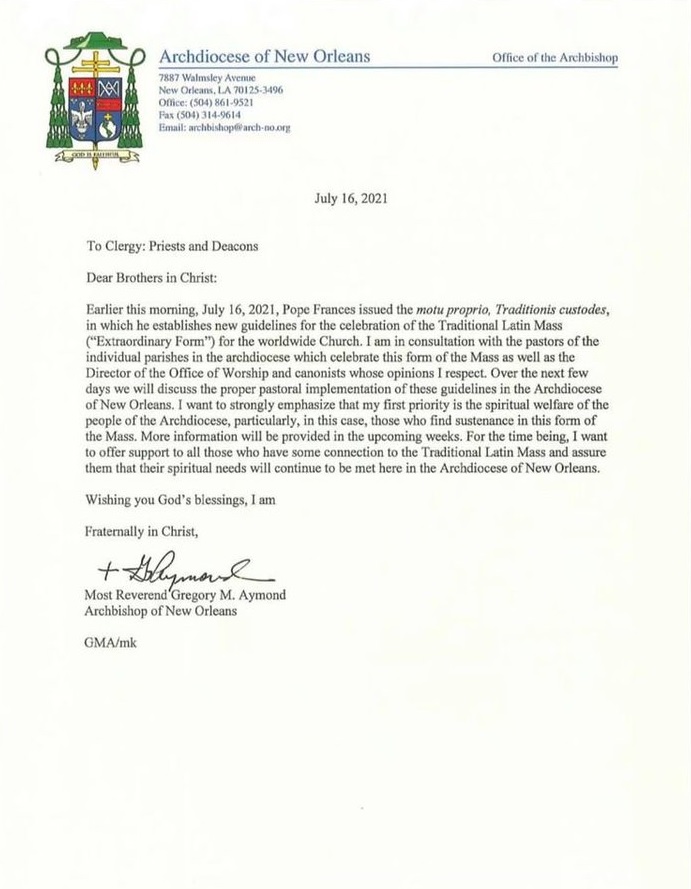
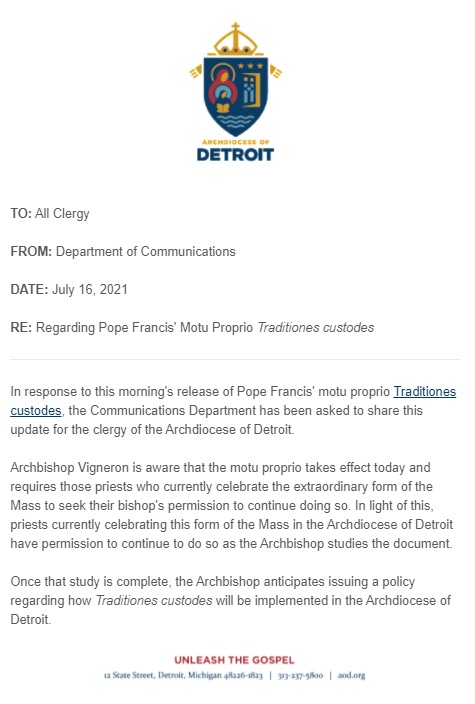
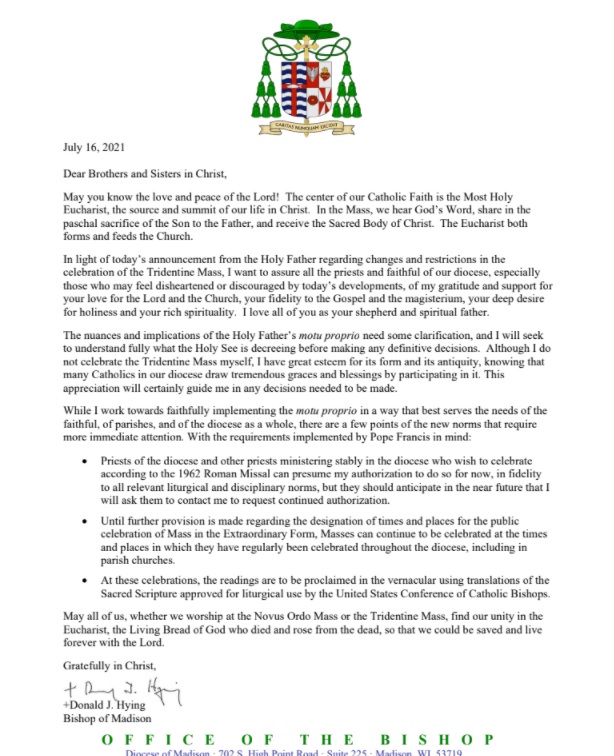
My Comments: As I have stated time and time again, the pope is the pope and His Holiness is the Supreme Legislator in the Church. We have to offer faithful obedience to him and as a priest I have made the promise of obedience to my bishop who has made an obedience to the pope. That’s why we are Catholic. Any other way is not Catholic but schismatic. I will never become a schismatic priest or Catholic, pure and simple.
We don’t worship the form of the Mass. We worship God and the Ordinary Form does this pure and simple despite any opinions to the contrary.
I do believe, though, that Pope Francis has accelerated a large schism in the Church. I don’t know why.
Certainly it is not lost on Pope Francis that some future pope can do to his Motu Proprio what His Holiness has done to Pope Emeritus Benedict’s Motu Proprio. It is a bit shocking to say the least.
First the letter accompanying the Motu Proprio
Dear Brothers in the Episcopate,
Just as my Predecessor Benedict XVI did with Summorum Pontificum, I wish to accompany the Motu proprio Traditionis custodes with a letter explaining the motives that prompted my decision. I turn to you with trust and parresia, in the name of that shared “solicitude for the whole Church, that contributes supremely to the good of the Universal Church” as Vatican Council II reminds us.[1]
Most people understand the motives that prompted St. John Paul II and Benedict XVI to allow the use of the Roman Missal, promulgated by St. Pius V and edited by St. John XXIII in 1962, for the Eucharistic Sacrifice. The faculty — granted by the indult of the Congregation for Divine Worship in 1984[2] and confirmed by St. John Paul II in the Motu Proprio Ecclesia Dei in 1988[3] — was above all motivated by the desire to foster the healing of the schism with the movement of Mons. Lefebvre. With the ecclesial intention of restoring the unity of the Church, the Bishops were thus asked to accept with generosity the “just aspirations” of the faithful who requested the use of that Missal.
Many in the Church came to regard this faculty as an opportunity to adopt freely the Roman Missal promulgated by St. Pius V and use it in a manner parallel to the Roman Missal promulgated by St. Paul VI. In order to regulate this situation at the distance of many years, Benedict XVI intervened to address this state of affairs in the Church. Many priests and communities had “used with gratitude the possibility offered by the Motu proprio” of St. John Paul II. Underscoring that this development was not foreseeable in 1988, the Motu proprio Summorum Pontificum of 2007 intended to introduce “a clearer juridical regulation” in this area.[4] In order to allow access to those, including young people, who when “they discover this liturgical form, feel attracted to it and find in it a form, particularly suited to them, to encounter the mystery of the most holy Eucharist”,[5] Benedict XVI declared “the Missal promulgated by St. Pius V and newly edited by Blessed John XXIII, as a extraordinary expression of the same lex orandi”, granting a “more ample possibility for the use of the 1962 Missal”.[6]
In making their decision they were confident that such a provision would not place in doubt one of the key measures of Vatican Council II or minimize in this way its authority: the Motu proprio recognized that, in its own right, “the Missal promulgated by Paul VI is the ordinary expression of the lex orandi of the Catholic Church of the Latin rite”.[7] The recognition of the Missal promulgated by St. Pius V “as an extraordinary expression of the same lex orandi” did not in any way underrate the liturgical reform, but was decreed with the desire to acknowledge the “insistent prayers of these faithful,” allowing them “to celebrate the Sacrifice of the Mass according to the editio typica of the Roman Missal promulgated by Blessed John XXIII in 1962 and never abrogated, as the extraordinary form of the Liturgy of the Church”.[8] It comforted Benedict XVI in his discernment that many desired “to find the form of the sacred Liturgy dear to them,” “clearly accepted the binding character of Vatican Council II and were faithful to the Pope and to the Bishops”.[9] What is more, he declared to be unfounded the fear of division in parish communities, because “the two forms of the use of the Roman Rite would enrich one another”.[10] Thus, he invited the Bishops to set aside their doubts and fears, and to welcome the norms, “attentive that everything would proceed in peace and serenity,” with the promise that “it would be possible to find resolutions” in the event that “serious difficulties came to light” in the implementation of the norms “once the Motu proprio came into effect”.[11]
With the passage of thirteen years, I instructed the Congregation for the Doctrine of the Faith to circulate a questionnaire to the Bishops regarding the implementation of the Motu proprio Summorum Pontificum. The responses reveal a situation that preoccupies and saddens me, and persuades me of the need to intervene. Regrettably, the pastoral objective of my Predecessors, who had intended “to do everything possible to ensure that all those who truly possessed the desire for unity would find it possible to remain in this unity or to rediscover it anew”,[12] has often been seriously disregarded. An opportunity offered by St. John Paul II and, with even greater magnanimity, by Benedict XVI, intended to recover the unity of an ecclesial body with diverse liturgical sensibilities, was exploited to widen the gaps, reinforce the divergences, and encourage disagreements that injure the Church, block her path, and expose her to the peril of division.
At the same time, I am saddened by abuses in the celebration of the liturgy on all sides. In common with Benedict XVI, I deplore the fact that “in many places the prescriptions of the new Missal are not observed in celebration, but indeed come to be interpreted as an authorization for or even a requirement of creativity, which leads to almost unbearable distortions”.[13] But I am nonetheless saddened that the instrumental use of Missale Romanum of 1962 is often characterized by a rejection not only of the liturgical reform, but of the Vatican Council II itself, claiming, with unfounded and unsustainable assertions, that it betrayed the Tradition and the “true Church”. The path of the Church must be seen within the dynamic of Tradition “which originates from the Apostles and progresses in the Church with the assistance of the Holy Spirit” (DV 8). A recent stage of this dynamic was constituted by Vatican Council II where the Catholic episcopate came together to listen and to discern the path for the Church indicated by the Holy Spirit. To doubt the Council is to doubt the intentions of those very Fathers who exercised their collegial power in a solemn manner cum Petro et sub Petro in an ecumenical council,[14] and, in the final analysis, to doubt the Holy Spirit himself who guides the Church.
The objective of the modification of the permission granted by my Predecessors is highlighted by the Second Vatican Council itself. From the vota submitted by the Bishops there emerged a great insistence on the full, conscious and active participation of the whole People of God in the liturgy,[15] along lines already indicated by Pius XII in the encyclical Mediator Dei on the renewal of the liturgy.[16] The constitution Sacrosanctum Concilium confirmed this appeal, by seeking “the renewal and advancement of the liturgy”,[17] and by indicating the principles that should guide the reform.[18] In particular, it established that these principles concerned the Roman Rite, and other legitimate rites where applicable, and asked that “the rites be revised carefully in the light of sound tradition, and that they be given new vigor to meet present-day circumstances and needs”.[19] On the basis of these principles a reform of the liturgy was undertaken, with its highest expression in the Roman Missal, published in editio typica by St. Paul VI[20] and revised by St. John Paul II.[21] It must therefore be maintained that the Roman Rite, adapted many times over the course of the centuries according to the needs of the day, not only be preserved but renewed “in faithful observance of the Tradition”.[22] Whoever wishes to celebrate with devotion according to earlier forms of the liturgy can find in the reformed Roman Missal according to Vatican Council II all the elements of the Roman Rite, in particular the Roman Canon which constitutes one of its more distinctive elements.
A final reason for my decision is this: ever more plain in the words and attitudes of many is the close connection between the choice of celebrations according to the liturgical books prior to Vatican Council II and the rejection of the Church and her institutions in the name of what is called the “true Church.” One is dealing here with comportment that contradicts communion and nurtures the divisive tendency — “I belong to Paul; I belong instead to Apollo; I belong to Cephas; I belong to Christ” — against which the Apostle Paul so vigorously reacted.[23] In defense of the unity of the Body of Christ, I am constrained to revoke the faculty granted by my Predecessors. The distorted use that has been made of this faculty is contrary to the intentions that led to granting the freedom to celebrate the Mass with the Missale Romanum of 1962. Because “liturgical celebrations are not private actions, but celebrations of the Church, which is the sacrament of unity”,[24] they must be carried out in communion with the Church. Vatican Council II, while it reaffirmed the external bonds of incorporation in the Church — the profession of faith, the sacraments, of communion — affirmed with St. Augustine that to remain in the Church not only “with the body” but also “with the heart” is a condition for salvation.[25]
Dear brothers in the Episcopate, Sacrosanctum Concilium explained that the Church, the “sacrament of unity,” is such because it is “the holy People gathered and governed under the authority of the Bishops”.[26] Lumen gentium, while recalling that the Bishop of Rome is “the permanent and visible principle and foundation of the unity both of the bishops and of the multitude of the faithful,” states that you the Bishops are “the visible principle and foundation of the unity of your local Churches, in which and through which exists the one and only Catholic Church”.[27]
Responding to your requests, I take the firm decision to abrogate all the norms, instructions, permissions and customs that precede the present Motu proprio, and declare that the liturgical books promulgated by the saintly Pontiffs Paul VI and John Paul II, in conformity with the decrees of Vatican Council II, constitute the unique expression of the lex orandi of the Roman Rite. I take comfort in this decision from the fact that, after the Council of Trent, St. Pius V also abrogated all the rites that could not claim a proven antiquity, establishing for the whole Latin Church a single Missale Romanum. For four centuries this Missale Romanum, promulgated by St. Pius V was thus the principal expression of the lex orandi of the Roman Rite, and functioned to maintain the unity of the Church. Without denying the dignity and grandeur of this Rite, the Bishops gathered in ecumenical council asked that it be reformed; their intention was that “the faithful would not assist as strangers and silent spectators in the mystery of faith, but, with a full understanding of the rites and prayers, would participate in the sacred action consciously, piously, and actively”.[28] St. Paul VI, recalling that the work of adaptation of the Roman Missal had already been initiated by Pius XII, declared that the revision of the Roman Missal, carried out in the light of ancient liturgical sources, had the goal of permitting the Church to raise up, in the variety of languages, “a single and identical prayer,” that expressed her unity.[29] This unity I intend to re-establish throughout the Church of the Roman Rite.
Vatican Council II, when it described the catholicity of the People of God, recalled that “within the ecclesial communion” there exist the particular Churches which enjoy their proper traditions, without prejudice to the primacy of the Chair of Peter who presides over the universal communion of charity, guarantees the legitimate diversity and together ensures that the particular not only does not injure the universal but above all serves it”.[30] While, in the exercise of my ministry in service of unity, I take the decision to suspend the faculty granted by my Predecessors, I ask you to share with me this burden as a form of participation in the solicitude for the whole Church proper to the Bishops. In the Motu proprio I have desired to affirm that it is up to the Bishop, as moderator, promoter, and guardian of the liturgical life of the Church of which he is the principle of unity, to regulate the liturgical celebrations. It is up to you to authorize in your Churches, as local Ordinaries, the use of the Missale Romanum of 1962, applying the norms of the present Motu proprio. It is up to you to proceed in such a way as to return to a unitary form of celebration, and to determine case by case the reality of the groups which celebrate with this Missale Romanum.
Indications about how to proceed in your dioceses are chiefly dictated by two principles: on the one hand, to provide for the good of those who are rooted in the previous form of celebration and need to return in due time to the Roman Rite promulgated by Saints Paul VI and John Paul II, and, on the other hand, to discontinue the erection of new personal parishes tied more to the desire and wishes of individual priests than to the real need of the “holy People of God.” At the same time, I ask you to be vigilant in ensuring that every liturgy be celebrated with decorum and fidelity to the liturgical books promulgated after Vatican Council II, without the eccentricities that can easily degenerate into abuses. Seminarians and new priests should be formed in the faithful observance of the prescriptions of the Missal and liturgical books, in which is reflected the liturgical reform willed by Vatican Council II.
Upon you I invoke the Spirit of the risen Lord, that he may make you strong and firm in your service to the People of God entrusted to you by the Lord, so that your care and vigilance express communion even in the unity of one, single Rite, in which is preserved the great richness of the Roman liturgical tradition. I pray for you. You pray for me.
FRANCIS
APOSTOLIC LETTER
ISSUED "MOTU PROPRIO"
BY THE SUPREME PONTIFF
FRANCIS
“TRADITIONIS CUSTODES”
On the Use of the Roman Liturgy
Prior to the Reform of 1970
Official translation
Guardians of the tradition, the bishops in communion with the Bishop of Rome constitute the visible principle and foundation of the unity of their particular Churches. [1] Under the guidance of the Holy Spirit, through the proclamation of the Gospel and by means of the celebration of the Eucharist, they govern the particular Churches entrusted to them. [2]
In order to promote the concord and unity of the Church, with paternal solicitude towards those who in any region adhere to liturgical forms antecedent to the reform willed by the Vatican Council II, my Venerable Predecessors, Saint John Paul II and Benedict XVI, granted and regulated the faculty to use the Roman Missal edited by John XXIII in 1962. [3] In this way they intended “to facilitate the ecclesial communion of those Catholics who feel attached to some earlier liturgical forms” and not to others. [4]
In line with the initiative of my Venerable Predecessor Benedict XVI to invite the bishops to assess the application of the Motu Proprio Summorum Pontificum three years after its publication, the Congregation for the Doctrine of the Faith carried out a detailed consultation of the bishops in 2020. The results have been carefully considered in the light of experience that has matured during these years.
At this time, having considered the wishes expressed by the episcopate and having heard the opinion of the Congregation for the Doctrine of the Faith, I now desire, with this Apostolic Letter, to press on ever more in the constant search for ecclesial communion. Therefore, I have considered it appropriate to establish the following:
Art. 1. The liturgical books promulgated by Saint Paul VI and Saint John Paul II, in conformity with the decrees of Vatican Council II, are the unique expression of the lex orandi of the Roman Rite.
Art. 2. It belongs to the diocesan bishop, as moderator, promoter, and guardian of the whole liturgical life of the particular Church entrusted to him, [5] to regulate the liturgical celebrations of his diocese. [6] Therefore, it is his exclusive competence to authorize the use of the 1962 Roman Missal in his diocese, according to the guidelines of the Apostolic See.
Art. 3. The bishop of the diocese in which until now there exist one or more groups that celebrate according to the Missal antecedent to the reform of 1970:
§ 1. is to determine that these groups do not deny the validity and the legitimacy of the liturgical reform, dictated by Vatican Council II and the Magisterium of the Supreme Pontiffs;
§ 2. is to designate one or more locations where the faithful adherents of these groups may gather for the eucharistic celebration (not however in the parochial churches and without the erection of new personal parishes);
§ 3. to establish at the designated locations the days on which eucharistic celebrations are permitted using the Roman Missal promulgated by Saint John XXIII in 1962. [7] In these celebrations the readings are proclaimed in the vernacular language, using translations of the Sacred Scripture approved for liturgical use by the respective Episcopal Conferences;
§ 4. to appoint a priest who, as delegate of the bishop, is entrusted with these celebrations and with the pastoral care of these groups of the faithful. This priest should be suited for this responsibility, skilled in the use of the Missale Romanum antecedent to the reform of 1970, possess a knowledge of the Latin language sufficient for a thorough comprehension of the rubrics and liturgical texts, and be animated by a lively pastoral charity and by a sense of ecclesial communion. This priest should have at heart not only the correct celebration of the liturgy, but also the pastoral and spiritual care of the faithful;
§ 5. to proceed suitably to verify that the parishes canonically erected for the benefit of these faithful are effective for their spiritual growth, and to determine whether or not to retain them;
§ 6. to take care not to authorize the establishment of new groups.
Art. 4. Priests ordained after the publication of the present Motu Proprio, who wish to celebrate using the Missale Romanum of 1962, should submit a formal request to the diocesan Bishop who shall consult the Apostolic See before granting this authorization.
Art. 5. Priests who already celebrate according to the Missale Romanum of 1962 should request from the diocesan Bishop the authorization to continue to enjoy this faculty.
Art. 6. Institutes of consecrated life and Societies of apostolic life, erected by the Pontifical Commission Ecclesia Dei, fall under the competence of the Congregation for Institutes of Consecrated Life and Societies for Apostolic Life.
Art. 7. The Congregation for Divine Worship and the Discipline of the Sacraments and the Congregation for Institutes of Consecrated Life and Societies of Apostolic Life, for matters of their particular competence, exercise the authority of the Holy See with respect to the observance of these provisions.
Art. 8. Previous norms, instructions, permissions, and customs that do not conform to the provisions of the present Motu Proprio are abrogated.
Everything that I have declared in this Apostolic Letter in the form of Motu Proprio, I order to be observed in all its parts, anything else to the contrary notwithstanding, even if worthy of particular mention, and I establish that it be promulgated by way of publication in “L’Osservatore Romano”, entering immediately in force and, subsequently, that it be published in the official Commentary of the Holy See, Acta Apostolicae Sedis.
Given at Rome, at Saint John Lateran, on 16 July 2021, the liturgical Memorial of Our Lady of Mount Carmel, in the ninth year of Our Pontificate.
FRANCIS
[1] Cfr Second Vatican Ecumenical Council, Dogmatic Constitution on the Church “ Lumen Gentium”, 21 november 1964, n. 23 AAS 57 (1965) 27.
[2] Cfr Second Vatican Ecumenical Council, Dogmatic Constitution on the Church “ Lumen Gentium”, 21 november 1964, n. 27: AAS 57 (1965) 32; Second Vatican Ecumenical Council, Decree concerning the pastoral office of bishops in the Church “ Christus Dominus”, 28 october 1965, n. 11: AAS 58 (1966) 677-678; Catechism of the Catholic Church, n. 833.
[3] Cfr John Paul II, Apostolic Letter given Motu proprio “ Ecclesia Dei”, 2 july 1988: AAS 80 (1988) 1495-1498; Benedict XVI, Apostolic Letter given Motu proprio “ Summorum Pontificum”, 7 july 2007: AAS 99 (2007) 777-781; Apostolic Letter given Motu proprio “Ecclesiae unitatem”, 2 july 2009: AAS 101 (2009) 710-711.
[4] John Paul II, Apostolic Letter given Motu proprio “ Ecclesia Dei”, 2 july 1988, n. 5: AAS 80 (1988) 1498.
[5] Cfr Second Vatican Ecumenical Council, Costitution on the sacred liturgy “ Sacrosanctum Concilium”, 4 december 1963, n. 41: AAS 56 (1964) 111; Caeremoniale Episcoporum, n. 9; Congregation for Divine Worship and the Discipline of the Sacrament, Instruction on certain matters to be observed or to be avoided regarding the Most Holy Eucharist “Redemptionis Sacramentum”, 25 march 2004, nn. 19-25: AAS 96 (2004) 555-557.
[6] Cfr CIC, can. 375, § 1; can. 392.
[7] Cfr Congregation for the Doctrine of the Faith, Decree “Quo magis” approving seven Eucharistic Prefaces for the forma extraordinaria of the Roman Rite, 22 february 2020, and Decree “Cum sanctissima” on the liturgical celebration in honour of Saints in the forma extraordinaria of the Roman Rite, 22 february 2020: L’Osservatore Romano, 26 march 2020, p. 6.