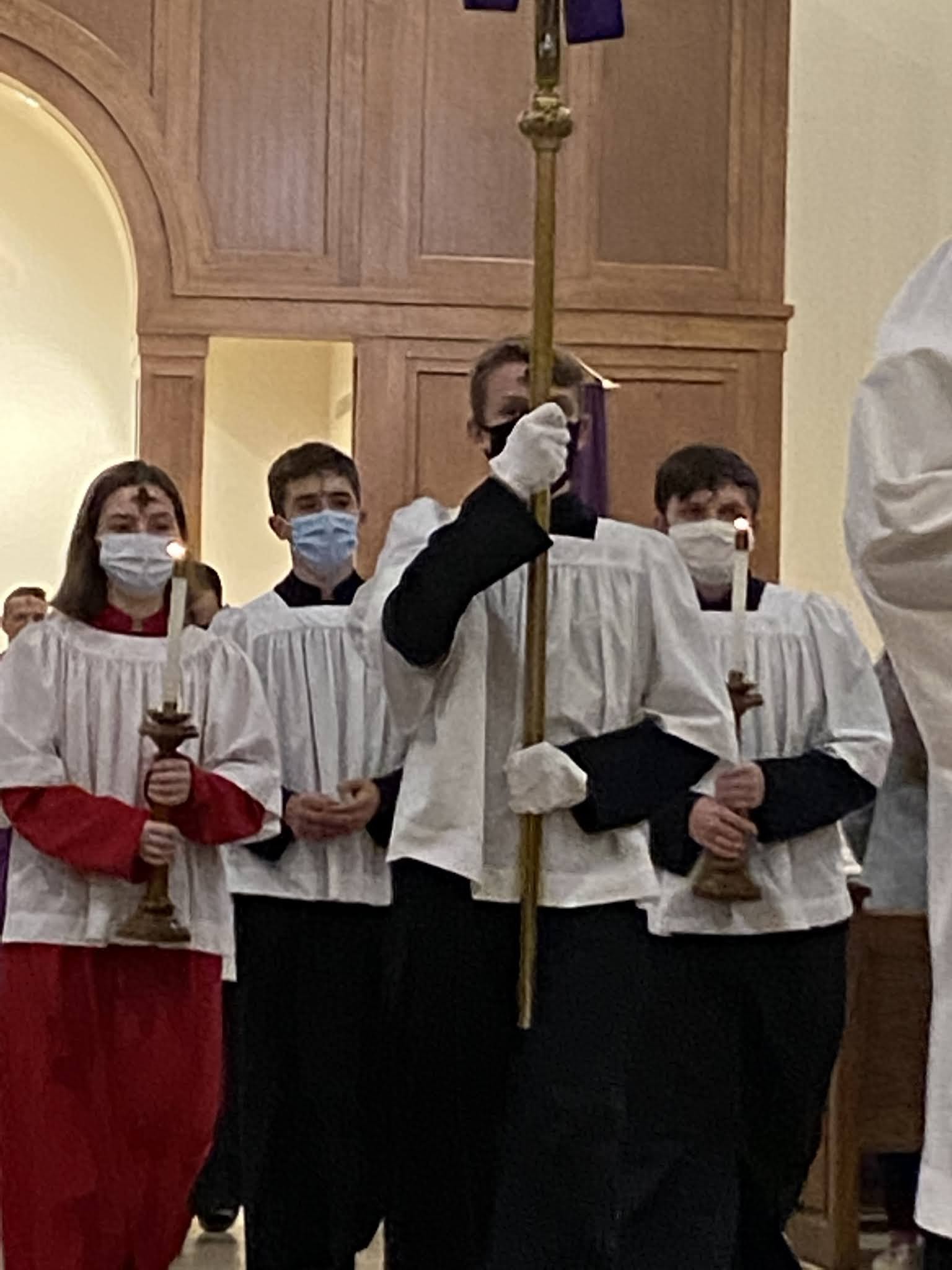
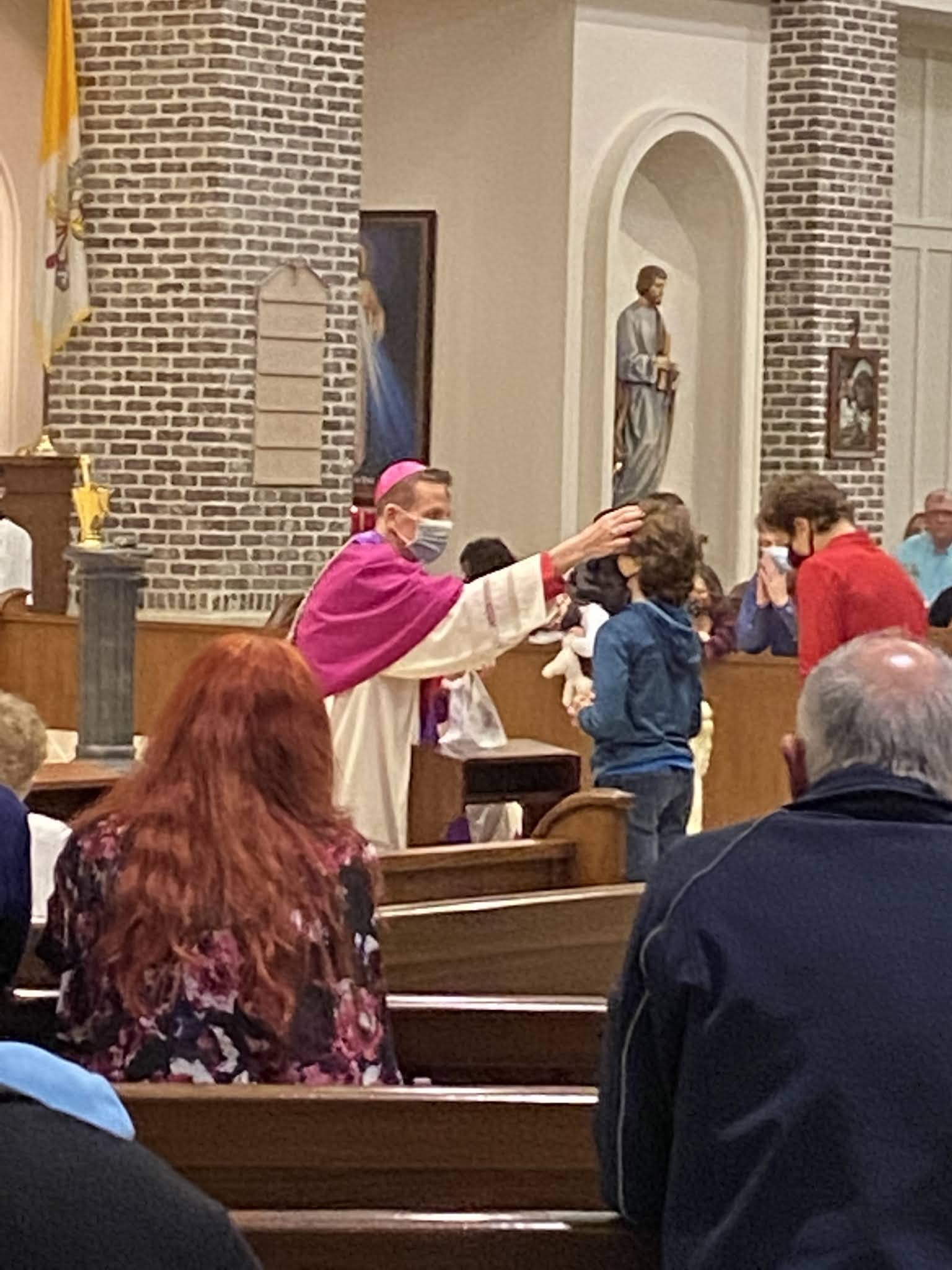
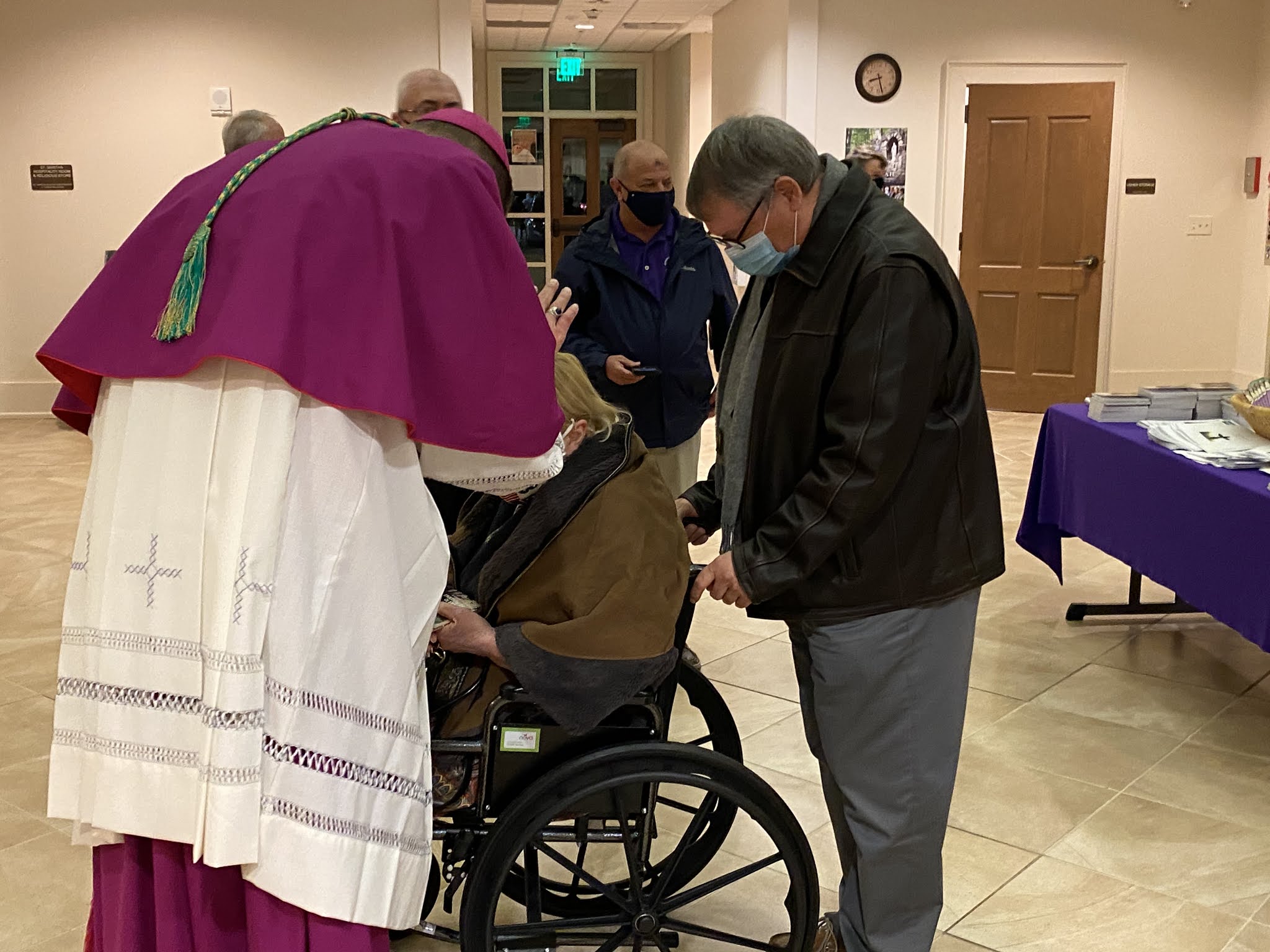
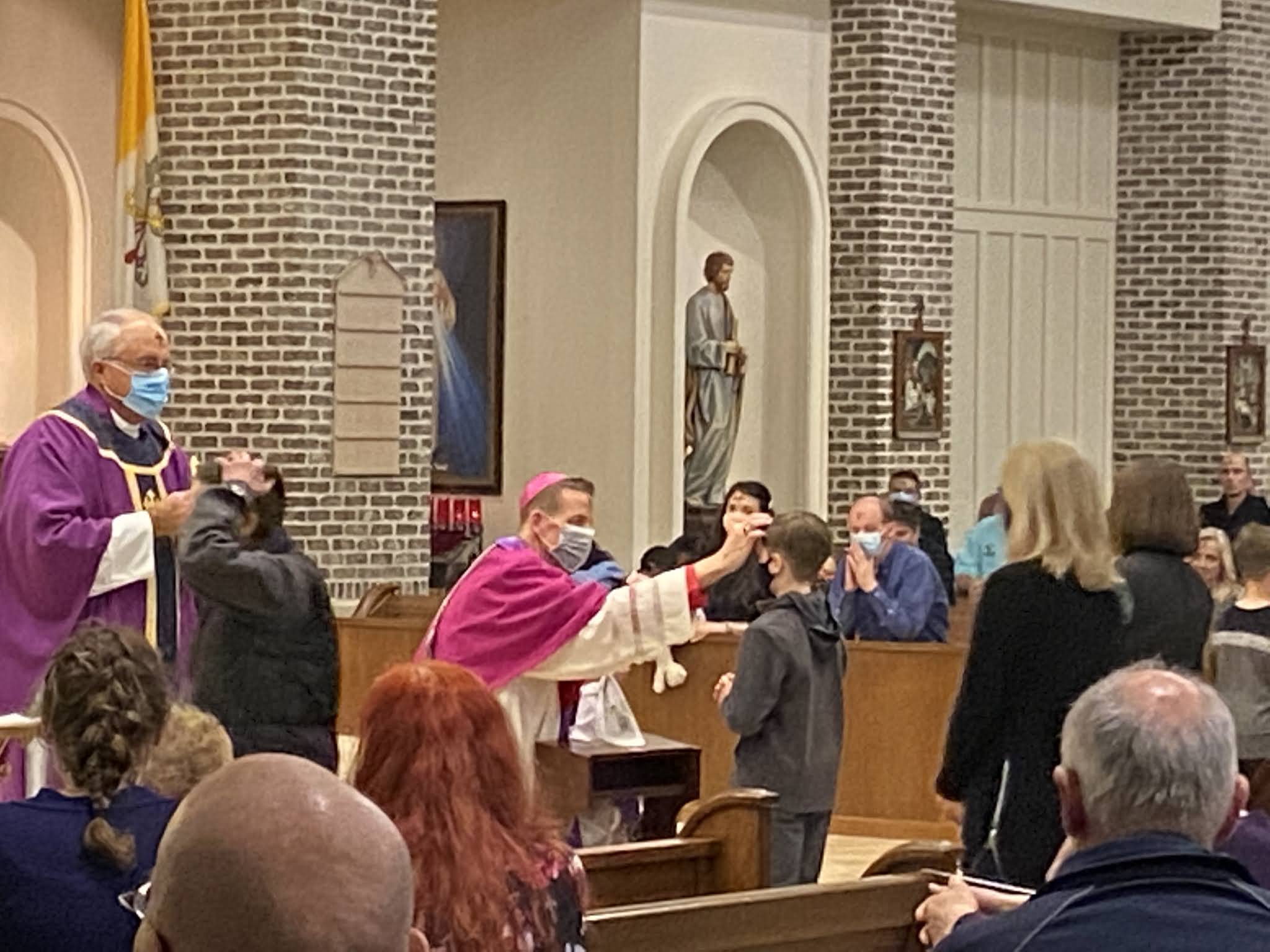
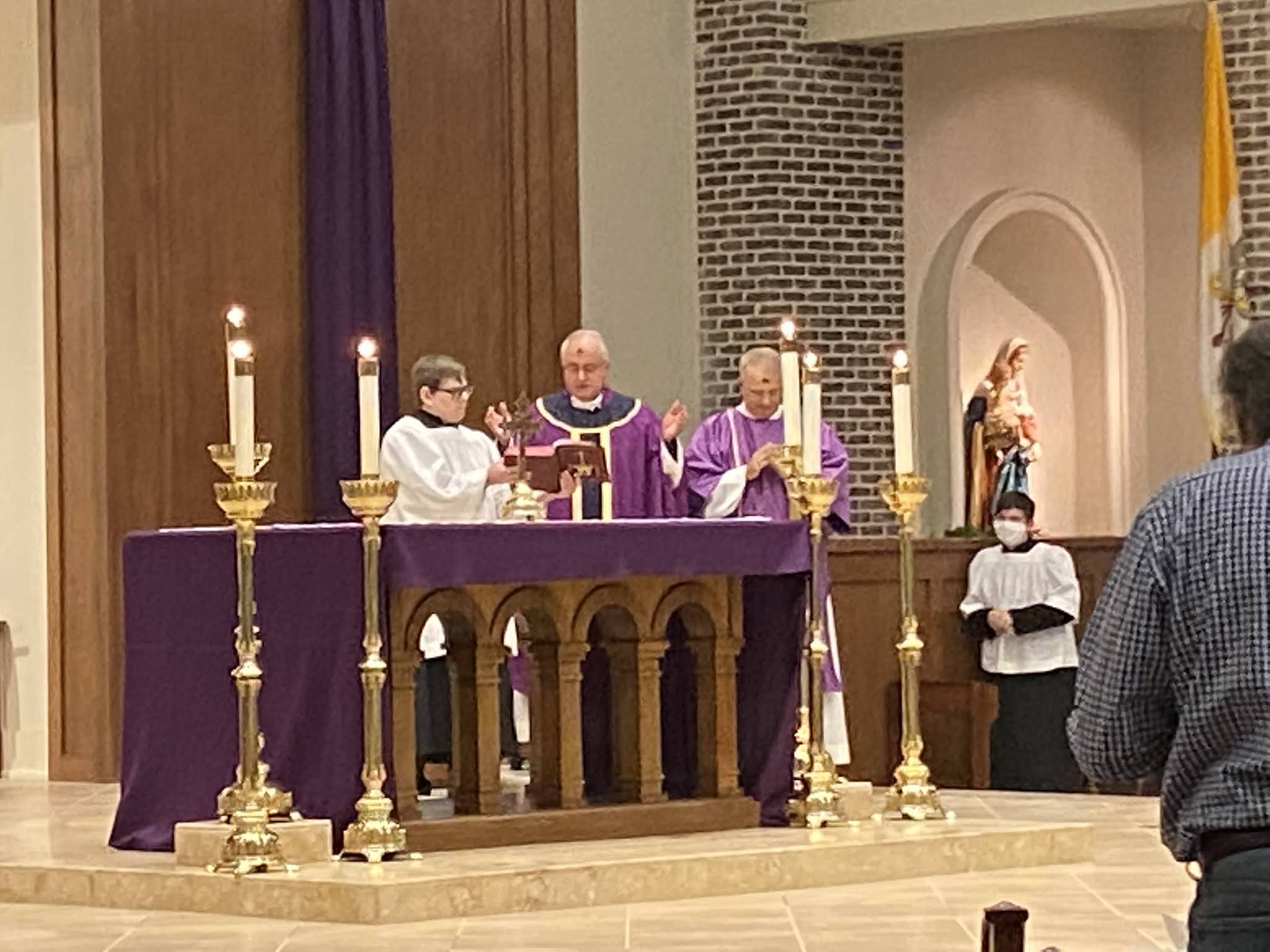
Here is our Facebook live-stream of the Mass at which Bishop Parkes presided on Ash Wednesday evening. I gave a pretty good homily and Bishop Parkes gave a great reflection after the Prayer after Holy Communion. Fortunately, for me, His Excellency has a good sense of humor and our bantering back and forth "just happened!"
Unfortunately, too many photos for my blog platform to get them in order, and I did input these in order, but you get the idea:
As the Church begins the holy season of Lent, Pope Francis celebrated Mass for Ash Wednesday, with the blessing and imposition of ashes.
In his homily, the Holy Father reflected on Lent as a journey of return to God and as an opportunity to deepen our love of our brothers and sisters.
God, said the Pope, is appealing to our hearts and our entire being, inviting us to Him.
“It is a time to reconsider the path we are taking,” he said, “to find the route that leads us home and to rediscover our profound relationship with God, on whom everything depends.”
From slavery to freedom
He urged Christians to evaluate the direction our lives are headed and how steadfastly we walk along our path toward God.
“The journey of Lent is an exodus from slavery to freedom,” he said.
As we progress, we will feel tempted to return to our old habits and illusions.
But, noted the Pope, we can rediscover our way by looking to the Word of God, no matter how many times we stumble.
Read also
Vatican modifies distribution of ashes for Ash Wednesday
12/01/2021
Vatican modifies distribution of ashes for Ash Wednesday
To the Father, Son, and Holy Spirit
Pope Francis said the first step of Lent involves returning to the Father, by accepting God’s forgiveness in the Sacrament of Confession.
“It is the Father’s forgiveness that always set us back on our feet,” he said.
Next, he said, we need to return to Jesus. Like the leper who returned to thank Him, we too “need Jesus’ healing. We need to present our wounds to Him and say: ‘Jesus, I am in your presence, with my sin, with my sorrows. You are the physician. You can set me free. Heal my heart’.”
Then, said the Pope, we are invited to return to the Holy Spirit.
The ashes sprinkled on our heads, he pointed out, remind us that we are dust. “Yet upon this dust of ours, God blew His Spirit of life.”
In heartfelt reconciliation.
The Holy Father went on to note that our return journey to God is only possible because He “first journeyed to us.”
Because Jesus embraced our sin and death, “our journey then is about letting Him take us by the hand.”
Our response to God’s invitation, said the Pope, involves heartfelt reconciliation, “with the deeds and practices that express it.”
A descent in love.
Finally, Pope Francis reminded us that Lent is the proper time both to journey toward God and toward our brothers and sisters.
“Lent is a humble descent both inwards and towards others,” he said. “It is about realizing that salvation is not an ascent to glory, but a descent in love.”
No matter how often we stumble, concluded the Pope, we can always turn to the Cross of Christ and contemplate in His wounds our own shortcomings and emptiness.
“By kissing those wounds, we will come to realize that there, in life’s most painful wounds, God awaits us with His infinite mercy.”
For Ash Wednesday, our bishop allowed us three options for the imposition of ashes. First, the formula while placing the ashes on the person is not to be said to each penitent, but rather over the entire congregation immediately following the blessing of the ashes.
For the individual imposition of ashes, we have three options: A. sprinkling ashes on the crown of the penitent's head; B. Using a new q-tip to make the Sign of the Cross on each person's forehead; C. the normal imposition of ashes with the priest/deacon's thumb to the forehead of the penitent.
At Saint Anne, we are using the traditional thumb to the forehead.
Saturday, February 13th was a cold, rainy, dreary day in Georgia and a rainy night in Georgia too.
This photo was taken after the most splendid Nuptial Mass. I like in particular the winters look out of our clear glass above the ad orientem altar in our Martha and Mary Chapel, built by Henry Ford and named after his mother and mother-in-law.
Let me take a poll. In the EF Nuptial Mass, the Rite of Holy Matrimony takes place prior to the Nuptial Mass as a prelude to it, although it could stand alone without the Nuptial Mass.
In the Ordinary Form, the Rite of Marriage takes place after the homily but before the Liturgy of the Eucharist. It too can stand alone without the Liturgy of the Eucharist.
But in the EF Nuptial Mass, the couple is married for the entire Mass whereas in the Ordinary Form’s Nuptial Mass, the couple is simply betrothed for the Mass through the homily.
Would it not be best to be married for the Liturgy of the Word and the entire Mass?
St. Anne Church in Richmond Hill, Georgia certainly did. One of the strengths of the Ordinary Form Mass is that you can celebrate a saint’s day on a Sunday and do it through the Universal Intercessions.
And we all know that with the Universal Prayer, you can make it up as you go and use whatever English you may like or any other vernacular and the translation police will not give you a ticket.
This is what we did. The priest’s introduction to the Universal Prayer indicated that it was Saint Valentine’s Day and that the response to each petition would be “pray for us.”
Each petition ended with, “Saint Valentine, priest and martyr” “Pray for us.”
There was an intercession that the Sacrament of Holy Matrimony be strengthened for all married couples’ Sacrament and a prayer for those courting and preparing for the Sacrament of Holy Matrimony.
The conclusion of the Intercessions was the Collect from the Extraordinary Form’s Feast of St. Valentine of Rome but in its unofficial English translation from my Saint Joseph Missal.
How did your parish honor Saint Valentine of Rome, Priest and Martyr?
Under Popes John Paul II and Benedict, especially Benedict, the clarification of the common priesthood of the baptized and the ordained or ministerial priesthood of those who receive the Sacrament of Holy Orders occurred. In the 60’s 70’s and 80’s, the emphasis on the common priesthood of the baptized had blurred the distinction of the ordained leading to an absurd laicizing of the priests and clericalization of the laity. Reversing that silliness led to an increase of vocations to the priesthood under these two pontificates.
It led to a recovery, too, of Catholic identity in a protestantized and now secularized world.
The question of renewing the true identity of the ordained priest and all other Catholics of their baptismal identity, has led the current pontificate to decry clericalism. This occurs in both the ordained priests and laity who are clericalized in paid and volunteer positions they hold for a lifetime sometimes.
I think this nebulous term of clericalism, not clearly defined, but opinions galore about it exist and sometimes the term is used wrongly, can create a mess for the Church and the true identities of both clergy and laity, meaning a loss of identity.
Clericalism is like an exclusive elite club. But priests need professional organizations that assist them in their “profession.” They have specific roles in the Church and should be regarded as “experts” in Church teaching and canon law. Their roles as defined by dogma, doctrine, theology and canon law must be respected not denigrated.
Clericalism, truly understood, oversteps the boundaries that doctrine and canon law establish as well as norms that are regulated by the pope or local bishops.
For example, Summorum Pontificum allows the faithful to have access to the Extraordinary Form of the Mass either in their own parish or nearby. It also allows them to have the other sacraments, such as baptism and Holy Matrimony in the EF form. It also allows for Requiem Masses in the EF form. To be denied this outright by a priest who does not agree with the norm established by the pope, would be clericalism. Of course if no priest who can do it is not available that is another question.
But another example is true too as it concerns the Ordinary Form. If a priest autocratically says Mass ad orientem, with out readers and extraordinary Ministers of Holy Communion and no female altar servers, in a parish where the pastor allows these things, that is clericalism which equals authoritarianism. What is allowed by liturgical law is denied.
Think too of priests who change the words and gestures of the Mass in what they think is a better academic way but truly is arrogant clericalism. They break liturgical law and complain they know better when they break the law.
However, when laity demand that the clergy allow them certain privileges not allowed them, such as having a second marriage without an annulment in the church, or at least the reception in a social hall where a civil official officiates, or to be able to receive Holy Communion, have official roles in the liturgy and in the parish even though living in a heterosexual or homosexual state of mortal sin, that is clericalism.
I'll let you read the article at Praytell which strikes me as truly unecumenical coming from an ultra progressive priest. He takes to task and shreds like Shredded Wheat the National Cathedral's rector and bishop for inviting an evangelical pastor to preach from their pulpit via recording. He crucifies the homilist they invited to speak.
I don't know anything about this evangelical pastor. It sounds, though, that he might be an "orthodox" Evangelical pastor, but who knows? The Episcopal priest though, is truly unwelcoming, uninclusive and judgmental of the evangelical minister.
And then this Anglican priests has the temerity to shred the local Catholic diocese, its Cathedral's rector by writing this which makes it sound like he's Catholic but he's not: My local Roman Catholic cathedral has a
notorious pastor who almost weekly references sin, homosexuals and
divorced persons in his sermons, without qualification or clarification.
But what I find disturbing is that a "priest" is participating in the "cancel culture" that has reared its ugly and unChristian head is applying it to the National Cathedral's rector and bishop and their invited guest. A priest is doing this.
If this evangelical had railed against some of the other profound social issues of the day, he would have been applauded as prophetic. Yet when he rails against some aspects of the post-modern, post-Christian views of sexuality today, where men can claim to be women, women can claim to be men and I claim that my spelling is the truth regardless of any English speaking authority, he is chastised as a neanderthal, so to speak as I don't want to denigrate neanderthals.
Does not the Word of God apply to all who are sinners, in need of repentance and reconciliation? Are preachers to be canceled and persecuted like the prophets of old and martyred for speaking an ounce of truth? Just wondering.
Pope Francis accepts resignation of bishop who called for council to discuss women priests
Bishop who called for council to discuss women priests resigns(CNA) Pope Francis on Monday accepted the resignation of a Swiss bishop who recently called for a council to discuss women priests. The Holy See press office announced Feb. 8 that the pope had accepted the resignation from the office of auxiliary bishop of the Diocese of Basel, Switzerland, presented by Bishop Denis Theurillat…
The first photo below has, what I use to think, prior to Vatican II, was the trademark look of Catholic altars. There was something magnificent about this look that directed your eyes upward to heaven, to Christ, to the Blessed Mother, to all the angels and saints.
Then, when the second photo of the same altar became somewhat the norm of the trademark of the post-Vatican II altar, my gut instinct told me that this was pedestrian, about the now, not the hereafter, and not as important.
I think if you asked an atheist which altar looks more important, their gut instinct would tell you the first not the second.
And thus you have it. When the majority of Catholics don't think anything really important happens on our altar, especially the post-Vatican II altars which look so inferior to the pre-Vatian II altars, why should they remain Catholic or go to Mass, Why?
I have been to this Basilica outside of Jerusalem, The Basilica of Gethsemane. I wondered what the pre-Vatican II altar looked like. I need not wonder any longer. So many of the Holy Land's magnificent altars were destroyed for looks like this. SAD!
What do you see and experience when you attend Mass? The Sacred? Or are you distracted by other concerns?
My own experience as a lay person and a priest was that other things got in the way and the focus shifted from the four “ends” of the Mass to something else altogether different, a focus away from God. The focus was on us, I, as an individual, and we as a community. The focus was on how to do this, that and the other, what to call, this, that and the other, where to celebrate, this, that and the other, and what to use at mass, this, that or the other? This is what Pope Benedict XVI decried as the shift from the “vertical” to the “horizontal.”
If you want to see how things got off track and very early after Vatican II, Adoremus has an article that lets you know exactly what was happening and how there became a pre-occupation with reform of the liturgy that became the driving force of the purpose of the post-Conciliar Mass, how best to reform by reforming, this, that and the other--that became the preoccupation for liturgy geeks of the reformed Ordinary Form Mass. And it is what these geeks did to the Ordinary Form of the Mass by constantly redecorating the Mass with innovations that has led now to about 12% of Catholics in some places actually attending Mass.
Here are a few of the doozies from the article I link below. Press title for complete article:
-- I have deferred to suggestions and have employed the word "presider",
rather than "celebrant", "president", or priest, to denote the one who
presides over the Eucharist and proclaims the Eucharistic Prayer…. It is
hoped that this usage will enable us even more to realize that the
entire assembly celebrates the Eucharist, that each person present is
truly a con-celebrant, and the role of the priest is to preside over a
communal act of worship. (p. 2)
-- Furthermore, the Western bias for hosts and grape wine as the only
acceptable materials for Eucharist symbolizes not only the dominance of a
specific culture but also of a specific ecosystem. (p. 24)
--Ritual sacrifices are the ultimate act of scapegoating and foundational
for many of the world’s religions. Could it be that our neutralization
of bread by transforming it into otherworldly hosts gave us the implicit
permission to sacrifice not only the host but also the physical world
in order to satisfy our violent tendencies?
-- If we persist in using lily-white little mass-produced hosts pressed
flat by professionals, and antique, highly stylized vessels, the
assembly will be hard-pressed to see the gifts as their own, as symbols
of themselves, of the goodness of creation and the dignity of the human
action required to bake bread and make wine. The gifts become so
fossilized that their purpose and natural symbolism of God can no longer
shine forth.
--I won’t ask how many of us have never celebrated a Liturgy of the
Word in one place and a Liturgy of the Eucharist in another place, but I
bet there are two or three of us in this room who haven’t done that. At
Theological College last Holy Saturday the liturgy of the fire was
celebrated outside in the garden; the Liturgy of the Word was celebrated
on the second floor in a big room that’s used for the rector’s
conferences and other big meetings, and the Liturgy of the Eucharist was
celebrated upstairs in the chapel. They’ve been doing that since the
1960’s. The 1970 Instruction didn’t affect the way that they celebrated.
It’s still been going on.
Read it all by pressing below and you'll know why the Ordinary Form of the Mass drifted from its four main ends of the Mass--I guess Jesus is in some of these details but its easy to miss Him!
I think people have always had their personal preferences about the Mass. I am old enough to remember the ethos of the pre-Vatican II Church, my father brought us normally to the early Low Mass on Sunday and Holy Days of Obligation. He like getting his obligation over with and so did I. Going to Mass was about fulfilling an obligation.
Often the homily was boring or over our heads or not practical.
Many people, though liked a sung Mass. I think few people that I knew ever went to a Solemn Sung Mass with deacon and subdeacon. More than likely they liked the brevity of a low Mass or High Mass.
Today, what people like (in terms of the OF Mass) is as varied but a bit different.
There are few places which offer a quiet Sunday Mass in the Ordinary Form where all is spoken with maybe a few hymns. They tell me they have to endure their parts being sung along with hymns. Some like the singing others don't.
And everyone has their likes and dislikes as it concerns music and style of instrumentation. For funerals everyone still wants these old standbys for the Ordinary Form: Eagle's Wings, Be Not Afraid, Here I am Lord, Amazing Grace and How Great Thou Art.
People like the vernacular but hate hybrid Masses of various vernaculars. In this neck of the woods, a mix of English and Spanish gets annoying, especially with the readings and music.
I think, for the most part, we have lost the crowd, and a sizable crowd it was, that came to Mass to honor the Sunday obligation. They may now account for the nones or those who come once or twice a year.
Funerals Masses are becoming obsolete as are Nuptial Masses and Baptisms for this crowd too.
Thus we have the post-Vatican II Church in the Post Modern World.
But it screams for the EF Mass and traditional altar candles arrangement.
UPDATE:And here it is thanks to Deacon Fritz Bauerschmidt, a nicer altar arrangement with an EF Mass.They do celebrate the EF Mass, FrMJK states they have a new organ only recently installed.
From “I’m fed up with ugly churches”: Little Flower Church in Richmond Heights (a suburb of St. Louis) Missouri. This round planned church was built in the late 1940's a few decades before the liturgical reforms and churches with this sort of design becoming widespread.
I can’t find a pre-Vatican II look. More photos HERE.
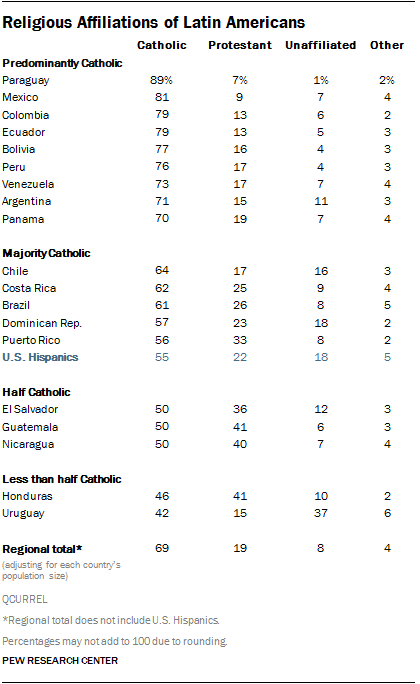
There are many factors at work in Mexico, Latin America and South America and all over the world that is leading many Catholics to jump ship and become Evangelical, non-denominational Protestants.
First: There has been over the last 50 years a loss of Catholic Liturgical identity where many parishes try to mock Evangelical, Pentecostal worship in style and music thus rendering Catholic identity once very strong weak and a poor second to what we once were and what Pentecostal worship is. So it is no wonder that Catholics cooked in a more Protestant, evangelical style of music and worship would think nothing of changing over to actual Protestant worship that is far superior that what Catholics usually attempt in a liturgical setting.
Liberalism in Catholicism pushes people looking for certitude to Protestant sects who promote it. Pope Francis calls Catholics like this in a deriding way: fundamentalist. I think he’s glad to see them go.
Here is a story I copy from The Deacon’s Bench:
“MOTHERS AND FATHERS SEARCH IN THE WORD OF GOD FOR VALUES SUCH AS FIDELITY IN MARRIAGE, HARMONY, LOVE OF CHILDREN, HONESTY, AND A HEALTHY LIFESTYLE.”
The Catholic majority in Mexico is slipping, as Protestants surpassed 10 percent of the population in the country for the first time ever.
According to recently released data from Mexico’s 2020 census, the Protestant/evangelical movement increased from 7.5 percent in 2010 to 11.2 percent last year.
The Catholic Church has historically dominated the religious landscape across Latin America, but especially in Mexico, which ranks among the most heavily Catholic countries in the region. Today, though an overwhelming majority of Mexicans still identify as Catholic, declines are accelerating.
It took 50 years—from 1950 to 2000—for the proportion of Catholics in Mexico to drop from 98 percent to 88 percent. Now, only two decades later, that percentage has slipped another 10 points to 77.7 percent.
National church leaders attribute the boom in Protestantism to a range of factors, from the influence of Americans and fellow Latin Americans in the country to effective evangelical outreach in indigenous areas.
Pentecostalism dominates the Protestant landscape, and even many of Mexico’s historical denominations—think Baptists, Presbyterians, and Methodists—have been “pentecostalized” in some beliefs and practices, embracing energetic worship, healing, and spiritual gifts.
Nearly a million American-born people live in Mexico, as well as tens of thousands of Guatemalans and Venezuelans, and others from Central American countries. Some of them have brought evangelicalism with them, while others encounter it when they arrive in Mexico, according to Rosa A. Duarte de Markham, coordinator of the department of biblical translation at the Missionary Cooperation of Mexico (Comimex).
Markham also believes that the recent Protestant growth reflects how Mexican society longs for the sense of morality and family values upheld in evangelical churches.
“Mexico has been in mourning for several years due to enforced disappearances. Surely this has led to the search for God as a comforter, to value peace and justice,” she said. “On the other hand, the need to rescue the family nucleus has led mothers and fathers to search in the Word of God for values such as fidelity in marriage, harmony, love of children, honesty, and a healthy lifestyle.”