And please, leave the altar arrangement as is!
Wednesday, December 31, 2025

TEACHING CERTAIN BISHOPS ABOUT THE LITURGY AND SYNODALITY…
When I read Fr. Steve Mattson’s article, I thought, Wow, that’s me, I am not alone!
I love this comment at that article:
Press the title for the fine article. I hope Bishop Martin reads it and learns from it:
Baffled by a bishop, Bishop Martin, OFM CONV, TO BE EXACT, NOT ME BUT MY CLONE…although me too!
A parish priest reflects on what is happening in Charlotte, and on what has transpired in his own parish over the past several years.
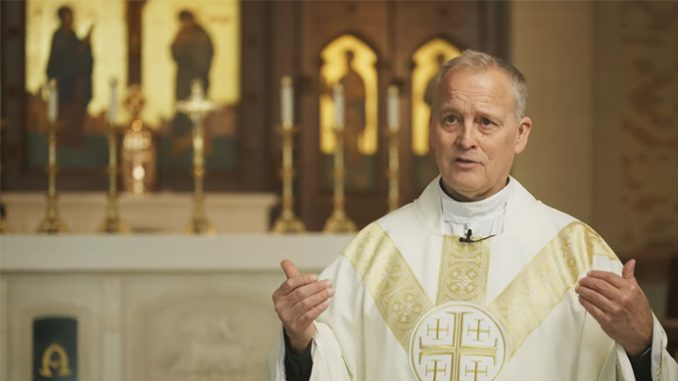
HOW CAN POPE LEO XIV “UNATTENTUATE” THE MASS OF BUGNINI/PAUL VI, MEANING, RESTORE FULL FORCE, EFFECT AND VALUE TO IT IN TERMS OF MYSTERY, REVERENCE, AWE AND WONDER


Just as Pope Leo has recovered so much that Pope Francis discarded, one hopes, too, that His Holiness will recover Summorum Pontificum.
A grand reversal of Pope Francis’ puritanical look in papal and liturgical garb is the return of the Papal Coat of Arms to the Papal Cassock’s sash!
But apart from that, how can His Holiness, Pope Leo XIV, recover what was lost in the Bugnini reform of the Tridentine Mass that led to a loss of full force, effect and meaning, without repudiating the Mass of Bugnini/Paul VI altogether as that would create more division and ill-feeling in the Church and put the liturgy wars on steroids?
I know I sound like a broken record, but give to the Bugnini/Paul VI Mass what Pope Francis approved for the Ordinariate Missal: Divine Worship! It’s that simple!
Apart from adding another option to the Bugnini/Paul VI Mass, what also needs to be done first is to “fix” the Introductory Rite of the Mass and this can be done very simply:
1. Only have two “Penitential Acts” options, A and B. These two choices both place the Kyrie in the proper place and independent of the Penitential Act. The Kyrie is always chanted or spoken after the “absolution”.
2. Revise slightly the Order of the Introductory Rites:
A. The Official Biblical Entrance Chant (Introit) is never to be omitted or completely substituted with another kind of hymn.
B. After the priest reverences the altar (and incenses it) he goes to his chair and without any other words but the ones prescribed makes the “Sign of the Cross” and immediately says (without the liturgical greeting) “My brothers and sisters, “let us prepare ourselves to celebrate the Sacred Mysteries by acknowledging our sins” followed by a bit of silence and then the choice of A or B for the Penitential Act.
C. If the Penitential Act is omitted in favor of the Blessing and Sprinkling of Holy Water, after the Sign of the Cross, the priest immediately uses the introduction for the Blessing of Holy Water and then prays the prayer of blessing followed by the blessing of the congregation with the Holy Water. Upon returning to his chair, he prays the proper absolution associated with the Blessing of the Congregation with the Holy Water. This is followed by the Kyrie (thus the Kyrie is never omitted in any Mass).
D. If prescribed, the Gloria is sung or said.
E. Then the priest says “The Lord be with you” (no other option) and then prays the Collect of the Day.
After this revision, then the privilege that the Ordinarite’s Missal has to use Tridentine elements as another option is clearly allowed for the Bugnini/Paul VI Mass. This will be an “appendix” for the Bugnini/Paul VI Mass:
A. In a sung Mass, as the Introit is chanted, the priest and ministers recite the PATFOTA, ad orientem, then the priest ascends the altar with the appropriate silent prayers, reverences the altar (and incenses it) and then the Kyrie is chanted and the Gloria chanted, if prescribed, followed by the Collect.
B. The Tridentine Offertory Prayers, etc are used
C. The added genuflections at the consecrations and at the end of the Great Amen.
D. The Tripple Dominum non sum dignus.
E. The Last Gospel
Any Mass may be celebrated ad orientem or facing the nave
The reception of Holy Communion at any Mass may be standing or kneeling at an altar railing or kneeler and receiving on the tongue or hand and if by hand strictly following the rubrics for such!
My recommendations would unattenuate the Bugnini/Paul VI Mass!
ONE OF POPE LEO’S FIRST SPEECHES WAS TO THE EASTERN RITE CATHOLICS, WHO BY GOD’S GRACE, HAPPENED TO BE CELEBRATING THIER JUBILEE IN ROME AT THE TIME OF POPE LEO’S ELECTION AND THIS GAVE THE BRAND NEW POPE A WAY TO SIGNAL HIS CONCERN ABOUT HOW THE MASS OF BISHOP BUGNINI HAD “ATTENUATED” THE HISTORIC AND ORGANICALLY DEVELOPED MASS OF TRENT,, AKA, THE TLM

In one of his first speeches as Pope, Pope Leo explicitly implied that the Mass of Bishop Bugnini, which St. Pope Paul VI approved and promulgated and thus is also known as the “Paul VI Mass”, had “attenuated” the Tridentine Mass. In case you don’t know, “attenuated” means, “having been reduced in force, effect and value.” In other words, Pope Leo explicitly implied that the Modern Mass of Bugnini/Paul VI is the Novus Disordered Mass”.
While Pope Leo was using the Eastern Rite liturgies as a corrective to the Bugnini Mass having “reduced the force, effect and value” of the Tridentine Mass, the Holy Father could have said the very same thing to a gathering of Summorum Pontificum Catholics, or those parishes, religious orders and communities that have kept the TLM alive and well and thus contribute to the “great need”, as Pope Leo says, “to recover the sense of mystery (in the Bugnini Mass) that remains alive in the TLM liturgies…”
With what Pope Leo explicitly implies about recovering what is lost in the Bugnini Mass in His Holiness’ elocution to Eastern Rite Catholics celebrating their Jubilee, let me take the liberty to adjust His Holiness’ words but certainly not their meaning or what these words explicitly imply. My adjustments are in red:
(Pope Leo XIV to TLM Catholics) The Church needs you. The contribution that the TLM can offer us today is immense! We have great need to recover in the Bugnini Mass the sense of mystery that remains alive in the TLM liturgies, liturgies that engage the human person in his or her entirety, that sing of the beauty of salvation and evoke a sense of wonder at how God’s majesty embraces our human frailty! It is likewise important to rediscover, especially in the Novus Disorder, a sense of the primacy of God, the importance of mystagogy and the values so typical of TLM spirituality: constant intercession, penance, fasting, and weeping for one’s own sins and for those of all humanity (penthos)! It is vital, then, that you preserve our traditions without attenuating them (meaning: having been reduced in force, effect and value) as the Bugnini Mass as done, for the sake perhaps of practicality or convenience, lest they be corrupted by the mentality of consumerism and utilitarianism.
Tuesday, December 30, 2025
CARDINAL MUELLER CELEBRATES MASS AT ST. PETER’S FOR THE THIRD ANNIVERSAY OF THE DEATH OF POPE BENEDICT XVI..
The music is splendid, but some peculiarities:
1. The Mass is a hybrid of ENGLISH and Latin
2. The homily is preached in English, not Italian or German
3. It’s quite beautiful, reverent and what the Mass of Pope Paul VI should be not only at St. Peter’s but every parish in the world.
4. A note to Bishop Martin of Charlotte, please note that Holy Communion is received in a variety of ways, diversity in unity, some kneel, most stand, many receive in the hand and most on the tongue. What is important at the reception of Holy Communion is our focus is on Jesus—He is at the center even in the diversity of how our Lord is received.
MOST HOLY FATHER AND THE CARDINALS OF THE EXTRAORDINARY CONSISTORY: WE DON’T JUST NEED THE EAST TO RECOVER THE REVERENCE, AWE AND WONDER OF THE LITURGY LOST IN THE WEST BECAUSE OF POPE PAUL’S POST-VATICAN II REFORMS, BUT WE NEED THE PRE-VATICAN II MASS MORE THAN THE EAST TO RE-ENCHANT OUR WESTERN RITES!!!!!
When I first saw this photo at the National catholic Reporter I thought it was a parody on the normal liturgical abuses associated with Pope Paul VI’s fabricated Mass, just one abuse against even smaller percentage of Catholics who desire a Modern Mass by the book not the liturgical abuses foisted on them by the disobedience of bishops and priests imposed on the Modern Mass’s liturgical laws and rubrics.
At first, I thought that the two “priests” featured in this photo were Wayne Brady who hosts “Let’s Make a Deal” and the laicized priest, Frank Pavone. What do you think?
But alas, they are actual Jesuit priests who happen to resemble Wayne Brady and Frank Pavone and their liturgical abuses thus makes sense. The same could be said for Conventional Franciscans:

Of the small percentage of Catholics who actually attend the Modern Mass, and that would be less than 5 % of Catholics in some parts of the world to a bit more that 25% of Catholics in other parts of the world, a large percentage of those Catholics like liturgical abuses, the buffoon-bishops and priests who cultivate liturgical abuse and a large percentage of Catholics who still go to the Modern Mass don’t believe what the Church teaches about Transubstantiation and the Sacrificial Aspect of the Mass nor do they miss the reverence of the Mass lost with the fabricated Mass of Pope Paul VI.

Of the small percentage of Catholics who actually attend the Modern Mass, and that would be less than 5 % of Catholics in some parts of the world to a bit more that 25% of Catholics in other parts of the world, a large percentage of those Catholics like liturgical abuses, the buffoon-bishops and priests who cultivate liturgical abuse and a large percentage of Catholics who still go to the Modern Mass don’t believe what the Church teaches about Transubstantiation and the Sacrificial Aspect of the Mass nor do they miss the reverence of the Mass lost with the fabricated Mass of Pope Paul VI.
As Pope Leo prepares to meet the Cardinals in an Extraordinary Consistory, let us recall His Holiness’ profound words acknowledging by implication that the Mass of Pope Paul VI is flawed and in some ways is the Novus Disorder:
Pope Leo addressed the Jubilee of Eastern Churches with these words:
The Church needs you. The contribution that the Christian East can offer us today is immense! We have great need to recover the sense of mystery that remains alive in your liturgies, liturgies that engage the human person in his or her entirety, that sing of the beauty of salvation and evoke a sense of wonder at how God’s majesty embraces our human frailty! It is likewise important to rediscover, especially in the Christian West, a sense of the primacy of God, the importance of mystagogy and the values so typical of Eastern spirituality: constant intercession, penance, fasting, and weeping for one’s own sins and for those of all humanity (penthos)! It is vital, then, that you preserve your traditions without attenuating them, for the sake perhaps of practicality or convenience, lest they be corrupted by the mentality of consumerism and utilitarianism.
Most Holy Father and Holy Cardinals, please reread Sacrosanctum Concilium and ask why Pope Paul’s Consilium headed by Bishop Bugnini, went way beyond what the Fathers of Vatican II asked in general terms for the updating of the Liturgies of the Church, especially the Holy Mass.
Most Holy Father and Holy Cardinals, please examine all the liturgical abuses of the Mass concocted by Pope Paul’s Consilium and that these abuses are intrinsic to the fabricated Mass that Consilium created and Pope Paul VI inadvisably promulgated.
Most Holy Father and Holy Cardinals, please reexamine Pope Benedict’s brilliant Christmas speech to the Roman Curia about the proper interpretation of the documents of Vatican II in continuity with what preceded the Second Vatican Council.
Most Holy Father and Holy Cardinals recover the letter of Summorum Pontificum as a way to recover the West’s proper sense of silence, wonder, awe, reverence lost in the fabricated, non-organically developed modern Mass of Consilium not Sacrosanctum Concilium.
Most Holy Father and Holy Cardinals, we don’t need to look to the Eastern Liturgies to recover what was lost in Pope Paul’s Mass, we need to look at our own liturgical patrimony lost because of Pope Paul’s Mass—recover the liberal celebration of the Tridentine Mass and that this may lead to what Pope Benedict prayed would organically follow in time:
Pope Benedict XVI sought continuity between the Ordinary (Novus Ordo) and Extraordinary (Traditional Latin) Forms of the Mass, believing the older form wasn't banned but was the Church's enduring identity, aiming for mutual enrichment, allowing wider access with Summorum Pontificum (2007) to heal divisions and show the beauty of tradition, viewing them as two expressions of the same Roman Rite, not contradictory, but capable of enriching each other. He emphasized preserving richness from the past, preventing a rupture with pre-Vatican II Church, and restoring a stronger sense of the sacred and sacrificial value lost in some modern celebrations.
Key Ideas & Actions:
- Summorum Pontificum (2007): This document granted priests freedom to use the 1962 Missal (Traditional Mass) without needing specific permission, seeing it as a right, not a privilege.
- "Hermeneutic of Continuity": He promoted this principle, arguing the Church's reforms should be understood as a development, not a break, from tradition.
- Mutual Enrichment: He hoped the Traditional Mass would highlight the sacrality that attracts people, while the Novus Ordo could incorporate elements like new saints or prefaces from the older rite, fostering a richer liturgy.
- Enduring Identity: Benedict stressed that the older Missal represents the enduring identity of the Church, a symbol that shouldn't be suppressed to avoid creating a "new" Church versus an "old" one.
- "Reform of the Reform": While not fully implementing a large-scale "reform of the reform," his actions, like careful celebration and promoting Latin, aimed to bring back a stronger sense of tradition and purity to the reformed liturgy, counteracting what he saw as excessive creativity and a diluted sense of the Mass's sacrificial nature.
In essence, Benedict XVI saw the two forms as expressions of the same faith, calling for their coexistence and integration to strengthen Catholic worship and identity, not to create separate rites.
Did Pope Benedict XVI ever say that the Mass of Pope Paul VI was fabricated?
Yes, while Pope Benedict XVI didn't say the
Novus Ordo (Mass of Paul VI) was "fabricated" in an official document, he used similar language in private writings and letters, lamenting that the post-conciliar liturgy, in its implementation, became a "fabricated liturgy" detached from tradition, a break from the Church's organic growth, and a "devastation" rather than renewal, especially when contrasted with the never-abrogated Traditional Latin Mass (TLM) he sought to liberate. He saw the new liturgy's introduction as a rupture, creating a sense of a "newly assembled" liturgy rather than a developed one, a stark contrast to the TLM. Key Points from Benedict XVI's View:
- "Fabricated Liturgy": In writings before and during his papacy, Cardinal Ratzinger (later Benedict XVI) criticized the way the new liturgy was introduced, describing it as a break from the past and a "fabricated" or "manufactured" liturgy, not a natural development.
- Rupture with Tradition: He felt the new missal's presentation suggested a complete break, creating pain for the faithful rooted in the old rites, and that the Novus Ordo itself sometimes bore responsibility for this.
- Never Abrogated TLM: In his 2007 Summorum Pontificum, Benedict emphasized that the 1962 Missal (the TLM) was "never juridically abrogated," meaning it was always permissible, contrasting with the Novus Ordo's problematic introduction.
- Desire for Unity: He aimed for a mutual enrichment between the two forms, wanting the new Mass to better show the sacrality that drew people to the old form, viewing the TLM as a treasure, not an error.
In essence, Benedict XVI viewed the Novus Ordo's implementation as a flawed, fabricated product, contrasting it with the continuous, organic development of the older rites, which he affirmed as never having been truly suppressed.
Monday, December 29, 2025
THE MODERN MASS NEEDS ABSOLUTELY NO APPROVAL FROM ROME; THE ANCIENT MASS DOES AS IT IS SEEN AS PROBLEMATIC…
The first Mass is one of those Modern Masses that allows for many various options, a unity in diversity and no need for permission from the Vatican every two years to celebrate Mass this way.
The TLM Mass in Savannah, needs Vatican approval, cannot be advertised in the bulletin and once approval is granted, after the time limit, the bishop has to reapply for permission. Under Pope Francis, the desired effect is to elimnate the TLM as it is seen as creating liturgical division in the Church and is not a part of the one unique expression of the liturgy of the post-Vatican II Church.
Given the part of the world where the Modern Mass is celebrated exclusively with all its variations, options, choices, etc, except kneeling for Holy Communion and ad oriented which are forbidden or frowned upon, only 5% to 25% of Catholics actually attend the Modern Mass. Of those who do attend the Modern Mass, the most, but not all, enjoy liturgical abuses but don’t know that liturgical abuses are liturgical abuses. As long as it yanks their chains, they like it, no matter what.
Yet, the TLM in the eyes of the Vatican is the biggest liturgical problem in the Church. Go figure!


THE NATIONAL cATHOLIC REPORTER ASKS A GOOD QUESTION, BUT IN THE MOST HYPOCRITICAL, SELF-SERVING WAY—THE KETTLE CALLING THE POT BLACK IF THERE EVER WAS ONE!

The National catholic Reporter rightly asks how a Pontifical Secret concerning the naming of a bishop by the pope was broken.
In this case, it concerns the naming of the new Archbishop of New York which was reported by a Spanish blog well before it was made public by the Vatican.
Who broke the pontifical secret, which, by the way, is so serious that the one doing it is subject to canonical punishments? Would someone call either Maxwell Smart or James Bond to find out?
But these are some hypocritical money bytes from the NcR opinion piece. Keep in mind that the NcR since the late 60’s has been fomenting heresy and schism, demanding the ordination of woman, same sex and multi-sex marriages, the collapse of Humanae Vitae and a hatred for St. Pope John Paul II and Pope Benedict XVI while they were reigning. Their hatred for the papacy and orthodoxy was put to the side when Pope Francis came into power and the NcR saw they could instrumentalize his less than clear preachings, his ambiguities and heterodox processes that some of his words began. They then became ultra-Montane!
Why the news leak about New York's change in archbishops should trouble Catholics
Earlier this fall, several U.S. bishops made a bold move to embarrass Cupich after he announced he would honor Sen. Dick Durbin, who is Catholic, for his lifetime of work on U.S. immigration policy. The bishops who objected pointed out that Durbin is also pro-choice, and that honoring him would send the wrong message. Leo intervened personally, seeming to take Cupich's side, but by that time Durbin had declined the honor.
Were Cupich's opponents at it again, leaking word of the New York appointment?
Some more history may be helpful. In their 2010 vote for president of their conference, the U.S. bishops broke with tradition and skipped over their vice president, the moderate Bishop Gerald Kicanas of Arizona, instead electing Dolan, who was seen as more conservative. This ugly flex of brute power set the bishops on their 15-year-long campaign to stand athwart the broader American culture, and, as it turned out, the coming direction of the church. Francis was elected pope barely two years later, and most of the U.S. bishops remained out of step with him until he died.
Playing havoc with Leo's appointment to replace Dolan — the last active cardinal archbishop created by Pope Benedict XVI — looks like a disruptive move by those who realize that the U.S. church is at last aligning with Francis' and Leo's priorities.
In an interview with NBC News after Hicks' appointment, Cupich said his former auxiliary bishop would bring a different style to New York, predicting Hicks will prioritize being a pastor, not a media figure, in line with Francis' vision of ministry. Without saying it, Cupich was declaring the end of an era, a time characterized by culture wars and confrontation.
Hardly the worst of the culture warrior bishops, Dolan was nevertheless a consistent one. From Obama-era religious liberty struggles and the Fortnight for Freedom campaign begun under Dolan's leadership of the USCCB to his obsequious flattery of President Donald Trump during the COVID-19 pandemic and his membership on Trump's religious liberty commission to his panegyric on Charlie Kirk, Dolan can't be said to have soothed division or promoted peace, even as Francis specifically asked the U.S. bishops to seek "unity," "reconcil[e] differences" and promote a church "in which no division dwells."
ATTENTION TO PAPAL DETAILS AND A QUESTION: WHAT ARE YOUNG BOYS AND TEENAGE BOYS ATTRACTED TO SERVING THE TLM?
Do you notice Pope Leo’s attention to papal details? A papal audience this Monday morning:


Sunday, December 28, 2025
THE BEST THING THAT THE EXTRAORDINARY CONSISTORY OF CARDINALS CAN ADVISE THE POPE ABOUT TRADITIONIS CUSTODIS IS NOT TO MEND IT BUT TO END IT! DO I HEAR AN “AMEN!”?

Mr. Kevin Tierney by way of “The New Liturgical Movement” blog hits the nail on the head as to why the extremely flawed and extremely damaging to the magisterium of the papacy, Motu Proprio, Traditionis Custodes should be abrogated not mended.
Read his great article in full by pressing the title. I provide a money byte below the title:
End, Don’t Mend, Traditionis Custodes: Guest Essay by Kevin Tierney
We are very grateful to Mr Kevin Tierney for sharing with NLM this insightful essay on the failure of Traditionis Custodes, which I am sure our readers will find especially interesting in light of the upcoming extraordinary consistory.
While normally this discussion centers on why people prefer the TLM vs the Novus Ordo, I’d like to look at the legislation itself, and the culture in which that legislation came into being. A striking thing about Traditionis custodes (hereafter TC) was that the plan had a single point of failure. By his own words, Pope Francis promulgated TC to bring about liturgical uniformity within the Roman Rite, because only liturgical uniformity could faithfully honor the Second Vatican Council. (“This unity I intend to re-establish throughout the Church of the Roman Rite.”) Since the bishop is the moderator of the liturgy in his diocese, Francis entrusted this task to the bishops… who mostly ignored it. This led to Francis changing Church law regarding the liturgy, removing the authority of the local bishop (in the Roman Rite) to regulate the sacred liturgy, and instead putting it in the hands of the head of the Dicastery for Divine Worship, whom he could more easily pressure into eliminating the TLM on a case-by-case basis. In doing so, he exposed TC’s single point of failure.
SOLEMN MASS FOR THE HOLY FAMILY OF JESUS, MARY AND JOSEPH FROM THE BASILICA OF THE ANNUNCIATION IN NAZARETH, ISRAEL…


The video below is the celebration of Mass for the Solemnity of the Holy Family at the Basilica of the Annunciation in Nazareth. After the Mass, there was to be a procession to the Church of Saint Joseph, the site where Jesus, Mary and Joseph, The Holy Family, lived. However, due to inclement weather, they were unable to do so. Instead the “para-liturgy” for that takes place in the Basilica after the Prayer after Holy Communion.
There are some unusual aspects to this liturgy. First, the vestments are quite beautiful and approximate the materials of the Eastern Rite vestments.
The Mass is a hybrid of Latin and the vernacular in Nazareth. Mostly the priestly prayers are in Latin and the sung or spoken parts of the laity in the vernacular.
Something quite unusual, which I have never seen before, is at Holy Communion. Children who are not of the age to receive Holy Communion have the Ciborium placed on top of their head. Never witnessed that before. Must be a custom of that area?
At the end of the Mass, the celebrant blesses the congregation with the Icon of the Most Holy Family of Jesus, Mary and Joseph. This would have taken place at the Church of Saint Joseph to end the Mass.
When I was on a priestly sabbatical in Rome in 2013, we made a pilgrimage to Israel and visited the Basilica of the Annunciation in Nazareth. Within the basilica there is a chapel built on the exact spot where the Angel Gabriel announced to the Blessed Virgin Mary that she would conceive the Christ-Child within her womb.
This is the only place in the world where Catholics recite the Nicene Creed and at the “Incarnatus est” everyone sings or says: “and by the Holy Spirt was incarnate of the Virgin Mary, HERE, and became Man.”
Another interesting aspect of this Mass, very beautiful by the way, and the way the Modern Mass should be celebrated, especially with the manner of the use of Latin, is that the celebrant, while wearing a miter, is not a bishop, I do not think. He is also wearing a dalmatic under the chasuble.
What he is not using, that a bishop would, is the pastoral staff, the bishop’s ring and the zucchetto. He must have a special role in Nazareth and thus has the privilege of the miter. He may be a high ranking Monsignor, a papal assistant, who are allowed the miter in some celebrations.
Saturday, December 27, 2025
THE CLOSING OF THE HOLY DOOR AT THE BASILICA OF SAINT JOHN LATERAN…
Very nicely celebrated. The Cardinal wears cope for the closing of the door and then changes to a beautiful chasuble for the Mass.
I like the hanging crucifix over the altar and enables a clear view of the celebrant at the altar along with the vessels in which the Body and Blood of Jesus will be consecrated.
It allows for the central crucifix and not shunting to the side as it is sometimes now done at St. Peter’s.
I think this would be a great solution for the papal altar at St. Peter’s, no?

WHY INTERPRETING VATICAN II IN CONTINUITY WITH THE CHURCH PRIOR TO VATICAN II IS NEEDED NOW MORE THAN EVER
I will write more about this religious order below the video I post below. Please note how young and vibrant the Sisters are and compare that with modern photos of dying post-Vatican II religious orders.


Let me be clear. I am not opposed to Vatican II and respect it as a part of the Magisterium of the Church. What I critique and criticize is how Vatican II was implemented, in discontinuity with what came before.
I lived through the transition from the pre-Vatican II Church to the post Vatican II Church as a young teenager. At the time, from about 12 years old in 1965 to about 17 years old in 1971, I matured in my excitement.
What appeared good to begin with, in terms of my own experience of Vatican II’s implementation, seem to go off the rails by the time I was 17. I could tell that as a 17 year old! I wasn’t alone in that sentiment either.
Thus, let us pray that Pope Leo XIV leads the Church in a honest critique of what has happened to the Church since Vatican II. Yes there is good, but yes there is some that is no good.
On Facebook, I have been getting videos of a Catholic school in Florida staffed by nuns in full habit and a very traditional Catholic education à la pre-Vatican II, something that all Catholics my age and older recall with affection and some fear and trepidation. I remember well my pre-Vatican II schools in Atlanta and Augusta with the Sisters of St. Joseph of Corondelet. We had many nuns and our Catholic eduction was like what this video shows but now in 2025. The only exception is that this “pre-Vatican II” school is very progressive in its educational hermeneutic and blends marvelously both in school and on-line Catholic education which I think is the wave of the future with all the home-schooling that there is, but homeschoolers want traditional Catholic education and they get it this way:
Now for the nuns in this Order; As I mentioned I had been getting videos feeds from their school and I was quite impressed with what I was seeing. But then I looked up the order and sadly discovered that it is completely schismatic as it is apparently a Sedevacanist group. I was greatly saddened by discovering this.
Their videos, though, on facebook did not seem ideological in terms of a fanatical sedevacantist position as they simply showed videos of educating children, choirs where Catholic children were singing the patrimony of the Church and marvelously so, not the kitsch they sing today in most Catholic schools and parishes.
This is what their website says:
The Nature of the Congregation
The Congregation of the Sisters of St. Thomas Aquinas is a traditional Catholic institute of women religious who, by the observance of the vows of poverty, chastity, and obedience, apply themselves to acquire Christian perfection.
The special object of the Congregation is to assist in the preservation and the propagation of the Faith in these troubled times. For this end, the Congregation is devoted to the Catholic education of the youth. The Sisters, therefore, have the teaching of truth at heart.
Fundamental Principles
The Congregation is organized according to pre-Vatican II standards. The Congregation professes that Vatican II and the doctrinal, disciplinary, and liturgical reforms that have proceeded from it are substantial alterations of the Catholic Faith. It professes that these heretical, evil, and blasphemous reforms can in no way proceed from the Roman Catholic Church, since she is infallible in her doctrines, her disciplines and her liturgical worship. Thus, the Congregation rejects these reforms and adheres to traditional Catholic doctrine, discipline, and liturgy, pristine and untouched. The Congregation professes that the members of the Novus Ordo hierarchy, despite any and all appearances of authority, are not true Catholic popes nor true Catholic bishops, and do not possess the authority to rule, for they are the authors of the doctrinal, disciplinary and liturgical abominations which have invaded our holy places.
Read the rest HERE.
My final comments:
Although Sedevacantist, this order is attracting huge numbers of young vocations and their school is prospering. And the school, from its educational hermeneutic is progressive, oddly enough!
While they have separated from the pope and bishops in union with him, and thus this qualifies as a true schism, they have preserved the Catholic faith as it was experienced prior to 1965. Their religious order, in terms of vocations, is experiencing in 2025 what most religious orders experienced prior to Vatican II. It is clear why that is!
In today’s world, if I were a parent living in this Florida town and I wanted my children to have a good, safe Catholic education, I would send them to this school and without hesitation. I would not, though, join this community as it is sedevacantist.
It would be like me sending my children to a good Protestant school; I might like their education and discipline but I won’t join them as a Church.
Subscribe to:
Comments (Atom)