Yesterday I had all three of our morning Masses. One parochial vicar is out of town, our priest from Ghana and the other, our priest from Poland was filling in for the pastor at our neighboring parish who had knee surgery and he is from Nigeria! But I digress! (Of course I'm from Italy, with a Canadian father, but thoroughly southern having grown up in Georgia.) But I digress!
Our first two Masses, the 9:30 AM what I would consider our principal Mass with full choir, are the same in terms of music, although the 7:45 AM Mass has cantor only to lead our congregational singing. Both these Masses and our 5:00 PM Sunday Mass as well as our 4:30 PM Saturday, Sunday's Vigil Mass are celebrated toward the congregation. We have the modified pre-Vatican II altar arrangement, not as strict as what Pope Francis has in Rome.
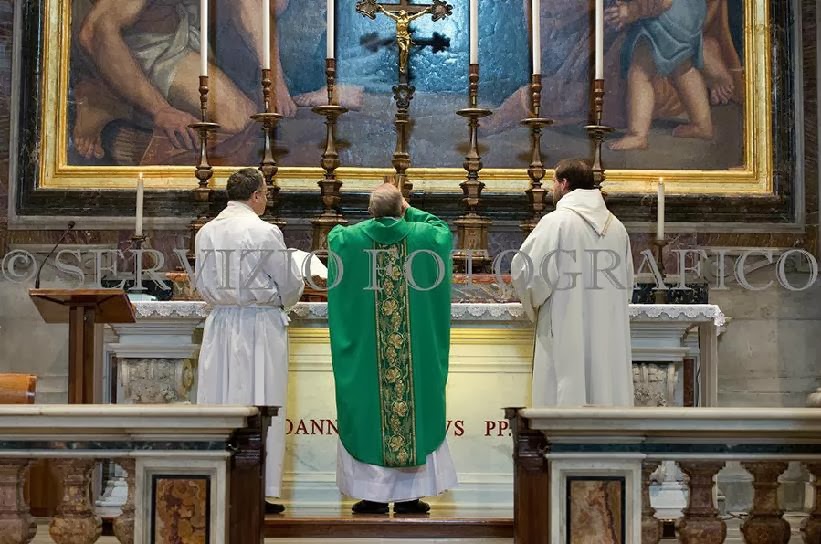
Our 12:10 PM Sunday Mass for the past two years now has the exact same music/chants as all our other Masses. The only difference is that the Liturgy of the Eucharist, beginning with the Preparations of the Offerings is ad orientem.
While there may have been some who dislike this arrangement, when we instituted it two years ago, I had only one person, who doesn't attend this Mass but went to experience it, who wrote to me that they did not like it. No one else has complained and there is not been any noticeable decline in attendance at this Mass. In fact at yesterday's Mass I was quite impressed with the number of young people there and young families who far outnumbered those approaching the grave, my age and older.
But I digress. I love celebrating Mass in either direction as well as the Extraordinary Form, although as I have stated before, while I love Latin, I love the vernacular and wish we could use the amount of English used in the 1965 Missal for the 1962 missal. I find it ridiculous that we can't.
But let's get back to our normal ad orientem 12:10 PM Mass. The Introductory Rite as well as the Concluding Rite are at the chair as is every other OF Mass we have. The Liturgy of the Word is identical. We have Holy Communion under both kinds and Extraordinary Ministers of Holy Communion to allow for this and the various stations we need, six chalices and four Host stations.
But for me personally (I can't speak for those in the congregation) I find the Liturgy of the Eucharist to be more solemn and more devotional for me. It also emphasizes better the two aspects of Holy Mass, the Sacrifice and the "Supper" or the Banquet of the Holy Eucharist in the Rite of Holy Communion.
Let me explain. Liturgical progressives formed in the deformed theology of the Mass in the 1970's, forgot or denigrated or ignored the sacrificial aspect of the Holy Eucharist and especially that of the Eucharistic Prayer, which actually begins with the Preface Dialogue and all that follows through the Great Amen and no matter the Eucharistic Prayer that is chosen.
Some progressives believe erroneously that the Eucharistic Prayer in its entirety is consecratory of the bread and wine which become the Most Precious Body, Blood, Soul and Divinity of our gloriously risen Lord and Savior Jesus Christ. That is simply false!
The bread and wine become the Body and Blood of Christ at the consecratory words, the words of institution. Each at their separate consecrations, but both are completely the Risen Christ albeit in a sacramental mode of presence. So, if the priest dies after the consecration of the host prior to the consecration of the wine, or he dies after the consecration of both, but before continuing with the rest of the Eucharistic Prayer, are the "accidents" consecrated or not? As far as I understand it, YES!
But the Mass as a sacrifice is not completed and if not completed would be invalid as a sacrifice, but the hosts or the hosts and "Wine" would nonetheless be consecrated. Technically another priest should conclude the Mass in the event that the celebrant dies prior to doing so to make the sacrificial part of the Mass valid, meaning that the Risen Lord in the Offerings is then actually offered to the Father!
And thus my point about the Eucharistic Prayer no matter which one. The entire prayer is needed not for consecration, but for Sacrifice. Progressive theologians and rank and file clergy and laity are completely oblivious to this since they only focus on the "meal" aspect of the Eucharist and not on the sacrificial.
The priest acting in the person of Christ, must offer the risen Lord, in an unbloodly, sacrificial way to the Father, he isn't offering unconsecrated "accidents." The bread and wine must be the Risen Lord to be offered to the Father. When does this take place? At the preparation of the offerings? No! During the Preface, Sanctus and first part of the EP after the Sanctus but prior to the words of consecration to include the calling of the Holy Spirit upon the offerings known as the Epiclesis? No! At the consecration? No!
The SACRIFICIAL OFFERING of our Risen Lord under the forms of "Bread" and "Wine" takes place after these become the Body of Blood of our Lord. It occurs during the "anemesis" which is the prayer immediately following the consecration but not the entire part of the EP following the consecration, but only that portion which the main celebrant either chants or says alone prior to any concelebrant taking over.
The reason why I think that the sacrificial aspect of the Eucharistic Prayers are best made clear in the ad orientem Liturgy of the Eucharist is that it is clear that this part of the Mass is sacrificial! No one is to eat and drink the Body and Blood of Christ prior to the Rite of Holy Communion which begins with the Pater Noster! And it is absolutely necessary for the completion of the Holy Sacrifice of the Mass for the priest to consume the Holocaust even if no laity receive Holy Communion.
Certainly the "Per Ipsum" makes clear also, the sacrificial aspect of the second part of the Eucharistic Prayer as the priest(s) offering our Lord to God the Father and by the power of the Holy Spirit, which we know and believe that God the Father accepts! But God the Father returns to us (in the resurrection and in each and every Holy Sacrifice of the Mass) His Son whose Sacrifice He lovingly accepts for all eternity. Our "eating and drinking" of the Body and Blood of Christ is for us and our salvation but not independent of the Sacrificial aspect of the Eucharistic Prayer and the Offering of our Lord on the Cross, the Father's acceptance of this and His return to us of His Son in Holy Communion, meaning the Rite of Holy Communion, not during the Eucharistic Prayer!!!!!
Howe many of you know this? How many Catholics after Vatican II until today really know and believe this? Even if the laity do not receive Holy Communion at a particular Mass (the celebrant must though to complete the Sacrifice) the Sacrifice of the Real Presence of Christ after the consecration is what is necessary for us to see and hear! As well as the self-offering of the Risen Christ to His Heavenly Father which the Father accepts and returns our Risen Lord to us in the Banquet part of the Holy Sacrifice of the Mass! Do you know this and has the Liturgy of the Eucharist facing the people with the priest proclaiming the prayer in such a fashion as it makes it appear to being read or proclaimed to the congregation????? Tell me about this. (BTW, I am not calling into question the sacrificial aspect of any Mass celebrated toward the congregation, but only the "sign" value of such and what this has done to rank and file clergy and priests and not for the better in the last 50 years!
So when I turn away from the altar and toward the congregation prior to my receiving Holy Communion to complete the sacrifice and the laity being allowing to receive the same Offering after me at their Holy Communion, it is clear at that point, when the priest says, "Behold the Lamb of God, behold Him who takes away the sins of the world, Blessed are those who are called to the Supper of the Lamb, followed by all saying "Lord I am not worthy..." this is the point of the supper or banquet of the Mass and certainly the priest should be gesturing toward the congregation, not during the Eucharistic Prayer and certainly not at the consecrations which too many priests and bishops actually do!
That's why I think ad orientem is the best posture for the priest at all Masses and specifically for the Eucharistic Prayer!




.JPG)


.JPG)


 G
G


