Translate

Friday, March 29, 2013

HOLY THURSDAY'S EVENING MASS OF THE LORD'S SUPPER, SAINT JOSEPH CHURCH, MACON, GA

MY GRATITUDE TO DR. BUCK MELTON FOR TAKING SUCH GRAND PICTURES OVER THE YEARS, CHRONICLING MY TIME HERE AT SAINT JOSEPH CHURCH!

Incense king!

Liturgy of the Word:

Our deacon has never looked so good!

Don't I look just like Pope Francis?

The first guy shocked me with his decorated feet!


Our parochial vicar, whose name I don't recall, did six and I did six! I know, I know, I'm just like Pope Francis in breaking the rubrics of the Mass!

Presentation of the Chrism and other oils from the Bishop's Chrism Mass on Tuesday night:


Stripping of the Altar:


BOMBSHELL: REFORM OF THE REFORM OF THE PAPAL COAT OF ARMS

This is the first design shown to the world recently:

And this bombshell! The Reform of the Reform of the papal coat of arms just released as a variation:

I like the reform of the reform one!

GOOD FRIDAY AND CHRIST THE BRIDEGROOM!

This, my brothers and sisters is the traditional image of Christ the Bridegroom of the Church and yes, it is from the Passion of our Lord on Good Friday, prior to His glorious resurrection. Does this image of Christ the Bridegroom discomfort you?


And here the perversion of Christ the Bridegroom into "Christa." This actually hung in the Episcopal Cathedral of Saint John the Divine in upper Manhattan in the 1970's. This was when women in the Episcopal Church were screaming for ordination to the priesthood. When the Bridegroom is perverted sacramentally or otherwise so is marriage:


A prayer to save the Church from heresy and blasphemy which is the Fatima prayer, a devotion and private revelation which Pope Francis takes very seriously:

O my Jesus, forgive us our sins, save us from the fires of hell, and lead all souls to Heaven, especially those in most need of Thy mercy.

THIS RERUN SHOULD CALM THE FEARS OF THOSE WHO ARE FREAKING OUT ABOUT POPE FRANCIS

Pope Francis is discomforting the "Reform of the Reform" group and many are saying that this movement is now dead. I would not be so quick as to write an obituary yet. But I did coin on another blog a few days back another term: "the counter-reform of the reform of the reform."

Those who are wild progressives will not like Pope Bergoglio's contention that the "smoke of Satan" has entered the Church distracting us from that which is central to our faith, which are hope and charity, with charity being the most enduring. They won't like his talk about popular devotions and the necessity of these especially a profound piety and devotion to our Blessed Mother. They won't like the talk of relativism and all things being equal when in fact they aren't.

Pope Francis will lead us into a revival of popular devotions, street processions and honoring our Blessed Mother in ways that have been discarded since Vatican II by the liturgical elitists who thought these were nonsense.

What most people are applauding or wringing their hands over is style over substance. Certainly the Holy Father's simple style is meant to be symbol of his desire for the Church to be seen as identifying with the poor and caring for them. Of course there are two kinds of poor people. The first would be the materially poor, who could be spiritually and religiously poor also. The second is the rich person who could be spiritually and materially poor at the same time.

Then you have rich and poor in the material sense who are both rich in the spiritual and religious sense. If not for the stewardship of this group either from their material or spiritual wealth the truly poor in both categories would not be assisted by the Church to the extent that they are.

But, let's talk theological substance. Here is a rerun of a video I post last week. It gives you insights into the theological mind of Pope Francis only a few weeks prior to his election as the Bishop of Rome. Please note the quick glimpse of the Benedictine Altar arrangement at a Church where the Cardinal was celebrating a liturgy! But again, that is only style, please listen to his substance!

OKAY, THE HOLY FATHER ISN'T THE ONLY ONE WHO BENDS THE RUBRICS


We hear confessions each morning before our 8:00 AM daily Mass. We begin at 7:30 AM and try to finish by 7:50 AM. Of course since we didn't have Mass in the morning of Holy Thursday, we did not plan on having confessions. Word didn't get to everyone though!

Since I didn't have the 8:00 AM Mass, I went to the gym for my morning exercise a bit later than usual. I usually get there at 5:45 AM and get back by 6:50 or so in order to shower and get ready for Mass. On Holy Thursday I got back to the church at 7:30 AM and I noticed a man sitting outside the locked church. I told him we didn't have a morning Mass on Holy Thursday. He said, I needed to go to confession and I said, well if you don't mind I can hear it here in the parking lot.

No sooner had I begun to hear his confession, the little boy in the pictures who had missed his First Confession a couple of weeks ago was brought by his mom for his First Holy Confession prior to the family departing for an Easter vacation.

So I had my first, hearing a First Confession outside in the parking lot without clerical garb or stole and the child's mom captured the spectacle on digital "film" catching me in the act of breaking a rubric of proper attire for a sacrament.

Just a disclaimer, I don't hear confessions like this except in extreme situations. After this First Confession I did open the Church and go to the confessional and put on a stole and heard about 8 more confessions of people wanting to go!

Thursday, March 28, 2013

HE MAY BE ARGENTINIAN, BUT HE IS VERY ITALIAN!


I just got a call from my first cousin, Gina Bartolomeo, who has been in Chicago since 1958, but is still an Italian citizen and does not speak English as well as my mother did! She's having a heart valve replacement in two weeks, so please say a prayer for her. Italians milk these sorts of things for all their worth, but at heart they can be quite pessimistic and morose about these sorts of things filled with legitimate worry. I told her not to worry, but to be happy. She said in Italian, "that's easy for you to say!"

So in Italian she asked me "do you like the pope? I love him very much!" I told her in my mix of Italian and English that I like him very much too, he's very Italian I said!

This pope will win over Italians and already has done so and if he can get them back to church in big numbers, well then, he's a godsend.

I've always stated that while I might not like this, that or the other and can see many sides to most issues, religious or otherwise, as a Catholic I'm sticking with the pope through thick and thin and casting aside my expertise if I were pope, which I have none obviously.

So Italians bend the rules, care for people and if the light is red and there isn't anyone around, especially the police, you go. And when everyone is driving in a crazy manner, for someone to think that he can change the Italian way of things by obeying the rules will be martyred in no time soon on the Italian streets.

I'm discomforted by some of the iconoclasm of this pope; I was discomforted by some of the things of the other popes. But you know what? This is Christ's Church and surely during this Holy Week we know that Christ discomforted many people, especially the most religious of His day to include the most irreligious in His plan of salvation.

So in the Church there is room for the EF, the OF, the EP and the OP. There is room for chant and more contemporary forms of singing and instrumentation. We don't have to like it all, but we do have to love God and neighbor, the first three Commandments focusing on love of God and the next seven focusing on love of neighbor. I wonder why there are more Commandments on love of neighbor than on love of God. Did God make a mistake?

HISTORY IN THE MAKING, POPE WASHES FEET OF TWO WOMEN (GIRLS)

You can see more pictures by pressing HERE for Zenit's New Service on Facebook:

The Holy Father wears a deacon's stole to do this as he did as Archbishop in Argentina!


His homily lasted all of two minutes if that long, like my daily Mass homilies! Mine tonight will last 10 minutes! Rupture already!

As translated by Vatican Radio, the following is an English rendering of Pope Francis' off-the-cuff homily at the Mass of the Lord's Supper (readings), which the new pontiff decided to celebrate in Rome's Casal del Marmo juvenile detention facility:

“This is moving, Jesus washes the feet of his disciples. Peter understands nothing. He refuses but Jesus explains to him. Jesus, God did this, and He Himself explains it to the disciples.. ‘Do you realize what I have done for you? You call me ‘teacher’ and ‘master,’ and rightly so, for indeed I am. If I, therefore, the master and teacher, have washed your feet, you ought to wash one another’s feet. I have given you a model to follow, so that as I have done for you, you should also do’.

It is the example set by Our Lord, it’s important for Him to wash their feet, because among us the one who is highest up must be at the service of others. This is a symbol, it is a sign – washing your feet means I am at your service. And we are too, among each other, but we don’t have to wash each other’s feet each day. So what does this mean? That we have to help each other…sometimes I would get angry with one someone, but we must let it go and if they ask a favor of do it!

Help one another. This is what Jesus teaches us. This is what I do. And I do it with my heart. I do this with my heart because it is my duty, as a priest and bishop I must be at your service. But it is a duty that comes from my heart and a duty I love. I love doing it because this is what the Lord has taught me. But you too must help us and help each other, always. And thus in helping each other we will do good for each other.

Now we will perform the ceremony of the Washing of the Feet and we must each one of us think, Am I really willing to help others? Just think of that. Think that this sign is Christ’s caress, because Jesus came just for this, to serve us, to help us”.

WHEN OUR PEOPLE LEAVE MASS, DO THEY LOOK LIKE THEY'VE HEARD GOOD NEWS?

Pope Francis uses same "chair of Peter" and same vestments and podium as for the Installation Mass Tuesday inside St. Peter's for this morning stunningly beautiful and solemn Chrism Mass. Thank you Msgr. Marini!

And yes, the Bishop of Rome will wash the feet of a girl or two at the prison Mass of the Lord Supper. Just think, the Bishop of Rome takes seriously the need to minister to all God's priestly people, ministerial and otherwise! Washing of the Feet is symbolic not or ordination but of service, that Christ's ordained priests must "smell like their sheep." This is precisely the reason why some priests grow dissatisfied, become sad priests, lose heart and become in some sense collectors of antiques or novelties – instead of being shepherds living with “the smell of the sheep”, shepherds in the midst of their flock...

(COMPLETE HOMILY AT THE END OF THIS POST)

GREAT HOMILETIC IMAGE: "A priest who seldom goes out of himself, who anoints little – I won’t say “not at all” because, thank God, our people take our oil from us anyway – misses out on the best of our people, on what can stir the depths of his priestly heart. Those who do not go out of themselves, instead of being mediators, gradually become intermediaries, managers. We know the difference: the intermediary, the manager, “has already received his reward”, and since he doesn’t put his own skin and his own heart on the line, he never hears a warm, heartfelt word of thanks. This is precisely the reason why some priests grow dissatisfied, become sad priests, lose heart and become in some sense collectors of antiques or novelties – instead of being shepherds living with “the smell of the sheep”, shepherds in the midst of their flock, fishers of men. True enough, the so-called crisis of priestly identity threatens us all and adds to the broader cultural crisis; but if we can resist its onslaught, we will be able to put out in the name of the Lord and cast our nets. It is not a bad thing that reality itself forces us to “put out into the deep”, where what we are by grace is clearly seen as pure grace, out into the deep of the contemporary world, where the only thing that counts is “unction” – not function – and the nets which overflow with fish are those cast solely in the name of the One in whom we have put our trust: Jesus."
Pope Francis is going to prove to be a great homilist in using imagery that we can chew on and enjoy. He wants priests to have the smell of their sheep, meaning that the priests' lives should be so intermingled with their parishioners in terms of ministry that they begin to smell like them. Interesting no?

And then this zinger! When our people depart Mass do they leave with a look on their face that indicates they have just heard "good news?"

I report, you decide. When you leave Mass, is the joy on your face because Mass is over or you've heard good news from your priest?

Priests are to be mediators not intermediaries. We priests are not managers or collectors of antiques or novelties. Priests are to become Shepherds taking on the smell of their sheep living in the midst of their flock. In other words, I guess I could say that we priests are not "middle men" in terms of commerce, but mediators of the grace of God's love and divine presence in a human way.

The Holy Father continues the Benedictine Altar arrangement in St. Peters, no novelties there. His Mass is a continuation of the hybrid of Italian and Latin, with the Preface and Eucharistic Prayer in Latin. He continues to distribute Holy Communion to kneeling deacons by way of intinction and the concelebrating priests and bishop take their Host after the Bishop of Rome has communed and intinct it into the Precious Blood.

The Holy Father has a wonderful solemn style of celebrating Mass, except for chanting of course, that priests would do well to emulate.

Two important quotes from the Bishop of Rome's Chrism Mass homily, our Holy Father:

"A priest who seldom goes out of himself, who anoints little – I won’t say “not at all” because, thank God, our people take our oil from us anyway – misses out on the best of our people, on what can stir the depths of his priestly heart. Those who do not go out of themselves, instead of being mediators, gradually become intermediaries, managers. We know the difference: the intermediary, the manager, “has already received his reward”, and since he doesn’t put his own skin and his own heart on the line, he never hears a warm, heartfelt word of thanks. This is precisely the reason why some priests grow dissatisfied, become sad priests, lose heart and become in some sense collectors of antiques or novelties – instead of being shepherds living with “the smell of the sheep”, shepherds in the midst of their flock, fishers of men.”

And the other quote:

“From the beauty of all these liturgical things, which is not so much about trappings and fine fabrics than about the glory of our God resplendent in his people”


HOMILY OF POPE FRANCIS
HOLY THURSDAY CHRISM MASS
ST PETER'S BASILICA
28 MARCH 2013


Dear Brothers and Sisters, This morning I have the joy of celebrating my first Chrism Mass as the Bishop of Rome. I greet all of you with affection, especially you, dear priests, who, like myself, today recall the day of your ordination.

The readings of our Mass speak of God’s “anointed ones”: the suffering Servant of Isaiah, King David and Jesus our Lord. All three have this in common: the anointing that they receive is meant in turn to anoint God’s faithful people, whose servants they are; they are anointed for the poor, for prisoners, for the oppressed… A fine image of this “being for” others can be found in the Psalm: “It is like the precious oil upon the head, running down upon the beard, on the beard of Aaron, running down upon the collar of his robe” (Ps 133:2). The image of spreading oil, flowing down from the beard of Aaron upon the collar of his sacred robe, is an image of the priestly anointing which, through Christ, the Anointed One, reaches the ends of the earth, represented by the robe.

The sacred robes of the High Priest are rich in symbolism. One such symbol is that the names of the children of Israel were engraved on the onyx stones mounted on the shoulder-pieces of the ephod, the ancestor of our present-day chasuble: six on the stone of the right shoulder-piece and six on that of the left (cf. Ex 28:6-14). The names of the twelve tribes of Israel were also engraved on the breastplate (cf. Es 28:21). This means that the priest celebrates by carrying on his shoulders the people entrusted to his care and bearing their names written in his heart. When we put on our simple chasuble, it might well make us feel, upon our shoulders and in our hearts, the burdens and the faces of our faithful people, our saints and martyrs of whom there are many in these times…

From the beauty of all these liturgical things, which is not so much about trappings and fine fabrics than about the glory of our God resplendent in his people, alive and strengthened, we turn to a consideration of activity, action. The precious oil which anoints the head of Aaron does more than simply lend fragrance to his person; it overflows down to “the edges”. The Lord will say this clearly: his anointing is meant for the poor, prisoners and the sick, for those who are sorrowing and alone. The ointment is not intended just to make us fragrant, much less to be kept in a jar, for then it would become rancid … and the heart bitter.

A good priest can be recognized by the way his people are anointed. This is a clear test. When our people are anointed with the oil of gladness, it is obvious: for example, when they leave Mass looking as if they have heard good news. Our people like to hear the Gospel preached with “unction”, they like it when the Gospel we preach touches their daily lives, when it runs down like the oil of Aaron to the edges of reality, when it brings light to moments of extreme darkness, to the “outskirts” where people of faith are most exposed to the onslaught of those who want to tear down their faith. People thank us because they feel that we have prayed over the realities of their everyday lives, their troubles, their joys, their burdens and their hopes. And when they feel that the fragrance of the Anointed One, of Christ, has come to them through us, they feel encouraged to entrust to us everything they want to bring before the Lord: “Pray for me, Father, because I have this problem”, “Bless me”, “Pray for me” – these words are the sign that the anointing has flowed down to the edges of the robe, for it has turned into prayer. The prayers of the people of God. When we have this relationship with God and with his people, and grace passes through us, then we are priests, mediators between God and men. What I want to emphasize is that we need constantly to stir up God’s grace and perceive in every request, even those requests that are inconvenient and at times purely material or downright banal – but only apparently so – the desire of our people to be anointed with fragrant oil, since they know that we have it. To perceive and to sense, even as the Lord sensed the hope-filled anguish of the woman suffering from hemorrhages when she touched the hem of his garment. At that moment, Jesus, surrounded by people on every side, embodies all the beauty of Aaron vested in priestly raiment, with the oil running down upon his robes. It is a hidden beauty, one which shines forth only for those faith-filled eyes of the woman troubled with an issue of blood. But not even the disciples – future priests – see or understand: on the “existential outskirts”, they see only what is on the surface: the crowd pressing in on Jesus from all sides (cf. Lk 8:42). The Lord, on the other hand, feels the power of the divine anointing which runs down to the edge of his cloak.

We need to “go out,” then, in order to experience our own anointing, its power and its redemptive efficacy: to the “outskirts” where there is suffering, bloodshed, blindness that longs for sight, and prisoners in thrall to many evil masters. It is not in soul-searching or constant introspection that we encounter the Lord: self-help courses can be useful in life, but to live by going from one course to another, from one method to another, leads us to become pelagians and to minimize the power of grace, which comes alive and flourishes to the extent that we, in faith, go out and give ourselves and the Gospel to others, giving what little ointment we have to those who have nothing, nothing at all.

A priest who seldom goes out of himself, who anoints little – I won’t say “not at all” because, thank God, our people take our oil from us anyway – misses out on the best of our people, on what can stir the depths of his priestly heart. Those who do not go out of themselves, instead of being mediators, gradually become intermediaries, managers. We know the difference: the intermediary, the manager, “has already received his reward”, and since he doesn’t put his own skin and his own heart on the line, he never hears a warm, heartfelt word of thanks. This is precisely the reason why some priests grow dissatisfied, become sad priests, lose heart and become in some sense collectors of antiques or novelties – instead of being shepherds living with “the smell of the sheep”, shepherds in the midst of their flock, fishers of men. True enough, the so-called crisis of priestly identity threatens us all and adds to the broader cultural crisis; but if we can resist its onslaught, we will be able to put out in the name of the Lord and cast our nets. It is not a bad thing that reality itself forces us to “put out into the deep”, where what we are by grace is clearly seen as pure grace, out into the deep of the contemporary world, where the only thing that counts is “unction” – not function – and the nets which overflow with fish are those cast solely in the name of the One in whom we have put our trust: Jesus.

Dear lay faithful, be close to your priests with affection and with your prayers, that they may always be shepherds according to God’s heart.

Dear priests, may God the Father renew in us the Spirit of holiness with whom we have been anointed. May he renew his Spirit in our hearts, that this anointing may spread to everyone, even to those “outskirts” where our faithful people most look for it and most appreciate it. May our people sense that we are the Lord’s disciples; may they feel that their names are written upon our priestly vestments and that we seek no other identity; and may they receive through our words and deeds the oil of gladness which Jesus, the Anointed One, came to bring us. Amen.

Wednesday, March 27, 2013

THE HOLY FATHER'S FIRST WEDNESDAY GENERAL AUDIENCE!


FRANCIS' FIRST GENERAL AUDIENCE: FOLLOWING JESUS IS LEARNING TO GO OUT OF OURSELVES
Vatican City, 27 March 2013 (VIS) -
“I am happy to welcome you to this, my first general audience,” Pope Francis said to the thousands of faithful who filled St. Peter's Square to participate in the Bishop of Rome's first catechesis. “With gratitude and veneration,” he continued, “I take up this 'witness' from the hands of my beloved predecessor, Pope Benedict XVI. After Easter we will return to the catechesis of the Year of Faith. Today I want to focus on Holy Week. We began this week—the heart of the entire liturgical year—during which we accompany Jesus in his Passion, Death, and Resurrection, with Palm Sunday.
“But what,” the Pope asked, “does it mean for us to live Holy Week? What does it mean to follow Jesus on his journey to Calvary, toward the Cross and his Resurrection? On his earthly mission, Jesus walked the streets of the Holy Land. He called 12 simple persons to stay with him, sharing his path and continuing his mission … He spoke to everyone, without distinction: to the great and the humble ... the powerful and the weak. He brought God's mercy and forgiveness. He healed, consoled, understood. He gave hope. He brought to all the presence of God who cares for every man and woman as a good father and a good mother cares for each of their children.”

“God,” Francis emphasized, “didn't wait for us to come to him. It was He who came to us. … Jesus lived the everyday reality of the most common persons. … He cried when he saw Martha and Mary suffering for the death of their brother Lazarus … He also experienced the betrayal of a friend. In Christ, God has given us the assurance that He is with us, in our midst. … Jesus has no home because his home is the people, us ourselves. His mission is to open the doors to God for all, to be the presence of God's love.”
“During Holy Week we are living the apex … of this plan of love that runs throughout the history of the relationship between God and humanity. Jesus enters into Jerusalem to take the final step in which his entire existence is summed up. He gives himself completely, keeping nothing for himself, not even his life. At the Last Supper, with his friends, He shares the bread and distributes the chalice 'for us'. The Son of God offers himself to us; puts his Body and his Blood in our hands to be always with us … And in the Garden of the Mount of Olives, as at the trial before Pilate, he makes no resistance, but gives himself.”
“Jesus doesn't live this love that leads to sacrifice passively or as his fatal destiny. He certainly didn't hide his deep human turmoil when faced with violent death, but he entrusted himself to the Father with full confidence ... to show his love for us. Each one of us can say, 'Jesus loved me and gave himself up for me'.”

“What does this mean for us? It means that this path is also mine, also yours, also our path. Living Holy Week, following Jesus not only with moved hearts, means learning to come out of ourselves … in order to meet others, in order to go toward the edges of our existence, to take the first steps towards our brothers and sisters, especially those who are farthest from us, those who are forgotten, those who need understanding, consolation, and assistance.”

“Living Holy Week is always going deeper into God's logic, into the logic of the Cross, which is not first and foremost a logic of sorrow and death but one of love and the self giving that brings life. It is entering into the logic of the Gospel. Following, accompanying Christ, staying with him when he demands that we 'go out': out of ourselves, out of a tired and habitual way of living the faith, out of the temptation of locking ourselves in our own schemes that wind up closing the horizon of God's creative action. God went out of himself in order to come amongst us … to bring us the mercy … that saves and gives hope. And we, if we want to follow and remain with him, cannot be satisfied with staying in the sheep pen with the ninety-nine sheep. We have to 'go out', to search for the little lost sheep, the furthest one, with him.”

“Often,” he observed, “we settle for some prayers, a distracted and infrequent Sunday Mass, some act of charity, but we don't have this courage to 'go out' and bring Christ. We are a little like St. Peter. As soon as Jesus talks of his passion, death, and resurrection, of giving himself and love for all, the Apostle takes him aside and scolds him. What Jesus is saying shakes up his plans, seems unacceptable, the safe certainty he had constructed, his idea of the Messiah, in difficulty. And Jesus … addressing some of the harshest words of the Gospel to Peter, says: 'Get behind me, Satan. You are thinking not as God does, but as human beings do.' God thinks mercifully. God thinks like a father who awaits the return of his son and goes out to meet him, sees him coming when he is still afar … a sign that he was awaiting him every day from the terrace of his house. God thinks like the Samaritan who doesn't pass by the unfortunate man, pitying him or looking away, but rather assisting him without asking anything in return, without asking if he was a Jew or a Samaritan, rich or poor.”

“Holy Week,” Francis concluded, “is a time of grace that the Lord gives us to open the doors of our hearts, of our lives, of our parishes—so many closed parishes are a shame—of our movements and associations, to 'go out' and meet others, to draw near them and bring them the light and joy of our faith. To always go out with the love and tenderness of God!”
After the catechesis and the summaries in different languages that the Gospel readers gave, the Pope greeted all the groups in Italian. Also in Italian, he addressed, among other groups, the university students participating in the international UNIV Congress sponsored by the Prelature of Opus Dei, thanking them for their prayers and affection for the Pope. “With your presence in the university world, each one of you carries out what St. Josemaria Escriva wished for: 'It is in the midst of the most material things of the earth that we must sanctify ourselves, serving God and all humankind'.”


IS THE "REFORM OF THE REFORM WITH CONTINUITY" DEAD? IT DEPENDS ON WHAT THE MEANING OF "IS" IS!


Perhaps I live in a different Church from those who read my blog, but I have never seen the Extraordinary Form of the Mass as anything but Extraordinary. If my parish had had over 150 to 200 people, from my parish, not the diocese, attending the once a month EF High Mass and others finding it what they need spiritually, I would have made our 12:10 PM Mass an EF Mass. As it stands only about 50 or so of St. Joseph parishioners find this Mass something they would want every Sunday. That is simply not enough to warrant displacing 400 people who attend the 12:10 PM Mass faithfully. Of course I have made the 12:10 PM Mass ad orientem and this has been well-received with only one complaint. So in this regard the EF Mass has had a gravitational pull on the OF Mass.

We also chant, in addition to any congregational hymn singing, the official Introit, Offertory and Communion antiphons at every Sunday Mass. This recovery has been wonderful and shows how these chants enrich the celebration of the Mass and set the tone for any given liturgy.

The reform of the reform in my estimation means celebrating the modern missal as it was intended to be celebrated. Where we get into heated debate concerns ad orientem, Benedictine altar arrangement, and music. There is no consensus on these elements and no mandates. The Church is all over the place concerning these three things with music being the biggest looser.

My understanding of the reform of the reform has nothing to do with limiting the expanded understanding of actual participation to include singing and speaking by the laity as well as internal participation quietly; it's not either/or but both/and and it is here that the Ordinary Form of the Mass must have a gravitation pull on the Extraordinary Form of the Mass with our laity who attend the EF.

The reform of the reform has nothing to do with eliminating liturgical roles given to the laity and women in particular as it concerns reader, Extraordinary Minister of Holy Communion and altar server. Those in the EF community who see the elimination of women in the sanctuary haven't been watching Pope Benedict and his liturgies in Rome and elsewhere. This is not going to happen in the Ordinary Form of the Mass.

What I would like to see is a more sober approach to our singing to include more chant as it is truly noble simplicity. The modern music we use today is too triumphant in sound and style, to much geared to superficial excitement rather than any real debt of meaning and experience from a truly Catholic spirituality.

So the on-going reform of the reform I believe means:

1. Recovering Gregorian Chant and Polyphony and vernacular chant based upon these two styles

2. Singing the Propers that are assigned to any given Mass, i.e. Introit, Offertory and Communion Antiphons

3. Developing more sober expressions of the Kyrie, Gloria, Sanctus, Mystery of Faith and Agnus Deiin the vernacular and a recovery of the Latin ones and giving the organ once again pride of place or even no instrumentation

We had our Chrism Mass last night at the Cathedral. I found the selection of music and the instrumentation of the music a bit too triumphalist especially given the more simple emphasis of our new Pope Francis and that it is the season of Lent, Holy Week specifically. There was brass and a somewhat operatic setting of the Responsorial Psalm and an Easter-like Gloria with refrain that makes it way too long. The Mass of Creation is better suited for Eastertide, especially with brass embellishments.

I thought to myself how beautiful it would have been simply to chant the given Introit, a simple Latin or English Gloria, a plain chant responsorial psalm and had no instrumentation for the Sanctus, Mystery of Faith, Great Amen and Agnus Dei and simply sung the Jubilatio Deo versions of these in Latin. I think the entire diocese should know this setting of the Mass in Latin and when there are diocesan events, especially with mixed language congregations, it should be used.

Sobriety of music not musical triumphalism is what is needed in the on-going "reform of the reform" but I think this call is falling on deaf ears everywhere except in the Church Music Association of America, which like a mustard seed will help bring about a true "reform of the reform" without a radical redesign of the Mass or its style of celebration.


Tuesday, March 26, 2013

CONTINUITY AND RUPTURE AND WAITING TO SEE WHERE THINGS GO

Of course, as we all know, Pope Benedict never rode in an open air jeep, he had to be behind bullet proof glass all the time!


Everyone is trying to read the tea leaves or focus their crystal balls to see where Pope Francis will lead the Church. So every move he makes, we think there is a symbolic meaning behind it, when in fact there may simply be practical considerations.

Also, I do think the "smoke of Satan" is entering the Church and her various divisive factions to derail Pope Francis or derail the traditionalist's desire for more respect from the institutional Church especially her pastors, i.e. bishops and priests.

Thus some in the Church with the aid of the media, both Catholic and otherwise seem to be pitting Pope Francis against Pope Benedict and thus tradition. John Allen in the NCR, the National Chismatic Reporter, has a good article on this which you can READ HERE.

1. The first incendiary false report, reported though on Catholic blogs as fact, was that Pope Francis told Msgr. Marini, the papal Master of Ceremonies, that when he was given the mozzetta to put on prior to coming to the loggia for his announcement, that he told Msgr. Marini, "the carnival is over." That is somewhat crass and insulting not only to Msgr. Marini but to many others in the Church, but evidently not all. Many took sinful pleasure in this falsehood. We know now, that it is Pope Francis' desire to not to put on airs. Now we might not like that, we might disagree with that, but that is the fact. He didn't say "the carnival is over."

2. A complete falsehood to make Pope Benedict look bad compared to the new pope is that Pope Francis immediately sent Cardinal Law packing to a monastery. This was reported as fact and even many of my commenters were duped by this fake story. It was a parody, I believe, to show that either Pope Benedict could have done this as easily as Pope Francis did, or that Pope Francis isn't going to do anything like Pope Benedict. In either case it is a slam against the pope.

3. The other contrast is that Pope Francis is the "people's pope" and Pope Benedict never engaged the crowds or rode in an open air jeep in the square. That is a lie as evidenced by the photos above taken just last year.

We know too that Pope Benedict wore simple vestments of modern style, as well as miters, and that he wore very elaborate, ornate antique vestments and that he likes the little "t" traditions associated with the papal court and the deference shown the office of the papacy, although I would say that Pope Benedict himself is a very humble person. But he was able to make the distinction between his own personality and the personality of the office, so to speak and enhanced the personality of the office while subduing his own.

Pope Francis has a different take on this and is imposing, as it were, what he would perceive to be a noble simplicity upon the office of the papacy in line with his theology of the Church identifying with the poor and that possessions are not important as you can't put them in the pocket of your burial shroud since there aren't any.

Just as many progressives dislike so much that Pope Benedict brought back, including the 1962 missal, traditionalists will dislike Pope Francis putting some of these things back into the closet and ignoring them. I don't think he will suppress any of them and certainly not Summorum Pontificum. He won't advocate it either. I think he will have a live and let live papacy especially as it regards the liturgy, OF or EF.

But if you notice the photo of Pope Benedict out in the open air jeep less than a year ago, you will notice that his vestments are as simple as the one that Pope Francis wore on Palm Sunday.

A year from now we will be in a better position to evaluate the pros and cons of the papacy of Pope Francis and what effect it is having on the Church.

So far, I think his mandate and agenda are the following, some of which will affect bishops more than laity and priests. So his agenda may be to reform the style of the bureaucracy of the Church and that will be good, for both at the Vatican and in dioceses the bureaucracy sometimes thwarts the ministry of bishops and is not responsive to either the bishop's agenda or the needs of the Church, universal or local.

So this is the agenda I see emerging for the papacy of Pope Francis.

1. He will model for other bishops what bishops should be doing in their own dioceses. That is why Pope Francis is emphasizing that he is the Bishop of Rome and is trying first to win his own diocese over to him. He is the pope of the people and is reaching out to his parishioners and endearing them to him. All bishops should be doing that and not set themselves so distant from the laity that he seem unapproachable.

2. His liturgies are quite beautiful thus far, very reverent and very solemn. Okay, he can't sing but we can't hold that against him or make more out of that than it is. Bishops should have beautiful liturgies.

3. The curia will be reformed and streamlined and that will be a blessing on many levels. Dioceses need to do the same thing. BLOAT is the biggest problem in many dioceses with some personnel power hungry rather than service oriented, carping at the very people they are to serve rather than supporting them. The amount of money spent on useless positions is a scandal both in the Vatican and local dioceses.

4. He will be like Pope John Paul II in his ability to inspire young and bring them closer to the Church and Christ. He will continue to challenge the dictatorship of relativism and individualism as Pope Benedict did.

5. He will continue to try to recover from the sex scandals in the Church and purify the Church of the filth. But he is going to preach mercy and its great abyss and that the Church should not bow to the revenge seeking victim advocacy groups and the litigious lawyers who are profiting off of this tragedy. Reconciliation between the bishops who have sinned in their mismanagement of their dioceses and the laity put off by the scandal of infidelity and perversion left unchecked will be his goal, but not in the worldly sense of revenge seeking, but justice tempered by mercy.

BUT FOLKS, LET'S WAIT A YEAR AND GET TO KNOW POPE FRANCIS AND LET US SEE IF THERE IS A REVIVAL IN CATHOLICISM IN ROME, ITALY, THE REST OF EUROPE AND TO THE WORLD. CLAIRVOYANT THAT I AM, BUT MAYBE NOT, I PREDICT THAT THERE WILL BE THINGS HE DOES THAT WE LIKE AND THINGS THAT HE DOES THAT WE DISLIKE. BUT YOU KNOW WHAT? WE ARE ADULTS AND CAN TAKE IT! THE CHURCH IS MORE THAN ANY ONE POPE.

Other myths debunked, like Pope Benedict never ate or would sip in public:


And Pope Benedict sipping water publicly at Christmas Eve Mass this past year and wearing the fannon to boot while he does it. You can't get any more humble than that!

And of course Pope Benedict never touched or kissed people, so cold and aloof was he:

Yes this was taken when Benedict was still pope:


Monday, March 25, 2013

PROGRESSIVES BELIEVE THE "EF" AND "OF" WERE NOT FORESEEN BY VATICAN II AND THUS IS ILLEGITMATE; I WONDER IF THEY FEEL THE SAME THING ABOUT HAVING AN "EP" AND AN "OP" AT THE SAME TIME TOO?

Of the two forms of the one Latin Rite Mass and the two forms of the popes of the one Catholic Church, which one of each, if progressives are consistent in their whining, would they think Vatican II never foresaw happening in the Post Vatican II Church? According to their whine, which one of each of the two types of Mass and Popes should be suppressed today? I report you decide!

The EF Mass, one of two forms of the one Latin Rite:

The OF Mass, the other form of the one Latin Rite:

At the Praytell Blog, there are those who post and those who comment (I comment often as the lone voice of reason :))who believe that the Second Vatican Council never foresaw that the Latin Rite of the Catholic Church would have two forms of the one Latin Rite, the Extraordinary Form and the Ordinary Form, what is now called the EF and the OF.

But the same pope who gave us the Extraordinary Form of the Mass (EF) along with the Ordinary Form Mass (OF) as legitimate organic development in Vatican II reform in continuity has also given us the Emeritus Pope (EP) and the Ordinary Pope (OP) too! I wonder if they disagree with Pope Benedict on that too? Do they see Pope Francis as illegitimate and not foreseen that we would have two popes in the one Catholic Church? Do they vociferously disagree with Pope Benedict in bringing this new reality about in the Catholic Church which Vatican II never, ever, ever foresaw, just as they say Vatican II never foresaw two forms of the One Latin Rite?

The Emeritus Pope (EP) and the Ordinary Pope (OP). Which one, according to the progressive Catholic's mentality is "illegitimate" and thus the modern "anti-pope?"

Is it the (EP) on the chair of Peter or the (OP) on the couch?

LITURGICAL TASTES AND THE ONE WHO DECIDES

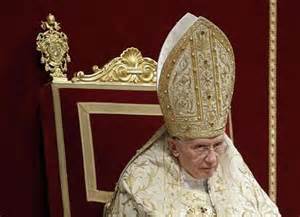
Don't expect to see this style of vestment, albs or otherwise, anytime soon again at the Vatican. To be honest with you, there is something about this photo that I think the world could misunderstand, not to mention, many loving, practicing, orthodox Catholics who love Liturgy that is more traditional than novel!

Palm Sunday last year and this year, what a difference a year makes in style!

When I was Master of Ceremonies for Bishop Raymond Lessard, I tried to move him from very simple, blah vestments to something that I thought was more fitting for the high priest of the diocese, I mean, the bishop. Having been ordained a bishop in 1974, he tended to have the 1970's mentality about vestments and liturgy. I tried mightily hard to move him into the 1980's. It was only that the High Church part of me awoke once I was transferred to the Cathedral and starting reading books about what the Cathedral liturgy should be (meaning the bishop's liturgy) and that our Cathedral at that time was far, far away from that template for not only the bishop but also the other non-bishop liturgies. So I went about "re-enchanting" the liturgy of the Cathedral, but in a 1980's sort of way that was eclectic. If I were the MC today, I would take what I began (which is still somewhat in place there as the religious brother who somewhat succeeded me is still there!)and start the chanting of the propers and not use "progressive solemnity" which I was into in the 1980's, but have a consistent "High" Mass each Sunday at the principal Mass with or without the bishop.

Like me, Bishop Lessard liked some modern vestments with the stole on the outside. So I bought a few very nice ones of that nature. But his criteria wasn't beauty, but simplicity and in Savannah's sultry, hot, and extremely humid climate, he wanted lightweight! Nothing lined would do.

But simplicity was the order of the day, supposedly noble simplicity. No brocade, no silk, no foo-foo sort of stuff! The cathedral had one set of very Baroque, Roman gold vestments in a drawer saved from yesteryear. I had never seen any of these in person and was amused by them and tempted to ask him to wear them at Easter or Christmas. There was also a deacon and sub-deacon tunic/dalmatic with real gold thread. He would have none of it and I thought these were also anachronistic.

Pope Benedict when he was first pope, in his first year or so, wore modern vestments. Only gradually then did he change from that to the Baroque and archaic. I think this would have been after he allowed broad use of the 1962 Roman Missal. I don't know how much Msgr. Marini influenced him in this, but make no mistake a good MC can have a great deal of influence!

To say that some of the cardinals, bishops and priests of the Church, not to mention some of the laity thought this was an an unfortunate turn of events, not only the pre-Vatican II looking vestments but the return of the pre-Vatican II Mass on an almost equal footing with the modern Mass, is an understatement.

The overnight abandonment (thus far anyway) by Pope Francis of these sorts of externals is telling. He took the name Francis to identify the Church with the poor and that possessions are less important than who one is and that when we die, a traditional shroud (how odd he would use this archaic term) has no pockets to bring our possessions with us.

I suspect that in the discussions the cardinals had in the conclave there were strong objections to the papacy returning to the things that the more progressive bishops would have thought Vatican II asked to simplify. This doesn't mean they are progressives in terms of Orthodoxy of teaching on faith and morals, but they wanted a pope who was more pastoral than academic and aloof and wore vestments that were less haughty and archaic.

I don't know that for sure, but I think this is a mandate for this particular pope. Another pope may bring the pendulum back to center or in the other direction.

Let me make clear, I am also somewhat uncomfortable with the lace and frilly looking stuff that we saw under Benedict's reign. It is not my cup of tea, although there is enough Italian in me that I can be duplicitous in this. There is a part of me that thinks it is cool. But then their is the stoic Canadian in me that thinks this stuff is a bit over the top!

I would also suggest with all the homosexual scandals in the Church that the more feminine looking lace and stuff is a put off to Cardinals and bishops trying to clean house and avoid making the Vatican and Church look like a gay cabal. Let's face it the lace is gay! I'm not saying that those who wear this are gay. In fact it takes (_alls)to wear this stuff. You have to be secure in your manhood in other words, but for some, maybe there is an untoward side to this.

Enjoy the pictures:

Yes, Virginia, this is Pope Benedict!


Appears to be a bit too heavy in many ways?:


Alright, I'm guilty, I had no problem parading around like this even if flamboyant. I don't know who the other is!

The question for the future: Will the next rector of Saint Joseph Cathedral, I mean, the next pastor of Saint Joseph Church, be so bold to wear this or will he be like Pope Francis and go "Back to the Future?