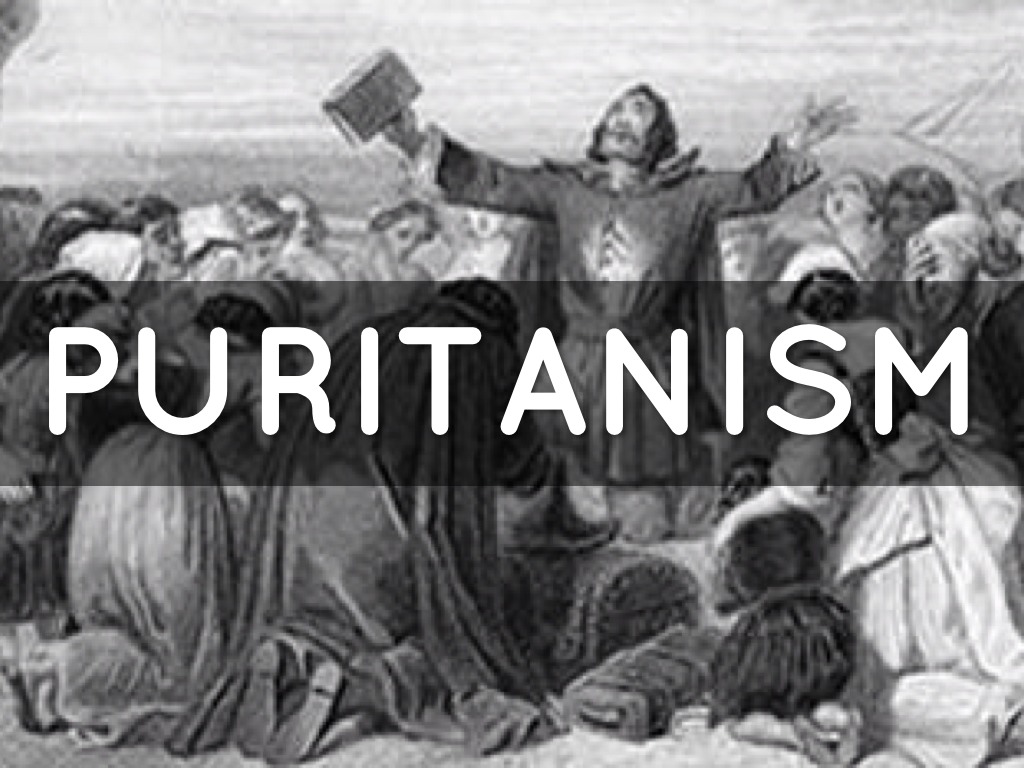
When you read neo-conservative, neo-traditionalist blogs (not mine of course, although some of these people comment here) you can see that the seeds of Protestantism/Puritanism are still germinating to this very day within Catholicism.
Protestantism was invented by disaffected Catholics (although monarchies back in the day delighted in Protestantism when Church and State were in cahoots. Monarchies in various nation-states could consolidate power and wealth independent from Rome. Today the monarchy is secularism which wants to destroy Roman Cathoicism's influence in the secular realm and any fragmentation of Catholics is a victory for the secular monarchies out there).
Thus a new or neo-Puritanism that is entering Catholicism and leading to a silent schism or is it noisy? Why did the Protestants leave the Catholic Church? Why did Protestantism then fragment into smaller sects? Why did Puritanism develop? Because there is a group of "super Christians" who can't stand Original Sin and the corruption it has wrought which affects even Divine institutions . Did God make a mistake in creating Adam and Eve in HIs own likeness. Do we need another God? You see where this Puritanism leads.
The Puritan pursuit of perfection sliced away from the true Church always leads to perdition. Why? Because of Original Sin. We simply can't get rid of its results on our own try as we may to reinvent ourselves and the Church and eventually god.
Pope Benedict famously said, or it was reported by fake news that His Holiness said, that the Church of the future will be a smaller but more faithful Church.
It appears that the Province of Ontario in Canada is the future now. Pope Francis just merged two dioceses into one. Neither are large enough to be their own diocese any longer and in fact the two merged ones in one the the coldest regions of Canada is too small to be one diocese, but I digress.
One day, will it be back to the future for the east coast of the USA? At one time Atlanta was a part of the Diocese of Savannah until the seceded from the union and became their own archdiocese. Will they be merged back into the true Diocese of Savannah one day? And will Savannah be merged back into Charleston and then Charleston back into Baltimore.
Where will it all end. What was before Baltimore? I just don't know.
The Dioceses of Hearst and Moosonee, both in the province of Ontario, in Canada, have been merged into a single ecclesiastical circumscription.
By Vatican News
Pope Francis has provided for the combination of the dioceses of Hearst and Moosonee, Canada, into a single Diocese, named Hearst-Moosonee, and belonging to the ecclesiastical province of Ottawa.
The Pope has appointed Bishop Robert O. Bourgon, who is currently serving as Bishop of Hearst and Apostolic Administrator of Moosonee, as Bishop of the new Diocese.
The new Diocese encompasses most of the northernmost part of the Canadian province of Ontario.
According to the Canadian Conference of Catholic Bishops, “the former Diocese of Moosonee has 14 parishes and missions, with a Catholic population of 3,830 served by five priests who are members of institutes of consecrated life. The former Diocese of Hearst has 18 parishes and missions, with a Catholic population of 20,045 served by 21 diocesan priests, two permanent deacons, and three religious Sisters.”
Here below is the official English text of the statement issued by Archbishop Viganò’s lawyers. (You can download the original Italian here.)
In light of the recent unfounded news that appeared in multiple newspapers and other media outlets, regarding an alleged conviction for “fraud,” “theft” or misappropriation of funds, to the detriment of his brother Fr. Lorenzo Viganò, Archbishop Carlo Maria Viganò states the following:
1) The Court of Milan, by judgment no. 10359/2018 of October 9, 2018, ordered Archbishop Viganò to pay, in response to a judicial request for the division of assets and adjustment of their mutual debits and credit with his brother Fr. Lorenzo Viganò, the principal of approximately € 1.8 million against an initial request from Fr. Lorenzo Viganò of almost € 40 million, a grossly unrealistic figure compared tothe actual value of the entire joint ownership of property of the two brothers;
2) With the above-mentionedCourt ruling, which neither of the two parties has appealed and which therefore has become final, the Court of Milan rejected all the other requests made by Fr. Lorenzo Viganò, who started the case against his brother, refusing any mediation from the family.
3) Archbishop Viganò has already willingly paid entirelythe amounts established by the judgment;
4) Fr. Lorenzo Viganò, as a result of the judgment, received essentially what he would have received had he accepted the settlement proposals made by his brother, pro bono pacis, in the course of the proceedings;
5) For over 10 years, Fr. Lorenzo Viganò has subjected Archbishop Viganò to a judicial siege and a veritable defamation campaign in the press, while failing to inform obligingjournalists that the accusations of Fr. Lorenzo Viganò have been abandoned or dismissed in the 10 civil, criminal, and administrative cases attempted to date.
6) Nevertheless, Archbishop Viganò has always suffered such attacks in silence in order to avoid further exploitation of the family’s legal affairs, which have nothing to do with the other well-known “institutional” affairs in which he has become involved;
7) The assets came to the two brothers as the undivided inheritance of their parents, who were entrepreneurs in the industrial field;
8) Archbishop Viganò has allocatedmost of this patrimony to works of charity and religion, including the construction of a Seminary in Nigeria and a Carmel in Burundi, and will continue to do so.
9) As for the painful personal relationship with his brother, Archbishop Viganò deeply loves his brother Fr. Lorenzo and will never stop hoping and praying that his brother would make peace with him and resume relations with him, which he unilaterally, totally and suddenly spurned in November 2008, when he fled from Milan accusing his brother, Archbishop Carlo Maria, of wanting to kidnap him. This is also why, despite having valid reasons to do so, Archbishop Viganò did not appeal the judgement of the Court, even though he considers it, in many ways, wrong and unjust. Archbishop Viganò intends to entrust his lawyers with the task of prosecuting by means of lawsuits any attempt to defame him.
Folks we are in new territory created by Pope Francis' exceptionally polarizing papacy. For cardinals and other bishops to public criticize the pope and actually want to correct His Holiness is unprecedented in modern times. The silence of the pope in the face of such public criticism is not new. His Holiness answers to no human person. Perhaps this must change, for at its core is the problem Pope Francis as diagnosed as a disease. That disease is clericalism. In Pope Francis case, since he is the pope, it is Supreme Clericalism.
This is a Rome Report editorial which merits consideration:
Cardinal Müller’s seeks to thread the needle, but misses the canonical mark
The idea that airing dirty laundry is what harms the credibility of the Church is part of the problem. Arguably, it is the problem.
The statue of St. Peter is seen as Cardinals Gerhard Muller and Kevin Farrell talk before a consistory at which Pope Francis created 14 new cardinals in St. Peter's Basilica at the Vatican June 28. (CNS photo/Paul Haring)
The Prefect emeritus of the Congregation for the Doctrine of the Faith, Cardinal Gerhard Müller, granted an interview to Italy’s La Stampa recently, in which he struck a critical stance toward the former nuncio to the United States, Archbishop Carlo Maria Viganò, saying in effect that the call for Pope Francis’s resignation that ended his first bombshell dossier in August was intemperate and a case of overreach.
The interview with La Stampa came on the heels of another interview, also in-depth, with Life Site News, in which the former prefect criticized the Holy Father’s response to the crisis, and called for a thorough investigation of l’Affaire McCarrick.
Taken together, the pair of interviews suggest Cardinal Müller is engaged in an effort to thread the needle between opposing factions and bring a measure of moderation to an increasingly tense and acrimonious impasse in the Vatican. While Müller’s search for a via media and call for all sides to work together to face the crisis are both welcome, his remarks to La Stampa contained elements that call for critical attention.
Cardinal Müller’s assertions to the effect that the Cardinals are the only ones who can ask the Pope for clarification, and must do so privately—viz. “This, however, must take place in a private way, in its own proper places, and without ever making a public polemic with attacks that end up putting the credibility of the Church and her mission in doubt.”—fly in the face of canon law (cf. CIC 212§2-3), the Pope’s own repeated calls for full involvement of all the faithful in every state of life, and common sense.
These are matters touching the public weal of the whole Church. Every member of the faithful has a stake in the issue of this crisis, as do the people who have not heard the call to accept Christ, or accepted it—for they have a right to the Gospel, and therefore to the Church as Our Divine Lord intends her to be. To insist that only high Churchmen have a say in these matters frankly reeks of precisely the clericalism, which Pope Francis insists is at the heart of the crisis and that every candid observer readily admits is a major driver of the malaise in the culture of the Church’s hierarchical leadership.
The idea that airing dirty laundry is what harms the credibility of the Church, moreover, is part of the problem. Arguably, it is the problem.
Cardinal Müller’s insistence that adequate norms already exist is likewise problematic, even rather incredible. “We have sufficient norms in Canon Law,” Müller told La Stampa, citing the 2001 motu proprio, Sacramentorum sanctitatis tutela. “First, we must do what is already established and indicated as necessary and obligatory by the existing norms,” he continued. The former Prefect also noted, “[T]here are the already existing norms of the Congregation for the Doctrine of the Faith, yet not always all the bishops have collaborated with our department.” He went on to say, “They have not informed [the CDF] as [they ought].”
Conspicuously absent from Cardinal Müller’s discussion—which included contemplation of eventual legal reforms (only after the Curial leadership and perhaps the bishops talked it over)—was any mention of Come una madre amorevole, the abortive reform that Pope Francis originally touted as a hallmark and signature of his commitment to combatting abuse, which would have streamlined the process for investigating, prosecuting, and removing negligent or malfeasant bishops.
Marie Collins, the Irish abuse survivor and victim advocate who served three years on Pope Francis’s Commission for the Protection of Minors before resigning in frustration, accused Cardinal Müller of foot-dragging and obstructionism vis à vis the abortive Come una madrereform, as well as of general unresponsiveness.
Müller, for his part, says he did his best, and tried to do more, but was stymied from above. Pope Francis did dismiss three clerics from service in the CDF prosecutor’s office. That happened over Müller’s strenuous objection, in an episode that Vatican watchers generally agree played a significant role in Müller’s departure from the dicastery.
Press the Daily Beast headline for the full article. Suffice it to say the liberal media and post Christian and pagan liberals now despise this pope too. The can no longer manipulate His Holiness' words to suit their agenda. He's no longer their gay darling. This places Pope Francis in the same barque as his other half, Pope Benedict!
Remember back in 2013, shortly after Pope Francis was elected when he shocked the world with his words: “If a person seeks God and has goodwill, then who am I to judge,” when asked about a gay priest?
What was then seen to be a change in decades of dogma sent shockwaves around the world, landing the pontiff on the cover of Advocate and winning him praise among LGBTQ groups and lapsed Catholics. In some ways, Francis has been eating his words ever since, constantly called to explain by conservatives in the church what he meant.
Now it seems Francis isn't mincing his words on the topic. He told Spanish Claretian missionary Fernando Prado that in reality he's actually “very worried” about homosexuality in the church. Prado, whose book La Forza della Vocazione (The Strength of Vocation) comes out in multiple languages on Monday, spent four hours interviewing the pontiff in Vatican City this fall about problems in the priesthood. Italy's Corriere Della Sera newspaper excerpted parts of the book on Saturday.
One widespread tradition is the use of an Advent wreath both in the
church and the home to mark each Sunday in the Advent season. While the
origin of this as an Advent tradition dates back to the Lutheran church
following the Reformation, the current form commonly used today was
developed more recently and is used in many other Christian churches
throughout the world. The wreath is made out of evergreens in the shape
of a circle to represent eternal life. It consisted of four candles
originally; three purple or blue candles to match the liturgical colors
and one pink candle lit on the 3rd Sunday in Advent. This 3rd Sunday is known as Gaudete Sunday, meaning “rejoice” in Latin and comes from Philippians 4:4. Lighting this 3rd candle, Christians relax the fast to rejoice for the promised Messiah is coming soon. Many Advent wreaths also have a 5th
candle, the Christ candle, which is lit during the time of Christmas,
symbolizing that Christ, the light of the world, has entered the
darkness.
So now I discover that my pre-Vatican II parish in Augusta where I grew up was way ahead of its time ecumenically as were the two pre-Vatican II Catholic elementary schools I attended. Advent wreathes were set up in the sanctuary and in our classrooms as well as pagan Xmas trees at Christmas.
And many of you will pass out over this. When I was at our Cathedral as the MC and then as pastor at the Church of the Most Holy Trinity in Augusta and also my first couple of years at St. Joseph in Macon, we would place a huge, and I mean huge, Advent wreath on the old high altar but hanging as a Xmas wreath would, not flat but upright. Then we would use four of the six huge candlesticks on either side with the proper color candles. What about that???????
In my pre-Vatican II parish, our pastor would put up two evergreen trees that looked like Christmas trees at Christmas but not decorated in any way. Poinsettias of course were used.
Was there a prohibition prior to Vatican II to use decorated trees and use lights, white or colored? I can't think of the name of these now, but in my parish in Augusta, we would decorate a very large tree with homemade religious ornament symbols. I think this is Protestant too? We also used white lights! What that too secular?????
These are some Xmas decorations at St. Joseph Church in Macon when I was there. Were we too pagan and department-store like, thus having dialogue with the secular side of Xmas?
And what about the fifth "Christ" candle for the advent wreath that is used at Christmas? Is this kosher in Catholic churches?
As though there isn't enough Advent and Christmas anxiety, this all adds to my ever increasing inability to cope with all this anxiety in an ecumenical, interfaith and pagan world. Because, after all, the fundamentalists tell us that all things Catholic are Pagan, like Halloween, Christmas and Easter!
I wonder how the SSPX feels about all these pagan, Protestant syncretizing influences in our Catholic churches?
Approximately 500 attended one of six listening sessions in the Diocese between Oct. 28 and Nov. 6, 2018, to provide an opportunity for Catholics to respond to the proposed agenda for the fall November 2018 US Conference of Catholic Bishops’ General Assembly. In addition, people were encouraged to submit answers in writing or via email.
The text below has names and other personal information removed, and has been edited for clarity, while still honoring the authors’ primary points. Four reflection questions were offered, and speakers were advised to explain which question they were addressing. Readers will quickly recognize this advice was not always followed. The responses are not organized in any other way. How can the bishops rebuild trust in their leadership, both among Catholics and others?
We need for all bishops to be 100 percent transparent in what’s being done. We need to be well informed and very open about what rules are being changed, what is happening. Would say I don’t believe bishops should be put out on their own. I think they should be sent to where they spend their whole days praying about why they did what they did if they’re guilty of these things. I think they should definitely be found guilty before they’re chastised. And I know that’s not always easy. It’s easy to accuse someone 35 years later. I’ve seen that happen to innocent people. I’ve seen it happen to guilty people. So I would like to make sure that those who are chastised are truly guilty of having committed these heinous things. Thank you. We have not been catechized properly in terms of sexuality. I would respectfully ask the bishop to always promote the teachings of the Catechism of the Catholic Church. There is a wealth of knowledge in it that we just don’t know.
In new book on clergy and religious life, Pope Francis addresses homosexuality
“In our societies it even seems that homosexuality is fashionable and that mentality, in some way, also influences the life of the Church,” says Francis in an upcoming book-length interview.
Pope Francis arrives Nov. 29 for a Vatican meeting with participants attending the International Convention of the Rectors and Pastoral Workers of Shrines. (CNS photo/Vatican Media)
Vatican City, Nov 30, 2018 / 05:00 pm (CNA).- In a book-length interview to be published next week, Pope Francis addressed gifts and challenges for clerical and religious vocations, among them the challenge of homosexuality in the clergy.
“The issue of homosexuality is a very serious issue that must be adequately discerned from the beginning with the candidates, if that is the case. We have to be exacting. In our societies it even seems that homosexuality is fashionable and that mentality, in some way, also influences the life of the Church,” the pope says in the book “The Strength of a Vocation,” set to be released Dec. 3 in ten languages.
In an excerpt from the book, released Friday by Religión Digital, the pope said he is concerned about the issue of evaluating and forming people with homosexual tendencies in the clergy and consecrated life.
“This is something I am concerned about, because perhaps at one time it did not receive much attention,” he said.
Francis said that with candidates for the priesthood or religious life “we have to take great care during formation in the human and affective maturity. We have to seriously discern, and listen to the voice of experience that the Church also has. When care is not taken in discerning all of this, problems increase. As I said before, it can happen that at the time perhaps they didn’t exhibit [that tendency], but later on it comes out.”
“The issue of homosexuality is a very serious issue that must be adequately discerned from the beginning with the candidates, if that is the case,” the pope reiterated.
Francis recalled that one time “I had a somewhat scandalized bishop here who told me that he had found out that in his diocese, a very large diocese, there were several homosexual priests and that he had to deal with all that, intervening, above all, in the formation process, to form a different group of clergy.
“It’s a reality we can’t deny. There is no lack of cases in the consecrated life either. A religious told me that, on a canonical visit to one of the provinces in his congregation, he was surprised. He saw that there were good young students and even some already professed religious who were gay,” he related.
The pope said that the religious “wondered if it were an issue and asked me if there was something wrong with that. Francis said he was told by one religious superior that the issue was not “that serious, it’s just an expression of an affection.”
“That’s a mistake,” Francis warned. “It’s not just an expression of an affection. In consecrated and priestly life, there’s no room for that kind of affection. Therefore, the Church recommends that people with that kind of ingrained tendency should not be accepted into the ministry or consecrated life. The ministry or the consecrated life is not his place.”
We “have to urge homosexual priests, and men and women religious to live celibacy with integrity, and above all, that they be impeccably responsible, trying to never scandalize either their communities or the faithful holy people of God by living a double life. It’s better for them to leave the ministry or the consecrated life rather than to live a double life.”
The pope was asked in the book if there are limits to what can be tolerated in formation.
“Of course. When there are candidates with neurosis, marked imbalances, difficult to channel not even with therapeutic help, they shouldn’t be accepted to either the priesthood or the religious life, They should be helped to take another direction (but they should not be abandoned. They should be guided, but they should not be admitted. Let us always bear in mind that they are persons who are going to live in the service of the Church, of the Christian community, of the people of God. Let’s not forget that perspective. We have to care for them so they are psychologically and affectively healthy,” the pope replied.
The book is the transcript of an interview conducted by Fr. Fernando Prado, director of the Claretian publishing house in Madrid.
This article was originally published by CNA’s sister agency, ACI Prensa. It has been translated and adapted by CNA.
The courtroom scene from Alfred Hitchcock's 1953 film I Confess, starring Montgomery Clift as Michael Logan and Brian Aherne as Willy Robertson. (Photo by �� John Springer Collection/CORBIS/Corbis via Getty Images)
Don’t get me wrong, yes there should be sanctions of some type for sins against solemnly professed chastity. For a priest or religious it is adultery. But consensual adult adultery or fornication, while a mortal sin, similar to breaking the promise of obedience to his bishop, it is not a civil crime.
Why would you agree or disagree with this editorial?
Letter: Diocese unfairly groups bad behavior with abuse
No one denies that there have been issues of sexual abuse within the Catholic Church. However, the diocese does Catholics a disservice when they lump inappropriate behavior by priests together with criminal behavior, such as pedophilia.
A homosexual priest making a pass at a 22 years old male, while inappropriate, is not criminal. Neither is a priest having a heterosexual affair with an adult female. Yet, for the most part, we are left guessing what the allegations against many of the priests are. We cannot separate true pedophiles from those who simply failed to live up to their vow of celibacy. That is wrong.
The diocese terms the allegations against the various priests, “credible,” but does not define what that means or how the determination was made. Who made that determination? Was it a priest with a degree in theology, or a trained criminal investigator? And if it was deemed credible and also criminal, why wasn’t it referred to the police? Moreover, how do you make a determination that something is credible when the person against whom the accusation is made is long dead and never had an opportunity to answer the allegation in the first place?
Seemingly in a panic over recent revelations on 60 Minutes, the Bishop threw the names of some good priests under the bus. One in particular, Monsignor William Stanton, served for many years as pastor at St. Ambrose Church without a hint of scandal. Malone needs to go, not only because he failed to act in certain cases, but because he has overreacted and desecrated the names of some good priests against whom no action was taken years ago because the allegations against them were “incredible.”