When I was in the seminary in the late 70’s, the hermeneutic of studying Scriptures with the historical/critical method was in full swing. As well, rational arguments were made to describe miracles in a non-miracle way or redefining miracles. We were into demythologizing the bible and Jesus Christ—yes, you read that correctly.
Let me add, that my first year class at St. Mary’s Seminary and University in Baltimore had over 60 seminarians. Many of those seminarians when exposed to the demythologizing of the Bible and of Jesus lost their faith and left the seminary. That and a whole host of other progressive/liberal deconstruction of the Catholic faith left our class by 1980 with about 20 seminarians. Those ordained priests left the priesthood or got into moral trouble and criminal activity. There’s about 6 of us left, God bless our little hearts.
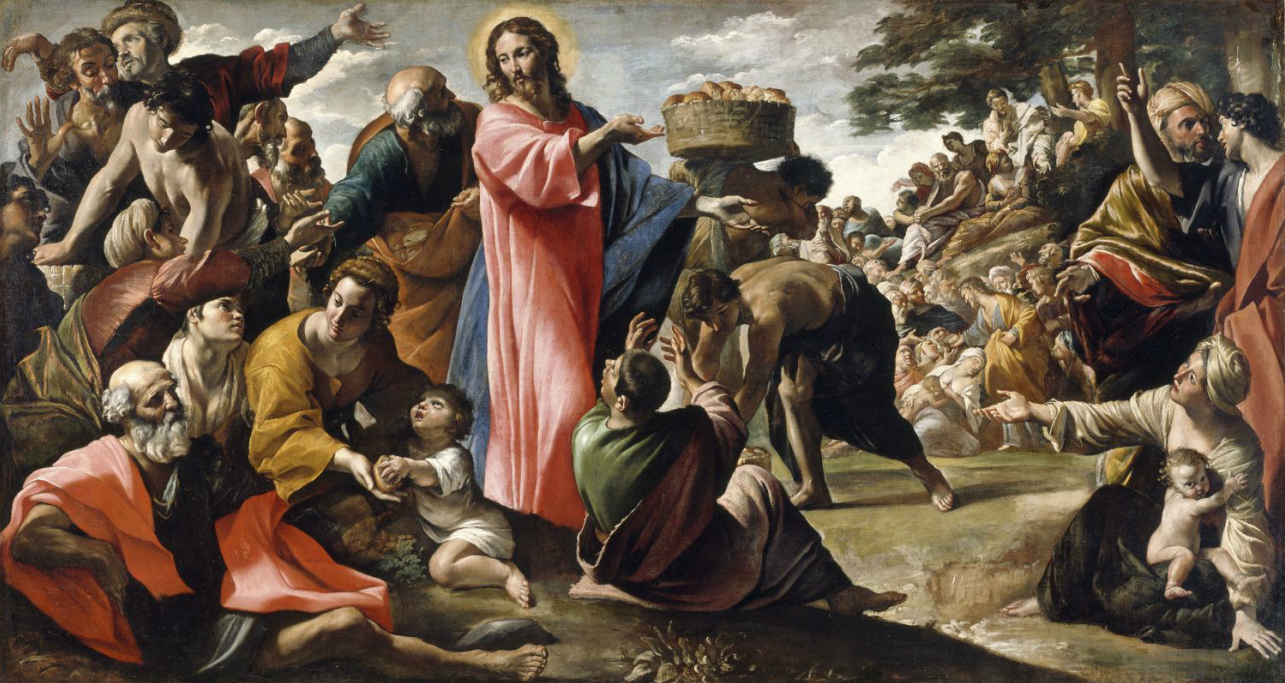
But let’s talk about the multiplication of loaves and fish. Yes, yes, yes—Jesus multiplying these is a supernatural miracle! We have to begin there and only then give some theological explanation of what happens next.
What Jesus gives, with His Word and the miracle of the multiplication of loaves and fish is good for body and soul—in other words, there is nothing rotten or poison in what Jesus gives us. It’s all very wholesome and eternal life generating and leads to good things, godly things, in the here and now.
It is a rational or natural miracle that as the miraculous food is given to the 5,000 there are no reports of the men hoarding the food for themselves exclusively to have later or bring home—there is equal sharing—that’s a miracle, no? Natural miracle, yes!
There are no fights that break out as the food is being passed to others and no one gets angry about anyone taking more than they need.
Without negating the true supernatural miracle of Jesus, there are many moral implications in this historical experience. Are there any more miracles that you see?

7 comments:
I think that particular dy-mythification was aimed at religious justification of Socialism and redistribution of wealth. A popular notion during that era.
The historical/critical method was also adopted by Catholics wholesale from main protestant church theologians, long after its disasterous effects were showing in those protestant (Anglican) denominations, despite the knowledge by then that scripture was showing to be remarkably historically accurate in other details, and that the vast majority of true historians admit that fact. Troy was also assumed to be only a legend, as modern skepticism took over and did not follow its own tenets of scientific investigation and instead cherry picked evidence to support skeptical assumptions. In modern scripture study, that assumption is always, "this cannot be true, so now let us look for natural explanations," ignoring the belief in God entirely, and God's presence in nature, disbelief masquerading as scholarship, and ushering in the age of "yeah? but whattabout"ism taking the place of rational study. The fact is, there is no compelling evidence to disbelieve any of scripture.
As for failures of the historical/critical approach, an assumption of theirs is that stories of Jesus were written long after the fact, and then-past events were written into those stories accurately to bolster later prophetic claims. Even a main Anglican skeptic was struck by how wrong the actual evidence of later writing date seemed to be. There are numerous examples in the writings of antiquity of old facts recycled as accurate prophecy and put into the mouths of seers/prophets. Contrast that with the prophecy of Jesus regarding the siege and fall of Jerusalem, the historical/critical skeptic method says immediately that that prophecy put into the mouth of Jesus by a later writer from after the fall in order to boost the divinity of Jesus. But, a study of the known true history of the seige shows that it did not play out militarily as foretold in that prophecy, and why would a later writer get so much wrong if he were seeking to show an divine prophet when the facts of the seige would be commonly known to anyone in that area if written later?
The evidence shows those gospels were written by whom and when they claim to be, while only skeptical assumption bolsters any other reading.
My question to the skeptic is always, "Why NOT believe it?". And the answer to that will tell you much ahout the skeptic.
I believe the loaves and fishes were multiplied miraculously.
I also believe that there is much more to the story that, without which an essential point would be lacking.
The words of the disciples and of Jesus - “There is no need for them to go away; give them some food yourselves"... "“Give them some food yourselves.” But they said to him, “Are we to buy two hundred days’ wages worth of food and give it to them to eat?”... “Give them some food yourselves.” They replied, “Five loaves and two fish are all we have, unless we ourselves go and buy food for all these people.” ... When Jesus raised his eyes and saw that a large crowd was coming to him, he said to Philip, “Where can we buy enough food for them to eat?” He said this to test him, because he himself knew what he was going to do. Philip answered him, “Two hundred days’ wages worth of food would not be enough for each of them to have a little [bit]” are a reminder and a challenge to us.
The idea of a "natural miracle" is cute, but oxymoronic.
The challenge to us is the call to action - to take the gifts we have received, be they great or small, and place them at the service of the Lord Jesus Christ and our neighbors. Sometimes we might be expected to be good Socialists, being generous to a fault and not counting the cost.
God will provide.
IS THE raising of Lazarus from the dead A MIRACLE? IT ALL DEPENDS ON WHAT YOU MEAN BY MIRACLE, WHAT IT, IS….HMM… Sometimes we just have to take things at face value.
The Miracle being a "miracle of sharing" originates, not from the Scriptural text or Tradition, but from a 19th century rationalist Protestant and German anti-Semite. One of the fruits of Luther.
Wikipedia summarizes: "As Jesus passes the loaves and fish to his disciples the multitude of people realize they are hungry as well and begin preparing their own food." Silly Hebrews, if you're hungry, just eat the food you brought with you!
What utter slop.
Nick
A miracle is defined as an extraordinary sensible effect wrought by God that surpasses the power and order of created nature. In my estimation, raising Lazarus fits the definition.
Post a Comment