Silerie non possum has a great interview with Dom Jean Pateau. Press the title for the full interview. I have an important answer to a question posed to him below the title:
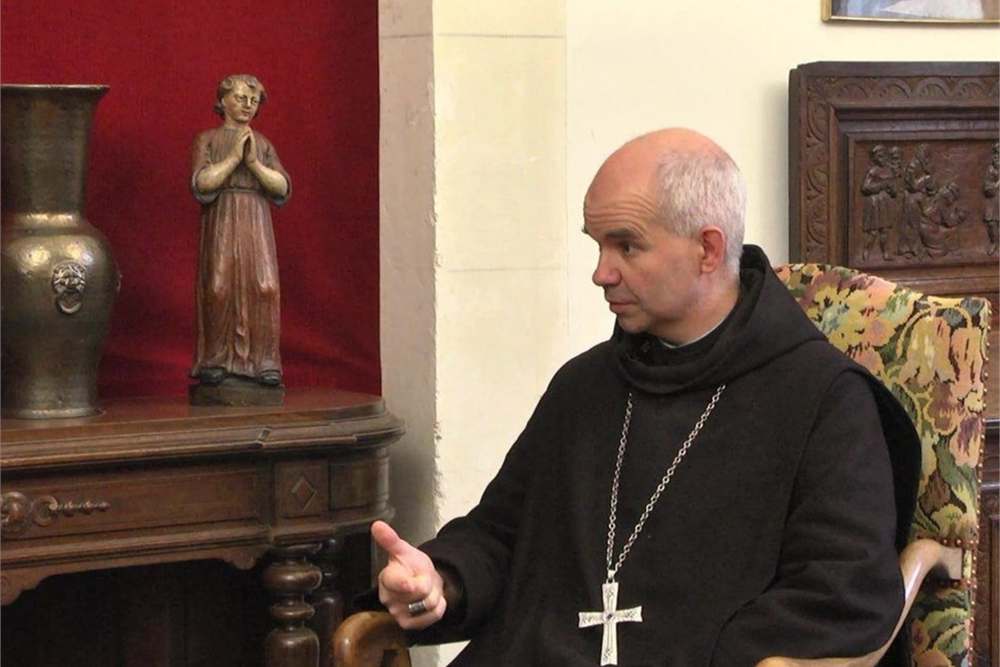
In recent hours, France has once again come to the centre of attention because of the words addressed by Leo XIV to the bishops gathered at Lourdes and, in the preceding days, because of the letter your Abbot President, Dom Geoffroy Kemlin, addressed to the Holy Father on the liturgical question. In this context, Fontgombault too carries a significant history, deeply bound up with the liturgy. How did you receive these two interventions?
could one fail to receive with gratitude, joy and thanksgiving interventions that seek to calm tensions unfortunately accumulated over decades around the altar and the sacrament of love? The Holy Father does not conceal his concern in this regard and invites us to “a new way of each person looking at the other, with greater understanding of the other’s sensibility... a gaze capable of enabling brothers enriched by their diversity to welcome one another mutually, in charity and in the unity of faith.” He implores the light of the Holy Spirit so that “concrete solutions may be found that will generously include those sincerely attached to the Vetus Ordo, in respect of the liturgical orientations desired by the Second Vatican Council.” The 1965 missal is precisely the implementation of the orientations desired by the Second Vatican Council. Saint Paul VI acknowledged this. As for the proposal of Abbot Geoffroy Kemlin, it would allow priests who use the Novus Ordo to benefit from the richness of the signs and gestures of the 1962 Ordo Missae while retaining the readings and certain prayers from the 1969 missal. For communities using the Vetus Ordo, however, it would be difficult to implement. There would no longer be coherence between the readings of the Mass and those of the Divine Office contained in the breviary and antiphonary. In this connection - and this is little known - a lectionary was drawn up in 1966 that enriches the lectionary of the 1962 missal. It preserves all the existing readings and, for weekdays on which the Sunday readings had previously been repeated, proposes proper readings. Its use was left to the discretion of the local Ordinary. It was used in France. This lectionary responds to the Council Fathers’ request for an enrichment of the lectionary and makes it possible to preserve coherence with the Divine Office. In any case, the decision to address the question of enriching the missals in a pragmatic way, whatever solution may be proposed, seems to me very positive and the only fruitful path in the long term. It makes it possible to avoid two pitfalls: rigidity and ideology. Liturgy, after all, is first and foremost a practice.

4 comments:
Dom Jean Pateau O.S.B:
"The 1965 missal is precisely the implementation of the orientations desired by the Second Vatican Council."
=======
Peter Kwasniewski:
"In short, the so-called 1965 Missal was a quick slash-and-burn edit on the 1962 to buy time for the completion of the innovating Bugnini Missal.
"Some of the changes made in '65 already go beyond anything the Fathers of the Second Vatican Council even touched on in the aula, let alone voted to include in Sacrosanctum Concilium.
"It marked the beginning of the end, and, as such, needs to be stalwartly resisted even as a theoretical option."
Pax.
Mark Thomas
So the Novus Bogus defied Vatican II.
Dom Jean Pateau O.S.B:
"The 1965 missal is precisely the implementation of the orientations desired by the Second Vatican Council."
=======
Michael Davies insisted that the 1965 A.D. Roman Missal was an appalling product that deserved to have been resisted an rejected to the hilt.
https://catholictradition.blogspot.com/2007_04_01_archive.html#8070905219972459579
Excerpts:
"The liturgical destruction did not begin in 1969 with the promulgation of the new rite of Mass, the Novus Ordo Missae.
"The debacle was well under way in 1965 when the Vatican allowed its liturgical bureaucrats to begin revising the Missal that had last been revised in 1962.
"No layman could help noticing the changes made to the Ordinary of the Mass in the 1965 Missal, and there can be little doubt that its purpose was to prepare the faithful for the revolutionary changes that were to be introduced in 1969.
"Likewise, the 1965 Missal was intended to condition the faithful into accepting without protest the radically reformed Missal of 1969."
Pax.
Mark Thomas
Dom Jean Pateau: "As for the proposal of Abbot Geoffroy Kemlin...For communities using the Vetus Ordo, however, it would be difficult to implement."
"There would no longer be coherence between the readings of the Mass and those of the Divine Office contained in the breviary and antiphonary."
=======
Trad Inc., trashed Abbot Kemlin's compromise in question.
But I remain hopeful that the following is credible: Abbot Kemlim insisted that many young Catholic trads also are on board with the Holy Mass of Pope Saint Paul VI.
Peter Kwasniewski, for example, trashed Abbot Kemlin's claim in question. But I wonder about Mister Kwasniewski's reading of young trads.
Michael Matt, for example, expressed concern recently that an increasing amount of young trads view a "dolled up" (Latin, Gregorian Chant...) Holy Mass of Pope Saint Paul VI as a "Traditional Latin Mass."
Michael Matt is worried that Pope Leo XIV will "trick" more and more young trads to embrace a "hybrid" Novus Ordo Mass.
Rome's long-term plan, going back to Pope Benedict XVI, supposedly is to trick trads to embrace a hybrid Novus Ordo Mass — that (as well as Pope Benedict XVI's supposed plan to lure trads into acceptance of Vatican II) served supposedly as the real purpose behind Summorum Pontificum.
Additional radtrads have joined Michael Matt in having worried that an increasing amount of young trads are on board with the Holy Mass of Pope Saint Paul VI.
I have a certain amount of confidence in Michael Matt's reading of young trads as he, if anything, is involved closely with the annual Chartres Pilgrimage — a pilgrimage that has featured numerous young Catholics.
Therefore, I am hopeful that Pope Leo XIV, as well as countless bishops, are able to foster a liturgical peace movement that would very much involve young Catholics.
It may be young Catholics who counter radtrad hatred of Vatican II/Holy Mass of Pope Saint Paul VI.
It may be young Catholics who embrace Pope Leo XIV's wonderful invitation to encounter the Roman Liturgical Tradition via the Holy Mass of Pope Saint Paul VI.
Pax.
Mark Thomas
Post a Comment