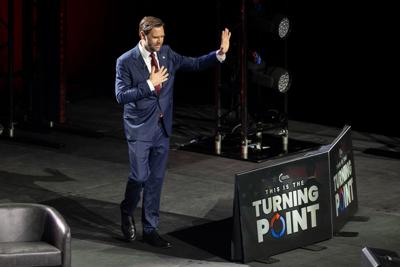
Vice President JD Vance waves to the audience during a stop on the Turning Point USA Tour held at the Akins Ford Arena in Athens, Georgia, on Tuesday, April 14, 2026. (Photo/Katherine Davis; @kat_clicks)
When the Neophyte Corrects the Vicar of Christ
On JD Vance, Theological Hubris, and the Gospel He Has Yet to Learn
There is a particular arrogance that takes root in the newly converted — the zeal of the autodidact who, having just discovered the tradition, mistakes enthusiasm for mastery. JD Vance, who received baptism into the Catholic Church in 2019 at the age of thirty-five, has now committed the singular error of instructing the Bishop of Rome to “be careful when he talks about matters of theology.”
We should sit with the full weight of that sentence.
The Vice President of the United States — seven years a Catholic, formerly an evangelical, before that a self-described atheist — stood before a Turning Point USA audience in Georgia and publicly admonished Pope Leo XIV about theological precision. “If you’re going to opine on matters of theology,” Vance informed the successor of Peter, “you’ve got to be careful, you’ve got to make sure it’s anchored in the truth.”
The audacity is breathtaking. The irony is almost comic.
While Vance was dispensing theological warnings from a stage in Georgia, Pope Leo XIV was standing at the archaeological site of Hippo in Algeria — the episcopal see where St. Augustine served as bishop until his death in 430 A.D. Vance, who claims Augustine as his patron saint and frequently invokes him in speeches, was lecturing on Augustinian just war theology to a political rally audience. The pope he was lecturing — who served as Prior General of the Order of St. Augustine for more than a decade and holds a doctorate in Canon Law from the Pontifical University of St. Thomas Aquinas — was planting an olive tree at the very ground where Augustine lived, prayed, wrote, and died. If God governs history with a sense of irony, this moment surely pleased Him.
The occasion for Vance’s correction was Pope Leo’s statement that “God is never on the side of those who wield the sword.” Vance responded by invoking the thousand-year tradition of Just War theory as if the pope were unaware of it. But Leo did not say war is never permissible. He said God is not simply enlisted as a combatant on any nation’s side. That is not a negation of Just War doctrine. That is its foundation. The Catechism at §2309 is unambiguous about the conditions that must all be simultaneously met for a war to be just. Archbishop Broglio stated plainly on Easter Sunday that the war against Iran does not meet those criteria. Cardinals Cupich, McElroy, and Tobin, along with Archbishop Coakley, have spoken with notable unanimity. Cardinal Tobin put it plainly: Pope Leo “will continue to speak clearly against war and other offenses against human dignity and to call for authentic dialogue, because the Church’s witness is grounded in the peace of Christ, not in partisan interests.” That is episcopal fidelity. What Vance offered was its precise opposite.
The deeper problem is not merely that Vance is wrong about just war. It is the ecclesiological framework he is importing from American Christian nationalism into a tradition that explicitly rejects it. Vance told Fox News that “in some cases it would be best for the Vatican to stick to matters of morality, to stick to matters of what’s going on in the Catholic Church, and let the president of the United States stick to dictating public policy.” Let that formulation stand naked for a moment. The pope — who holds a universal pastoral office precisely because the Gospel speaks to every dimension of human life — is being instructed to confine himself to the sacristy, while the president is assigned the role of “dictating” the political world. This is not a Catholic understanding of faith and public life. Catholic Social Teaching from Rerum Novarum onward has always insisted that the Gospel is not a private spiritual comfort but a public moral claim. When Vance tells the pope to stay in his lane, he is not defending Catholic doctrine. He is betraying it.
JD Vance’s forthcoming book on his Catholic faith is titled Communion. Its cover features a United Methodist church. I do not say this merely to mock. Symbolism matters in Catholic theology, and the symbolism here is telling. A book about Catholic unity, bearing Protestant ecclesial architecture on its cover, written by a man who publicly contradicts the pope on Just War doctrine — this is not communion. This is confusion dressed in piety. Archbishop Coakley said it plainly: “The Pope is not Trump’s rival, nor is the Pope a politician. He is the Vicar of Christ who speaks from the truth of the Gospel and for the care of souls.” Communion, in Catholic theology, is not a feeling of spiritual warmth. It is a participation in the Body of Christ that carries radical obligations — to the poor, the stranger, the enemy, to peace. It is a table the powerful do not preside over. They are guests at it, like everyone else.
A seven-year Catholic who tells the pope to watch his theology, while defending an administration that posted an AI image of the president as Jesus Christ and refused to apologize, is not in communion with the tradition he claims to be writing about. He is in communion with power. And that, as Augustine himself understood deeply, is a very different thing.

25 comments:
One wonders if this article would have been written if it were about a catholic from baptism in a catholic family ? Or are converts second class catholics ?
Here's a reality check for you Papalotors! Not everyone is wrong about Leo's hypocritical approach to politics. You just can't handle the truth!
https://www.americanthinker.com/blog/2026/04/pope_leo_xiv_the_lamentably_political_pontiff.html
Good point, he should have expanded the critique to include life long Catholics formed prior to the Council and afterward!
Yet another know nothing political hit piece using political talking points, mixing apples and oranges, to denigrate the Supreme Pontiff. Have you lost your cotton picking mind, TJM? If there is any idolatry that should be condemned, it is yours!
Interpreting anyone for one line of an argument is silly. I watched VP Vance's short talk and found nothing in it objectionable (I am a cradle Catholic with PhD in theology). The Pope's statement (if the news is accurate - an important "if") taken by itself is hard to reconcile with the Old Testament. JD Vance thinks it does not align with the Just War theory - so what? That is not his area of expertise; but he can (and as a Catholic should) state his perspective. Geo-politics and military operations is not the Pope's area of expertise - but he does rightly talk about how the Gospel informs actions in daily life of people and nations. Vance does - importantly - welcome the Pope's voice in political matters and conversation/debate in general.
I appreciate that perspective. I am confused though by the Old Testament reference. In His public ministry, Jesus did away with two Jewish customs, an eye for an eye and a tooth for a tooth and the other, divorce. In the Risen Lord’s ministry in the Church, many other Old Testament expectations are abrogated, circumcision the biggest. The Church’s view of just war as enunciated by St. Augustine is far from the Old Testament.
Neophyte Catholics often "expand" on what they have learned during their recent conversion experiences. Those of us who have been in Catholicism for the long haul know that there is far more nuance, far more refinement in the Church's teaching and theology. That comes with experience.
Vance got into trouble earlier with his crude understanding and application on the concept of ordo amoris - the order of charity.
https://www.americamagazine.org/faith/2025/02/13/ordo-amoris-stephen-pope-vance-249926/
In regard to President Trump's nasty comments directed at Pope Leo XIV:
Among various religious folks within and without the Church, as well as various secularized folks, Pope Leo XIV and Pope Francis (requiescat in pace) have shared similar reputations.
Pope Leo XIV is a Vatican II modernist, a communist, tree-hugger, liberal politically, unfit to pronounce upon international affairs, pacificist, soft on homosexuality...
Pope Francis, among various folks, also carried the above reputation.
Nevertheless, even prior to his first term in the White House to Pope Francis having fallen asleep in the Lord, Donald Trump had spoken well of Pope Francis.
"I like his personality; I like what he represents..."
"...a very good man who loved, loved the world..."
February 2013 A.D. Donald Trump tweeted: "Congratulations to my Catholic friends on the selection of Pope Francis...People that know him love him!"
December 2013 A.D. "The new Pope is a humble man, very much like me, which probably explains why I like him so much!"
August 2015 A.D. "He's becoming very political, there's no question about it. But I like him. He seems like a pretty good guy."
April 21, 2025 A.D: TRUMP PAYS TRIBUTE to POPE FRANCIS at White House EASTER EGG roll ceremony
https://www.youtube.com/watch?v=kg7ECA__Sjg
=======
What a tremendous difference between President Trump's attituded toward "liberal" Pope Francis and "liberal" Pope Leo XIV.
Why?
Pax.
Mark Thomas
Here is the CCC articulation of the just war doctrine:
2309 The strict conditions for legitimate defense by military force require rigorous consideration. The gravity of such a decision makes it subject to rigorous conditions of moral legitimacy. At one and the same time:
• the damage inflicted by the aggressor on the nation or community of nations must be lasting, grave, and certain;
• all other means of putting an end to it must have been shown to be impractical or ineffective;
• there must be serious prospects of success;
• the use of arms must not produce evils and disorders graver than the evil to be eliminated. The power of modern means of destruction weighs very heavily in evaluating this condition.
These are the traditional elements enumerated in what is called the "just war" doctrine.
1897 The evaluation of these conditions for moral legitimacy belongs to the prudential judgment of those who have responsibility for the common good.
____________________________
One very common error is to suppose that “prudential judgment” means that the decision evaluating these conditions, i.e., applying them to the messy world of specific situations and circumstances, is just a matter of opinion, as if one opinion were as good as another. Nothing could be further from the truth, and such a view completely overlooks the meaning of the key words: “prudence” and “judgment,” in other words “practical wisdom.” Instead, those entrusted with striving to achieve the common good are required to exercise practical wisdom when they act. Here is the AI Overview, which seems right to me:
Prudential judgment in Catholic thought is the application of moral principles to concrete, real-life situations to determine the best action for achieving good. It requires using the virtue of prudence to weigh specific circumstances, as opposed to applying rigid, universal rules. This process involves informed conscience and aligns with Catholic teaching, allowing for reasonable disagreement on policy or strategy.
Key Aspects of Prudential Judgment:
• Application of Principles: Prudence (the "charioteer of virtues") helps distinguish true good in every circumstance and chooses the right means to achieve it.
• Not Subjective Preference: A prudential judgment is not just a personal opinion, but a thoughtful assessment of the best, most moral course of action.
• Distinction from Moral Absolutes: It applies to situations where the right path is not immediately obvious, unlike intrinsic evils (e.g., murder) which are never allowed.
• Role in Policy and Politics: It is frequently used to evaluate public policy, such as determining the best way to handle immigration, economic policies, or environmental challenges.
• Examples: A pastor making decisions about ministry, or a voter selecting a candidate while considering which policy decisions best protect the common good.
Common Misunderstandings:
• It is not a "smokescreen" for bypassing official Church teaching, but rather a guide on how to apply those teachings effectively.
• It does not mean "you have your truth, I have mine," but rather finding the best, objective course of action in complex scenarios.
[continued]
In chapter 3 of my book Professions and Politics in Crisis (2021) (see pages 82-83) I give the following account of the “master virtue” of practical wisdom, which for me requires a combination of technical and moral expertise:
The master virtue of practical wisdom is a distinctive kind of “practical reasoning” or “practical rationality” (judgment resulting in action). Specifically, practical wisdom is the overarching ability of the expert practitioner, a phronimos in the practice, to access, draw upon, and conduct other, particular qualities or attributes—theoretical knowledge, skills, and qualities of character—in a way appropriate to the context so as to do the right thing in the right way at the right time for the right reason in the particular circumstances, for the benefit of the individual, organization, or community being served. In technical matters the practitioner is able to draw on relevant qualities or attributes to demonstrate technical expertise; in moral matters the practitioner is able to access, draw upon, and conduct relevant qualities or attributes to demonstrate moral expertise; and the practitioner is able to combine both types of expertise to achieve a practically wise outcome.
This overarching ability resolves itself—both in the technical sphere and the moral sphere, as well as in the combined operation of both spheres—into four interrelated abilities. These are the abilities
(a) To see the world and read situations in a distinctive way,
(b) To make sound judgments about ends and means (including ends that are a means to other ends) in light of such perceptions, and to do so either intuitively and instantaneously or consciously and deliberately, depending on such factors as complexity, ambiguity, or novelty,
(c) To be motivated to translate judgment into action, and then
(d) To act.
In brief, the practically wise practitioner has good judgment and acts well on the basis of that good judgment.
Mark J.
TJM:
Your comment about not being able to handle the truth is ironic given that the sources you post, including this one, are full of lies and distortions. But none of this is surprising given that propagating such lies and distortions, as commanded and modeled by the Great leader, is the modus operandi of MAGA.
Mark J.
I see that Trump is at it again, this time sharing an image of himself with Jesus embracing him:
https://www.forbes.com/sites/maryroeloffs/2026/04/15/trump-posts-ai-photo-with-jesus-days-after-he-was-slammed-for-blasphemy/
While I have no doubt that Jesus Christ loves Donald Trump, as He loves all of us sinners, I suspect that Trump might have been thinking more of the caption that accompanies the original post (which he did not also share): "I was never a very religious man .. but doesn't it seem, with all these satanic, demonic, child sacrificing monsters being exposed ... that God might be playing his Trump card !"
Mark J.
To complete the analysis, I relate these four abilities to the three interrelated capacities of independent practical reasoners articulated by Alasdair MacIntyre, explaining that rather than being coterminous with the four abilities, these three capacities seem to be foundational capacities the person of practical wisdom draws upon when exercising these abilities. It would be tiresome to recount the exact relationship here, but it might be instructive to reproduce MacIntyre’s formulation of the three capacities (which MacIntyre calls abilities):
“[T]he ability to evaluate, modify, or reject our own practical judgments, to ask, that is, whether what we take to be good reasons for action really are sufficiently good reasons, and the ability to imagine realistically alternative possible futures, so as to be able to make rational choices between them, and the ability to stand back from our desires, so as to be able to enquire rationally what the pursuit of our good here and now requires and how our desires must be directed and, if necessary, reeducated, if we are to attain it.”
I have addressed all these matters in my comments because so many discussions of the just war doctrine in relation to the Iran War seem to be superficial, often just focusing on the first condition of just cause. But even assuming the existence of just cause, so much more is required for a proper analysis and application of the doctrine. Importantly, one of the most important virtues in acquiring, or in exercising, prudential judgment or practical wisdom, perhaps indeed the most important virtue, is the virtue of humility, a virtue J.D. Vance should exhibit a little more before he lectures the Holy Father.
Mark J.
One problem that I see with just war theory is a fundamentally false presupposition. Namely, killing can never be “good.”
The attempt to turn something intrinsically evil—killing—into a good in any circumstances is fraught with theoretical and practical problems, ultimately resulting in tortuous (and ultimately subjective) logic. Put simply, one can always justify one’s actions.
Rather, I suggest that killing is always evil. When one must kill (for individually or collectively justifiable means), it should still be recognized that one has done an evil thing and that demands repentance. That is, healing.
There’s an excellent book that discusses this framework with a special eye toward working out a way to help those who have experienced traumatic events is called The Ethics of Beauty. It is a long book that covers a lot of other ground, but you might find some articles about it that might interest you.
Babylon Bee nails it:
"We must not resort to violence against the Nazis - Pope Leo "
The problem with you Mark is that YOUR side can commit excretable crimes, abortion, child mutilation, adoring illegal aliens murdering citizens while demanding taxpayers support them, Obama bombing Libya without congressional approval, jailing Grandmas for protesting abortion and parents being attacked for protesting at school board meeting ! Hypocrisy on steroids!!
Proverbs 6:16-19. I try to limit myself to just one or two, but to hit six or seven... oof.
Nick
Correction – I have now read additional reports and seen their reproduction of the image shared on Truth Social, and it does indeed seem that Trump also included the caption from the original post on X.
Mark J.
Not sure if it would be wrong a priori for someone in Vance's position to criticize a pope, though I'd be interested in other perspectives. A pope (most of the time) is capable of error.
However it seems ludicrous to imply that war has nothing to do with morality. This new Georgia speech is new to me. While again, in principle, one could criticize a Pope if truly warranted, Vance's words come across as irreverent and arrogant. Especially to such a wide audience. He speaks as if he's on the debate stage trying to get zingers in on an opponent when he's actually talking to his spiritual father, very inappropriate. Thus is the sort of rhetoric I'd expect to hear from the Josh Shapiros of the world, not a Catholic politician. I think even Nancy Pelosi knows better than that.
The December 2023 quote sent me lol
It’s not so much that Vance is putting forth his opinion—he’s doing it by denigrating the pope and his teaching authority in the areas of faith and morals, but what makes it more concerning, he’s a politician elected to the second highest office in the land. What offends me more and more is the instrumentalizing and manipulation of religious people, no matter what faith, to get their vote. MAGA has done that with Catholics and we see what that has done to Catholics like TJM and a significant number of others, who won’t defend the pope in his God given right to teach the Catholic Faith in season and out of season, even if it offends the current elected regime, no matter the political party!
TJM:
For the umpteenth time, it is not MY side! I am not a Democrat or a Republican. Like Father McDonald, I am an Independent. Unlike Father McDonald, however, I did vote Democrat in 2020 and 2024, because I regarded it as the only way to stop this madman from becoming president. For the same reason, I voted in the Republican primary for an alternative candidate. Had John Kasich, Marco Rubio (before he sold out to MAGA), or Nikki Haley been the Republican candidate, I might very well have voted for them. So please shut it.
Mark J.
What a juvenile comment from Babylon Bee, whoever that is. The Second World War complied with the Just War doctrine, at least in its inception, although not in its execution.
Mark J.
Marc:
Thank you for referring us to this fascinating book, which I have just been sampling on its Amazon page.
I agree that in the West we have succumbed to an overly rationalistic approach to matters of morality and religion. It is one reason I have been so attracted to the mystical tradition of the Church.
This said, I do not understand Just War doctrine to be premised on the notion that the killing in war can sometimes be a good. Indeed, the fact that we so often refer to war as a necessary evil reflects our natural intuition that it is an evil, not a good. But perhaps I am mistaken and am happy to be corrected by those trained in theological ethics.
Mark J.
Marc:
As I continued to read the Amazon sample, I was reminded of the wonderful film The Mission, which addresses many of the themes in the book’s chapter on war. Thank you again for alerting us to this book, which I will plan on getting.
Mark J.
One of the issues I have with just war is, perhaps, semantical -- I'm not sure that any war can be considered "just." Something's being just suggests there is a rightness to it, which I think is always lacking in war. War might, at best, be considered necessary. The practical problem with that, as we have seen so many times, is who decides what is necessary. The issue is a more straightforward where one's homeland is attacked. Rebuffing foreign invasion is almost certainly necessary by any standard. Aside from such an event, though, necessity is mostly subjective and, unfortunately, subject to the whims of (typically) unreliable politicians making unreliable (at best) political calculations.
Anyway, by assessing a particular war as being a just one, the tendency, it seems to me, is to suggest the rightness of its cause. And if the cause is right, then actions taken in support of that cause, within normal bounds, would also be right. So, it would seem that killing during a just war would be right and, therefore, good. Effectively, I think the result is to suggest that a soldier's killing another during a just war is not sinful.
While I think that killing during a necessary war is justifiable (again, within normal bounds), the killing itself is still sinful in the sense that it is out of step with what God wants for his people, and it is harmful to the soldier who has done the killing. It is a necessary and unavoidable action that is sinful and demands repentance. That is why the Church has historically separated returning soldiers from Holy Communion for a time so that they can be healed before returning to the regular participation in the Sacraments.
Post a Comment