Translate

Monday, September 3, 2018

WILL THE GRAND SILENCE WORK? MAYBE! BUT ONLY GOD KNOWS

The Pope, before “wild dogs” who 

seek scandals: silence and prayer


First mass in Santa Marta after the summer break and
the recent scandals of the Viganò dossier:
 “There are those who seek division and
destruction, even within the family. Truth is humble and silent”

Pubblicato il 03/09/2018
Ultima modifica il 03/09/2018 alle ore 14:08
VATICAN CITY
"Silence and prayer". Before those who cause "scandal" and "divisions", before the "wild dogs" who seek war and not peace, nothing else is needed. Only silence and prayer. Pope Francis resumes the morning masses in the chapel of Casa Santa Marta after the summer break and after the controversy aroused by the publication of Monsignor Carlo Maria Viganò’s controversial "communiqué", in which the former nuncio to the USA asks for the resignation of the Pope.  
  
  Taking his cue from today’s Gospel of Luke - in which Jesus, returning to Nazareth, is received "with suspicion" - Bergoglio explains the attitude to adopt in all those situations of life in which "the father of lies, the accuser, the devil, acts to destroy the unity of a family, of a people".  Whether it is through small "misunderstandings" or large "attacks",  in any case, silence is needed to oppose them, the Pope affirms in his reflection reported in Vatican News. Silence like that of Jesus in the synagogue where everyone wanted to see with their own eyes the great works they had heard he was capable of in other lands. In front of the Messiah there were no "people", Francis says, but "a pack of wild dogs who wanted him out of the city. They were not thinking right, they were shouting. Jesus remained silent. They took him to the edge of the mountain to throw him down”.  
  
  The Gospel ends with these words: "but he passed through the midst of them and went away". "With his silence, Jesus triumphs over that wild pack and leaves. Because the time had not yet come. The same thing will happen on Good Friday: the people who on Palm Sunday had celebrated Jesus and had told him "Blessed are you, Son of David", said "Crucify him": they had changed. The devil had sown lies in their heart, and Jesus remained silent," Bergoglio comments.  
  
  Jesus used only "the word of God", as every time he "wants to overcome the devil". Precisely this humble attitude leaves room for the first "bridge-word", that is meant to construct a bridge but instead sows doubt immediately changing the atmosphere “from peace to war”, from “amazement to fury”. the Pope emphasizes. "With his silence Jesus triumphs over the wild dogs", triumphs over "the devil who had sown the lie". His behavior, crystallized in today's Gospel passage, thus helps to "reflect on the way of acting in daily life" when creating uncomfortable situations.  
  
"Truth is humble, truth is silent, the truth is not noisy", the Pontiff emphasizes. Therefore, "with people who seek only scandal, who seek only division", the only way to go is that of "silence". "The silence that triumphs, but through the Cross... Even in families there are times when division occurs because of ”discussions about politics, sport, money, and it can happen that those families end up destroyed, in these discussions in which we see the presence of the devil, he is there and he wants to destroy ...".  
  
Thus "silence": "say what you have to say and then keep silent". "It is not easy - Francis admits - what Jesus did; however, the dignity of the Christian is anchored in the power of God. With people who have no good will, with people who seek only scandal, who seek only division, who seek only destruction, even within families: silence. And prayer.  
  
The Pope's prayer, at the conclusion of his first Mass in September, was "May the Lord give us the grace to discern when we should speak and when we should stay silent. This applies to every part of life: to work, at home, in society…. Thus we will be closer imitators of Jesus".  

Francis during mass in Santa Marta (photo © Vatican Media)

IS IT AN ACT OF GOD THAT WE HAVE TWO POPES LIVING AT THE VATICAN AT THE SAME TIME????????


Side by side comparison of the papal thrones for Benedict XVI and Francis


I have been reading liberal or heterodox commentators decrying what they are calling an ultra-right (read orthodox) schism in the Church led by, now get this, EWTN! Then these commentators go on to name the names of those who are now in SCHISM with Pope Francis! Who are some of these? The three biggest culprits are Cordilione of San Francisco (how ironic is that?), Morlino of LaCrosse and of course Burke of the Vatican. In addition, anyone who has supported Vigano is in schism with Pope Francis.

The word SCHISM from the leftist heterodox has to be just about the most incredible statement I've heard or read! Never mind how they treated Blessed Pope Paul VI in 1968 and up until his death because of Humanae Vitae and His Holiness public recognition that Vatican II had gone off the rails and the smoke of Satan had entered the cracks of the Church brought about by Vatican II's heterodox bishops and theologians, primarily priests and religious.

Never mind how they treated St. Pope John Paul II and Pope Benedict.

But this is my point: Having two popes today, one reigning, the other contemplative, and it seems God is keeping the contemplative pope alive throughout Pope Francis' reign for some reason only known to God now, but will be revealed in due time, we have two ways of looking at the papacy and how the Church should be.

I prefer Pope Benedict's papacy and vision for the future of the Churchwhich is  Vatican II as understood as renewal in continuity. I prefer the looks of Pope Benedict's papacy with the restoration of so many visible signs of the papacy that points to the Monarchy of heaven with the Ultimate Monarch, the Most Holy Trinity whose subjects constitute the Communion of Saints.

Pope Francis has brought the visible image of the papacy down to a South American dictator's vision of the world ruled by those who wear the clothes of the common person or the military uniform, just think of the Castros. The resurrection and our true home of perfection in heaven are subverted by the plight of the poor and the need to make a eutopian village on earth and where the earth s placed above heaven.

Pope Benedict was clear, unambiguous and able to call out error and anathamatize evil and sin. The Church of the future needs to recover her authority to anathamatize! Pope Benedict continued Pope St. John Paul's vision of Divine Mercy never seperated from divine retribution for the unrepentant or the need of severe penance/punishment for the forgiven.

Pope Francis has recovered the flexible heterodox's view of forgiveness and the enablement of sin and the victimization of victims because of sin that continues, like bishops in the USA who sent their victimizing priests off to spiritual and psychological therapy in order to be forgiven and restored to public ministry without warning the unsuspecting laity and thus allow for future victims!

Pope Francis has recovered the idea of the 1960's that dogma and doctrine can change and the key phrase to obfuscate this heresy is "the development of doctrine!" He purposely creates ambiguity, confusion and chaos to promote a heterodox, progressive view of the Church promoted in the 1960's by liberals who were the cause of the "smoke of Satan" that entered the Church at that time.

Shall I go on?

Which do you want, a more rigid, Orthodox Church or a flexible, heterodox Church? As for me and my household I pick Benedict's vision of the papacy and Church! 

IT'S COME TO THIS, AUGUSTA CHRONICLE PRINTS ASSCOCIATED PRESS CAPTION ON DIOCESE OF LINCOLN STORY


In this Aug. 28 photo, turkey vultures rest on the cross atop the Cathedral of The Risen Christ adjacent to the Catholic Chancery in Lincoln, Neb. [NATI HARNIK/THE ASSOCIATED PRESS]

QUOTE OF THE DAY FROM POPE SAINT GREGORY THE GREAT


"It is better that scandals arise than the truth be suppressed." 

Sunday, September 2, 2018

WOW! AND IN THE ARCHDIOCESE OF ATLANTA

I Stood Up in Mass and Confronted My Priest. You Should, Too.

Catholics should not keep on filling the pews every Sunday. It is wrong to support the church.
By Naka Nathaniel

Mr. Nathaniel is a former editor and videographer at The New York Times.

  • CreditCreditTerry Vine & J Patrick Lane/Blend Images, via Getty Images

  • ATLANTA — Last Sunday, I did something that no properly raised Catholic ever does. I stood up in the middle of Mass and called out the priest.

    As the priest began his homily, I drew my 9-year-old son closer and asked him to pay close attention. Days before, a Pennsylvania grand jury had released a damning report detailing decades of horrific child sex abuse by clergymen and a church culture that covered it up
    .
    The priest addressed the report. He said he was surprised that people showed up for that day’s service. He said the church had to change. Then he began to move on. 

    I couldn’t help myself. I stood up and yelled out: “Father!” He turned. I asked him, simply: “How?”
    He responded that I should write to the nuncio, the pope’s representative in the United States. I told him that this was a bureaucratic answer. 

    Standing in front of the congregation, I pointed to my son and asked how could I ever let him make his first Communion. 

    As the priest answered, I became aware of the other families around me. I knew so many of them, and I was reminded of how I had always felt so at home at Mass. It always gave me such pride when my family would take up most of a pew in church.

    Now I’m angry. I feel betrayed.

    Susan Reynolds, a Catholic theologian from nearby Emory University, witnessed the exchange. She tweeted about it, and her recounting went viral. 

    I wouldn’t exist without Catholicism. My parents’ interracial marriage was condoned by their families because they shared the religion. I was an altar boy and attended Catholic school. I played church-organized youth sports, and I was an Eagle Scout in the parish troop.

    I attended Mass regularly while in college. Later, working as a journalist, it was a big thrill to cover Pope John Paul II’s visit to New York in 1995. My non-Catholic wife and I were married in Holy Spirit Catholic Church in San Antonio. 

    In the aftermath of the Sept. 11 attacks, I naturally turned to the church for solace. But on the following Sunday, to my surprise, none of the church leaders at Mass acknowledged what had just happened. I was deflated and left feeling empty. Soon after, the sexual abuse scandal erupted.

    The repugnant stories of abuse touched my peers. I blamed the clergy. My wife and I moved abroad, and I stopped attending Mass regularly. But as I traveled in the developing world, I was proud to see Catholic missionaries working in the most desperate situations driven by our shared faith. I have still occasionally felt the pull of Sunday Mass. 

    It was the church’s own teachings that made me stand up on Sunday and question the priest. Catholics are taught that it’s imperative to help others. We are told to protect the innocent. The church has profoundly failed to abide by these basic principles by allowing the sins of sexual abuse to continue. 

    Aside from my family, two institutions helped form my character: the Catholic Church and the Boy Scouts. Both organizations encouraged me to stand up for what is right and to use our strength to aid those in need. 

    On Father’s Day 2012, with those lessons in mind, I wrote an op-ed and went on television calling on the Boy Scouts to drop their antigay policies. I hated that the Scouts had won a Supreme Court case in 2000 that let them exclude gay scouts and leaders. 

    Just before my son was old enough to join the Scouts, the head of the organization, Robert Gates, ended the unjust prohibitions against gay members, just as he had done as secretary of defense. I enthusiastically signed up my son and became cub master of our local pack.

    I’m not someone to quit and run. I’m proud that I spoke out against the injustice of the Scouts and helped instigate change from inside an organization that had lost its way.

    In a letter on Monday to the congregation, Father Mark Horak, the Jesuit priest I confronted, wrote: “If you love the church, remain within and work for its fundamental reform.”

    But the church can’t be changed from the inside. It has already tried that.

    Ms. Reynolds has become the lead author on a letter calling for the American bishops to resign. I’m glad that my actions inspired her. I hope the rest of the flock heeds her call.

    But we should go further and demand that every ordained member of the Catholic Church resign, including the pope. If any other organization had covered up the rampant sexual abuse of children, the government would rightly shut it down. Why should the Catholic Church be any different?

    I’m mad at the church administration, as I was in 2002. But now I’m also angry at the congregation. I’m upset with the people who aren’t demanding that every member of the clergy resign.
    Catholics cannot keep on filling the pews every Sunday. It is wrong to support the church.

    At the end of last Sunday’s service, before the recessional, the priest stopped us and kindly told my son that he had a good dad. Then the father looked at me and said the most honest thing I’ve ever heard in a church: “You and I have no influence.”

    He was right. And if congregants like me have no influence, and if parents like me no longer feel safe and comfortable bringing our sons and daughters to make Communion, then the Catholic Church is beyond redemption.

    Naka Nathaniel is a former editor and videographer at The New York Times.

    MORE VEILED BUT NONETHELESS POLARIZING OF THE HIERARCHY LANGUAGE?

    Emphasis below is mine:

    The Word Itself Purifies the Heart and Actions, and Our Relationship with God and with Others Is Freed from Hypocrisy’


    Here is a ZENIT translation of the address Pope Francis gave September 2, 2018, before and after praying the midday Angelus with those gathered in St. Peter’s Square.
    * * *
    Before the Angelus

     Dear Brothers and Sisters, good morning!

    This Sunday we take up again the reading of Mark’s Gospel. In today’s passage (Cf. Mark 7:1-8.14-15.21-23), Jesus addresses an important subject for all of us believers: the authenticity of our obedience to the Word of God, against every worldly contamination or legalistic formalism. The account begins with the objection of the Scribes and Pharisees, addressed to Jesus, accusing His disciples of not following the ritual precepts according to the traditions.  

    Thus the interlocutors intended to strike at the credibility and authoritativeness of Jesus as Teacher because they said: “But this Teacher allows the disciples not to fulfill the prescriptions of the tradition.” However, Jesus replies strongly, saying: “Well did Isaiah prophesy of you hypocrites, as it is written, ‘This people honors me with their lips, but their heart is far from me; in vain do they worship me, teaching as doctrines the precepts of men’”(vv. 6-7). So says Jesus, in clear and strong words! Hypocrite is, so to speak, one of the strongest adjectives that Jesus uses in the Gospel and He says it addressing the teachers of religion: Doctors of the Law, Scribes . . .“Hypocrite,” says Jesus.

    Jesus, in fact, wants to shake the Scribes and the Pharisees from the error in which they have fallen, and, what is this error? It is that of distorting the Will of God, neglecting His Commandments to observe human traditions. Jesus’ reaction is severe because much is at stake: it’s about the truth of the relationship between man and God, the authenticity of religious life. A hypocrite is a liar; he isn’t genuine.

    Also today, the Lord invites us to flee from this danger of giving more importance to form than to substance. He calls us to recognize ever anew what is the true center of the experience of faith, namely, love of God and love of neighbor, purifying it from the hypocrisy of legalism and ritualism.


    The message of today’s Gospel is also reinforced by the voice of the Apostle James, who tells us in synthesis what true religion must be, and he says thus: true religion is “to visit orphans and widows in their affliction, and to keep oneself unstained from the world” (James 1:27).

    “To visit orphans and widows,” means to practice charity towards one’s neighbor beginning with the most needy, most fragile and most marginalized people. They are the people that God takes care of in a special way and asks us to do likewise.

    “To keep oneself unstained from the world” doesn’t mean to isolate and close oneself to reality.  No. Here also, the attitude must not be exterior but interior, of substance: it means to watch that our way of thinking and of acting isn’t polluted by a worldly mentality, that is, by vanity, avarice, and pride. In reality, a man or a woman who lives in vanity, in avarice, in pride and at the same time believes and makes him/herself seen as religious and even arrives at condemning others, is a hypocrite.

    Let us make an examination of conscience to see how we receive the Word of God. We hear it on Sunday at Mass. If we listen to it in a distracted or superficial way, it won’t be of much use to us. Instead, we must receive the Word with an open mind and heart, as a good terrain, so that it’s assimilated and bears fruit in concrete life. Jesus says that the Word of God is like a seed; it’s a seed that must grow in concrete works. So the Word itself purifies the heart and actions, and our relationship with God and with others is freed from hypocrisy.

    May the example and intercession of the Virgin Mary help us to honor the Lord always with our heart, witnessing our love for Him in concrete choices for the good of brothers.

    THE POPE SPEAKS THROUGH JESUIT FATHER SPADARO, THE POPE CLOSEST ADVISOR?

    I report you decide. But I personally think that this tactic will backfire. Just what we Catholics need at this point.

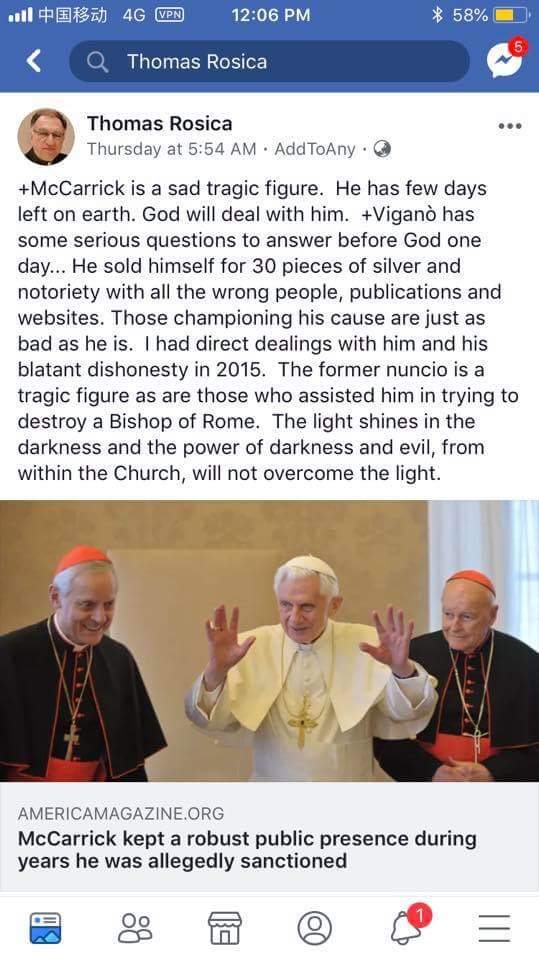
    Image may contain: text

    And then we have Fr. Rosica, who thinks Pope Francis is Jesus, not just His vicar, spews this garbage:


    OUR BISHOP WRITES

    In this morning’s Savannah News Press:

    LETTERS TO THE EDITOR

    Church must practice what it preaches
    I first want to thank those of you who took the time to share your thoughts and feelings regarding the morality crisis in the Catholic church today. I agree that words alone are meaningless. We need to take swift and serious action to clean up our own house. As a relatively new bishop, I am scandalized, angered and deeply hurt by the cover-ups that have occurred over the last 70 years. I was not even born when some of this disgusting behaviorFortunately, during my childhood and throughout my lifetime, I came to know hundreds of priests and sisters who taught and guided me. Many are deceased now, but my gratitude and my prayerful remembrance of them will continue until the end of my life. I am so sorry that some of you did not have the same experience. I still share your anger and shame. I am embarrassed to be a bishop. I simply want to be a Franciscan priest. But if I can be more helpful to change this culture of immorality as a bishop, then I will continue.

    We need the help of the laity to correct the horrific behavior of the clergy of the past. The Dallas Charter of 2002 has been effective in creating safer parishes and schools for our children. Please support your parish priest and me as we, together, strive to cease this sinful and criminal activity occurring within our church. We now need to create a charter to review the behavior of bishops.

    As a result of this current crisis, I will never look upon the crucifix quite the same way. I see Jesus’ pain so much more vividly now. I now see more clearly our sins for which Jesus died. We can only make restitution by a significant change in our own lives. There is no free ticket to heaven. Dante is believed to have said that “the floor of hell is paved with the skulls of bad bishops and priests.” That is certainly a sobering thought.
    Pope Francis calls us to prayer and penance for the intention of the victims of sexual abuse. We must also urge the bishops to open the closed doors of secrecy and let in the Spirit of Truth. We must practice what we preach.

    Bishop Gregory J. Hartmayer Diocese of Savannah

    WHAT A MESS! AND YET A POPE CANNOT BE FORCED TO RESIGN!

    If Pope Francis is a validly elected pope (and yes given all of the mess since day one but now on steroids, it isn’t too brash too suggest it) no one can force a pope to resign even for high crimes and misdemeanors, as a forced resignation is an invalid resignation. The same criteria can also be applied to Pope, so-called Emeritus, as well.

    But this Swiss news account is both sober and commonsensical:

    Prominent Swiss newspaper on Viganò report: ‘The silence of the two popes seems strange’

    SWITZERLAND, August 31, 2018 (LifeSiteNews) – One of the most prominent German-speaking daily newspapers in Switzerland is calling upon Pope Francis and Pope Emeritus Benedict XVI to come out with some clarifications concerning the Viganò report. About Pope Francis, the journalist asks: “Why does he not simply issue a denial?”
    Michael Meier, writing for the national newspaper Tages-Anzeigerfrom Zurich, Switzerland, reports in an August 30 article on the Viganò claim that Pope Francis had been informed about the McCarrick scandal but still made the predatory prelate one of his counselors. Commenting on the many objections raised against Viganò himself, especially on the “thesis of a plot” of the “right-wing camp which is critical of Francis,” Meier states, “that is quite possible, yes plausible. But even if the thesis of a plot is true, it does not refute Viganò's accusations.”
    “One can only agree with the columnist Matthew Schmitz at the New York Times,” he adds, “that Pope Francis would have to resign, should the accusations be true.” (My comment: no, he is WRONG!)
    Using his common sense, this journalist notes, “the silence of the two popes seems strange.” With regard to Pope Francis’ own silence, the journalist has a logical question to ask: “Why does he not simply issue a denial? He would not hurt anyone with it, except Viganò.” Quoting Archbishop Georg Gänswein's announcement that Pope Benedict XVI will not speak about the Viganò report, Meier also asks: “Why is the ex-Pope silent when he would be in the position to exonerate his successor?”
    The Swiss journalist refers back to Josh Shapiro, attorney general of Pennsylvania, who recently claimed that the Vatican had been informed about the clerical sex abuse cases in that state: “Whether Francis himself also knew, he (Shapiro) could not tell.”
    For Meier, it is “quite possible that Francis, in spite of all accusations, cherished and promoted McCarrick who was known for his engagement for the poor.”  
    “It is known,” Meier adds, “that Francis does not like to be talked into his personnel decisions. If he likes someone, he stands also by the black sheep.” Francis trusts here “the Holy Spirit, that is to say his gut feeling.” Thus, “reflexion is being missed out,” Meier concludes.
    At the end of this reflective article, the Swiss journalist joins Cardinal Daniel DiNardo’s call for “logical and evidence-based answers.” With regard to DiNardo's request for an all-encompassing investigation of the accusations and an audience with the Pope, Meier states: “He (DiNardo) now has to remind him (Pope Francis) of his own words: ‘covering-up was yesterday. Now transparency is demanded.’”

    Saturday, September 1, 2018

    IS THE NEW YORK TIMES TURNING ON POPE FRANCIS???????


    Archbishop Carlo Maria Viganò released an explosive letter that called for the resignations of Francis and a slew of other church leaders.CreditGregory A. Shemitz/Reuters
    READ THE FULL NEW YORK TIMES STORY HERE!

    This is an excerpt:

    The Viganò letter has pitted Francis against Benedict XVI, the emeritus pope, who stepped down in 2013 — confirming the worst fears of Catholics who warned that having two popes living as neighbors in the small, intrigue-laden footprint of Vatican City would be dangerous to the church.

    Both popes could clear up the confusion created by the letter. Neither one has.

    The silence has left a vacuum into which speculation, gossip and ideological combat have now poured, consuming the Vatican and Francis’ pontificate and drowning out the issue of child sexual abuse, a scourge that is devouring his church from within.

    Archbishop Viganò has filled the vacuum with fresh allegations against Pope Francis on sensitive topics such as the pontiff’s 2015 meeting with Kim Davis, the Kentucky clerk who refused to issue same-sex marriage licenses.

    The archbishop argued in another detailed letter published on Friday in conservative Roman Catholic news outlets that he had personally briefed the pope about the meeting beforehand and that the Vatican’s efforts to characterize him as ambushing the pope with the meeting were untrue.

    FROM THE JESUIT AMERICA MAG, A GOOD SUGGESTION?


    Cardinal Daniel N. DiNardo of Galveston-Houston is pictured Nov. 15, 2017, at the annual fall general assembly of the USCCB in Baltimore. (CNS photo/Bob Roller)  Cardinal Daniel N. DiNardo of Galveston-Houston is pictured Nov. 15, 2017, at the annual fall general assembly of the USCCB in Baltimore. (CNS photo/Bob Roller)
    There has never been a moment in the history of the U.S. Catholic Church when the trust and confidence in bishops as leaders has been more in doubt. The allegations of sexual abuse and misconduct levied against Archbishop Theodore McCarrick—and how they were or were not handled by church leaders—would have been enough to sink our episcopal poll numbers. The Pennsylvania grand jury report guaranteed a loss of trust and gave birth to a new level of skepticism.
    Trust will not be easily reclaimed. I do not think I am being too alarmist in suggesting that it may well be lost for all but the younger members of our episcopal conference. But there is a critical decision coming, which will define the depth of the morass in which the bishops find themselves at this moment.
    The United States Conference of the Catholic Bishops must promise the people of our church in this country that in addressing the issues we currently face, we will do so in open session and further promise that nothing will be discussed in closed session. In fact, I would proffer that there should be no “executive session” at our November meeting at all and that the entire meeting and discussion be open.
    There has never been a moment in the history of the U.S. Catholic Church when the trust in bishops as leaders has been more in doubt.
    Our general habit when dealing with neuralgic issues is to introduce the topic in public session, strictly control and limit debate and then really hash our solutions out in closed session. That did not always work in the past, and it will not work now.
    There is something of a history here with which I am familiar. Up until about 1965 and the end of the Second Vatican Council, the meetings of the U.S. bishops were strictly closed affairs held at the Catholic University of America. Even my predecessor four times removed as general secretary, Msgr. Paul Tanner, was not allowed in the room and was required to sit outside the doorway to the meeting room with notes being passed under the door if questions arose and his help was needed.
    With Vatican II and the presidency of Cardinal John Dearden, conference staff, including the general secretary, were admitted to the meetings for the first time. Another five years passed before the membership could be convinced that most of the meeting should be in open session with the press, observers and a few other categories given admission and access. It was then that “executive sessions” were introduced as a setting where the membership could really say what they meant and felt.
    God’s people deserve to know not just exactly what is being done but who is doing it.
    Finally came video coverage of the meetings by EWTN and with it some occasional grandstanding for the cameras. Secrecy at that time became an even more treasured commodity, and I can personally attest that there were many discussions held behind closed doors that would have edified our people and only a few that would have been embarrassing. I fear for what I am proposing because I know a good number of my brothers would prefer to return to closed sessions altogether. It is not likely, but that would be a tragedy.

    Whatever the history, this moment requires government in the “sunshine.” Business as usual can no longer be the norm, and God’s people deserve to know not just exactly what is being done but who is doing it. It can be a moment of epochal change for the church in this country.
    Cardinal Daniel N. DiNardo has outlined an approach that has good merit. The administrative committee of the conference meets in a few weeks to work on the agenda for the November gathering. It would be a good thing if that meeting would also be open to some representation to the outside (something like a “pool” arrangement). There cannot be much left to hide.
    The custom of more recent times to delete from the official minutes of all major conference meetings, which bishops receive, the names of the bishops speaking on each subject should be discussed and changed. The church does not belong to us, and we cannot continue to think we have the sole responsibility for governance. The proposal of the executive committee announced by Cardinal DiNardo cedes oversight and action to possible new entities. I know there will be debate on that issue, but will it be fully in the open or following past protocols—introduced in public, hammered out in private?
    It could be that the terrible, painful mess in which the U.S. bishops find themselves at the moment will be an opening to a new, more inclusive, more transparent, more accountable episcopacy continuing the evolution begun with the Second Vatican Council. Such a possibility provides, for me at least, the slightest beam of light in a very dark moment.

    LET ME OPINE ABOUT THIS ONE MORE TIME: SHORT TERM OR LONG TERM CONGREGATIONALISM IS THE KEY TO SURVIVAL OF LOCAL CLERGY AND LAITY’S FAITH IN THE POST-VATICAN II 60 YEAR INSTITUTIONAL MELTDOWN


    Let’s keep it local. Keep our local parishes strong. Preach the Word, mean The Word Incarnate, Jesus Christ, and celebrate the Sacraments by reading the black, doing the red and with flair and most of all faith and devotion.

    Provide opportunities for popular devotions, Adoration of the Most Blessed Sacrament, and personal prayer in an open church.

    Provide opportunities for Christian Service especially ecumenical ones, various apostolates and teach the pristine Catholic Faith.

    Help families to be congregational too, by being the Church in miniature as it concerns all I write above.

    Finally I found this comment on another blog. What do you think:

    If I could go back in time, to the day after Vatican II and I could tweak the church on one item and it would not be theology, celibacy or birth control.  I would give people in parishes the option to buy back the deed to their local church, school etc.  That so much of the anger with the church these past five or more decades has more to the secular accounting, global spreadsheet, philosophy/religion, founded at Wharton, Brown and Harvard.  
    That to see the parishes of my parents and grandparents, aunts and uncles become obsolete and turned into 7/11s in Philly or upstate Pennsylvania is the real reason so much anger is out there or at least from my point of view.  My grandparents sweated blood and gave everything to help found a church and now 90 years later, the deed is in some cleric's hands who is selling it for the price of the land and not the buildings on it,  goes to your point about democracy. 
    Constantine did not make every Christian a shareholder in the local basilica. He gave it, the deed, to the men who could deliver taxes and men into his armies, collected and recruited out of those very same basilicas. 
    That one tweak I think would have created a better flow of energy, understanding and purpose of the Spirit from that day to this than any other thing. 

    GLAD TO SEE THAT WHEN I AM IN SOUTH CAROLINA MY BISHOP THERE HAS MADE AN EXCEPTIONALLY STRONG STATEMENT TO THE HOLY FATHER--KUDOS!

    My Comment first: South Carolina's bishop implies that Pope Francis' non communication on the Vigano accusations is this terrible form of clericalism which, oddly enough, the Holy Father condemns in everyone else. It is the same type of clericalism that the Holy Father exhibits in not answering the dubia, one way or another. It is dishonesty and clericalism at its worst!

    Dear Archbishop Christophe Pierre, Nuncio
    August 31, 2018

    Our Church is in crisis and as the leader of the Catholic faithful in the State of South Carolina, I write with urgency to express my sentiments and echo those of the people in my care. We feel betrayed, angry and misled. 


    Something must be done now. I have several recommendations that support the statement from Cardinal Daniel N. DiNardo, President of the United States Conference of Catholic Bishops. It is imperative that the Holy See take a leadership role in investigating the rise of Archbishop Theodore McCarrick, despite the reported knowledge of his prior sexual misconduct and monetary settlements during his earlier diocesan assignments. It is absolutely necessary for all of us to know how and why this happened. Action must occur immediately and publicly.  


    I, too, strongly support an investigation by the Holy See along with a national lay commission with its own authority to seek the truth about the statements made by Archbishop Carlo Maria Vigano. These recent reports have triggered many different versions of what has actually happened and it is necessary that the Holy Father respond to the allegations made by the Archbishop. 


    Please encourage the Holy Father to address these allegations directly. This is in everyone’s best interest; lack of knowledge and uncertainty contribute to the confusion so much a part of our people’s lives today. Our Church is called to be a beacon of light in the darkness. I ask that you be an ambassador of truth and assist in the securing of actionable change.

    Also, I wholeheartedly endorse every effort to reform and renew our initiatives to protect survivors in allowing the national review board to serve as an independent entity that will review allegations made against bishops. This work must be entrusted to the laity. 

    This time of scandal requires especially strong and courageous leadership. I pray that all bishops commit to anew era of transparency and action. We must dedicate ourselves to the healing of all whose faith has been undermined and work to do all we can to prevent such crimes from happening in the future.

    Please know that I support all of your efforts to assist our Church here in the United States.


    MIXING APPLES AND ORANGES AT THE VATICAN INSIDER


    Former Apostolic Nuncio to the USA Carlo Maria Viganò awards Cardinal McCarrick (2 May 2012)


    The Vatican Insider in Rome has another salvo against Archbishop Viganò. This time they are mixing apples 🍏  and oranges 🍊 as it concerns McCarrick and subverting the actual scandals.

    You can read The Vatican Insiders article HERE, where Pope Francis is praised for removing McCarrick’s red hat and publicly compared to Pope Benedict’s “secret” sanctions.

    My points as it concerns The McCarrick scandal:

    1. As far as we know, McCarrick’s homosexual abuse of at least two young teenage boys was unknown until these now adult men came forward recently with their credible accusations

    2. It was known, though, in high places and for decades that McCarrick was an active homosexual and still was made a bishop, named to Washington and then made a Cardinal.

    3. Pope Benedict’s unfortunate secret sanctions were about what Benedict thought was terrible corruption in McCarrick involving consensual homosexual sex with adult seminarians and young adult priests, not ephebophilia. For better or worse, I believe worse, Pope Benedict wanted to send a reprimand to McCarrick about what he thought was consensual homosexuality but did not want to out him or the seminarians and priests. Unfortunately I don’t think the abuse of power angle or clericalism was considered by Pope Benedict.

    4. It appears Pope Francis rehabilitated McCarrick, in mercy forgave his homosexuality peccadilloes and used him as a close friend and confidant who advised him on the USA and appointments of bishops and cardinals.

    5. It wasn’t until it became publicly known that McCarrick was also a homosexual ephebophile through New York’s investigation of two accusations that were deemed credible that Pope Francis acted quickly to remove McCarrick’s red hat.

    6. Certainly Pope Benedict would have done the same given what Francis did in my point #5.

    BOMBSHELL OR FIRECRACKER, I ASK, YOU ANSWER

     I will go out on a limb here, but this whole peculiar scandal has to do with the Catholic schism on homosexuality . The footnote in Amoris Laetitia, is a deceitful attempt to make heterodoxy look like orthodoxy and is meant to collapse Catholic moral teachings on sexuality and prepare the Catholic Church to embrace the Anglican Church’s modernism, not only on divorce and remarriage, but on homosexual marriage and female ordination. It is an attempt to subvert natural law as well.

    Thus Archbishop Viganò’s new bombshell testimony connects more dots:

    Remember them?

    Featured Image

    Lifesite reports this, this morning:

    Here below is the official English text of Archbishop Carlo Maria Viganò’s statement on Pope Francis private meeting with Kim Davis and what really happened. The English text may also be accessed in pdf form here, while a pdf of the Italian original may be read here. Emphasis not added.
    ***
    Pope Francis met privately with Kim Davis: here is what really happened
    by
    His Excellency Carlo Maria Viganò
    Titular Archbishop of di Ulpiana
    Apostolic Nuncio
    On August 28, 2018, the New York Times reported part of a conversation that Juan Carlos Cruz, the most well known Chilean sexual abuse victim of Father Karadima and Bishop Barros, allegedly had with Pope Francis. Inexplicably, in his conversation with Cruz, the Pope is said to have spoken about his meeting with Kim Davis during his visit to Washington on September 24, 2015, and to have said that he knew nothing about the case before the meeting.
    Faced with the Pope’s reported statement, I feel obliged to recount the events as they really unfolded.
    At the end of the dinner, at the Nunciature in Washington, on the evening of September 23, 2015, I told the Pope that I needed him to grant me a half hour, because I wished to bring to his attention, and possible approval, a delicate and easily achievable initiative; that is, to meet personally and in a completely confidential way, out of the media spotlight, with Kim Davis, a clerk in Rowan County, Kentucky, the first American citizen condemned and imprisoned for one week for having exercised her right to conscientious objection.
    At the beginning of our meeting, on the evening of September 23, I gave the Pope a one-page memo summarizing the Davis case (here attached in Italian and English). The Pope immediately appeared in favor of such an initiative, but added that the meeting would have political implications, and said, “I don’t understand these things, so it would be good for you to hear Cardinal Parolin’s opinion.”
    It was already 9:30 in the evening, so I went in person with two of the counselors of the Nunciature (an Italian and a Lithuanian) to the hotel not far away, where the Pope’s entourage was being hosted. Since I had called ahead to give advance notice of my arrival, His Excellency Archbishop Angelo Becciu (Substitute of the Secretary of State) and His Excellency Archbishop Paul Gallagher (Secretary for Relations with States, and Head of the Political Section of the Secretariat of State) were waiting for me in the hotel lobby. They immediately notified me that Cardinal Parolin had already retired to his room, and they did not consider it appropriate to disturb him, since they could easily make him aware of our meeting the following morning.
    We then met in a small lounge of the hotel. As I said, there were five of us. I gave them the same memo that I had given to the Pope, setting forth its content and explaining the reason for my visit, which had been requested by the Pope. After considering the case, Archbishop Becciu was immediately in favor of the Pope receiving Davis privately before he left Washington for New York.
    Archbishop Gallagher, while showing support for the idea given the importance of defending the right to conscientious objection, said that it was appropriate to verify from the point of view of common law whether there were any reasons that would render the meeting inadvisable; namely, whether the legal proceedings brought against Davis were concluded or were still open. I therefore had him speak by telephone with the canonist for the Nunciature, who before becoming a priest had been a judge in the American military courts and a professor of canon law. After the conversation with the canonist to clarify matters — he said there were no procedural obstacles — Bishop Gallagher gave an unconditionally favorable opinion that the Pope should receive Davis.
    The following morning, after the Mass that the Pope concelebrated with us in the Nunciature, I informed the Pope of the positive opinion of his two principal collaborators, who had then told Cardinal Parolin about our meeting. The Pope then gave his consent, and I organized to have Davis come to the Nunciature without anyone noticing, by having her sit in a separate room. Everything was made much easier by the fact that Davis was already in Washington, where she was invited to receive a Cost of Discipleship Award from the Family Research Council.
    Before the meeting took place, I alerted the photographer from L’Osservatore Romano that he should not release the photographs of the meeting without the permission of his superiors. He of course observed the orders, but took many photographs, which have never been published, and are currently kept in the photographic archive of L’Osservatore Romano. I also had Davis promise me in advance that she would not give any news to the media until after the Pope’s return to Rome, at the end of his pastoral visit to the USA. Davis faithfully kept her promise.
    Early in the afternoon of September 24, before leaving for New York City, the Pope entered as planned into the sitting room where Davis and her husband were waiting for him. He embraced her affectionately, thanked her for her courage, and invited her to persevere. Davis was very moved and started crying. She was then taken back to her hotel in a car driven by a pontifical gendarme, accompanied by an American Monsignor and staff member of the Nunciature.
    Once the Pope returned to Rome from Philadelphia after the World Meeting with the Families, the news of his meeting with Davis broke out in the media. An avalanche of phone calls, faxes and emails arrived at the Nunciature in Washington and the Vatican Press Office, many with insults and protests, but also many in favor of the Pope’s meeting with Davis. In an article of September 30, 2015, the New York Timesreported that “Vatican officials initially would not confirm that the meeting occurred, finally doing so on Wednesday afternoon, while refusing to discuss any details.” The Vatican Press Office then issued a statement — without their superiors in the Secretariat of State ever consulting me — stating that the Pope had never received Davis in a private audience, and that at most he may have greeted her among many other people before departing for New York. Father Rosica and Father Lombardi increased added to the lies, and were quoted as follows in the October 2, 2015 edition of the New York Times: “But the Rev. Thomas Rosica, a Vatican spokesman, said on Friday that the office of Archbishop Viganò had extended the invitation to Ms. Davis and that the Pope was probably not briefed about her case. And the Rev. Federico Lombardi, the chief Vatican spokesman, depicted the meeting as one meet-and-greet among many.” This is the transparency of the Holy See under Pope Francis!
    The next morning, at about 6:00 a.m. in Washington — I remember it well because I had just entered the chapel at the Nunciature — I received a frantic telephone call from Cardinal Parolin, who told me “You must come immediately to Rome because the Pope is furious with you!” I left as soon as possible and was received by the Pope at the Domus Sanctae Marthae, around 7 o’clock in the evening on October 9, at the conclusion of one of the afternoon sessions of the Second Synod on the Family.
    The Pope received me for almost an hour, and was very affectionate and paternal. He immediately apologized to me for troubling me with coming to Rome, and he lavished continuous praise on me for the way I had organized his visit to the USA, and for the incredible reception he received in America. He never expected such a welcome.
    To my great surprise, during this long meeting, the Pope did not mention even once the audience with Davis!
    As soon as my audience with the Pope was over, I immediately phoned Cardinal Parolin, and said to him, “The Pope was so good with me. Not a word of reproach, only praise for the success of his visit to the USA.”At which point Cardinal Parolin replied, “It’s not possible, because with me he was furious about you.”
    This is a summary of the events.
    As mentioned at the beginning, on August 28, 2018, the New York Times reported an interview with Juan Carlos Cruz, in which Cruz reported that during his meeting with the Pope, in April 2018, the Pope told him about the Davis case. According to Cruz, the Pope said: “I did not know who the woman was and he [Msgr. Viganò] snuck her in to say hello to me — and of course they made a whole publicity out of it. And I was horrified and I fired that Nuncio.”
    One of them is lying: either Cruz or the Pope? What is certain is that the Pope knew very well who Davis was, and he and his close collaborators had approved the private audience. Journalists can always check, by asking the prelates Becciu, Gallagher and Parolin, as well as the Pope himself.
    It is clear, however, that Pope Francis wanted to conceal the private audience with the first American citizen condemned and imprisoned for conscientious objection.
    + Carlo Maria Viganò
    Titular Archbishop di Ulpiana
    Apostolic Nuncio
    August 30, 2018
    Feast of Saint Jeanne Jugan and Blessed Alfredo Ildefonso Schuster
    Official translation by Diane Montagna