Translate

Monday, December 4, 2023

HOW WISE IS IT WHEN ONE PROCLAIMS A PREFERENTIAL OPTION FOR THE POOR, OR AS POPE FRANCIS DESIRES, A POOR CHURCH FOR THE POOR, THAT AFFLICTING THE COMFORTABLE AND COMFORTING THE AFFLICTED, BACKFIRES ON BOTH THE RICH AND THE POOR..


In my 1970’s seminary, we were taught that Vatican II demanded a preferential option for the poor and that the Church most go to the poor and others on the margin of society with the Good News, that in their poverty they were blessed. And by way of extension, the Church would be blessed by being poor.

Thus, the Church taught us would-be priests to afflict the comfortable and comfort the afflicted.

Well, afflicting the comfortable will only go so far until they are pushed to the margins and fed up with being afflicted by those in the Church they stop practicing the faith and become nones. 

And the poor, fed up with the paternalism of the Church, which tells them they can’t help themselves so let us do everything for you and keep you subservient in your poverty, they too get fed up and become nones or only come to the Church for a handout not a change of life by God’s grace!

And the rich and not so rich fed up with being afflicted for what they have stop giving to the Church and the poor suffer as programs must be cut.

It is no secret that Pope Francis’ desire for a poor church and afflicting the comfortable has backfired. Those most generous to the Vatican and supporting papal efforts directly with their money have been the rich in the Church, most of whom are conservative and traditional. But Pope Francis has bitten the hand that feeds the Vatican so much by afflicting them with name calling, pop psychology diagnosis, and marginalizing those who don’t agree with the heterodox direction the pope seems to be leading everyone, that they have stopped giving and now the Vatican is in a financial crisis, not just from their own financial corruption and ineptness but because the rich are no longer giving because they are alienated by this pope.

This is from the Pillar as it concerns Pope Francis’ desire to charge market price to Cardinal Burke for his place of residence. (You would think the pope would offer him a room next to his at the Vatican Motel Six!)

From the Pillar:

In March, the Vatican announced that it would end its customary practice of providing free or subsidized accommodations in Vatican-owned properties to cardinals, prefects of dicasteries, presidents of Vatican bodies, as well as senior curial staffers, in light of the Vatican's economic crisis.

The obvious question that must be asked is, who in the past ten years has exacerbated the financial crisis of the Church by alienating Americans, rich as well as poor Americans (and other nationalities) who have always been generous to Peter's Pence and other needs of the Holy Father? Just who might that be?


Sunday, December 3, 2023

THE INFLUENTIAL ITALIAN BLOG, SILERE NON POSSUM, TAKE ON THE CARDINAL BURKE DEBACLE

UPDATE: Cardinal Burke notified of Vatican apartment changes


To date, there has been absolutely no OFFICIAL confirmation that Pope Francis is removing Cardinal Burke’s Vatican apartment and cardinalate stipend. There is nothing at Vatican News or any of the websites of the Vatican that cover papal meetings and decisions. 

The only confirmation is in the form of gossip from Austen Ivereigh. He gloats over at “Where Peter Is” that he called the pope and received confirmation about Pope Francis’ decision but also that the pope said he did not call Cardinal Burke an enemy. 

All of this is gossip on the part of the pope and Austen Ivereigh, the papal biographer.  

There is now concern that Pope Francis is now compromised in his physical health and soon to be 87 years old, the physical complications with his breathing can lead to a drop in his blood oxygen which then compromises the person experiencing such a thing in a mental way with confusion, hearing voices, and acting like a person with dementia. When blood oxygen levels return to normal levels, symptoms dissipate, but at 87 years old, things will never return to complete normalcy.

THIS IS SILERE NON POSSUM’S ARTICLE BY WAY OF GOOGLE TRANSLATE OF THE ORIGINAL ITALIAN

LA QUESTIONE BURKE DIVENTA UN PROBLEMA SERIO IN VATICANO

(THE BURKE QUESTION BECOMES A SERIOUS PROBLEM IN THE VATICAN)

On 20 November 2023, in the Apostolic Palace, the Holy Father Francis chaired a meeting with the Heads of Dicasteries of the Roman Curia. There were various topics addressed but one, more than all, made some cardinals turn up their noses. The Pope spoke of his intention to intervene on American Cardinal Raymond Leo Burke, patron emeritus of the Sovereign Military Order of Malta.

The prelate has been the recipient of a "demonizing" campaign by the press for years. He, more than many others, suffered harsh criticism for having celebrated the Holy Mass according to the vetus ordo, for having taken a position on particularly delicate issues such as life and marriage. But why? It is clear that Burke is the target of that wing of individuals who believe they are Catholic because they are "socially committed". In a historical moment like the current one, therefore, it is clear that a personality like Burke is enemy number one. The press did everything to describe him as "crazy", "out of touch with reality", "rich", "rigid", etc... But the question we asked several of his fellow cardinals was: "But do you know him personally? Has he ever had tea together?"

The answer, unfortunately, is always the same: “No”. This drift was the price of the 2013 conclave. The ideas and impressions of the principles of the Church were based on newspaper articles or television reports. This has caused enormous damage to individual people but, today we can say it with full knowledge of the facts, to the Church itself.

Many times, browsing the countless blogs, one reads declaration after declaration from cardinals that they have never actually uttered. Yet, most people, but also their brothers, believe what they read and their judgment will not change easily. In recent years, therefore, we have witnessed a series of injustices directed towards one or the other and most have commented: "Well, okay, but it's Burke, but it's Muller, but it's..." This happens because we have the belief that they are different from us and therefore they will be affected, we will not. There is the belief that in the end if they were hit "there is a reason". Yet, we are realizing that this is not the case. Today the message is clear: “You could be next”.

Because it is also essential to understand that it is not enough to act like an ostrich and stick your head in the sand, not to contradict the Pope, to pretend that nothing is happening. As we know well, here all it takes is for someone to accuse you of something and the letter arrives from Santa Marta.

Northern Vatican

This is a powerful own goal that Francesco scored and perhaps he didn't even realize it. We are seeing it, day after day the Pope "loses his grip". Also this morning, December 3, he reread a piece of the Angelus that Monsignor Braida had already read. The problem now, however, becomes more and more serious because if we find ourselves facing the same dynamics as the last years of John Paul II, we are really fresh. This is precisely what frightened Benedict XVI. If in 2000 there were stamps that passed from one room to another and episcopal appointments that came out in packets without the knowledge of the dying Pope; Today we can't even imagine what we could face with the entire entourage that Francesco brought with him.

There is one certainty: the law no longer exists. On 28 February 2023 Silere non possum gave the news regarding the Rescriptum on apartments. Precisely on that occasion we reiterated how these ad hoc rules were clearly aimed at hitting enemies and fixing friends. The clause where the Pope reserves any rights, in fact, has already been applied several times.

Just think of when Víctor Manuel Fernández wrote enthusiastically on Facebook that the Pope had personally looked for an apartment suitable for him. Does Fernández pay the rent? Does he pay it at a subsidized rate?

Furthermore, when that Rescriptum was published, many cardinals were deluded by the rule which said that existing contracts were not affected. Yet, with Raymond Leo Burke it didn't go that way at all.

This is not, therefore, about supporters: traditionalists or modernists. The situation is much more serious. At stake is the very function, the essence, of the episcopal ministry and of the cardinalate. If a bishop is no longer free to speak because otherwise he risks having his diocese or even his salary taken away, what parrhesia are we talking about? The Pope will also like the image of the polyhedron but understanding what he looks like here is really difficult if he suddenly changes his mind every day.

North Korea, by now, doesn't give a damn. The Pope's will is to throw out all those who, in one way or another, do not fit into his idea of ​​governance. Is there anything to ask? Now that he sees his strength waning more and more, will he do so with even more freedom? What is the end? To ensure a conclave with only his head?

Burke scares the Pope

While some up-to-date journalists attempt to attribute this provision to the latest Dubia presented, in reality Francis had been harboring these ideas long before. It is clear that the Pope did not utter the phrase: "Burke is an enemy." He would never do it in front of the Heads of Departments, it is also something for fifth graders to do. The bottom line, however, is that the Pontiff is afraid of American Catholicism and is aware that Burke enjoys the esteem of all American Catholics. What the Pope perhaps didn't consider is that taking away his apartment and his cardinal's plate will only create division in the United States. He certainly won't create economic problems because, as we have seen on several occasions, when these measures are in place people react accordingly and support them.

So let's ask ourselves, wasn't Francis the Pope of unity? Wasn't he the "all in" Pope? At WYD, didn't he say "todos, todos, todos"? In Germany, however, a real schism is emerging. In America it's better not to even mention it because otherwise they'll slap you. In Argentina they don't even want to see it. Maybe there is something not working. Perhaps the only thing he has in hand is the press.

All these journalists who are starving and who throw themselves at Francis' table to get a word, repeated a thousand times, but in front of their camera. How beautiful!

Mrs. Doubtfire: new spokesperson

While the Press Office of the Holy See is silent because he no longer knows what to do, Francis for years has continued to issue "pizzini" to those dogs, faithful servants, who spend their days on Twitter pontificating in defense of Bergoglio. Since the news about Burke leaked, the Press Office has been under categorical orders not to talk about the subject. At the same time, however, the journalist who defines himself as the "Pope's biographer", nicknamed Doubtfire here in the Vatican, wrote: "I met Pope Francis on the afternoon of November 27th. It was a short meeting due to his lung inflammation, which meant it took him some effort to speak. During our conversation, Francis told me that he had decided to remove Cardinal Burke's cardinal privileges – his apartment and his salary – because he had used those privileges against the Church. He told me that while the decision was not a secret, he did not intend a public announcement, but earlier that day (Monday) he had leaked it."
Now, is it possible that the confirmations or denials of the Pontiff's words come from a street newsagent who, who knows why, has access to Santa Marta? We have a Dicastery for Communication with hundreds of employees paid to do nothing and the Pope relies on these ambassadors of bad luck? This is also part of the Pope's strategy, who will be able to retrace his steps whenever he wants, perhaps by dumping Mrs. Doubtfire and saying that he told a lie.
We ask ourselves: are there really people who still want to play this game?

Route change

What is certain is that the Sacred College and also the bishops must change course and stop thinking about their own backyard. We cannot think of proceeding in this way. Today it's Burke, yesterday it was Pell, then Becciu, tomorrow who will it be? But how many bishops have felt humiliated in front of everyone? This system is no longer bearable and the Church is also suffering as regards vocations. How many years has it been since we have had people enter the seminary enthusiastic about this pontificate?

Maybe it's time to abandon the fans, the ideologies and it's time to examine one's conscience. Without looking at the small territory of our dioceses but let's think of the Church as a whole, because if it suffers all the members suffer with it.

d.M.T

Silere not possum

A TAKE ON CHAIRING…


I still think, despite those younger priests who want to go backwards, that the celebrant’s chair has a liturgical significance in the Modern Mass that it did not have in the TLM. To impose the TLM’s sedalia purpose on the chair in the Modern Mass is incorrect and does not acknowledge the development of liturgical theology that has occurred with the Modern Mass Chair. 

The liturgical development concerning the Celebrant’s Chair in the past 50 years means that the chair is used for the Liturgy and given a prominence it did not have in the TLM’s sedalia. That prominence is in the style of the chair (which shouldn’t be throne like in appearance, which has occurred unfortunately, nor placed as it was in the TLM). It should have a prominent location as it had at St. Anne’s in Richmond Hill and at St. Gregory’s in the photos with this post! 

But this might be a happy compromise born of necessity.

St. Gregory the Great Church in Bluffton, South Carolina (Diocese of Charleston) where I assist on Sundays, since the pandemic has had the Roman Missal on the altar from start to finish. The Mass begins and ends at the chair with this exception which I like:

The Introductory Rite begins at the Chair but after the Gloria, the Priest says or chants “Let us pray” and then proceed to the altar to pray the Collect. Then he returns to the chair for the Liturgy of the Word.

At the end of Holy Communion, once the Hosts are returned to the tabernacle and as the deacon finishes the “ablutions” the priest sits at the chair. After the appropriate silence, he stands, says or chants “Let us pray” and proceeds to the altar for the Prayer after Holy Communion, the blessing and dismissal. 

What I like about that is that it brings liturgical movement to these parts of the Mass which is a “take” on the liturgical movement that happens at the altar in the TLM. 

As I have said before, the TLM is Liturgical Dance and there is no need to impose dance on that Mass. The liturgical dancing of the TLM was horribly deformed in the revised Mass, so adding some liturgical dance as I described above isn’t a bad idea for the MRM!


Saturday, December 2, 2023

TO PROPERLY CHAIR OR NOT TO PROPERLY CHAIR—THAT IS THE QUESTION…

Please note the angled celebrant’s chair at St. Joseph Church in Macon, and yes that me sitting on it;

The post Vatican II Liturgy has four focal points:

1. The altar

2. The ambo

3. The Celebrant’s chair

4. The seating for the assembly

In this post, I will focus only on the Celebrant’s chair, because the revised Liturgy emphasizes three locations in the sanctuary for the celebration of the Mass,  the altar, ambo and celebrant’s chair, all three used for liturgical functions. 

In the TLM, the celebrant’s chair (sedalia) was not used at all in a Low Mass but would have been used in a Sung and Solemn Sung Mass, but only to sit as no liturgical action was/is done by the priest at the chair. However, that was/is not the case for the bishop in a sung or solemn sung pontifical Mass. 

Thus the priest’s sedalia in the TLM is to the side of the altar facing sideways. It is not elevated since no liturgical function occurs at the chair, nor angled to the assembly for the same reason and it is on the lowest level of the sanctuary.

The rubrics for the Modern Missal indicate that the Celebrant presides from the chair for the Introductory Rites and the Concluding Rites of the Mass. He sits for the Liturgy of the Word while the reader proclaims the scriptures and stands at the chair while the deacon proclaims the Gospel. The chair has liturgical significance for the celebrant in the revised Mass. 

Unfortunately, going backwards to the early Church, many sidelined the tabernacle in order to place the celebrant’s chair dead center behind the altar. In some cases, the chair was placed directly in front of the altar, both a recovery of a very early tradition that developed differently in subsequent centuries. 

Today, it is best to have the celebrant’s chair to the side of the altar and slightly angled, so there is not a direct frontal confrontation with the congregation. 

This is how the chair was configured at St. Anne when I was there as pastor:

The Mass above is the Modern Missal Mass but ad orientem and recovering some aspects of the TLM that is permissible in the MRM. 

Since I departed, the chair as been reoriented slightly but still used in the proper way for the MRM:


Since the two above photos were taken, the platform elevation under the celebrant’s chair has been removed. 

The problem I have with the new configuration is that there are a significant number of pews on either side of the altar. Thus the presiding chair does not have the same significance as when it is angled in the photos above the ones immediately above this paragraph. 

What do you think? Angled or not angled in a church with significant seating on three sides of the altar?

TO RAIL OR NOT TO RAIL, THAT IS THE QUESTION, BUT IF YOU RAIL, HOW DO YOU RAIL, THAT IS THE SECOND QUESTION

If you rail, this is how not to rail, putting the altar behind bars and makes the railing equal in value to the altar and ambo:

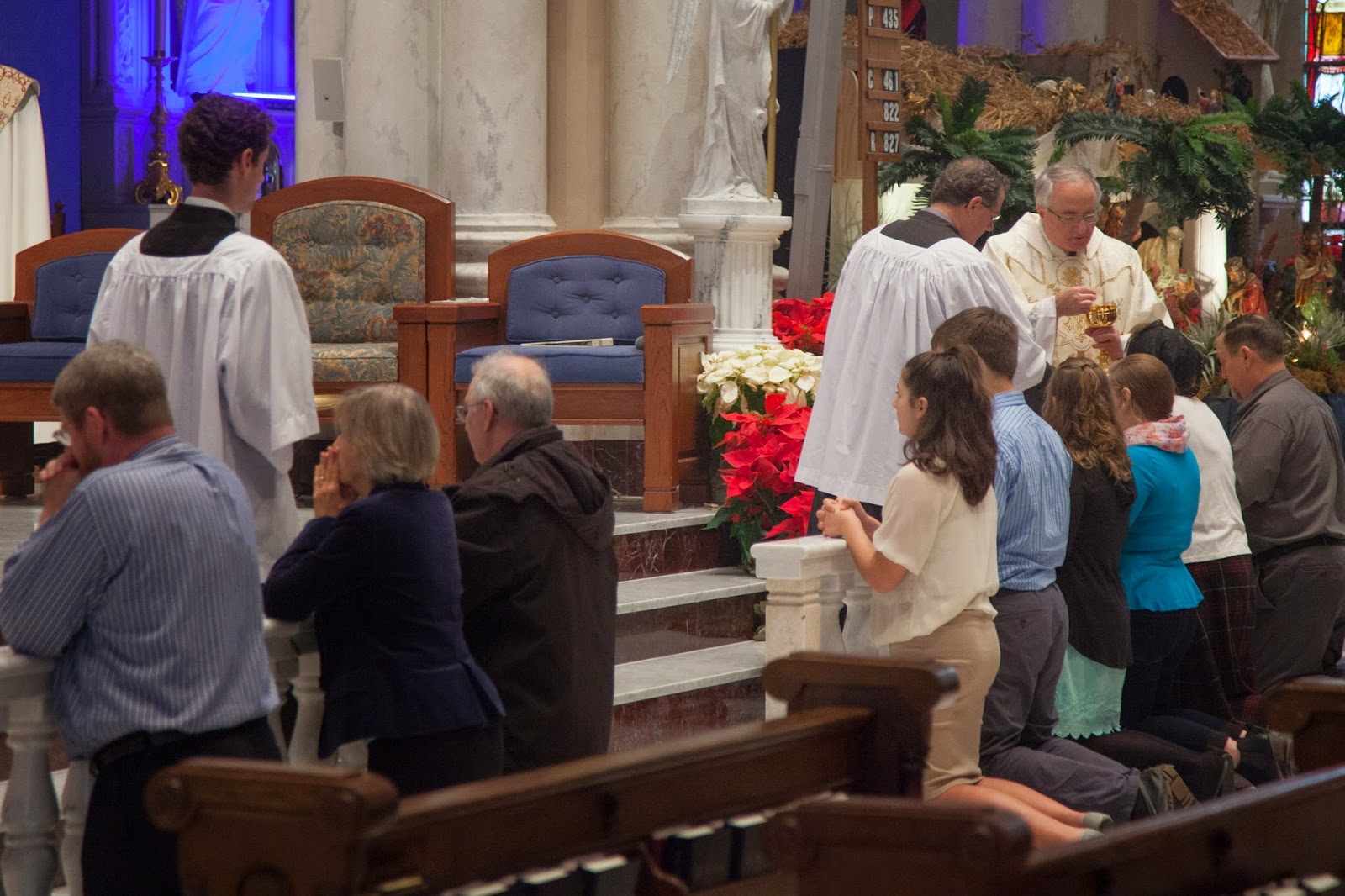
If you rail, this is how you rail, making sure the rail is secondary and/or invisible from the nave in a full church:


I think some liturgists got it right when they insisted that the sanctuary not seem to be fenced off from the nave of the church by an altar railing. I did not agree and still do not agree that altar railings should have been removed altogether. I don’t agree that standing to receive Holy Communion has been a good thing for Eucharistic belief and piety, in fact it has been a clear disaster as has been Holy Communion received casually on the hand and in a variety of silly ways. 

But back to railings. This is the altar railing at Saint Joseph Church in Macon, Georgia prior to Vatican II:


The high altar is, of course, the altar; there is no altar in front of it. The altar railing placed on the top step of the sanctuary in no way hides the high altar or the ambo/pulpit.  The altar is completely seen even in the last row of pews in a crowded church, even with people standing in front of it as in the photo above!

But look at this post-Vatican II photo with a new, but horrible, free standing altar placed in front of the intended altar but  on the lower floor of the sanctuary and taking up all the room:

Of course the chairs hide the old high altar no longer used nor the tabernacle, as that was shunted to the right side altar, not in view in this photo. But look at the altar railing, still in its original place, it hides the new free standing altar or is in competition with the new free-standing altar. That is not the case, even in this photo, with the high altar which, if the chairs weren’t there, would be completely visible and the railing isn’t competing with it in importance. The altar is the most important liturgical furnishing in any church!

In 2004, when I became pastor at St. Joseph, we went through a major renovation/restoration and expansion of the sanctuary into the nave. I convinced the committee to remove the altar railing and I asked that the new altar we had designed be placed higher up so as to be in a prominent position as is the high altar and that the new altar, at least look like the main altar, since we could not or would not remove the high altar which was beloved and a beautiful backdrop.

When the church was dedicated in 2006, it no longer had an altar railing as these photos show:


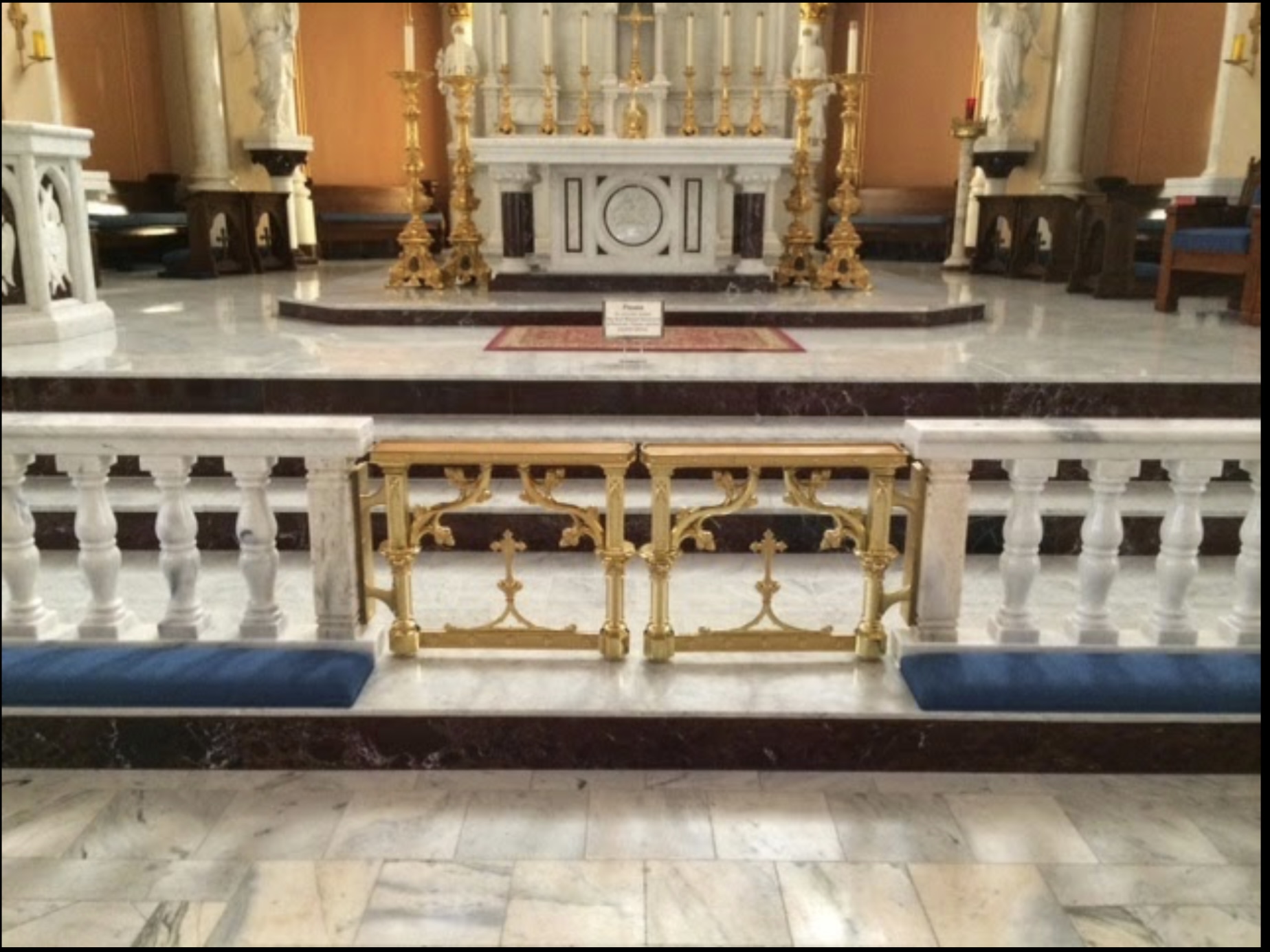
Then, I, who removed the altar railing by 2006, decided in 2014 that I would rail again and do it right. This is how we did it. We extended the first step leading the the sanctuary into the nave so that the railing could be placed in a way that there was room for people to kneeling in front of it, but from the nave level, without going up any stairs, and there was enough room for the priest to distribute Holy Communion behind the railing, spacious room:


Then the old railing, which we stored under another parish building, was recovered, additional sections fabricated and then installed. Only one gate survived the immediate post-Vatican II adjustments, thus three new sections were fabricated looking identical to the one which survived:


And then, communicants could kneel at the altar railing, railed right, to reverently receive Holy Communion and live happily ever after and forever in heaven. 


Friday, December 1, 2023

WHEREIN CARDINAL PAROLIN AGREES WITH ME ABOUT THE RESURGENCE OF THE THEOLOGY AND LEGACY OF POPE BENEDICT XVI


 As I have written before, it appears that Cardinal Parolin is reasserting himself recently. During the Synod on Synodality he reiterated that doctrine cannot be changed. I think  this was in reference to the discussion of admitting women to Holy Orders and changing the doctrinal meaning of marriage to allow for LGBTQ+ blessings which would resemble marriage or validate illicit, immoral sexual unions recognized in civil law. 

Then he slapped down the German synodal way as it concerns women’s ordination and changing the Church’s doctrine on homosexuality. He warned the Germans that if any bishop ordained women they would face excommunication. Implied in this too, is presiding over same sex or LBGTQ+ blessings that resemble marriage or validate civil marriages. 

It would seem that the good Cardinal may be positioning himself as the future Pope, no?

And today, Cardinal Parolin upholds the legacy of Pope Benedict XVI and that that legacy will benefit the Church in the future! That’s a bombshell, no? Of course, I have already written that on my blog a few years ago! 

From Vatican News with my astute comments embedded in RED:

Cardinal Parolin: Benedict XVI’s legacy will bear fruit for the Church

As Cardinal Secretary of State Pietro Parolin presents this year’s Ratzinger Prizes to theologian Pablo Blanco Sarto and philosopher Francesc Torralba, he recalls the importance of Pope Benedict XVI's thought concerning the relationship between faith and reason. 

By Michele Raviart

An attitude of “flying high with the two open wings of reason and faith, albeit always with humility, effort, and perseverance”: This is the legacy, “alive and set to bear fruit in the future journey of the Church,” that Benedict XVI leaves behind a little less than a year after his death. (Thank you Cardinal Parolin for reminding us that the future of the Church depends on Pope Benedict’s teaching legacy!)

Cardinal Secretary of State Pietro Parolin made the remarks during the presentation of the 2023 Ratzinger Prize, the first ceremony for the Prize since the death of its namesake. Cardinal Parolin described the former Pope as “a pastor and teacher of faith” and “a luminous and courageous example of dialogue.” Pope Benedict’s Magisterium, the Cardinal said, is “characterized by an awareness of the cultural and spiritual situation of the world,” and of the tensions between peoples and between man and creation.

Continuity with Francis

These are themes and issues to which Benedict XVI contributed with profound insight, subjects that have been powerfully developed in the subsequent Magisterium of Pope Francis – one can think of the influence of the encyclical Caritas in veritate on Laudato sí and Fratelli tutti – which demonstrates the strong continuity between the two pontiffs.

Cardinal Parolin noted that Benedict can also serve as a guide in dealing with the crisis of clerical sexual abuse, the gravity of which “he had already seen as cardinal prefect and with which he had to deal throughout his pontificate.” “He did so,” the Cardinal continued, “with intimate suffering, but with humble respect for the victims and for the truth, guiding the Church along the paths of listening, of justice and rigour, of conversion and prevention.” Benedict saw what was essential “with order and clarity,” Cardinal Parolin recalled, even during his final years of the “growing fragility of old age lived in prayer.”

The very act of renouncing the papacy was defined by Parolin as “an admirable synthesis of a lucid and reasonable vision of the situation, of responsibility in the exercise of government, and of humility before God and men.”

Blanco Sarto: I heard the music of the Mozart of theology

The winners of the 2023 Ratzinger Prize – awarded annually since 2011 by the Ratzinger Foundation to “scholars who have distinguished themselves for particular merits in publication and/or scientific research” – were Spaniards Pablo Blanco Sarto and Francesc Torralba Roselló.

In presenting the award to Blanco Sarto, a theologian at the University of Navarra, Cardinal Luis Ladaria, Prefect Emeritus of the Dicastery for the Doctrine of the Faith, recalled his 2011 book, The Theology of Joseph Ratzinger, where “one glance is enough to get an idea of the breadth of Ratzinger’s thought: Beauty, the liturgy, the Church, the person, faith, love, ministry, Mary, Jesus Christ.” (We definitely need to recover in the future, Pope Benedict’s liturgical legacy and the allowance of the TLM to continue, after an unfortunate hiatus, the inner healing of the Church as it concerns the implementation of Vatican II documents in rupture with her past which has caused such polarization and the heresy of trying to created a different Church from what has been!)

“If [Ratzinger] was the Mozart of theology, I think I have heard this music,” said Professor Blanco Sarto, who has dedicated much of his studies to delving into the thought of the theologian Pope. “What struck me,” he said, “is the vital, existential and hermeneutic dimension of his thought,” along with his realism and “fully accessible language.”

Torralba Rosellò: expanded the concept of reason

Over the years, recalled Cardinal Gianfranco Ravasi, President Emeritus of the Pontifical Council for Culture, the Ratzinger Prize has broadened its dimension from theology to the arts, law, sociology, and philosophy, all areas addressed by the Pope Emeritus. The award to the philosopher Francesc Torralba Rosellò, professor at the Ramon Llull University in Barcelona, should be understood in this sense. Ratzinger has expanded the concept of modern reason, said the laureate, “adding the measure of the gift and adding gratuitousness.” Reason, for Benedict, cannot be reduced only to what is verifiable and subject to experimentation: all metaphysics would be excluded. Faith and reason are fundamental for building tomorrow. (Excellent!)

Lombardi: he taught us to seek and find the truth

“Joseph Ratzinger never intended to build his own system of thought or to establish his own school, but he taught us to seek and find the truth with the strength of reason and the light of faith, always keeping reason ‘open’, in the dialogue between people, disciplines, and the great religious traditions,” said Father Federico Lombardi, president of the Ratzinger Foundation, during opening remarks.

“In the dramatic times in which we live,” Father Lombardi continued, “it is the very dignity of the person and the meaning of his life and his being in the world that are being put to the test in their fundamentals”; and in this sense Pope Benedict “is well aware of the possibilities and risks of the journey of humanity, as well as the mission of the Church for its salvation. He leads us to enter with humility and courage into the deepest level, to find and rediscover solid and indispensable common reference points.” (The true mission of the Church and her evangelistic endeavors is the salvation of souls, the salvation of the world!)

Morning prayer at Benedict XVI’s tomb and audience with Francis

Lombardi recalled the meetings that preceded the award ceremony. In the morning, those present at the ceremony gathered in prayer in the Vatican Grottoes, at the tomb of St Peter and the tomb of Benedict XVI. “Together we asked the Lord, that He reward him for his service, but also that his spiritual and cultural legacy continue to bear precious fruit for the Church, for us, and for the good of humanity,” Lombardi said. (God knows that at this polarized juncture in Church history, especially on steroids in the last 10 years, we need Pope Benedict’s clarity, lucidity and pastoral approach. God willing, it will be recovered in the near future!)

“Indeed,” he continued, “we consider it is our duty to cultivate not only in cultural reflection, but also in spiritual communion and prayer, the sense of the living and inspiring presence of this great teacher and pastor of ours.” Later, the award-winners were received by Pope Francis. (AMEN! ALLELUIA!)

Vatican News - English section contributed to this report

IN THE FACE OF THE SEEDS OF SCHISM AND DISUNITY THAT GERMANY’S CARDINALS AND BISHOPS AND LAITY ARE SOWING, MUCH WORSE THAN WHAT CARDINAL BURKE HAS DONE, POPE FRANCIS IS REASSERTING MAGISTERIAL INFALLIBLE TEACHINGS ON THE PRIESTHOOD…

 My astute comments embedded in RED:

(From Vatican News) Pope: Priests lead people to Christ when conformed to Him

Pope Francis encourages seminarians in France to accompany people with “the smell of the sheep” in their pastoral ministry, while nurturing their own relationship with Christ.

By Devin Watkins

As over 700 seminarians from across France take part in a pilgrimage to Paris, Pope Francis has renewed his call for the Church’s ordained ministers to adopt radical self-giving and pastoral closeness.

In a message sent Friday and signed by Cardinal Secretary of State Pietro Parolin, the Pope assured seminarians of his prayers for their formation and ministry.

He noted that our secularized Western societies greatly need the “generosity and boldness of faith” that they represent.

Priestly celibacy

The Church of France, said the Holy Father, needs priests who are conformed to Christ so that they can bring Christ to the people of God and “teach them with authority, guide them with certainty, and effectively transmit grace to them through the celebration of the sacraments.”

Pope Francis urged the French seminarians to take their celibacy seriously as a fundamental aspect of their priestly identity.

“The priest is celibate—and wants to be—simply because Jesus was,” he said. “The requirement of celibacy is not primarily theological but mystical.”

He noted that the priestly ministry is sometimes relativized or distorted, but affirmed that “no one has the power to change the nature of the priesthood”.

“No one will ever change it, even if the modalities of its exercise must necessarily take into account the developments of current society and the condition of the serious vocational crisis we are experiencing,” said the Pope.

(The pope makes a good comment on priestly celibacy which is configured to the celibacy of Christ and thus is mystical, not necessarily practical. I have always taught that celibacy isn’t meant to make the priest available to the laity 24/7 but more available to God in prayer, contemplation and also pastoral works. His focus in on his priesthood and the sacramental ministry that flows from it, not primarily on a wife and his own children. Thus celibacy is a “sacramental” of Christ’s sexuality which is chaste. But Jesus is masculine, manly and shows forth the chaste spousal relationship (Husband/Groom) that He is to His bride the Church, the souls of the Church.)

Closeness to Christ and people of God

Pope Francis went on to reflect on the new evangelization of societies in which the Church and the priest have lost all prestige or natural authority.

He said priests must allow Christ to draw people to have a personal encounter with Him through the priest’s presence.

The only way to achieve this, added the Pope, is to “adopt a pastoral style of proximity, compassion, humility, gratuitousness, patience, gentleness, radical self-giving to others, simplicity, and poverty.” (Nothing wrong with that and the only way to go, of course.)

The priest must “have the smell of the sheep” and walk with them at their own pace, seeking to gain their trust and lead them to encounter Christ. (I don’t particularly like the Biblical metaphor of the laity as smelly sheep and that priests have to smell like smelly sheep. I tend to take things literally, so it isn’t pleasant to my olfactory senses even imagining it. Why not just say that the priest is configured to the people of God having come from them in order to serve them through Sacrament and Word, faith and good works in the image of Jesus Christ, True God and True Man.)

“This is not new, of course,” he said. “Countless saintly priests have adopted this style in the past, but it has now become a necessity, under penalty of not being credible or heard.”

Love of Jesus enough for any priest

In conclusion, the Pope urged French seminarians to nourish a strong, authentic, and personal relationship with Jesus, in order to live the demands of priestly perfection.

“Love Jesus more than anything,” he said. “Let His love be enough for you, and you will emerge victorious from all crises, from all difficulties.”

(Not bad at all and quite traditional.)

ON THE LIGHTER SIDE…

 Liturgists can have a sense of humor, as wild as that sounds…


A BLAST FROM THE PAST, A POST FROM JANUARY 4, 2011 WITH COMMENTS MADE THEN BY SOME WHO NO LONGER COMMENT HERE


The other day I received a new comment from “Daniel” on the post I reprint below from January 4, 2011. It was another world and unfortunately another Church. 

With our national “Eucharistic Revival” I thought it a good idea to reprint this. I appreciate “Daniel’s” recent comment on it as it caused me to reread it. Enjoy it and the comments that focus on the substance of the post rather than personal insults and rancor: 


Tuesday, January 4, 2011

THE ACCIDENTS ARE NO ACCIDENTS

Yesterday, Fr. Z at the What Does the Prayer Really Say blog, made some comments about what a former Episcopalian, turned Catholic, reverting to the Episcopal Church had to say about what he believed the Catholic Church teaches on a number of areas, his premises all wrong.

When it came to the Most Holy Eucharist Fr. Z lambastes his misunderstanding of transubstantiation:

The former Episcopalian who became Catholic but reverted to the Episcopal Church ridiculed what he believed to be the Church's teaching that "the bread and wine physically change into his body and blood during the Eucharist without any palpable evidence of it."

Father Z writes the following:  "In fact, Roman Catholics do not believe that the bread and wine physically change during the Eucharist. The change, referred to as Transubstantiation, is sacramental and metaphysical, not physical. The "substance" of Christ's body is a reality apart from its "accidents" or specific physical manifestations. It is this substance which is present under the accidents of bread and wine. If "physical" is understood in the sense of "accidents" (or that which is empirically verifiable), then in Roman Catholic dogma, physically speaking, the bread and wine remain bread and wine."

Father Z has succinctly stated the Catholic Church's understanding that the bread and wine become the "Body, Blood, Soul and Divinity" of Jesus Christ. But this is not a "physical" changing of the bread and wine, but a "metaphysical" change. The "substance" the meaning, purpose, reality, changes, but the "accidents" remain, the look, smell, feel, taste, of the bread and wine.

But the accidents are no accident! In a sense we can say that the bread and wine once consecrated become metaphors for Jesus Christ, not similes, but metaphor. Remember your English class, a simile is when you say Jesus is like bread or He is like wine. A metaphor is when you say, Jesus is Bread; Jesus is Wine. You notice in the metaphor I capitalize Bread and Wine, but in the simile, I don't.

(On December 1, 2023: The same would be true of saying Jesus is “Food and Drink”, those words are capitalized because these refer to Jesus Christ and Who He is. If we said “food and drink are like Jesus Christ” these would not be capitalized.)

So what are the qualities of bread? It nourishes--Jesus nourishes. It is the staff of life--Jesus is the Staff of Life. It unites people who break and share it--Jesus unites people who receive Him, crucified and risen! 

We could also get into the details of how wheat is made into Bread and How Jesus is "made" into our Savior and makes our salvation, by being crushed in the sacrifice of the Cross and "raised" to new life in the resurrection. 

What are the qualities of wine? Wine brings warmth and joy to the heart--Jesus brings eternal warmth and joy to the heart. Wine unites people in being poured out and shared--Jesus pours out His life for us, especially on the cross, as we share Him in Holy Communion. Wine has a medicinal quality, brings healing when poured over wounds--Jesus heals us of sin and division.

We could also get into the details of how grapes are turned into wine. They are crushed, as Jesus is on the cross, etc.

We could go on and on about the significance of the metaphor of bread and wine, not only as it is Jesus, but also shows forth the one sacrifice of Jesus on the Cross.

So, we believe that bread and wine become the Body, Blood, Soul and Divinity of the Crucified and Risen Christ at every Mass. But we also believe that Jesus is Bread and Jesus is Wine at every Mass! Capice?

9 comments:

Marc said...

Great post (both your's and Fr. Z's). I like your exposition about simile and metaphor - I never thought of it that way before!

The Mystery of the Eucharist is similar to the Mystery of the Incarnation itself... How can the Second Person of the Holy Trinity become Bread and Wine? Well, the same way the Second Person of the Holy Trinity can become fully Human while continuing to be fully Divine!

Here's St. Iraneus on this point: "In the same manner in which you ascribe to the Eucharist only the value of a symbol, so also the incarnation is reduced (by you) to mere appearance: there is not more flesh in the one than in the other. The incarnation does not differ from the Eucharist."

Going back to the difference between simile and metaphor. When speaking of the Incarnation, one wouldn't say that the Second Person of the Holy Trinity became like man [simile], but that he actuallybecame man [metaphor].

I don't think I'm making sense here...

SqueekerLamb said...

Marc, you and St Iraneus make PERFECT sense!

For many of us humans, it's difficult to believe what we cannot physically touch, feel, see, or hear. To say that which to the physical senses is bread & wine, is actually something else is diffuclt to believe.

Kind of reminds me of people thinking were are just bodies without a soul, i.e. we are just physical beings. Ya' know I believed that for a long time, because I had nothing to convince me otherwise.
If the unbelievers would not put up walls and be open to the possiblity, then God will show them in they way that they need to be shown. He'll fix their unbelief if they'd just LET Him. God knows how to deal with the Doubting Thomas's of this world, if they'd only quit thinking that they know it all and just ALLOW Him to do His work.
Ya' know, Doubting Thomas didn't poo-poo Jesus and brush Him off. He took Jesus up on His offer to touch Him. If we'd be like Thomas and do things His way, then we'll also have our doubt and unbelief removed and be crying 'My Lord, and My God' at each and every elevation of the Eucharist.
So, if what Fr. Z, FrAJM, and Marc, and St. Iraneus have written is the way someone reading this needs to have it presented to them, then I hope they take heed, andnot look a gifthorse in the mouth.

J. Peliks said...

One would do well to review the history of the controversy of "exaggerated realism" as played out in the case of Radbertus Paschasius (d. 865) and Ratramnus (d c 868).

Jesus us not literally present, but sacramentally present under the forms/accidents of bread and wine.

SqueekerLamb said...

Forgive my ignorance, but what is the difference between literally present and sacramentally present?

Gene said...

I took part in a public forum on religious topics at a small liberal arts college once. There were representatives from most denominations and Judaism on the panel. After several presentations, the floor was opened for general question and answer from the public. At one point, a little Baptist lady was grilling the very naughty Catholic Priest member of the forum. She asked him, "Fr., do you really believe that bread is Jesus?" To which he replied, "Ma'am, it is easier to believe it is Jesus than it is to believe it is bread." Hilarious! The audience roared with laughter. Undaunted, however, she later said to the Priest, "I cannot imagine that you actually believe in Infant Baptism." To this he replied, "My dear lady, not only do I believe in it, I have seen it done!"

J. Peliks said...

If you were LITERALLY climbing the walls, you would be holding on to the walls with your fingers and toes, leaving the floor behind.

If you were LITERALLY crying your heart out, your tears would be full of cardiac muscle and blood.

If Jesus were LITERALLY in the chalice, you would see hair, skin, etc.

LITERALLY is one of the most frequently mis-used words we have . . . Literally.

Fr. Allan J. McDonald said...

S L, I think the point is not Jesus is not physically present in the sense of dead flesh and extracted blood. He is present, Body, Soul and Divinity, truly present, but in a sacramental, metaphysical way.

SqueekerLamb said...

The term 'metaphysical' is a helpful translation of the term 'sacramental'. Thank you.

(Just for the record, I did and do believe in the Real Presence...didn't want anyone to think I had knelt on hard marble for what I thought was only a simile.)

So, if something in the Church isn't considered by the church to be sacramental, then it isn't considered to be metaphysical, and therefore it is just physical..is that line of thinking correct? 
If that is correct, then how does the church consider/view a marriage that it convalidates but isn't then sacramental? What's the difference between a sacramental Matrimony and a non-sacramental convalidated marriage in the Church's eyes?

Daniel said...

Hey wait! I thought the Catholic Church always taught that after the consecration bread and wine no longer exist (only their "accidents" remain; the only things truly existing are Body and Blood). What you're saying sounds very Lutheran. I'm confused.