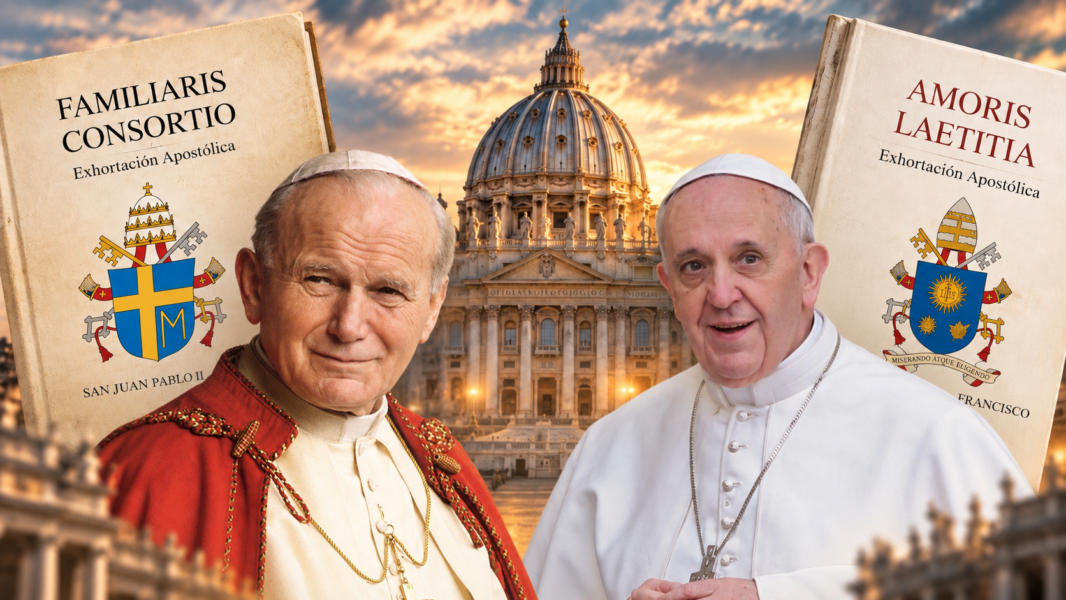
From Familiaris consortio to Amoris laetitia and the pending response to the dubia?
Rome begins this Wednesday to take stock of the ten years of Amoris laetitia. From October 7 to 14, nearly 250 bishops, including presidents of Episcopal Conferences and leaders of the Church…
MY COMMENTARY:
I can remember the first synods Pope Francis had soon after His Holiness became pope and the drama and reactions that these produced, not just from rigid rank and file lay Catholics but from academic theologians, bishops and cardinals, some in the Curia.
It seem that whenever there was a synod or a meeting or a letter or whatever, there were hysterical reactions often well-founded.
It appeared to many that Pope Francis thrived off of chaos and confusion and loved creating it.
Fast-forward to Pope Leo XIV, a no drama-pope—clear in what His Holiness says and writes and fair and balanced reaching out to all ideological aspects the Church exacerbated by the previous pontiff.
Those prone to PTSD syndrome, react hysterically to every move of the current pontiff, scruntizing every bishops’ choice, who His Holiness meets and looking for footnotes in every letter written.
Meeting with Fr. James Martin SJ signals those with PTSD that Pope Leo is Pope Francis II, never mind that Pope Leo also met with leaders of Courage and made it well known that he had.
And now Pope Leo has invited 111 Presidents of Bishops’ Conferences throughout the world to discuss Amoris Letitia and to see how it has been implemented or received. It appears to be only a listening session for Pope Leo and it will be behind closed doors, so not live-drama as with Pope Francis.
Of Course, those suffering from Pope Francis’ style PTSD, went nuts when we learned that Pope Leo had invited the three most polarizing Cardinals in the USCCB to attend, Cardinals Cupich, McElroy and Tobin.
Since I don’t suffer from Francis PTSD, I thought nothing about it, but others went off the deep end and started name-calling Pope Leo, Pope Francis II! Sheesh!
Thus, I love Infovaticano’s take on this meeting.
Here is the money byte:
From Familiaris consortio to Amoris laetitia
One of the keys to understanding what lies behind this anniversary is the relationship between Amoris laetitia and the earlier teaching of Saint John Paul II.
In 1981, Familiaris consortio explicitly addressed the situation of divorced persons who had entered a new union while a valid matrimonial bond still existed.
John Paul II then reaffirmed “the practice of not admitting to Eucharistic communion those who are divorced and remarried,” because their state and way of life “objectively contradict the union of love between Christ and the Church, which is signified and made present in the Eucharist.”
When serious reasons—for example, the education of children—advised maintaining cohabitation, Familiaris consortio linked the return to the sacraments to the commitment to live “in complete continence,” abstaining from the acts proper to spouses.
Amoris laetitia maintained the doctrine of the indissolubility of marriage, but placed greater emphasis on the discernment of each situation and on factors capable of diminishing subjective responsibility.
Its paragraph 305 states that, due to “conditioning or mitigating factors,” a person may find themselves “in an objective situation of sin” without being fully culpable. And the well-known footnote 351 added that the help offered by the Church “in certain cases” could also include the sacraments, with explicit references to Confession and the Eucharist.
The exhortation did not specify at that point what those cases were, nor did it reiterate the condition of continence established by Familiaris consortio.
From that difference arose one of the main controversies that accompanied the reception of the document.
The five dubia that Francis did not answer
On September 19, 2016, barely five months after the publication of Amoris laetitia, Cardinals Walter Brandmüller, Raymond Leo Burke, Carlo Caffarra, and Joachim Meisner sent Francis five dubia, doctrinal questions formulated to obtain an affirmative or negative response.
The first went directly to the point that had generated the greatest discussion.
The cardinals asked whether, after Amoris laetitia 300-305, it was possible to grant sacramental absolution and admit to the Eucharist a person who, being bound by a valid marriage, was living more uxorio—maintaining a relationship proper to spouses—with another person without fulfilling the conditions set forth in Familiaris consortio 84.
The other four questions broadened the problem. Taking Veritatis splendor as a reference, they asked whether the teaching on the existence of absolute moral norms, intrinsically evil acts, the objective situation of grave sin, the role of circumstances, and the limits of conscience in relation to moral norms remained valid.
Francis did not formally respond to the questions. The four cardinals decided to make them public in November 2016. Caffarra and Meisner died the following year without having received a response.

2 comments:
We might see him as Fracis II because he said he was; and much of what he has bears that out.
It was rude and classless for Francis not to respond, either directly or through his minions. No accompanying for you guys!
Post a Comment