The New York Times which also owns the Boston Globe is gunning for the Pope in much the same way as the Boston Blob gunned for the Church in 2002 by uncovering unreported sexual abuse in the Church going back 50 years.
Today the New York Times has a particularly scurrilous attack on Pope Benedict leading the Catholic League's sometimes strident voice to greater heights.
It's going to get worse before it gets better folks. Be prepared. I think we're at war!
This past Sunday, Joan Vennochi, who writes editorials for the Boston Globe, pontificated on secular society not giving the Church a pass on criminal prosecution of those who covered up the scandal in the Church of Boston. I wrote her an email which of course I have not received any response. This is the email:
In your editorial about sex abuse, you make some good points about “cover up” in the Church and secular society not giving the Church a pass especially by not prosecuting those in Church leadership, like Cardinal Law. Since I don’t read your editorials too often, I am sure you must be consistent in your decrees by asking the same for public school personnel and the abuse that has happened there in Boston. Or has the Boston Globe put a spotlight on that going back fifty and sixty years? If not, why not? If you have please direct me to the links where I can find it on the Boston Globe. Thanks in advance. What government officials would be implicated, dead or alive? Just who would be prosecuted? What code of silence and secrecy is operative in Boston’s secular, governmental culture? Could you name names on who should be prosecuted? What governor; what senator; what representative; what mayor; what school superintendent; what principal? Has the secular press in Boston done investigative reporting on that? When will you publish the secular leaderships “Letter of Apology” and then criticize it for not being enough? Keep up the good work. I’d love to know how you have reported on the secular public school’s handling of sex abuse in their system going back 50 and 60 years ago. I can’t wait for the links you will send me from the Boston Globe. God bless you. Fr. Allan J. McDonald
To date, no links to articles in the Boston Globe about sex abuse in Boston's public schools and reformatories has been sent to me! Is the Boston Globe covering up this scandal and those who perpetuate it?
Thursday, March 25, 2010

IT'S GETTING UGLY, CAN CATHOLICS BE CHRIST LIKE AND CHRISTIAN ABOUT IT?
Well the secular press is trying to paint all pro-life voters, anti-abortion as they call us, as right wing, name-calling, fanatics hurling racial slurs against African-American law makers and issuing death threats to democrats who voted for the Health bill and caved on abortion funding.
How are Catholics to respond? We are to use the political means available to us to advance Christ's message and the agenda Christ has given to the Church. We are to do so in a loving, non-hateful way. Death threats to living persons is not a part of the Church's pro-life agenda or consistent ethic of life.
The same goes for this blog and comments submitted. These comments must be Christ-like while still challenging those who are divisive in our Church. True division comes about when we are disobedient to the Faith, Morals and Canon Laws of the Church as well as Natural Law. Everything that the Church teaches and all of her discipline are codified and out in the open. We have only one Pope, one bishop in this diocese and one Magisterium in the universal Church. There is a hierarchy of beliefs and authority and no one trumps the pope and the bishops in union with him, even on the national level, let alone diocesan level.
Remember the Golden Rule: "Do unto others as you would have them do unto you!"
How are Catholics to respond? We are to use the political means available to us to advance Christ's message and the agenda Christ has given to the Church. We are to do so in a loving, non-hateful way. Death threats to living persons is not a part of the Church's pro-life agenda or consistent ethic of life.
The same goes for this blog and comments submitted. These comments must be Christ-like while still challenging those who are divisive in our Church. True division comes about when we are disobedient to the Faith, Morals and Canon Laws of the Church as well as Natural Law. Everything that the Church teaches and all of her discipline are codified and out in the open. We have only one Pope, one bishop in this diocese and one Magisterium in the universal Church. There is a hierarchy of beliefs and authority and no one trumps the pope and the bishops in union with him, even on the national level, let alone diocesan level.
Remember the Golden Rule: "Do unto others as you would have them do unto you!"
SOLEMNITY OF THE ANNUNCIATION: SOLEMN SUNG VESPERS AND BENEDICTION OF THE MOST BLESSED SACRAMENT
SOLEMN SUNG VESPERS I, FOR THE SOLEMNITY OF THE ANNUNCIATION BEGINNING WITH EUCHARISTIC PROCESSION AND CONCLUDING WITH BENEDICTION OF THE MOST BLESSED SACRAMENT
As a prelude to Solemn Sung Vespers and Benediction of the Most Blessed Sacrament,the Eucharistic Procession through the Church (not last night, but a previous time, but almost like this!)

For the Vigil of the Solemnity of the Annunciation, Solemn Sung Vespers, with Exposition of the Most Blessed Sacrament and a Eucharistic Procession in the Church as a prelude, concluding with Benediction of the Most Blessed Sacrament. It was glorious and befitting such a solemn feast:
Our Incarnate Lord, Incarnate now in the Most Holy Eucharist, The Most Blessed Sacrament of the Altar. This too is by the Power of the Holy Spirit as was the Incarnation!

Venite Adoramus, O Come Let us Adore Him!

Let us go in peace to love and serve the Lord!

We had our children preparing for First Holy Communion and our 9th graders preparing for Confirmation to form an honor guard for the Eucharistic Procession. The choir, cantor and congregation sang the psalms of the Liturgy of the Hours for Evening Prayer I for this Solemnity. The choir sang the Magnificat by Ralph Vaughn Williams. Every part of Vespers was sung. It was indeed glorious.
Until we meet again for the Solemnity of the Annunciation 2011!

Christmas is exactly nine months from now, I can't wait!

As a prelude to Solemn Sung Vespers and Benediction of the Most Blessed Sacrament,the Eucharistic Procession through the Church (not last night, but a previous time, but almost like this!)

For the Vigil of the Solemnity of the Annunciation, Solemn Sung Vespers, with Exposition of the Most Blessed Sacrament and a Eucharistic Procession in the Church as a prelude, concluding with Benediction of the Most Blessed Sacrament. It was glorious and befitting such a solemn feast:
Our Incarnate Lord, Incarnate now in the Most Holy Eucharist, The Most Blessed Sacrament of the Altar. This too is by the Power of the Holy Spirit as was the Incarnation!

Venite Adoramus, O Come Let us Adore Him!
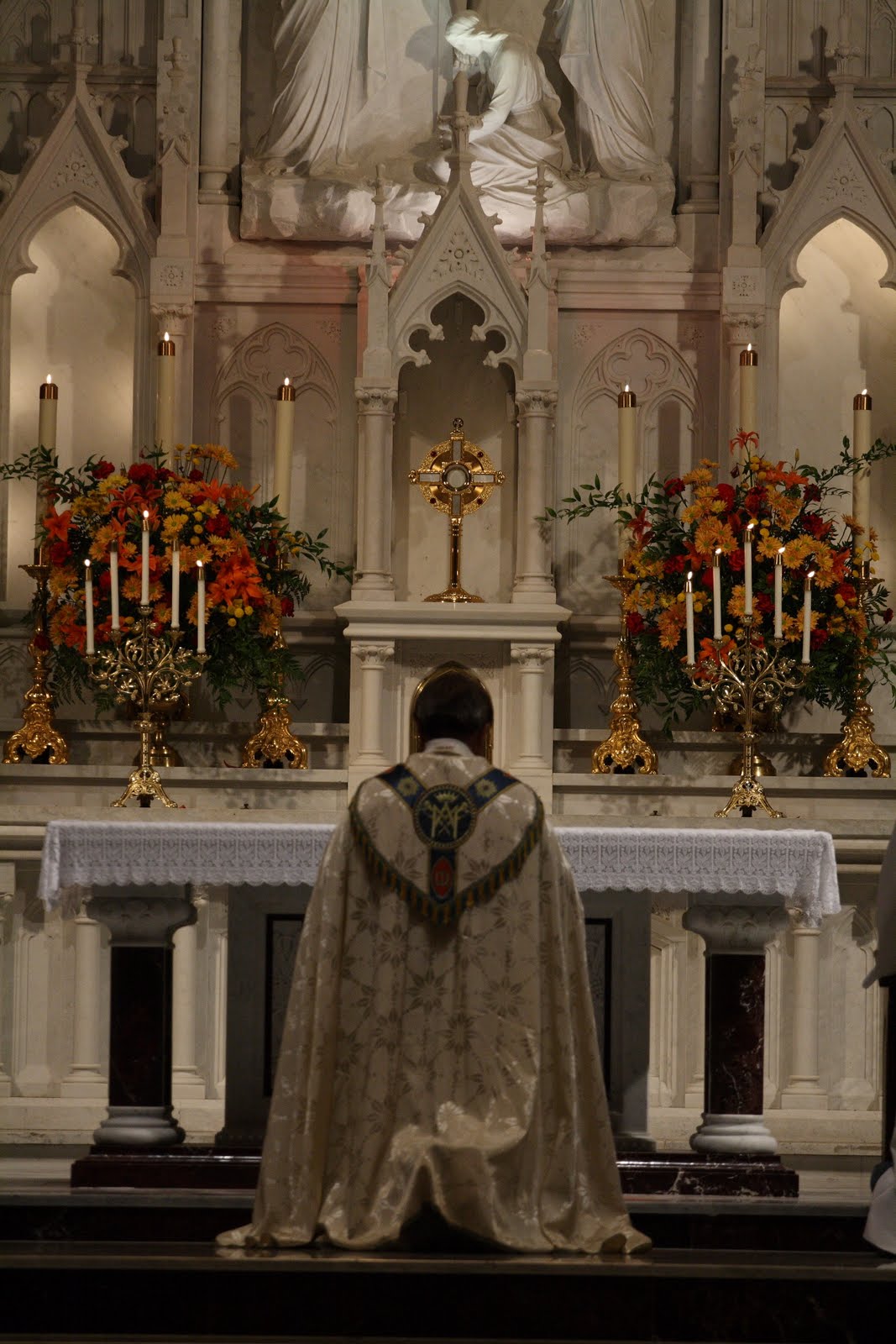
Let us go in peace to love and serve the Lord!

We had our children preparing for First Holy Communion and our 9th graders preparing for Confirmation to form an honor guard for the Eucharistic Procession. The choir, cantor and congregation sang the psalms of the Liturgy of the Hours for Evening Prayer I for this Solemnity. The choir sang the Magnificat by Ralph Vaughn Williams. Every part of Vespers was sung. It was indeed glorious.
Until we meet again for the Solemnity of the Annunciation 2011!

Christmas is exactly nine months from now, I can't wait!

Wednesday, March 24, 2010
POPE AND ANTI POPE, MAGISTERIUM AND ANTI MAGISTERIUM
Pope Benedict XVI, the man who is pope:

Fr. Hans Kung, the man who wishes he was pope, but really is the anti-pope:

Anti-Popes and Dangers of a Parallel Magisterium
By Monsignor Giampaolo Crepaldi
ROME, MARCH 22, 2010 (Zenit.org).- The attempt of the press to implicate Benedict XVI in the question of pedophilia is only the most recent sign of the aversion that many have for the Pope.
It is necessary to ask oneself how this Pontiff, despite his evangelical meekness and honesty, the clarity of his words joined to the depth of his thought and of his teachings, arouses in some places sentiments of disgust and forms of anti-clericalism that it was believed had been surmounted. And this, it must be said, causes even greater astonishment and also distress when those who do not follow the Pope and criticize his alleged errors are men of the Church, whether theologians, priests or laymen.
The unheard of and clearly forced accusations of theologian Hans Kung against the person of Joseph Ratzinger, theologian, bishop, prefect of the Congregation for the Doctrine of the Faith and now Pontiff for having caused, according to him, the pedophilia of some ecclesiastics through his theology and magisterium on celibacy profoundly distress us. It never happened before that the Church was attacked in this way.
To the persecutions against many Christians, crucified in the literal sense in many parts of the world, to the many attempts to uproot Christianity in previously Christian societies with a devastating violence on the legislative and educational plane, and to customs that cannot be explained by good common sense, has been added for some time a fury against this Pope, whose providential greatness is before everyone's eyes.
These attacks are echoed sadly by those who do not listen to the Pope, also among ecclesiastics, professors of theology in seminaries, priests and laymen. Those who do not accuse the Pontiff openly, but are deaf to his teachings, who do not read the documents of his magisterium, who write and say exactly the contrary of what he says, give life to pastoral and cultural initiatives, for example in the area of bioethics or in that of the ecumenical dialogue, in open diverge with all that he teaches. The phenomenon is very grave as it is very widespread.
Benedict XVI has given teachings on the Second Vatican Council that many Catholics reject openly, promoting forms of counter-formation and of systematic parallel teaching, led by many "anti-popes"; he has given teachings on "non-negotiable values" which very many Catholics minimize or reinterpret, and this also happens on the part of theologians and famous commentators guests of the Catholic press in addition to secular press; he has given teachings on the primacy of the apostolic faith in the wise reading of events and very many continue talking of the primacy of the situation, or of the practice, or of the data of human sciences; he has given teachings on conscience and on the dictatorship of relativism but very many put democracy or the Constitution before the Gospel. For many, "Dominus Iesus," the Note of 2002 on Catholics in politics, the 2006 Regensburg address, "Caritas in Veritate," is as if they had never been written.
The situation is serious, because the gap between the faithful who listen to the Pope and those who do not is spreading everywhere, even in diocesan seminaries and Institutes of Religious Sciences, and animates two pastoral programs that are very different in themselves, so that they almost no longer understand one another, as if they were the expression of two different Churches, causing insecurity and error in many faithful.
In these very difficult times, our Observatory feels the duty to express our filial closeness to Benedict XVI. We pray for him and remain faithful in following him.
[Translation by ZENIT]
* * *
Archbishop Giampaolo Crepaldi of the Diocese of Trieste is the president of the Cardinal Van Thuân International Observatory for the Social Doctrine of the Church.

Fr. Hans Kung, the man who wishes he was pope, but really is the anti-pope:

Anti-Popes and Dangers of a Parallel Magisterium
By Monsignor Giampaolo Crepaldi
ROME, MARCH 22, 2010 (Zenit.org).- The attempt of the press to implicate Benedict XVI in the question of pedophilia is only the most recent sign of the aversion that many have for the Pope.
It is necessary to ask oneself how this Pontiff, despite his evangelical meekness and honesty, the clarity of his words joined to the depth of his thought and of his teachings, arouses in some places sentiments of disgust and forms of anti-clericalism that it was believed had been surmounted. And this, it must be said, causes even greater astonishment and also distress when those who do not follow the Pope and criticize his alleged errors are men of the Church, whether theologians, priests or laymen.
The unheard of and clearly forced accusations of theologian Hans Kung against the person of Joseph Ratzinger, theologian, bishop, prefect of the Congregation for the Doctrine of the Faith and now Pontiff for having caused, according to him, the pedophilia of some ecclesiastics through his theology and magisterium on celibacy profoundly distress us. It never happened before that the Church was attacked in this way.
To the persecutions against many Christians, crucified in the literal sense in many parts of the world, to the many attempts to uproot Christianity in previously Christian societies with a devastating violence on the legislative and educational plane, and to customs that cannot be explained by good common sense, has been added for some time a fury against this Pope, whose providential greatness is before everyone's eyes.
These attacks are echoed sadly by those who do not listen to the Pope, also among ecclesiastics, professors of theology in seminaries, priests and laymen. Those who do not accuse the Pontiff openly, but are deaf to his teachings, who do not read the documents of his magisterium, who write and say exactly the contrary of what he says, give life to pastoral and cultural initiatives, for example in the area of bioethics or in that of the ecumenical dialogue, in open diverge with all that he teaches. The phenomenon is very grave as it is very widespread.
Benedict XVI has given teachings on the Second Vatican Council that many Catholics reject openly, promoting forms of counter-formation and of systematic parallel teaching, led by many "anti-popes"; he has given teachings on "non-negotiable values" which very many Catholics minimize or reinterpret, and this also happens on the part of theologians and famous commentators guests of the Catholic press in addition to secular press; he has given teachings on the primacy of the apostolic faith in the wise reading of events and very many continue talking of the primacy of the situation, or of the practice, or of the data of human sciences; he has given teachings on conscience and on the dictatorship of relativism but very many put democracy or the Constitution before the Gospel. For many, "Dominus Iesus," the Note of 2002 on Catholics in politics, the 2006 Regensburg address, "Caritas in Veritate," is as if they had never been written.
The situation is serious, because the gap between the faithful who listen to the Pope and those who do not is spreading everywhere, even in diocesan seminaries and Institutes of Religious Sciences, and animates two pastoral programs that are very different in themselves, so that they almost no longer understand one another, as if they were the expression of two different Churches, causing insecurity and error in many faithful.
In these very difficult times, our Observatory feels the duty to express our filial closeness to Benedict XVI. We pray for him and remain faithful in following him.
[Translation by ZENIT]
* * *
Archbishop Giampaolo Crepaldi of the Diocese of Trieste is the president of the Cardinal Van Thuân International Observatory for the Social Doctrine of the Church.
THE FRUIT OF HORIZONTAL WORSHIP AT MASS
Facing each other and all smiles! What a joy! But what happens to this oh,so joyful community when one punches the other one out, and pours hot charcoal with incense smoking all over the other?
 click to enlarge
What happens to Catholics when the emphasis at Mass is on the "community" and the "priest?" Well, if you have a great community, people who love the Lord, who appear to be perfect, a good looking priest, who smiles, is charismatic, outgoing, well spoken, well liked and seemingly perfect, then you have heaven on earth! It is great and what a joy to worship in such a perfect community, all circled around one another and experiencing such love, sympathy, empathy and compassion. Yes! "Wherever two or three gather in my name, I am in their midst!"
Will this help you keep the faith when your parishioners and priests run a muck?
 click to enlarge
But what happens to a community like this, when it is discovered that the pastoral council president is a womanizer, the communion ministers belong to exclusive, prejudicial country clubs, the lectors don't always attend Sunday Mass, that families have serious drinking and drug problems, that there are thieves and killers in their midst not to mention child molesters and mobsters. And the priest who faces them Sunday after Sunday has been in treatment for sex addiction, and unproven allegations have been hurled at him from decades ago and on top of that he's ugly, can't speak well, alienates people with his looks and isn't charismatic.
What if this priest is known to be a scandal to the community?
 click to enlarge
I suspect people would leave that Church. Well, folks, I've heard that people are leaving the Faith in large numbers in those places where the community and their priests are not perfect. Places like Boston, LA, Ireland, Germany, Austria. They simply can't stand looking at them, priests or community. So they leave the Church altogether. Some people even leave if the language of the Mass is not to their liking.
But I wonder how things would be if we had just left our "vertical" form of worship and architecture in place? I wonder if the priest joined the congregation and all facing the "liturgical East" awaiting the Lord's return to the Altar of Sacrifice as well as His return at the end of time, if things wouldn't be better today in terms of people sticking with the Church when Catholic laity and priests have gone wild?
Does it really matter who the priest is at the altar in this photo? No it just matters that there is a priest there!
 click to enlarge
Perhaps Catholics would focus more on their faith, their sinfulness, their need for forgiveness, that they're all in the same miserable sinner's boat in desperate need of the wonderful sacrifice of love Jesus offers them through His Incarnation, life, passion, death and resurrection. I wonder if it would matter that much to them who the priest is with his back to them most of the time, joining them in the same stance of need, prayer and worship? If he's validly ordained, then the worship is valid and the only Perfect One would come down from Heaven to save, nourish and redeem them all.
This could be any priest, good, bad or indifferent, but the Sacrifice celebrated and received would be what counts to aid the sin sick soul!

I think the emphasis on community and on priests that our current orientation at the Ordinary Form Mass must be re-examined and seen for the novelty it is and not beneficial to the Catholic Faith and the people for whom the Mass is meant to strengthen and nourish their faith in times like these we are encountering. Facing each other and facing the priest and the priest facing us doesn't cut the mustard. We need a new orientation which is really ancient. We need to focus on God and how God saves us. We humans while nice, aren't the best signs of perfection! If we think we've found God in community and the priests that serve that community, we are sadly mistaken. But if we as sinners know we need God and all of us face Him together, then our focus is on our need for forgiveness and our miserable state which brought about so great a Savior! O Happy Fault, O necessary sin of Adam which brought about so great a Savior! I thank Adam for his sin not because Adam is so great, but because God is Greater! I'll face God with Adam knowing that we both brought about the need for our Savior because of our wretchedness in choosing sin and death over grace and life.
I think this is healthier when things run a muck in the community!

click to enlarge
 click to enlarge
What happens to Catholics when the emphasis at Mass is on the "community" and the "priest?" Well, if you have a great community, people who love the Lord, who appear to be perfect, a good looking priest, who smiles, is charismatic, outgoing, well spoken, well liked and seemingly perfect, then you have heaven on earth! It is great and what a joy to worship in such a perfect community, all circled around one another and experiencing such love, sympathy, empathy and compassion. Yes! "Wherever two or three gather in my name, I am in their midst!"
Will this help you keep the faith when your parishioners and priests run a muck?
 click to enlarge
But what happens to a community like this, when it is discovered that the pastoral council president is a womanizer, the communion ministers belong to exclusive, prejudicial country clubs, the lectors don't always attend Sunday Mass, that families have serious drinking and drug problems, that there are thieves and killers in their midst not to mention child molesters and mobsters. And the priest who faces them Sunday after Sunday has been in treatment for sex addiction, and unproven allegations have been hurled at him from decades ago and on top of that he's ugly, can't speak well, alienates people with his looks and isn't charismatic.
What if this priest is known to be a scandal to the community?
 click to enlarge
I suspect people would leave that Church. Well, folks, I've heard that people are leaving the Faith in large numbers in those places where the community and their priests are not perfect. Places like Boston, LA, Ireland, Germany, Austria. They simply can't stand looking at them, priests or community. So they leave the Church altogether. Some people even leave if the language of the Mass is not to their liking.
But I wonder how things would be if we had just left our "vertical" form of worship and architecture in place? I wonder if the priest joined the congregation and all facing the "liturgical East" awaiting the Lord's return to the Altar of Sacrifice as well as His return at the end of time, if things wouldn't be better today in terms of people sticking with the Church when Catholic laity and priests have gone wild?
Does it really matter who the priest is at the altar in this photo? No it just matters that there is a priest there!
 click to enlarge
Perhaps Catholics would focus more on their faith, their sinfulness, their need for forgiveness, that they're all in the same miserable sinner's boat in desperate need of the wonderful sacrifice of love Jesus offers them through His Incarnation, life, passion, death and resurrection. I wonder if it would matter that much to them who the priest is with his back to them most of the time, joining them in the same stance of need, prayer and worship? If he's validly ordained, then the worship is valid and the only Perfect One would come down from Heaven to save, nourish and redeem them all.
This could be any priest, good, bad or indifferent, but the Sacrifice celebrated and received would be what counts to aid the sin sick soul!

I think the emphasis on community and on priests that our current orientation at the Ordinary Form Mass must be re-examined and seen for the novelty it is and not beneficial to the Catholic Faith and the people for whom the Mass is meant to strengthen and nourish their faith in times like these we are encountering. Facing each other and facing the priest and the priest facing us doesn't cut the mustard. We need a new orientation which is really ancient. We need to focus on God and how God saves us. We humans while nice, aren't the best signs of perfection! If we think we've found God in community and the priests that serve that community, we are sadly mistaken. But if we as sinners know we need God and all of us face Him together, then our focus is on our need for forgiveness and our miserable state which brought about so great a Savior! O Happy Fault, O necessary sin of Adam which brought about so great a Savior! I thank Adam for his sin not because Adam is so great, but because God is Greater! I'll face God with Adam knowing that we both brought about the need for our Savior because of our wretchedness in choosing sin and death over grace and life.
I think this is healthier when things run a muck in the community!

click to enlarge
FROM AN IRISH TABLOID, TRINITY NEWS, THE ANGRY MEDIA MOB
Media Mob Angry at the Catholic Church

The enraged anti-Catholic mob
Written by Eamonn Hynes
The angry mob that has sprung up in response to Church paedophila needs to calm down, according to Eamonn Hynes.
There’s nothing like a good paedophile story to drum up the outraged, liberal-media-reading masses; most of whom have never experienced the horrors of child abuse, nor are they charged with cleaning up the mess left behind by a bunch of sick perverts. Cribbing and moaning from the sidelines and making snipes at the Catholic Church are the tactics of a coward and symptoms of their ignorance. It is in an air of calm that I write this piece in support of the Irish Catholic Church and in support of the Irish clergy in their mission to cleanse the institution and continue on the path of repentance, healing and renewal.
First off, we should calm down. Is one really that interested in the kind of slippery implication that one reads about in the holier-than-thou Irish media who bandy about terms such as “misprision of felony” and the 1937 Offences Against the State Act like bullies in a school yard. The fact is that in order for a person to be guilty of a crime (such as this Section 17 of the Offences Against the State Act that we hear about so often), proof of fault, culpability or blameworthiness in both behaviour and mind is required. Some of the stuff I’ve read in recent weeks would lead you to believe that Pope Benedict is the anti-Christ and Cardinal Brady one of his evil minions. But getting back to the issue that caused shock-waves of outrage across the nation, I say this: The then-Fr. Sean Brady never at any stage consciously acted to further harm an abuse victim with an accompanying level of mens rea. Yes, Fr. Brady was a man in a position of responsibility, but I do not believe for one moment that he purposely acted to expose more children to the care of a sex pervert. Brendan Smyth went on to abuse children after Fr. Sean Brady interviewed him, wrote his report and sent it on to his Bishop, but to say that this is because of an act or an act of omission on the part of Cardinal Sean Brady 35 years later is a farce. We’d better start building prisons, because if we’re going to hold leaders of all institutions to those kinds of standards, we need to round ‘em all up, drag ‘em all before the judiciary (themselves of course squeaky clean in matters pertaining to child abuse and child pornography) and imprison them in a dungeon. There are plenty of company directors in the construction sector who have seen people killed under their watch: a tragedy that cannot be undone. Any right-minded Christian will acknowledge that the death or serious injury of a worker is a tragedy and that seeking vengeance against those higher up the hierarchy is futile and counter-productive in the process of grieving and recovering from life’s setbacks. There’s a big difference between the justice demanded by the angry mob and the type that civilised society dispenses. We must also remember that there are different standards of accountability in society, in that those who work 40 hours per week can engage in their little perversions outside office hours, unlike priests who are on duty 24 hours a day and cannot be “sacked” no matter how grave their crimes.
The Church is an earthly institution run by humans with human failings and human temptations. It has been this way since the time of the Apostles. There have been terrible Popes in its 2,000-year history, not to mention lots of scandal. But that is not the real story of the Church: the Church is the largest charitable organisation in the world, has been responsible for the conversion of hundreds of millions in Africa, is the bedrock of the great European cultures, motivates and inspires over a billion people all over the globe to follow in the footsteps of Christ, has played a central role in the peace process of Northern Ireland and provides a moral blueprint for life in the family and life in the community. Modern capitalism, the culture of consumerism and globalised business do not take human factors into account when deciding how to maximise their profit margins – a nation full of dumbed-down, individualistic, intoxicated consumer types who live on top of one another in apartment blocks and are continually in debt is their goal: not happiness, family life and divine sustenance. Bourgeois society with all its pretensions of decency and morality is hypocritical when it comes to the matter of child abuse. So what’s all this got to do with perverted priests? Well, be very careful what you wish for: if one wishes for the ruin of the Church, what will it be replaced with? The model for society that we currently have, complete with public drunkenness, violent crime, teenage pregnancies, widespread sexual perversion, abortion, drug-taking, murder, rape and the birth of a social underclass who will never work a day in their lives? What those who knock the Church know full well and artfully suppress, is that any system that operates on such a scale will occasionally make mistakes, even bad ones, since all human institutions are manned by people with human weakness. We must strive for perfection, minimise mistakes and when mistakes do occur, they must be rectified. The bien-pensant Church-bashers fear their censure and crave approbation: they are quick to point the finger and not in the habit of examining themselves. They don’t have the mechanisms of accountability that currently exist in the Church, having been instigated several years ago from the highest levels of the clergy. The fact is that young childing are safer in the hands of the Church than any other organisation in the country as no other organisation has such a rigorous vetting scheme and child protection procedures.
The Pope’s letter to the Catholic people in Ireland which was read out in every Church across the land last Sunday gives us much to think about and highlights the current challenges and future work that needs to be done. While some will never be happy no matter what the Pope writes (ultimately, even if they had his head on a plate, they would not be satisfied), the opus Dei must go on. It is not often that a Pontiff addresses the island of Ireland in such a direct manner. Having one of the world’s greatest intellectuals write over 4,000 of the most humble and apologetic of words on this particular issue demonstrates just how serious this matter is in the minds of the most senior clergy in Rome. I don’t expect this post-Celtic Tiger society of ours to embrace the words of the Pope quite just yet: there are still a lot of closed hearts to be healed, but I do expect that at some point in the future, we will look back and see the direct intervention and solemn apology from Pope Benedict as a major milestone in the purification of the Irish Church.
Cardinal Brady’s moving St. Patrick’s Day homily made several references to his own failings, the plight of abuse victims and the Church’s duty to them. He equated the challenges currently facing Irish Catholicism with those faced by St. Patrick when he managed to lead a nation of pagans to the way of Christ. Brady openly acknowledged that he is a sinner, just like St. Peter who, when asked by God to become a fisher of men, replied: “Leave me Lord, I am a sinful man.” Cardinal Brady took office in 2007 and his primary duty since then has been in tackling the child abuse issue head-on in the spirit of Christ. This is no easy feat. The 71-year-old has taken on this task, probably the most challenging of his life, with a level of fortitude that most men half his age would balk at. He has managed to achieve all this in the most sensitive, soft-handed manner in which the recompense of abuse victims is central and the Gospel is his guiding light.
That said, his journey has not ended and there is much still to be done. This sinner wishes for Cardinal Brady to remain steadfast through these difficult times and expects that he will bring repentance and healing to the Catholic Church.

The enraged anti-Catholic mob
Written by Eamonn Hynes
The angry mob that has sprung up in response to Church paedophila needs to calm down, according to Eamonn Hynes.
There’s nothing like a good paedophile story to drum up the outraged, liberal-media-reading masses; most of whom have never experienced the horrors of child abuse, nor are they charged with cleaning up the mess left behind by a bunch of sick perverts. Cribbing and moaning from the sidelines and making snipes at the Catholic Church are the tactics of a coward and symptoms of their ignorance. It is in an air of calm that I write this piece in support of the Irish Catholic Church and in support of the Irish clergy in their mission to cleanse the institution and continue on the path of repentance, healing and renewal.
First off, we should calm down. Is one really that interested in the kind of slippery implication that one reads about in the holier-than-thou Irish media who bandy about terms such as “misprision of felony” and the 1937 Offences Against the State Act like bullies in a school yard. The fact is that in order for a person to be guilty of a crime (such as this Section 17 of the Offences Against the State Act that we hear about so often), proof of fault, culpability or blameworthiness in both behaviour and mind is required. Some of the stuff I’ve read in recent weeks would lead you to believe that Pope Benedict is the anti-Christ and Cardinal Brady one of his evil minions. But getting back to the issue that caused shock-waves of outrage across the nation, I say this: The then-Fr. Sean Brady never at any stage consciously acted to further harm an abuse victim with an accompanying level of mens rea. Yes, Fr. Brady was a man in a position of responsibility, but I do not believe for one moment that he purposely acted to expose more children to the care of a sex pervert. Brendan Smyth went on to abuse children after Fr. Sean Brady interviewed him, wrote his report and sent it on to his Bishop, but to say that this is because of an act or an act of omission on the part of Cardinal Sean Brady 35 years later is a farce. We’d better start building prisons, because if we’re going to hold leaders of all institutions to those kinds of standards, we need to round ‘em all up, drag ‘em all before the judiciary (themselves of course squeaky clean in matters pertaining to child abuse and child pornography) and imprison them in a dungeon. There are plenty of company directors in the construction sector who have seen people killed under their watch: a tragedy that cannot be undone. Any right-minded Christian will acknowledge that the death or serious injury of a worker is a tragedy and that seeking vengeance against those higher up the hierarchy is futile and counter-productive in the process of grieving and recovering from life’s setbacks. There’s a big difference between the justice demanded by the angry mob and the type that civilised society dispenses. We must also remember that there are different standards of accountability in society, in that those who work 40 hours per week can engage in their little perversions outside office hours, unlike priests who are on duty 24 hours a day and cannot be “sacked” no matter how grave their crimes.
The Church is an earthly institution run by humans with human failings and human temptations. It has been this way since the time of the Apostles. There have been terrible Popes in its 2,000-year history, not to mention lots of scandal. But that is not the real story of the Church: the Church is the largest charitable organisation in the world, has been responsible for the conversion of hundreds of millions in Africa, is the bedrock of the great European cultures, motivates and inspires over a billion people all over the globe to follow in the footsteps of Christ, has played a central role in the peace process of Northern Ireland and provides a moral blueprint for life in the family and life in the community. Modern capitalism, the culture of consumerism and globalised business do not take human factors into account when deciding how to maximise their profit margins – a nation full of dumbed-down, individualistic, intoxicated consumer types who live on top of one another in apartment blocks and are continually in debt is their goal: not happiness, family life and divine sustenance. Bourgeois society with all its pretensions of decency and morality is hypocritical when it comes to the matter of child abuse. So what’s all this got to do with perverted priests? Well, be very careful what you wish for: if one wishes for the ruin of the Church, what will it be replaced with? The model for society that we currently have, complete with public drunkenness, violent crime, teenage pregnancies, widespread sexual perversion, abortion, drug-taking, murder, rape and the birth of a social underclass who will never work a day in their lives? What those who knock the Church know full well and artfully suppress, is that any system that operates on such a scale will occasionally make mistakes, even bad ones, since all human institutions are manned by people with human weakness. We must strive for perfection, minimise mistakes and when mistakes do occur, they must be rectified. The bien-pensant Church-bashers fear their censure and crave approbation: they are quick to point the finger and not in the habit of examining themselves. They don’t have the mechanisms of accountability that currently exist in the Church, having been instigated several years ago from the highest levels of the clergy. The fact is that young childing are safer in the hands of the Church than any other organisation in the country as no other organisation has such a rigorous vetting scheme and child protection procedures.
The Pope’s letter to the Catholic people in Ireland which was read out in every Church across the land last Sunday gives us much to think about and highlights the current challenges and future work that needs to be done. While some will never be happy no matter what the Pope writes (ultimately, even if they had his head on a plate, they would not be satisfied), the opus Dei must go on. It is not often that a Pontiff addresses the island of Ireland in such a direct manner. Having one of the world’s greatest intellectuals write over 4,000 of the most humble and apologetic of words on this particular issue demonstrates just how serious this matter is in the minds of the most senior clergy in Rome. I don’t expect this post-Celtic Tiger society of ours to embrace the words of the Pope quite just yet: there are still a lot of closed hearts to be healed, but I do expect that at some point in the future, we will look back and see the direct intervention and solemn apology from Pope Benedict as a major milestone in the purification of the Irish Church.
Cardinal Brady’s moving St. Patrick’s Day homily made several references to his own failings, the plight of abuse victims and the Church’s duty to them. He equated the challenges currently facing Irish Catholicism with those faced by St. Patrick when he managed to lead a nation of pagans to the way of Christ. Brady openly acknowledged that he is a sinner, just like St. Peter who, when asked by God to become a fisher of men, replied: “Leave me Lord, I am a sinful man.” Cardinal Brady took office in 2007 and his primary duty since then has been in tackling the child abuse issue head-on in the spirit of Christ. This is no easy feat. The 71-year-old has taken on this task, probably the most challenging of his life, with a level of fortitude that most men half his age would balk at. He has managed to achieve all this in the most sensitive, soft-handed manner in which the recompense of abuse victims is central and the Gospel is his guiding light.
That said, his journey has not ended and there is much still to be done. This sinner wishes for Cardinal Brady to remain steadfast through these difficult times and expects that he will bring repentance and healing to the Catholic Church.
Tuesday, March 23, 2010
THIS POPE STIRS REACTIONS, BOTH POSITIVE AND NEGATIVE: IS HE HEADING FOR THE SAME FATE AS JESUS?
This is copied from guardian.co.uk
It is another long article but very balanced and insightful concerning our present Holy Father Pope Benedict XVI. Please continue to pray for the Holy Father asking the intercession of Saint Joseph, Patron of the Universal Church.
Is the pope a reactionary or a prophet?
By John Hooper, The Guardian, Tuesday 23 March 2010
Pope Benedict XVI is shy, humble, a man of temperate habits with a love of cats and classicial music. How does this square with his image as God's rottweiler? And why has he upset more people than any other pope?
Benedict XVI is facing the biggest crisis of his reign as pope.

Photograph: VINCENZO PINTO/AFP
Under an all-but-full moon on the opening evening of the Second Vatican Council in 1962, tens of thousands of Romans poured into St Peter's Square in a torchlight procession. Called to the window of his study by the multitude, John XXIII, the man Italians called "the good pope" (a term that speaks volumes about their view of the previous 260), delivered one of the great speeches of an eloquent decade. Its emotional high point came when he told the crowd: "Returning home, you'll find the children. Give your children a caress and say: 'This is the caress of the pope.'"
Forty-three years later, on the night Benedict XVI was elected, a text message hurtled between mobiles as the crowds dispersed from that same square. "Returning home, you'll find the children", it read. "Give them a belt round the ear and say: 'That's a belt round the ear from the pope.'"
In the five years since, it has become clear that the daunting reputation the former Cardinal Joseph Ratzinger brought into office as "God's rottweiler" was, in many respects, misleading. A man less likely to cuff a child would be hard to imagine – although, as the latest and biggest scandal to rock his papacy has revealed, his choirmaster brother was not above cuffing choristers.
On Saturday, Benedict tried to put the lid on that scandal with a letter to the Catholics of Ireland apologising for the "sinful and criminal" abuses of children whose disclosure has rocked the Irish church to its foundations and helped bring down a Dublin government. Using language rarely heard from popes, whose utterances on some issues are held by Catholics to be infallible, he said he was "truly sorry" for what had happened over a period of decades.
But, as at other crucial junctures in his papacy, Benedict's gesture left many critics – and admirers – feeling that he could have achieved more by being bolder. As the scandal over clerical paedophilia spread through Europe, more than one senior Vatican official suggested it would be diplomatic for the pope to extend his letter to include countries other than Ireland.
Words such as "diplomatic" and phrases such as "media impact", though, have little relevance for Benedict. He stuck to his original plan, with the result that Catholics in the Netherlands, Germany, Austria, Switzerland and Italy feel he does not care about similar outrages that have come to light in their own churches. Emotions in Germany are running particularly high about the silence of the first German pope for almost 1,000 years.
The affair highlights two characteristics of this most paradoxical of pontiffs: his timidity and his stubbornness. Benedict has a soft, plump handshake, and a tendency to cast his eyes downwards as you speak to him – a shyness that, associates say, goes hand in hand with genuine humility. He is also a man of temperate habits; though not teetotal, his favourite drink is said to be fresh orange juice.
Other than theology and philosophy, the pope's main known enthusiasms are for classical music (he is an accomplished pianist, with a special love of Mozart and Bach) and cats – and they also seem to have a fondness for him. Cardinal Tarcisio Bertone, his secretary of state, has recounted how, when Ratzinger was a senior Vatican official, "Every time he met a cat, he would talk to it, sometimes for a long time. The cat would follow him." On one occasion, Bertone said, Ratzinger had led an entourage of "about 10" cats into the Vatican and a Swiss Guard had protested that they were "invading the Holy See".
"In private, he is more informal than you might expect," says Marcello Pera, an Italian senator who collaborated with Benedict on a book published in 2004. "He loves to talk and cast off his [official] role. If you speak to Benedict, you soon cease to remember that you're speaking to a pope." However, a rueful subordinate describes him as "bloodless" – and, certainly, his fame as the late John Paul II's "enforcer" was not unearned.
Formidable self-belief
For 24 years before becoming pope, Benedict was head of the Congregation for the Doctrine of the Faith (CDF), the Vatican department (once known as the Inquisition) whose main task is to maintain doctrinal orthodoxy by ensuring that theologians licensed to teach in Catholic institutions keep within bounds set in Rome. Among the most famous cases he dealt with was that of the American theologian Charles Curran, who was suspected of straying from the Vatican's line on birth control.
In his biography of Benedict, John Allen recounts a chilling episode. On 8 March 1986, Curran held a meeting with the then Joseph Ratzinger and others in the CDF's offices in Piazza del Sant'Uffizio, next to St Peter's. Curran was arguing that his approach fell within the mainstream of contemporary theological thinking when "Ratzinger asked Curran to name others who held his views. Curran did so – pointedly, they were all German – and Ratzinger then asked if Curran would like to accuse these thinkers, because if so, the Congregation would be happy to open an investigation."
This hardline story begins to explain the apparent contradiction of the current papacy – that a man as mild as Benedict should have upset more people than perhaps any pope in history. His earliest and most notorious gaffe (if that is what it was) came in 2006. In a scholarly lecture at his old university at Regensburg, he quoted the words of the 14th-century Byzantine emperor Manuel II that all Muhammad had brought were "things only evil and inhuman". And that was just the start of his controversial musings.
He then dismayed Protestants by signing off on a document that relegated their churches to mere "ecclesial communities"; outraged indigenous representatives in Latin America by insisting that evangelisation in the New World did not represent "the imposition of a foreign culture"; and angered Jews by setting the controversial wartime pope, Pius XII, on the road to beatification. Last year, he appalled many Catholics – and not just on the progressive wing of his church – by agreeing to lift the excommunication of four breakaway, ultra-traditionalist bishops, one of whom turned out to be a Holocaust denier.
"I'm like the cellist Rostropovich," Benedict is said to have told a friend. "I never read the critics." Even by papal standards, his self-belief is formidable.
"He's shy – almost timid, I would say – but when he has to take a stand, he does it. When he thinks it's his duty, he can't be moved from saying what he feels," says Rocco Buttiglione. An Italian philosopher and politician who first met Benedict almost 40 years ago, Buttiglione knows all about the implications of voicing unpopular opinions: his own views on homosexuality cost him a place on the European Commission. And it is precisely Benedict's bluntness – especially with regard to Islam – that endears him to admirers such as Buttiglione. "There is so much ecumenism that is simply the exchange of meaningless words. Sooner or later we must get to grips with the real issues over Islam," he says.
However painfully, argues Buttiglione, Benedict's Regensburg lecture helped to do just that. "It provoked a real dialogue." Several initiatives have since been launched from the Muslim side, and two years ago, representatives of 138 scholars who signed a response – the Common Word declaration – met the pope at the Vatican.
Once regarded as a liberal
As the latest crisis has shown, though, Benedict's candour does not go hand-in-hand with a propensity for swift, decisive action. He might, for example, have won back a lot of ground for himself and the Vatican in Ireland by removing the Irish primate, Cardinal Sean Brady, after he admitted being involved in a shameful cover-up in the 1970s. Yet Brady remains in his job. The pope – who is to visit Britain later this year – may be fearless in some respects, but his personal history is one of growing fearfulness in others.
Unlikely as it may seem, Benedict was once regarded as a liberal, even a radical. As theological adviser to Cardinal Joseph Frings, the archbishop of Cologne and one of the decisive figures at the Second Vatican Council, a younger Joseph Ratzinger played a key role in awakening his church from centuries of reactionary slumber. Like many other young Catholic theologians of the time, he embraced the council's support for ecumenism, its enthusiasm for dialogue with other religions, its adoption of a liturgy in which worshippers could participate more actively, and its endorsement of greater internal democracy (in the form of increased autonomy for national Bishops' conferences). In 1966, he wrote a book that was translated into English as Theological Highlights of Vatican II.
"That book is absolutely brilliant," says a leading British liberal Catholic who, such is the atmosphere in today's Catholic church, asked not to be identified. "I've never seen the spirit of the council better exemplified. It's very moving. You feel that this is a man on fire." Intriguingly, Buttiglione uses precisely the same metaphor when describing his first encounter with Benedict, six years later: "He had an inner fire and great knowledge as well as a great capacity for listening."
By 1972, however, the flames kindling Ratzinger's intellect were different ones. In between, Europe had been shaken to the core by an eruption of student protest that began on the streets of Paris and raced across the continent, soon reaching the tranquil university town of Tübingen. Its revolutionary implications profoundly alarmed the then 41-year-old Ratzinger, the university's professor of dogmatic theology, and the following year he fled Tübingen for Regensburg, in his (more traditionalist) native region of Bavaria.
Buttiglione visited him there as part of a delegation from an emerging Catholic lay movement, Communion and Liberation, whose young members aimed to offer an alternative to the maverick student Marxism of the "68ers". Now, Ratzinger was one of their idols – having embarked on a process of intellectual change that would see him question many of the most important decisions reached by the Second Vatican Council.
Ratzinger and his supporters insist he has remained theologically consistent, but the Catholic author and academic John Cornwell disagrees. "He has not been a great champion of respect for other religions. He has not been a champion of giving a greater say to bishops, and nor has he supported the liturgy of participation – his own enthusiasm being for the Tridentine [pre-conciliar] Mass," which is normally said in Latin.
The man who once wrote so movingly about the council's embrace of the 20th century has become the pope who, as Cornwell notes, "gave a bishopric to an Austrian priest who preached that hurricane Katrina was a retribution for the sinfulness of New Orleans". But Benedict's supporters (and even some of his detractors) argue that to see him purely as a conservative is to do him an injustice.
"It would be interesting to know how he is viewed in a hundred years' time," muses a professional Vatican-watcher who also requested anonymity. "It will be either as a reactionary or a prophet. Benedict may be behind or ahead of his time, because one thing is certain – he certainly isn't of his time."
Difficult to pigeonhole
Mistrust of the zeitgeist is one of Benedict's outstanding intellectual characteristics, possibly a consequence of his having been born into a society that inflicted untold suffering on the world because it fell into unthinking conformity. Among his favourite passages from the scriptures is Romans 12:2: "Do not conform any longer to the pattern of this world, but be transformed by the renewing of your mind."
Like John Paul II, his position on several issues is more left than right. He condemned the invasion of Iraq. He deplores the death penalty as well as abortion. And the anti-free market stance of his most recent encyclical, on social and economic questions, came as an unwelcome revelation to his neocon admirers in the US. "This is not a conservative pope," insists Pera. "This is a pope who accepts the language of liberalism, in the original sense of the word, and wants to engage with all those who use that language. This is a pope who quotes Kant – a rationalist and Protestant, one of whose books was on the Index [of works banned by the Vatican]."
Pera himself illustrates why Benedict is difficult to pigeonhole. The few cardinals who have published books with lay writers have chosen unimpeachably orthodox Catholic journalists or academics. Yet Ratzinger teamed up with a former socialist who belongs to the party of Italy's divorced and secular prime minister, Silvio Berlusconi; a man who, when asked if he is an atheist, replies, "I can't say I'm a believer."
What brought him together with the future pope was a shared belief in one of the key ideas in Benedict's intellectual make-up: that many of the most treasured (and progressive) "western" values are inextricably bound up with Christianity and threatened by its decline. As Buttiglione puts it: "We are losing the values of the Enlightenment because we are abandoning Christianity and the idea of God." (Often the corollary of this view, which is widespread on the Italian right and centre-right, is that the biggest threat to western ideas comes from the advance of Islam.)
The idea that today's Catholic church – hostile to abortion and contraception, antipathetic to homosexuality and dismissive of the idea of women priests – might be a bastion of enlightened values is one many Britons will find hard to accept. But then it is difficult to think of a society that provides Benedict with a greater challenge to his ideas than multicultural Britain, with its anti-discriminatory ethos and increasingly vociferous atheist minority. The growing popularity of writers such as Richard Dawkins, Christopher Hitchens and AC Grayling, who argue that religion is not just irrelevant but pernicious, is a key difference between the Britain that Benedict will find when he visits and the altogether more respectful one John Paul II experienced 28 years ago.
The chances of yet another controversy during his visit are high, not least because – unlike his predecessor – Benedict writes all his keynote addresses himself. "You could get another Regensburg," warned the liberal Catholic who preferred not to be identified. "It is entirely possible."
It is another long article but very balanced and insightful concerning our present Holy Father Pope Benedict XVI. Please continue to pray for the Holy Father asking the intercession of Saint Joseph, Patron of the Universal Church.
Is the pope a reactionary or a prophet?
By John Hooper, The Guardian, Tuesday 23 March 2010
Pope Benedict XVI is shy, humble, a man of temperate habits with a love of cats and classicial music. How does this square with his image as God's rottweiler? And why has he upset more people than any other pope?
Benedict XVI is facing the biggest crisis of his reign as pope.

Photograph: VINCENZO PINTO/AFP
Under an all-but-full moon on the opening evening of the Second Vatican Council in 1962, tens of thousands of Romans poured into St Peter's Square in a torchlight procession. Called to the window of his study by the multitude, John XXIII, the man Italians called "the good pope" (a term that speaks volumes about their view of the previous 260), delivered one of the great speeches of an eloquent decade. Its emotional high point came when he told the crowd: "Returning home, you'll find the children. Give your children a caress and say: 'This is the caress of the pope.'"
Forty-three years later, on the night Benedict XVI was elected, a text message hurtled between mobiles as the crowds dispersed from that same square. "Returning home, you'll find the children", it read. "Give them a belt round the ear and say: 'That's a belt round the ear from the pope.'"
In the five years since, it has become clear that the daunting reputation the former Cardinal Joseph Ratzinger brought into office as "God's rottweiler" was, in many respects, misleading. A man less likely to cuff a child would be hard to imagine – although, as the latest and biggest scandal to rock his papacy has revealed, his choirmaster brother was not above cuffing choristers.
On Saturday, Benedict tried to put the lid on that scandal with a letter to the Catholics of Ireland apologising for the "sinful and criminal" abuses of children whose disclosure has rocked the Irish church to its foundations and helped bring down a Dublin government. Using language rarely heard from popes, whose utterances on some issues are held by Catholics to be infallible, he said he was "truly sorry" for what had happened over a period of decades.
But, as at other crucial junctures in his papacy, Benedict's gesture left many critics – and admirers – feeling that he could have achieved more by being bolder. As the scandal over clerical paedophilia spread through Europe, more than one senior Vatican official suggested it would be diplomatic for the pope to extend his letter to include countries other than Ireland.
Words such as "diplomatic" and phrases such as "media impact", though, have little relevance for Benedict. He stuck to his original plan, with the result that Catholics in the Netherlands, Germany, Austria, Switzerland and Italy feel he does not care about similar outrages that have come to light in their own churches. Emotions in Germany are running particularly high about the silence of the first German pope for almost 1,000 years.
The affair highlights two characteristics of this most paradoxical of pontiffs: his timidity and his stubbornness. Benedict has a soft, plump handshake, and a tendency to cast his eyes downwards as you speak to him – a shyness that, associates say, goes hand in hand with genuine humility. He is also a man of temperate habits; though not teetotal, his favourite drink is said to be fresh orange juice.
Other than theology and philosophy, the pope's main known enthusiasms are for classical music (he is an accomplished pianist, with a special love of Mozart and Bach) and cats – and they also seem to have a fondness for him. Cardinal Tarcisio Bertone, his secretary of state, has recounted how, when Ratzinger was a senior Vatican official, "Every time he met a cat, he would talk to it, sometimes for a long time. The cat would follow him." On one occasion, Bertone said, Ratzinger had led an entourage of "about 10" cats into the Vatican and a Swiss Guard had protested that they were "invading the Holy See".
"In private, he is more informal than you might expect," says Marcello Pera, an Italian senator who collaborated with Benedict on a book published in 2004. "He loves to talk and cast off his [official] role. If you speak to Benedict, you soon cease to remember that you're speaking to a pope." However, a rueful subordinate describes him as "bloodless" – and, certainly, his fame as the late John Paul II's "enforcer" was not unearned.
Formidable self-belief
For 24 years before becoming pope, Benedict was head of the Congregation for the Doctrine of the Faith (CDF), the Vatican department (once known as the Inquisition) whose main task is to maintain doctrinal orthodoxy by ensuring that theologians licensed to teach in Catholic institutions keep within bounds set in Rome. Among the most famous cases he dealt with was that of the American theologian Charles Curran, who was suspected of straying from the Vatican's line on birth control.
In his biography of Benedict, John Allen recounts a chilling episode. On 8 March 1986, Curran held a meeting with the then Joseph Ratzinger and others in the CDF's offices in Piazza del Sant'Uffizio, next to St Peter's. Curran was arguing that his approach fell within the mainstream of contemporary theological thinking when "Ratzinger asked Curran to name others who held his views. Curran did so – pointedly, they were all German – and Ratzinger then asked if Curran would like to accuse these thinkers, because if so, the Congregation would be happy to open an investigation."
This hardline story begins to explain the apparent contradiction of the current papacy – that a man as mild as Benedict should have upset more people than perhaps any pope in history. His earliest and most notorious gaffe (if that is what it was) came in 2006. In a scholarly lecture at his old university at Regensburg, he quoted the words of the 14th-century Byzantine emperor Manuel II that all Muhammad had brought were "things only evil and inhuman". And that was just the start of his controversial musings.
He then dismayed Protestants by signing off on a document that relegated their churches to mere "ecclesial communities"; outraged indigenous representatives in Latin America by insisting that evangelisation in the New World did not represent "the imposition of a foreign culture"; and angered Jews by setting the controversial wartime pope, Pius XII, on the road to beatification. Last year, he appalled many Catholics – and not just on the progressive wing of his church – by agreeing to lift the excommunication of four breakaway, ultra-traditionalist bishops, one of whom turned out to be a Holocaust denier.
"I'm like the cellist Rostropovich," Benedict is said to have told a friend. "I never read the critics." Even by papal standards, his self-belief is formidable.
"He's shy – almost timid, I would say – but when he has to take a stand, he does it. When he thinks it's his duty, he can't be moved from saying what he feels," says Rocco Buttiglione. An Italian philosopher and politician who first met Benedict almost 40 years ago, Buttiglione knows all about the implications of voicing unpopular opinions: his own views on homosexuality cost him a place on the European Commission. And it is precisely Benedict's bluntness – especially with regard to Islam – that endears him to admirers such as Buttiglione. "There is so much ecumenism that is simply the exchange of meaningless words. Sooner or later we must get to grips with the real issues over Islam," he says.
However painfully, argues Buttiglione, Benedict's Regensburg lecture helped to do just that. "It provoked a real dialogue." Several initiatives have since been launched from the Muslim side, and two years ago, representatives of 138 scholars who signed a response – the Common Word declaration – met the pope at the Vatican.
Once regarded as a liberal
As the latest crisis has shown, though, Benedict's candour does not go hand-in-hand with a propensity for swift, decisive action. He might, for example, have won back a lot of ground for himself and the Vatican in Ireland by removing the Irish primate, Cardinal Sean Brady, after he admitted being involved in a shameful cover-up in the 1970s. Yet Brady remains in his job. The pope – who is to visit Britain later this year – may be fearless in some respects, but his personal history is one of growing fearfulness in others.
Unlikely as it may seem, Benedict was once regarded as a liberal, even a radical. As theological adviser to Cardinal Joseph Frings, the archbishop of Cologne and one of the decisive figures at the Second Vatican Council, a younger Joseph Ratzinger played a key role in awakening his church from centuries of reactionary slumber. Like many other young Catholic theologians of the time, he embraced the council's support for ecumenism, its enthusiasm for dialogue with other religions, its adoption of a liturgy in which worshippers could participate more actively, and its endorsement of greater internal democracy (in the form of increased autonomy for national Bishops' conferences). In 1966, he wrote a book that was translated into English as Theological Highlights of Vatican II.
"That book is absolutely brilliant," says a leading British liberal Catholic who, such is the atmosphere in today's Catholic church, asked not to be identified. "I've never seen the spirit of the council better exemplified. It's very moving. You feel that this is a man on fire." Intriguingly, Buttiglione uses precisely the same metaphor when describing his first encounter with Benedict, six years later: "He had an inner fire and great knowledge as well as a great capacity for listening."
By 1972, however, the flames kindling Ratzinger's intellect were different ones. In between, Europe had been shaken to the core by an eruption of student protest that began on the streets of Paris and raced across the continent, soon reaching the tranquil university town of Tübingen. Its revolutionary implications profoundly alarmed the then 41-year-old Ratzinger, the university's professor of dogmatic theology, and the following year he fled Tübingen for Regensburg, in his (more traditionalist) native region of Bavaria.
Buttiglione visited him there as part of a delegation from an emerging Catholic lay movement, Communion and Liberation, whose young members aimed to offer an alternative to the maverick student Marxism of the "68ers". Now, Ratzinger was one of their idols – having embarked on a process of intellectual change that would see him question many of the most important decisions reached by the Second Vatican Council.
Ratzinger and his supporters insist he has remained theologically consistent, but the Catholic author and academic John Cornwell disagrees. "He has not been a great champion of respect for other religions. He has not been a champion of giving a greater say to bishops, and nor has he supported the liturgy of participation – his own enthusiasm being for the Tridentine [pre-conciliar] Mass," which is normally said in Latin.
The man who once wrote so movingly about the council's embrace of the 20th century has become the pope who, as Cornwell notes, "gave a bishopric to an Austrian priest who preached that hurricane Katrina was a retribution for the sinfulness of New Orleans". But Benedict's supporters (and even some of his detractors) argue that to see him purely as a conservative is to do him an injustice.
"It would be interesting to know how he is viewed in a hundred years' time," muses a professional Vatican-watcher who also requested anonymity. "It will be either as a reactionary or a prophet. Benedict may be behind or ahead of his time, because one thing is certain – he certainly isn't of his time."
Difficult to pigeonhole
Mistrust of the zeitgeist is one of Benedict's outstanding intellectual characteristics, possibly a consequence of his having been born into a society that inflicted untold suffering on the world because it fell into unthinking conformity. Among his favourite passages from the scriptures is Romans 12:2: "Do not conform any longer to the pattern of this world, but be transformed by the renewing of your mind."
Like John Paul II, his position on several issues is more left than right. He condemned the invasion of Iraq. He deplores the death penalty as well as abortion. And the anti-free market stance of his most recent encyclical, on social and economic questions, came as an unwelcome revelation to his neocon admirers in the US. "This is not a conservative pope," insists Pera. "This is a pope who accepts the language of liberalism, in the original sense of the word, and wants to engage with all those who use that language. This is a pope who quotes Kant – a rationalist and Protestant, one of whose books was on the Index [of works banned by the Vatican]."
Pera himself illustrates why Benedict is difficult to pigeonhole. The few cardinals who have published books with lay writers have chosen unimpeachably orthodox Catholic journalists or academics. Yet Ratzinger teamed up with a former socialist who belongs to the party of Italy's divorced and secular prime minister, Silvio Berlusconi; a man who, when asked if he is an atheist, replies, "I can't say I'm a believer."
What brought him together with the future pope was a shared belief in one of the key ideas in Benedict's intellectual make-up: that many of the most treasured (and progressive) "western" values are inextricably bound up with Christianity and threatened by its decline. As Buttiglione puts it: "We are losing the values of the Enlightenment because we are abandoning Christianity and the idea of God." (Often the corollary of this view, which is widespread on the Italian right and centre-right, is that the biggest threat to western ideas comes from the advance of Islam.)
The idea that today's Catholic church – hostile to abortion and contraception, antipathetic to homosexuality and dismissive of the idea of women priests – might be a bastion of enlightened values is one many Britons will find hard to accept. But then it is difficult to think of a society that provides Benedict with a greater challenge to his ideas than multicultural Britain, with its anti-discriminatory ethos and increasingly vociferous atheist minority. The growing popularity of writers such as Richard Dawkins, Christopher Hitchens and AC Grayling, who argue that religion is not just irrelevant but pernicious, is a key difference between the Britain that Benedict will find when he visits and the altogether more respectful one John Paul II experienced 28 years ago.
The chances of yet another controversy during his visit are high, not least because – unlike his predecessor – Benedict writes all his keynote addresses himself. "You could get another Regensburg," warned the liberal Catholic who preferred not to be identified. "It is entirely possible."
PRIESTS LIKE THIS MIGHT GET CRUCIFIED FOR SPEAKING THE TRUTH SO BLUNTLY, OH, SO DID JESUS GET CRUCIFIED FOR HIS WORDS AND ACTIONS
We are in the season of Passiontide and we need to ponder why the words and actions of our Savior led to this:

From the blog of Fr. Brent Shelton
A Priest of the Diocese of Knoxville
Dear brethren of the Legion of Mary, today we celebrate Passion Sunday and the beginning of Passiontide, during which we focus our attention on the passion of the innocent Christ. If you have had the opportunity to read the Holy Father’s pastoral letter to the Catholics of Ireland, you will know that this is also a time for reflection upon the mystery of sin by clergy and religious against innocent children. This letter address deeper failures within our Church to implement the renewal of Vatican II, and serves to provide us context for today's consecration.
The suffering of these innocent children took place at the hands of those who sacramentally represent Christ the Good Shepherd, but who instead chose to become serpents in the garden of innocence. And their bishops, who have the authority of the apostles to govern and safeguard their flocks, instead chose to apply pop psychology and intrigue rather than the discipline and truth that was at their disposal, thereby enabling continuing violations of the innocent lambs.
That the nation that gave birth to the Legion of Mary could come to embrace sin and darkness with such determination, and in such contrast to her recent past, is the result of an adulterous affair between her and Satan, an affair entered into at the time of the Second Vatican Council and which diabolically subverted the holy efforts of the Council.
The Church in Ireland was not the Devil’s only companion during this time. In too many countries we have seen the subversion of the Council, whose call for renewal proposed a deeper embrace, not a Satanic reordering, of the Sacred Liturgy, doctrine, morality, evangelization, penance, devotional practices and discipline.
That lay Catholics in these countries so gullibly accepted instructions from their priests, issued with deceitful and unfounded reference to the holy Council, to banalize the Holy Mass, to lay aside their devotions, to forget their catechisms, and to consider the immoral moral, gives testimony to a radical misunderstanding on the part of the laity regarding the legitimate authority of the clergy. It is within the competence of the clergy to urge greater reverence, greater penance, greater morality, greater knowledge and greater mercy, not to impose plans to reduce any of these.
Who told you to stand and take Holy Communion into your hand and pick up the Savior with your fingers for your mouth? Who told you to look at the priest during the Sacrifice or while you make your confession? Who told you to eat meat on Fridays or to use contraception? Who told you to address priests by our first names? Who got rid of the Legion of Mary in many of our parishes (are there no longer people in need of mercy?)? Why haven’t the young been taught the truths of our faith or the traditions of our fathers? The children of this parish can’t even recite the Ten Commandments! Why don’t Catholics know their parts of the Roman Mass in Latin as the Council instructed, and why don’t families kneel down to pray when Mass is ended?
The clergy responsible for dismantling the faith and tradition of the Western Church are members of the generation whose perversion has poisoned the mission of the Holy Church. And restoration will not be easy. I have told seminarians that they will have the opportunity to accept a bloodless martyrdom once they are ordained. You see, if you tell Catholics today that their sins aren’t that bad, that their casual reverence at Mass is sufficient, that their piety at home will be just fine without rosaries and scapulars, fasting and study, if you tell jokes at Mass and praise the choir, inviting an army of laymen to enter the sanctuary to do the work of the priest, you will be thanked, praised and worshiped yourself. But if you insist on increased reverence, piety, morality and knowledge, if you promote the Legion of Mary over lay communion ministers and the parish council, you will be dismissed, mocked, attacked and will have a file of complaints at the chancery that grows by the day. Such is the state of our perversion today as Catholics. May God have mercy on us. There’ve been many revelations of evil within the Church in recent years. How many more must there be before we see the solution is not in adopting new policies and procedures, but in a return to piety and penance? The image the world has today of Our Lord’s Church is no longer one of pious grandmothers and penitential monks, but of pervert priests and unfaithful politicians.
What’s needed now, brethren, is a new generation devoted to truth and tradition, morality and mercy, a holy generation that will flush away the horrors, deceptions, impiety, irreverence and scandals of the "hippie" catastrophe that has marked the recent decades of the Latin Church, a generation that will discover anew the work of the Holy Ghost in the documents of Vatican II, leaving behind the so called “spirit of Vatican II”--the spirit of Satan, and help the Church discover for the first time the wisdom and promise of the holy Council, which is the wisdom and promise of 2000 years of faith, hope and charity.
I trust you can see the absurdity of the times in which we Catholics live, and the need for urgent reform. This is the reason I must begin to dispense with the “feel-good” messages I prefer to give at gatherings such as these. We Catholics, clergymen and laymen, have lusted after sin and deception, self-love and the cult of the community for almost five decades now. Well, enough! It’s time for hard-core Catholics, men and women like you, to say “be gone Satan, suggest not to me thine evil ways”, and like the many great reformers of the past, from Saint Benedict to Saint Francis, Saint Athanasius to Saint Charles Borromeo, to reorient Our Lord’s Holy Church back to Our Almighty God, back to his truths, his morals, his Mother, and his afflicted people, that one day you may each arise, “dripping with Catholicism”, into the Promised Life of Heaven.
We make our consecration today in circumstances very different from those first Legionaries in Dublin at the beginning of the last century. Consecration to her today is not the same as consecration to her was then. I urge you not to come forward unless you fully intend to offer yourself to her in the service of her Son without reservation. But if you are prepared to give yourself into her maternal arms, then come forward now for the consecration.

From the blog of Fr. Brent Shelton
A Priest of the Diocese of Knoxville
Dear brethren of the Legion of Mary, today we celebrate Passion Sunday and the beginning of Passiontide, during which we focus our attention on the passion of the innocent Christ. If you have had the opportunity to read the Holy Father’s pastoral letter to the Catholics of Ireland, you will know that this is also a time for reflection upon the mystery of sin by clergy and religious against innocent children. This letter address deeper failures within our Church to implement the renewal of Vatican II, and serves to provide us context for today's consecration.
The suffering of these innocent children took place at the hands of those who sacramentally represent Christ the Good Shepherd, but who instead chose to become serpents in the garden of innocence. And their bishops, who have the authority of the apostles to govern and safeguard their flocks, instead chose to apply pop psychology and intrigue rather than the discipline and truth that was at their disposal, thereby enabling continuing violations of the innocent lambs.
That the nation that gave birth to the Legion of Mary could come to embrace sin and darkness with such determination, and in such contrast to her recent past, is the result of an adulterous affair between her and Satan, an affair entered into at the time of the Second Vatican Council and which diabolically subverted the holy efforts of the Council.
The Church in Ireland was not the Devil’s only companion during this time. In too many countries we have seen the subversion of the Council, whose call for renewal proposed a deeper embrace, not a Satanic reordering, of the Sacred Liturgy, doctrine, morality, evangelization, penance, devotional practices and discipline.
That lay Catholics in these countries so gullibly accepted instructions from their priests, issued with deceitful and unfounded reference to the holy Council, to banalize the Holy Mass, to lay aside their devotions, to forget their catechisms, and to consider the immoral moral, gives testimony to a radical misunderstanding on the part of the laity regarding the legitimate authority of the clergy. It is within the competence of the clergy to urge greater reverence, greater penance, greater morality, greater knowledge and greater mercy, not to impose plans to reduce any of these.
Who told you to stand and take Holy Communion into your hand and pick up the Savior with your fingers for your mouth? Who told you to look at the priest during the Sacrifice or while you make your confession? Who told you to eat meat on Fridays or to use contraception? Who told you to address priests by our first names? Who got rid of the Legion of Mary in many of our parishes (are there no longer people in need of mercy?)? Why haven’t the young been taught the truths of our faith or the traditions of our fathers? The children of this parish can’t even recite the Ten Commandments! Why don’t Catholics know their parts of the Roman Mass in Latin as the Council instructed, and why don’t families kneel down to pray when Mass is ended?
The clergy responsible for dismantling the faith and tradition of the Western Church are members of the generation whose perversion has poisoned the mission of the Holy Church. And restoration will not be easy. I have told seminarians that they will have the opportunity to accept a bloodless martyrdom once they are ordained. You see, if you tell Catholics today that their sins aren’t that bad, that their casual reverence at Mass is sufficient, that their piety at home will be just fine without rosaries and scapulars, fasting and study, if you tell jokes at Mass and praise the choir, inviting an army of laymen to enter the sanctuary to do the work of the priest, you will be thanked, praised and worshiped yourself. But if you insist on increased reverence, piety, morality and knowledge, if you promote the Legion of Mary over lay communion ministers and the parish council, you will be dismissed, mocked, attacked and will have a file of complaints at the chancery that grows by the day. Such is the state of our perversion today as Catholics. May God have mercy on us. There’ve been many revelations of evil within the Church in recent years. How many more must there be before we see the solution is not in adopting new policies and procedures, but in a return to piety and penance? The image the world has today of Our Lord’s Church is no longer one of pious grandmothers and penitential monks, but of pervert priests and unfaithful politicians.
What’s needed now, brethren, is a new generation devoted to truth and tradition, morality and mercy, a holy generation that will flush away the horrors, deceptions, impiety, irreverence and scandals of the "hippie" catastrophe that has marked the recent decades of the Latin Church, a generation that will discover anew the work of the Holy Ghost in the documents of Vatican II, leaving behind the so called “spirit of Vatican II”--the spirit of Satan, and help the Church discover for the first time the wisdom and promise of the holy Council, which is the wisdom and promise of 2000 years of faith, hope and charity.
I trust you can see the absurdity of the times in which we Catholics live, and the need for urgent reform. This is the reason I must begin to dispense with the “feel-good” messages I prefer to give at gatherings such as these. We Catholics, clergymen and laymen, have lusted after sin and deception, self-love and the cult of the community for almost five decades now. Well, enough! It’s time for hard-core Catholics, men and women like you, to say “be gone Satan, suggest not to me thine evil ways”, and like the many great reformers of the past, from Saint Benedict to Saint Francis, Saint Athanasius to Saint Charles Borromeo, to reorient Our Lord’s Holy Church back to Our Almighty God, back to his truths, his morals, his Mother, and his afflicted people, that one day you may each arise, “dripping with Catholicism”, into the Promised Life of Heaven.
We make our consecration today in circumstances very different from those first Legionaries in Dublin at the beginning of the last century. Consecration to her today is not the same as consecration to her was then. I urge you not to come forward unless you fully intend to offer yourself to her in the service of her Son without reservation. But if you are prepared to give yourself into her maternal arms, then come forward now for the consecration.
HOW TO PILOT THE CHURCH THROUGH A TEMPEST
Pope Benedict teaching and piloting the Church through verbal catechesis.

Pope Benedict teaching by extemporaneous persuasion.

Another way Pope Benedict teaches, by example!

The article below by Sandro Magister, an Italian blogger, contains many insights into Pope Benedict's papacy during this time of great crisis for the Church. I believe this crisis is greater than the terrible confusion that engulfed the Church shortly after Vatican II, but in some ways is the fruit of that calamity. In the early 1970's an aging and depressed Pope Paul VI lamented that the "smoke of Satan" had entered the Church. Well, it's been that way since Jesus founded His Church and it will continue until Jesus returns. But for some reason, this spiritual combat brought on by the great tempter, the devil, seems very virulent. Pray for the Pope. Below are not only Sandro Magister's comment on Pope Benedict's talk last week, but the actual words of Benedict who evidently spoke spontaneously, apart from his text during his talk at the Wednesday audience.
How to Pilot the Church in the Storm. A Lesson
Benedict XVI has taught it to the faithful in a general audience, against those who call for a new beginning for Christianity, without hierarchy or dogmas. The secret of good governance, he said, is "above all to think and to pray"
by Sandro Magister, from his blog, "Chiesa"
ROME, March 18 – Few have noticed it, but in the thick of the storm that has battered the Catholic Church in the wake of the scandal presented to the "little ones" by some of its priests, Joseph Ratzinger has faced the challenge in a way uniquely his own. With a surprising lesson on the theology of history, not without references to his own experience as theologian and pope.
He gave the lesson to the pilgrims crowding the hall for the general audience on the morning of Wednesday, March 10.
The pope repeatedly looked up from the written text and improvised. The complete transcript is reproduced further below, and deserves to be read from beginning to end. But a few of its features should be pointed out immediately.
At the center of the lesson stands Bonaventure of Bagnoregio, doctor of the Church, one of the first successors of Saint Francis as head of the order he founded.
And this is the first of the autobiographical features. Because it was precisely on Saint Bonaventure's theology of history that the young Joseph Ratzinger published, in 1959, his thesis for certification to teach theology, which has recently been republished.
The novelty of this early text was that it compared, for the first time, Saint Bonaventure's theology of history with the highly influential version of Joachim of Fiore.
Joachim of Fiore has had a tremendous influence on both Christian and atheist thought, in his own century and in later ones, up until our own time. Thirty years ago, the theologian Henri De Lubac dedicated a two-volume study to this influence, entitled: "La posterité spirituelle de Joachim de Flore."
When today, in reaction to the scandal of some priests, appeals come again for an epochal, radical purification of the Church, a new Council to be a "new beginning and rupture," a spiritual Christianity made up of the bare Gospel without any more hierarchies or dogmas, what is being invoked if not the age of the Spirit proclaimed by Joachim of Fiore?
In his lesson last March 10, Benedict XVI described and made accessible with rare clarity the contrast between Joachim and Bonaventure. He showed how Joachim's utopia found fertile ground in Vatican Council II to reproduce itself once again, successfully opposed, however, by the "wise helmsmen of Peter's barque," by the popes who were able to defend simultaneously the novelty of the Council and the continuity of the Church.
It's a small step from spiritualism to anarchy, Benedict XVI warned. That's the way it was in Saint Bonaventure's century, and that's the way it is today. In order to be governed, the Church needs hierarchical structures, but these must be given a clear theological foundation. This is what Saint Bonaventure did in governing the Franciscan order. For him, "to govern was not simply a task but was above all to think and to pray. At the base of his government we always find prayer and thought; all his decisions resulted from reflection, from thought illumined by prayer."
The same thing – the pope said – must happen today in the universal Church: "governing, that is, not only through commands and structures, but through guiding and enlightening souls, orienting them to Christ."
This is the second, decisive autobiographical trait from the lesson on March 10. In it, Benedict XVI said how he intends to govern the Church. He said it with the meek humility that is characteristic of him, putting himself in the shadow of a saint.
Just as for Saint Bonaventure the theological and mystical writings were "the soul of governance," so it is for the current pope. The soul of his governance is the liturgical homilies, instruction for the faithful and the world, the book on Jesus, in short, "thought illuminated by prayer." It is there that the hierarchical structure of the Roman Church and its acts of governance find their foundation and nourishment. It is from there that the Church of Pope Benedict draws healing for its children's sins and an answer to the attacks – far from innocent – that reach it from without and from within.
But let's let him speak. Here is his catechesis from Wednesday, March 10, 2010:
__________
"There is not another higher Gospel, there is not another Church to await..."
by Benedict XVI
Dear brothers and sisters, [...] among various merits, St. Bonaventure had that of interpreting authentically and faithfully the figure of St. Francis of Assisi, whom he venerated and studied with great love.
In a particular way, in the times of St. Bonaventure a current of Friars Minor called "spiritual" held that there was a totally new phase of history inaugurated with St. Francis; the "eternal Gospel" had appeared, of which Revelation speaks, which replaced the New Testament.
This group affirmed that the Church had now exhausted her historical role, and in her place came a charismatic community of free men guided interiorly by the Spirit, namely, the "spiritual Franciscans."
At the base of the ideas of this group were the writings of a Cistercian abbot, Joachim of Fiore, who died in 1202. In his works, he affirmed a Trinitarian rhythm of history. He considered the Old Testament as the age of the Father, followed by the time of the Son, the time of the Church. To be awaited yet was the third age, that of the Holy Spirit.
The whole of history was thus interpreted as a history of progress: from the severity of the Old Testament to the relative liberty of the time of the Son, in the Church, up to the full liberty of the children of God, in the period of the Holy Spirit, which would have been also the period of peace among men, of the reconciliation of peoples and religions.
Joachim of Fiore aroused the hope that the beginning of the new time would come from a new monasticism. It is thus understandable that a group of Franciscans thought it recognized in St. Francis of Assisi the initiator of the new time and in his order the community of the new period –- the community of the time of the Holy Spirit, which left behind it the hierarchical Church, to begin a new Church of the Spirit, no longer connected to the old structures.
There was, hence, the risk of a very serious misunderstanding of the message of St. Francis, of his humble fidelity to the Gospel and to the Church, and such a mistake implied an erroneous vision of Christianity as a whole.
St. Bonaventure, who in 1257 became minister-general of the Franciscans, found himself before serious tension within his own order due, precisely, to those who espoused this current of "spiritual Franciscans," which aligned itself to Joachim of Fiore. Precisely to respond to this group and to give unity again to the order, St. Bonaventure carefully studied the authentic writings of Joachim of Fiore and those attributed to him and, taking into account the need to present correctly the figure and message of his beloved St. Francis, he wished to show a correct view of the theology of history.
St. Bonaventure addressed the problem in fact in his last work, a collection of conferences to monks of the Paris studio, which remained unfinished and which was completed with the transcriptions of the hearers. It was titled "Hexaemeron," that is, an allegorical explanation of the six days of creation.
The Fathers of the Church considered the six or seven days of the account of creation as a prophecy of the history of the world, of humanity. The seven days represented for them seven periods of history, later interpreted also as seven millennia. With Christ we would have entered the last, namely, the sixth period of history, which would then be followed by the great sabbath of God. St. Bonaventure accounts for this historical interpretation of the relation of the days of creation, but in a very free and innovative way.
For him, two phenomena of his time render necessary a new interpretation of the course of history.
The first: the figure of St. Francis, the man totally united to Christ up to communion of the stigmata, almost an "alter Christus," and with St. Francis the new community created by him, different from the monasticism known up to then. This phenomenon called for a new interpretation, as a novelty of God which appeared in that moment.
The second: the position of Joachim of Fiore, who announced a new monasticism and a totally new period of history, going beyond the revelation of the New Testament, called for an answer.
As minister-general of the Order of Franciscans, St. Bonaventure had seen immediately that with the spiritualistic conception, inspired by Joachim of Fiore, the order was not governable, but was going logically toward anarchy.
For him there were two consequences.
The first: the practical need of structures and of insertion in the reality of the hierarchical Church, of the real Church, needed a theological foundation, also because the others, those who followed the spiritualist conception, showed an apparent theological foundation.
The second: although taking into account the necessary realism, it was not necessary to lose the novelty of the figure of St. Francis.
How did St. Bonaventure respond to the practical and theoretical need? Of his answer I can only give here a very schematic and incomplete summary in some points:
St. Bonaventure rejected the idea of the Trinitarian rhythm of history. God is one for the whole of history and he is not divided into three divinities. As a consequence, history is one, even if it is a journey and – according to St. Bonaventure – a journey of progress.
Jesus Christ is the last word of God, in him God has said all, giving and expressing himself. More than himself, God cannot express, cannot give. The Holy Spirit is Spirit of the Father and of the Son. Christ himself says of the Holy Spirit: He "will bring to your remembrance all that I have said to you" (John 14:26), "he will take what is mine and declare it to you" (John 16:15).
Hence, there is not another higher Gospel, there is not another Church to await. Because of this, the Order of St. Francis had also to insert itself in this Church, in her faith, in her hierarchical order.
This does not mean that the Church is immobile, fixed in the past and that novelties cannot be exercised in her. "Opera Christi non deficiunt, sed proficiunt," the works of Christ do not go backward, do not fail, but progress, says the saint in the letter "De tribus quaestionibus."
Thus St. Bonaventure formulates explicitly the idea of progress, and this is a novelty in comparison with the Fathers of the Church and a great part of his contemporaries. For St. Bonaventure, Christ is no longer, as he was for the Fathers of the Church, the end, but the center of history; history does not end with Christ, but a new period begins.
Another consequence is the following: prevailing up to that moment was the idea that the Fathers of the Church were at the absolute summit of theology, all the following generations could only be their disciples. Even St. Bonaventure recognizes the Fathers as teachers for ever, but the phenomenon of St. Francis gave him the certainty that the richness of the word of Christ is inexhaustible and that also new lights can appear in the new generations. The uniqueness of Christ also guarantees novelties and renewal in all the periods of history.
Certainly, the Franciscan Order – so he stresses – belongs to the Church of Jesus Christ, to the Apostolic Church, and cannot build itself on a utopian spiritualism. But, at the same time, the novelty of such an order is valid in comparison with classic monasticism, and St. Bonaventure [...] defended this novelty against the attacks of the secular clergy of Paris. The Franciscans do not have a fixed monastery, they can be present everywhere to proclaim the Gospel. Precisely the break with stability, characteristic of monasticism, in favor of a new flexibility, restored to the Church her missionary dynamism.
At this point perhaps it is useful to say that also today there are views according to which the whole history of the Church in the second millennium is a permanent decline; some see the decline already immediately after the New Testament.
In reality, "opera Christi non deficiunt, sed proficiunt," the works of Christ do not go backward, but progress. What would the Church be without the new spirituality of the Cistercians, of the Franciscans and Dominicans, of the spirituality of St. Teresa of Avila and St. John of the Cross, and so on?
This affirmation is also valid today: "Opera Christi non deficiunt, sed proficiunt," they go forward. St. Bonaventure teaches us the whole of the necessary discernment, even severe, of the sober realism and of openness to new charisms given by Christ, in the Holy Spirit, to his Church.
And while this idea of decline is repeated, there is also the other idea, this "spiritualistic utopianism," which is repeated. We know, in fact, how after the Second Vatican Council, some were convinced that everything should be new, that there should be another Church, that the pre-conciliar Church was finished and that we would have another, totally "other" Church. An anarchic utopianism! And thanks be to God, the wise helmsmen of Peter's Barque, Pope Paul VI and Pope John Paul II, on one hand defended the novelty of the council and on the other, at the same time, defended the uniqueness and continuity of the Church, which is always a Church of sinners and always a place of grace.
In this connection, St. Bonaventure, as minister-general of the Franciscans, took a line of government in which it was very clear that the new order could not, as a community, live at the same "eschatological height" of St. Francis, in which he saw the future world anticipated, but – guided, at the same time, by healthy realism and spiritual courage – had to come as close as possible to the maximum realization of the Sermon on the Mount, which for St. Francis was the rule, though taking into account the limits of man, marked by original sin.
Thus we see that for St. Bonaventure, to govern was not simply a task but was above all to think and to pray. At the base of his government we always find prayer and thought; all his decisions resulted from reflection, from thought illumined by prayer. His profound contact with Christ always accompanied his work of minister-general and that is why he composed a series of theological-mystical writings, which express the spirit of his government and manifest the intention of guiding the order interiorly, of governing, that is, not only through commands and structures, but through guiding and enlightening souls, orienting them to Christ.
Of these his writings, which are the soul of his government and show the way to follow either as an individual or a community, I would like to mention only one, his masterwork, the "Itinerarium mentis in Deum," which is a "manual" of mystical contemplation.
This book was conceived in a place of profound spirituality: the hill of La Verna, where St. Francis had received the stigmata. In the introduction, the author illustrates the circumstances that gave origin to his writing: "While I meditated on the possibility of the soul ascending to God, presented to me, among others, was that wondrous event that occurred in that place to Blessed Francis, namely, the vision of the winged seraphim in the form of a crucifix. And meditating on this, immediately I realized that such a vision offered me the contemplative ecstasy of Father Francis himself and at the same time the way that leads to it" ("Journey of the Mind in God," Prologue, 2, in "Opere di San Bonaventura. Opuscoli Teologici," 1, Rome, 1993, p. 499).
The six wings of the seraphim thus became the symbol of six stages that lead man progressively to the knowledge of God through observation of the world and of creatures and through the exploration of the soul itself with its faculties, up to the satisfying union with the Trinity through Christ, in imitation of St. Francis of Assisi.
The last words of St. Bonaventure's "Itinerarium," which respond to the question of how one can reach this mystical communion with God, would make one descend to the depth of the heart: "If you now yearn to know how that happens (mystical communion with God), ask grace, not doctrine; desire, not the intellect; the groaning of prayer, not the study of the letter; the spouse, not the teacher; God, not man; darkness not clarity; not light but the fire that inflames everything and transport to God with strong unctions and ardent affections... We enter therefore into darkness, we silence worries, the passions and illusions; we pass with Christ Crucified from this world to the Father, so that, after having seen him, we say with Philip: that is enough for me" (Ibid., VII, 6).
Dear friends, let us take up the invitation addressed to us by St. Bonaventure, the Seraphic Doctor, and let us enter the school of the divine Teacher: We listen to his Word of life and truth, which resounds in the depth of our soul. Let us purify our thoughts and actions, so that he can dwell in us, and we can hear his divine voice, which draws us toward true happiness.
(Translation by Zenit).

Pope Benedict teaching by extemporaneous persuasion.

Another way Pope Benedict teaches, by example!

The article below by Sandro Magister, an Italian blogger, contains many insights into Pope Benedict's papacy during this time of great crisis for the Church. I believe this crisis is greater than the terrible confusion that engulfed the Church shortly after Vatican II, but in some ways is the fruit of that calamity. In the early 1970's an aging and depressed Pope Paul VI lamented that the "smoke of Satan" had entered the Church. Well, it's been that way since Jesus founded His Church and it will continue until Jesus returns. But for some reason, this spiritual combat brought on by the great tempter, the devil, seems very virulent. Pray for the Pope. Below are not only Sandro Magister's comment on Pope Benedict's talk last week, but the actual words of Benedict who evidently spoke spontaneously, apart from his text during his talk at the Wednesday audience.
How to Pilot the Church in the Storm. A Lesson
Benedict XVI has taught it to the faithful in a general audience, against those who call for a new beginning for Christianity, without hierarchy or dogmas. The secret of good governance, he said, is "above all to think and to pray"
by Sandro Magister, from his blog, "Chiesa"
ROME, March 18 – Few have noticed it, but in the thick of the storm that has battered the Catholic Church in the wake of the scandal presented to the "little ones" by some of its priests, Joseph Ratzinger has faced the challenge in a way uniquely his own. With a surprising lesson on the theology of history, not without references to his own experience as theologian and pope.
He gave the lesson to the pilgrims crowding the hall for the general audience on the morning of Wednesday, March 10.
The pope repeatedly looked up from the written text and improvised. The complete transcript is reproduced further below, and deserves to be read from beginning to end. But a few of its features should be pointed out immediately.
At the center of the lesson stands Bonaventure of Bagnoregio, doctor of the Church, one of the first successors of Saint Francis as head of the order he founded.
And this is the first of the autobiographical features. Because it was precisely on Saint Bonaventure's theology of history that the young Joseph Ratzinger published, in 1959, his thesis for certification to teach theology, which has recently been republished.
The novelty of this early text was that it compared, for the first time, Saint Bonaventure's theology of history with the highly influential version of Joachim of Fiore.
Joachim of Fiore has had a tremendous influence on both Christian and atheist thought, in his own century and in later ones, up until our own time. Thirty years ago, the theologian Henri De Lubac dedicated a two-volume study to this influence, entitled: "La posterité spirituelle de Joachim de Flore."
When today, in reaction to the scandal of some priests, appeals come again for an epochal, radical purification of the Church, a new Council to be a "new beginning and rupture," a spiritual Christianity made up of the bare Gospel without any more hierarchies or dogmas, what is being invoked if not the age of the Spirit proclaimed by Joachim of Fiore?
In his lesson last March 10, Benedict XVI described and made accessible with rare clarity the contrast between Joachim and Bonaventure. He showed how Joachim's utopia found fertile ground in Vatican Council II to reproduce itself once again, successfully opposed, however, by the "wise helmsmen of Peter's barque," by the popes who were able to defend simultaneously the novelty of the Council and the continuity of the Church.
It's a small step from spiritualism to anarchy, Benedict XVI warned. That's the way it was in Saint Bonaventure's century, and that's the way it is today. In order to be governed, the Church needs hierarchical structures, but these must be given a clear theological foundation. This is what Saint Bonaventure did in governing the Franciscan order. For him, "to govern was not simply a task but was above all to think and to pray. At the base of his government we always find prayer and thought; all his decisions resulted from reflection, from thought illumined by prayer."
The same thing – the pope said – must happen today in the universal Church: "governing, that is, not only through commands and structures, but through guiding and enlightening souls, orienting them to Christ."
This is the second, decisive autobiographical trait from the lesson on March 10. In it, Benedict XVI said how he intends to govern the Church. He said it with the meek humility that is characteristic of him, putting himself in the shadow of a saint.
Just as for Saint Bonaventure the theological and mystical writings were "the soul of governance," so it is for the current pope. The soul of his governance is the liturgical homilies, instruction for the faithful and the world, the book on Jesus, in short, "thought illuminated by prayer." It is there that the hierarchical structure of the Roman Church and its acts of governance find their foundation and nourishment. It is from there that the Church of Pope Benedict draws healing for its children's sins and an answer to the attacks – far from innocent – that reach it from without and from within.
But let's let him speak. Here is his catechesis from Wednesday, March 10, 2010:
__________
"There is not another higher Gospel, there is not another Church to await..."
by Benedict XVI
Dear brothers and sisters, [...] among various merits, St. Bonaventure had that of interpreting authentically and faithfully the figure of St. Francis of Assisi, whom he venerated and studied with great love.
In a particular way, in the times of St. Bonaventure a current of Friars Minor called "spiritual" held that there was a totally new phase of history inaugurated with St. Francis; the "eternal Gospel" had appeared, of which Revelation speaks, which replaced the New Testament.
This group affirmed that the Church had now exhausted her historical role, and in her place came a charismatic community of free men guided interiorly by the Spirit, namely, the "spiritual Franciscans."
At the base of the ideas of this group were the writings of a Cistercian abbot, Joachim of Fiore, who died in 1202. In his works, he affirmed a Trinitarian rhythm of history. He considered the Old Testament as the age of the Father, followed by the time of the Son, the time of the Church. To be awaited yet was the third age, that of the Holy Spirit.
The whole of history was thus interpreted as a history of progress: from the severity of the Old Testament to the relative liberty of the time of the Son, in the Church, up to the full liberty of the children of God, in the period of the Holy Spirit, which would have been also the period of peace among men, of the reconciliation of peoples and religions.
Joachim of Fiore aroused the hope that the beginning of the new time would come from a new monasticism. It is thus understandable that a group of Franciscans thought it recognized in St. Francis of Assisi the initiator of the new time and in his order the community of the new period –- the community of the time of the Holy Spirit, which left behind it the hierarchical Church, to begin a new Church of the Spirit, no longer connected to the old structures.
There was, hence, the risk of a very serious misunderstanding of the message of St. Francis, of his humble fidelity to the Gospel and to the Church, and such a mistake implied an erroneous vision of Christianity as a whole.
St. Bonaventure, who in 1257 became minister-general of the Franciscans, found himself before serious tension within his own order due, precisely, to those who espoused this current of "spiritual Franciscans," which aligned itself to Joachim of Fiore. Precisely to respond to this group and to give unity again to the order, St. Bonaventure carefully studied the authentic writings of Joachim of Fiore and those attributed to him and, taking into account the need to present correctly the figure and message of his beloved St. Francis, he wished to show a correct view of the theology of history.
St. Bonaventure addressed the problem in fact in his last work, a collection of conferences to monks of the Paris studio, which remained unfinished and which was completed with the transcriptions of the hearers. It was titled "Hexaemeron," that is, an allegorical explanation of the six days of creation.
The Fathers of the Church considered the six or seven days of the account of creation as a prophecy of the history of the world, of humanity. The seven days represented for them seven periods of history, later interpreted also as seven millennia. With Christ we would have entered the last, namely, the sixth period of history, which would then be followed by the great sabbath of God. St. Bonaventure accounts for this historical interpretation of the relation of the days of creation, but in a very free and innovative way.
For him, two phenomena of his time render necessary a new interpretation of the course of history.
The first: the figure of St. Francis, the man totally united to Christ up to communion of the stigmata, almost an "alter Christus," and with St. Francis the new community created by him, different from the monasticism known up to then. This phenomenon called for a new interpretation, as a novelty of God which appeared in that moment.
The second: the position of Joachim of Fiore, who announced a new monasticism and a totally new period of history, going beyond the revelation of the New Testament, called for an answer.
As minister-general of the Order of Franciscans, St. Bonaventure had seen immediately that with the spiritualistic conception, inspired by Joachim of Fiore, the order was not governable, but was going logically toward anarchy.
For him there were two consequences.
The first: the practical need of structures and of insertion in the reality of the hierarchical Church, of the real Church, needed a theological foundation, also because the others, those who followed the spiritualist conception, showed an apparent theological foundation.
The second: although taking into account the necessary realism, it was not necessary to lose the novelty of the figure of St. Francis.
How did St. Bonaventure respond to the practical and theoretical need? Of his answer I can only give here a very schematic and incomplete summary in some points:
St. Bonaventure rejected the idea of the Trinitarian rhythm of history. God is one for the whole of history and he is not divided into three divinities. As a consequence, history is one, even if it is a journey and – according to St. Bonaventure – a journey of progress.
Jesus Christ is the last word of God, in him God has said all, giving and expressing himself. More than himself, God cannot express, cannot give. The Holy Spirit is Spirit of the Father and of the Son. Christ himself says of the Holy Spirit: He "will bring to your remembrance all that I have said to you" (John 14:26), "he will take what is mine and declare it to you" (John 16:15).
Hence, there is not another higher Gospel, there is not another Church to await. Because of this, the Order of St. Francis had also to insert itself in this Church, in her faith, in her hierarchical order.
This does not mean that the Church is immobile, fixed in the past and that novelties cannot be exercised in her. "Opera Christi non deficiunt, sed proficiunt," the works of Christ do not go backward, do not fail, but progress, says the saint in the letter "De tribus quaestionibus."
Thus St. Bonaventure formulates explicitly the idea of progress, and this is a novelty in comparison with the Fathers of the Church and a great part of his contemporaries. For St. Bonaventure, Christ is no longer, as he was for the Fathers of the Church, the end, but the center of history; history does not end with Christ, but a new period begins.
Another consequence is the following: prevailing up to that moment was the idea that the Fathers of the Church were at the absolute summit of theology, all the following generations could only be their disciples. Even St. Bonaventure recognizes the Fathers as teachers for ever, but the phenomenon of St. Francis gave him the certainty that the richness of the word of Christ is inexhaustible and that also new lights can appear in the new generations. The uniqueness of Christ also guarantees novelties and renewal in all the periods of history.
Certainly, the Franciscan Order – so he stresses – belongs to the Church of Jesus Christ, to the Apostolic Church, and cannot build itself on a utopian spiritualism. But, at the same time, the novelty of such an order is valid in comparison with classic monasticism, and St. Bonaventure [...] defended this novelty against the attacks of the secular clergy of Paris. The Franciscans do not have a fixed monastery, they can be present everywhere to proclaim the Gospel. Precisely the break with stability, characteristic of monasticism, in favor of a new flexibility, restored to the Church her missionary dynamism.
At this point perhaps it is useful to say that also today there are views according to which the whole history of the Church in the second millennium is a permanent decline; some see the decline already immediately after the New Testament.
In reality, "opera Christi non deficiunt, sed proficiunt," the works of Christ do not go backward, but progress. What would the Church be without the new spirituality of the Cistercians, of the Franciscans and Dominicans, of the spirituality of St. Teresa of Avila and St. John of the Cross, and so on?
This affirmation is also valid today: "Opera Christi non deficiunt, sed proficiunt," they go forward. St. Bonaventure teaches us the whole of the necessary discernment, even severe, of the sober realism and of openness to new charisms given by Christ, in the Holy Spirit, to his Church.
And while this idea of decline is repeated, there is also the other idea, this "spiritualistic utopianism," which is repeated. We know, in fact, how after the Second Vatican Council, some were convinced that everything should be new, that there should be another Church, that the pre-conciliar Church was finished and that we would have another, totally "other" Church. An anarchic utopianism! And thanks be to God, the wise helmsmen of Peter's Barque, Pope Paul VI and Pope John Paul II, on one hand defended the novelty of the council and on the other, at the same time, defended the uniqueness and continuity of the Church, which is always a Church of sinners and always a place of grace.
In this connection, St. Bonaventure, as minister-general of the Franciscans, took a line of government in which it was very clear that the new order could not, as a community, live at the same "eschatological height" of St. Francis, in which he saw the future world anticipated, but – guided, at the same time, by healthy realism and spiritual courage – had to come as close as possible to the maximum realization of the Sermon on the Mount, which for St. Francis was the rule, though taking into account the limits of man, marked by original sin.
Thus we see that for St. Bonaventure, to govern was not simply a task but was above all to think and to pray. At the base of his government we always find prayer and thought; all his decisions resulted from reflection, from thought illumined by prayer. His profound contact with Christ always accompanied his work of minister-general and that is why he composed a series of theological-mystical writings, which express the spirit of his government and manifest the intention of guiding the order interiorly, of governing, that is, not only through commands and structures, but through guiding and enlightening souls, orienting them to Christ.
Of these his writings, which are the soul of his government and show the way to follow either as an individual or a community, I would like to mention only one, his masterwork, the "Itinerarium mentis in Deum," which is a "manual" of mystical contemplation.
This book was conceived in a place of profound spirituality: the hill of La Verna, where St. Francis had received the stigmata. In the introduction, the author illustrates the circumstances that gave origin to his writing: "While I meditated on the possibility of the soul ascending to God, presented to me, among others, was that wondrous event that occurred in that place to Blessed Francis, namely, the vision of the winged seraphim in the form of a crucifix. And meditating on this, immediately I realized that such a vision offered me the contemplative ecstasy of Father Francis himself and at the same time the way that leads to it" ("Journey of the Mind in God," Prologue, 2, in "Opere di San Bonaventura. Opuscoli Teologici," 1, Rome, 1993, p. 499).
The six wings of the seraphim thus became the symbol of six stages that lead man progressively to the knowledge of God through observation of the world and of creatures and through the exploration of the soul itself with its faculties, up to the satisfying union with the Trinity through Christ, in imitation of St. Francis of Assisi.
The last words of St. Bonaventure's "Itinerarium," which respond to the question of how one can reach this mystical communion with God, would make one descend to the depth of the heart: "If you now yearn to know how that happens (mystical communion with God), ask grace, not doctrine; desire, not the intellect; the groaning of prayer, not the study of the letter; the spouse, not the teacher; God, not man; darkness not clarity; not light but the fire that inflames everything and transport to God with strong unctions and ardent affections... We enter therefore into darkness, we silence worries, the passions and illusions; we pass with Christ Crucified from this world to the Father, so that, after having seen him, we say with Philip: that is enough for me" (Ibid., VII, 6).
Dear friends, let us take up the invitation addressed to us by St. Bonaventure, the Seraphic Doctor, and let us enter the school of the divine Teacher: We listen to his Word of life and truth, which resounds in the depth of our soul. Let us purify our thoughts and actions, so that he can dwell in us, and we can hear his divine voice, which draws us toward true happiness.
(Translation by Zenit).
IN DEFENSE OF THE CATHOLIC CLERGY
Saint John Vianney, pray for us!

In Defense of the Catholic Clergy (Or Do We Want Another Reign of Terror?)
By: Elizabeth Lev, Contributor
Publish in POLITICS DAILY
Posted:
03/21/10
Filed Under:Religion, Hate Crimes
In 1790, most of the world was congratulating France for what seemed like a successfully completed revolution. The hated King had been brought to heel, and change had swept through an oppressed nation, offering hope for a brighter future under better government.
Newspapers, then coming into their own, proclaimed the dawn of a new era of peace and prosperity while proto-pundits compared the change of rule to England's Glorious Revolution of 1688.
One observer however, English statesman Edmund Burke, wasn't fooled by the triumphant images produced by revolutionary PR teams; he saw gathering clouds for the darkest storm yet. His first clue that the Revolution had yet to run its course? The sustained hostile attacks on the Catholic clergy.
After the National Assembly diminished the authority of Louis XVI in 1789, anti-monarchical literature dwindled, but fierce accusations against Catholic clergy for misdeeds past and present increased. Isolated cases of clerical immorality were magnified to make depravity appear endemic to the entire priesthood (ironically, in an age where sexual libertinism was running rampant). The French propagandists labored night and day, dredging the past for old scandals whether decades or even centuries distant.
In his Reflections on the Revolution in France, published in 1790, Burke, a Protestant, asked the French, "From the general style of late publications of all sorts, one would be led to believe that your clergy in France were a sort of monsters, a horrible composition of superstition, ignorance, sloth, fraud, avarice and tyranny. But is this true?"
What would Edmund Burke make of the headlines of the past few weeks, as stories of a clerical sex abuser in Germany a quarter century ago, made front page headlines and top TV stories in US news? What would he think of the insistent attempts to tie this sex abuser to the Roman pontiff himself through the most tenuous of links?
In 1790, Burke answered his own question with these words: "It is not with much credulity I listen to any when they speak evil of those whom they are going to plunder. I rather suspect that vices are feigned or exaggerated when profit is looked for in their punishment." As he wrote these words, the French revolutionaries were readying for the mass confiscation of Church lands.
As the present sales of church property to pay settlements swell the coffers of contingent-fee lawyers and real estate speculators, one has to credit Burke for a profound and historical sense of human nature.
The salacious reporting on clerical sex abuse ( as if it were limited to only Roman Catholic clergy) has been given a prominence greater than the massacres of Christians happening right now in India and Iraq. Moreover, the term "clerical sex abuse" is often misleadingly equated with "pedophilia" to whip up even more public outrage. It doesn't take the political acumen of an Edmund Burke to wonder why the Catholic Church has been singled out for this treatment.
While no one denies the wrongdoing and the harm caused by a small minority of priests, their misconduct has been used to undermine the reputations of the overwhelming majority of clergy who live holy quiet lives in their parishes, tending to their flocks. These good men have been smeared with the same poisonous ink.
The brutal reality is that there are an estimated 39 million victims of childhood sexual abuse in the United States today. Of these, between 40 and 60 percent were abused by a family member (for the most part uncles, cousins, stepfathers and live-in boyfriends). Carol Shakeshaft and Audrey Cohan have produced a study showing that 5 percent were molested by school teachers, while the New York Times published a survey showing that fewer than 2% of the offenders were Catholic priests. But to read the papers, it would seem that Catholic clergy hold a monopoly in child molestation.
Burke's explanation for the furious anti-clericalism of yore could have been written today: The denigration of the clergy was "to teach them [the people] to persecute their own pastors....by raising a disgust and horror of the clergy."
If Burke were alive today, he would perhaps discern another motive behind the selective assaults on Catholic clergy, besides designs on Church property: namely to destroy the credibility of a powerful moral voice in public debate. The most recent example concerns the heated battle over the health care reform bill. The vocal opposition of the United States Bishops' conference (particularly in regard to tax-payer -funded abortion) has proved especially annoying to the proponents of the legislation. As the final vote approaches, the clerical sex abuse drumbeat has risen to a frenzy.
The record number of participants in January's Pro-Life March; Bishop Tobin's rebuke to Rep. Patrick Kennedy for his pro-abortion positions; and the success of the marriage movement in the United States, indicate that the voice of the bishops is indeed resonating with people. To silence the moral voice of the Church, the preferred option has been to discredit its ministers.
Within three years of Burke's Reflections, his dire predictions proved accurate. The Reign of Terror descended in 1793, bringing hundreds of priests to the guillotine, and forcing the rest to swear oaths of loyalty to the State over the Church. To Burke it was clear that the anti clerical campaign of 1790 was "only to be temporary and preparatory to the utter abolition.... of the Christian religion," by " bringing its ministers into universal contempt."
One hopes Americans will have the good sense to change course long before we reach that point.

In Defense of the Catholic Clergy (Or Do We Want Another Reign of Terror?)
By: Elizabeth Lev, Contributor
Publish in POLITICS DAILY
Posted:
03/21/10
Filed Under:Religion, Hate Crimes
In 1790, most of the world was congratulating France for what seemed like a successfully completed revolution. The hated King had been brought to heel, and change had swept through an oppressed nation, offering hope for a brighter future under better government.
Newspapers, then coming into their own, proclaimed the dawn of a new era of peace and prosperity while proto-pundits compared the change of rule to England's Glorious Revolution of 1688.
One observer however, English statesman Edmund Burke, wasn't fooled by the triumphant images produced by revolutionary PR teams; he saw gathering clouds for the darkest storm yet. His first clue that the Revolution had yet to run its course? The sustained hostile attacks on the Catholic clergy.
After the National Assembly diminished the authority of Louis XVI in 1789, anti-monarchical literature dwindled, but fierce accusations against Catholic clergy for misdeeds past and present increased. Isolated cases of clerical immorality were magnified to make depravity appear endemic to the entire priesthood (ironically, in an age where sexual libertinism was running rampant). The French propagandists labored night and day, dredging the past for old scandals whether decades or even centuries distant.
In his Reflections on the Revolution in France, published in 1790, Burke, a Protestant, asked the French, "From the general style of late publications of all sorts, one would be led to believe that your clergy in France were a sort of monsters, a horrible composition of superstition, ignorance, sloth, fraud, avarice and tyranny. But is this true?"
What would Edmund Burke make of the headlines of the past few weeks, as stories of a clerical sex abuser in Germany a quarter century ago, made front page headlines and top TV stories in US news? What would he think of the insistent attempts to tie this sex abuser to the Roman pontiff himself through the most tenuous of links?
In 1790, Burke answered his own question with these words: "It is not with much credulity I listen to any when they speak evil of those whom they are going to plunder. I rather suspect that vices are feigned or exaggerated when profit is looked for in their punishment." As he wrote these words, the French revolutionaries were readying for the mass confiscation of Church lands.
As the present sales of church property to pay settlements swell the coffers of contingent-fee lawyers and real estate speculators, one has to credit Burke for a profound and historical sense of human nature.
The salacious reporting on clerical sex abuse ( as if it were limited to only Roman Catholic clergy) has been given a prominence greater than the massacres of Christians happening right now in India and Iraq. Moreover, the term "clerical sex abuse" is often misleadingly equated with "pedophilia" to whip up even more public outrage. It doesn't take the political acumen of an Edmund Burke to wonder why the Catholic Church has been singled out for this treatment.
While no one denies the wrongdoing and the harm caused by a small minority of priests, their misconduct has been used to undermine the reputations of the overwhelming majority of clergy who live holy quiet lives in their parishes, tending to their flocks. These good men have been smeared with the same poisonous ink.
The brutal reality is that there are an estimated 39 million victims of childhood sexual abuse in the United States today. Of these, between 40 and 60 percent were abused by a family member (for the most part uncles, cousins, stepfathers and live-in boyfriends). Carol Shakeshaft and Audrey Cohan have produced a study showing that 5 percent were molested by school teachers, while the New York Times published a survey showing that fewer than 2% of the offenders were Catholic priests. But to read the papers, it would seem that Catholic clergy hold a monopoly in child molestation.
Burke's explanation for the furious anti-clericalism of yore could have been written today: The denigration of the clergy was "to teach them [the people] to persecute their own pastors....by raising a disgust and horror of the clergy."
If Burke were alive today, he would perhaps discern another motive behind the selective assaults on Catholic clergy, besides designs on Church property: namely to destroy the credibility of a powerful moral voice in public debate. The most recent example concerns the heated battle over the health care reform bill. The vocal opposition of the United States Bishops' conference (particularly in regard to tax-payer -funded abortion) has proved especially annoying to the proponents of the legislation. As the final vote approaches, the clerical sex abuse drumbeat has risen to a frenzy.
The record number of participants in January's Pro-Life March; Bishop Tobin's rebuke to Rep. Patrick Kennedy for his pro-abortion positions; and the success of the marriage movement in the United States, indicate that the voice of the bishops is indeed resonating with people. To silence the moral voice of the Church, the preferred option has been to discredit its ministers.
Within three years of Burke's Reflections, his dire predictions proved accurate. The Reign of Terror descended in 1793, bringing hundreds of priests to the guillotine, and forcing the rest to swear oaths of loyalty to the State over the Church. To Burke it was clear that the anti clerical campaign of 1790 was "only to be temporary and preparatory to the utter abolition.... of the Christian religion," by " bringing its ministers into universal contempt."
One hopes Americans will have the good sense to change course long before we reach that point.
Monday, March 22, 2010
THE BREAKDOWN OF CHURCH DISICIPLINE
Making a mockery and sacrilege of the Most Holy Eucharist and the priesthood Christ instituted, but they have been excommunicated!

These women call themselves Catholic priests, but they have been excommunicated!

Do you think Catholics formed by the Extraordinary Form Mass would do this?

What is it about the manner in which the Ordinary Form Mass has been celebrated that makes some Catholics think this is permissible in a Catholic Church and Mass?

His Holiness, Pope Benedict XVI in his recent letter to Ireland wrote:
"In recent decades, however, the Church in your country has had to confront new and serious challenges to the faith arising from the rapid transformation and secularization of Irish society. Fast-paced social change has occurred, often adversely affecting people’s traditional adherence to Catholic teaching and values. All too often, the sacramental and devotional practices that sustain faith and enable it to grow, such as frequent confession, daily prayer and annual retreats, were neglected. Significant too was the tendency during this period, also on the part of priests and religious, to adopt ways of thinking and assessing secular realities without sufficient reference to the Gospel. The programme of renewal proposed by the Second Vatican Council was sometimes misinterpreted and indeed, in the light of the profound social changes that were taking place, it was far from easy to know how best to implement it. In particular, there was a well-intentioned but misguided tendency to avoid penal approaches to canonically irregular situations. It is in this overall context that we must try to understand the disturbing problem of child sexual abuse, which has contributed in no small measure to the weakening of faith and the loss of respect for the Church and her teachings."
My comments:
Since the Second Vatican Council, the "spirit of Vatican" contributed in no small way to the break down of Church discipline and a loss of respect for the Church and her teachings. The baby was thrown out with the bath water and abuses in liturgy became the norm in many places throughout the world. Evidently, abuse of people, either children, teenagers or adults took place also. In both, the priest who abuses the liturgy and abuses people, is using his power not for good but for evil. It is a corruption of power focused on the need to control and manipulate for one's own sick satisfaction or need to feel powerful.
I have heard of priests shortly after Vatican II publicly castigating parishioners who would not open their hymnal and sing a prescribed song. One priest took the hymnal, opened it to the right page, shoved it in a non-singing parishioner's hands and was told, sing!
Were there any bishops suspending priests for grievous behavior toward the Mass or their parishioners? I suspect some did or called them in for a talk or had to meet pastoral councils who had real issues with their priests. But apart from that, little occurred. What sanctions can a bishop place against a disobedient, errant priest, apart now from sexual abuse of a minor? I suspect there are canonical sanctions, but these are seldom used.
Bishop Raymond Lessard the retired Bishop of Savannah, back in the late 1980's lamented the fact that priests since the Second Vatican Council had lost a sense of "majesty" in terms of their high calling and how to celebrate the Mass and live their lives. This included everyday etiquette also. The bishop was ridiculed by many of our priests for suggesting such a thing, a throw back to earlier times that had no place in the priest's life in the post Vatican II Church. The prevalent thought of the day was that priests should be no different than their "lay" counterparts. To be "incarnated" in the lives of their parishioners,meant being no different than they. Secular dress, public language that would make a sailor blush, and a more materialistic lifestyle have become the "Christ with the Culture" symbol of priesthood today, rather than "Christ transforming Culture" through Gospel simplicity. But that's another story.
The latest bomb thrown at the Church's esteemed discipline are the dissident sisters and the Catholic Health Association who defied the National Conference of Catholic Bishop's agenda concerning the Health Care Bill just passed by the House of Representatives. If you don't think this act of defiance and setting these groups up as an "alternative" Magisterium aren't part and parcel of the breakdown of Church discipline tied into the decline that Pope Benedict writes to Ireland, then you live on another planet. Will these "Catholic" groups face any sort of sanction that is permitted by Canon Law? Probably not, thus continuing the legacy of abuse of Church discipline leading to its further erosion.
Some in the past may have thought that "therapy" and then holding hands and singing "Kumbaya" would conquer all problems. The "Kumbaya" approach to being Church has destroyed lives and it has shaken the Church to her Foundation. That Foundation, of course is Jesus Christ and no better place than to start rebuilding according to the Hermeneutic of Continuity that Pope Benedict is directing the Church to do. Begin with the Liturgy, go to the bishops, priests, deacons and religious and the laity will be sure to follow.

These women call themselves Catholic priests, but they have been excommunicated!

Do you think Catholics formed by the Extraordinary Form Mass would do this?

What is it about the manner in which the Ordinary Form Mass has been celebrated that makes some Catholics think this is permissible in a Catholic Church and Mass?

His Holiness, Pope Benedict XVI in his recent letter to Ireland wrote:
"In recent decades, however, the Church in your country has had to confront new and serious challenges to the faith arising from the rapid transformation and secularization of Irish society. Fast-paced social change has occurred, often adversely affecting people’s traditional adherence to Catholic teaching and values. All too often, the sacramental and devotional practices that sustain faith and enable it to grow, such as frequent confession, daily prayer and annual retreats, were neglected. Significant too was the tendency during this period, also on the part of priests and religious, to adopt ways of thinking and assessing secular realities without sufficient reference to the Gospel. The programme of renewal proposed by the Second Vatican Council was sometimes misinterpreted and indeed, in the light of the profound social changes that were taking place, it was far from easy to know how best to implement it. In particular, there was a well-intentioned but misguided tendency to avoid penal approaches to canonically irregular situations. It is in this overall context that we must try to understand the disturbing problem of child sexual abuse, which has contributed in no small measure to the weakening of faith and the loss of respect for the Church and her teachings."
My comments:
Since the Second Vatican Council, the "spirit of Vatican" contributed in no small way to the break down of Church discipline and a loss of respect for the Church and her teachings. The baby was thrown out with the bath water and abuses in liturgy became the norm in many places throughout the world. Evidently, abuse of people, either children, teenagers or adults took place also. In both, the priest who abuses the liturgy and abuses people, is using his power not for good but for evil. It is a corruption of power focused on the need to control and manipulate for one's own sick satisfaction or need to feel powerful.
I have heard of priests shortly after Vatican II publicly castigating parishioners who would not open their hymnal and sing a prescribed song. One priest took the hymnal, opened it to the right page, shoved it in a non-singing parishioner's hands and was told, sing!
Were there any bishops suspending priests for grievous behavior toward the Mass or their parishioners? I suspect some did or called them in for a talk or had to meet pastoral councils who had real issues with their priests. But apart from that, little occurred. What sanctions can a bishop place against a disobedient, errant priest, apart now from sexual abuse of a minor? I suspect there are canonical sanctions, but these are seldom used.
Bishop Raymond Lessard the retired Bishop of Savannah, back in the late 1980's lamented the fact that priests since the Second Vatican Council had lost a sense of "majesty" in terms of their high calling and how to celebrate the Mass and live their lives. This included everyday etiquette also. The bishop was ridiculed by many of our priests for suggesting such a thing, a throw back to earlier times that had no place in the priest's life in the post Vatican II Church. The prevalent thought of the day was that priests should be no different than their "lay" counterparts. To be "incarnated" in the lives of their parishioners,meant being no different than they. Secular dress, public language that would make a sailor blush, and a more materialistic lifestyle have become the "Christ with the Culture" symbol of priesthood today, rather than "Christ transforming Culture" through Gospel simplicity. But that's another story.
The latest bomb thrown at the Church's esteemed discipline are the dissident sisters and the Catholic Health Association who defied the National Conference of Catholic Bishop's agenda concerning the Health Care Bill just passed by the House of Representatives. If you don't think this act of defiance and setting these groups up as an "alternative" Magisterium aren't part and parcel of the breakdown of Church discipline tied into the decline that Pope Benedict writes to Ireland, then you live on another planet. Will these "Catholic" groups face any sort of sanction that is permitted by Canon Law? Probably not, thus continuing the legacy of abuse of Church discipline leading to its further erosion.
Some in the past may have thought that "therapy" and then holding hands and singing "Kumbaya" would conquer all problems. The "Kumbaya" approach to being Church has destroyed lives and it has shaken the Church to her Foundation. That Foundation, of course is Jesus Christ and no better place than to start rebuilding according to the Hermeneutic of Continuity that Pope Benedict is directing the Church to do. Begin with the Liturgy, go to the bishops, priests, deacons and religious and the laity will be sure to follow.
Sunday, March 21, 2010
THE PRESS WON'T BE PLEASED UNTIL THE CATHOLIC CHURCH GOES THE WAY OF THE EPISCOPAL CHURCH--THAT WON'T HAPPEN. PRAY FOR POPE BENEDICT!
The statements below are from Fr. Tim Finigan who writes "The Hermeneutic of Continuity" blog out of England. He gives us that part of the world's take on things.
Pope’s letter to Irish Catholics
There will be much comment in the media this weekend concerning the Pastoral Letter of the Holy Father Pope Benedict to the Catholics of Ireland. The Holy Father apologies to victims of abuse who have suffered the “grave betrayal” of these “egregious crimes”. Pope Benedict also refers to “grave errors of judgment and failure of leadership” on the part of some Bishops.
May I encourage you to read the letter itself: the text is available at the Vatican website.(It is in full belong this post)
Please remember in your prayers all those who have been victims of abuse. The Holy Father encourages the Irish Catholics to offer up their Friday penances for the coming year to Easter 2011 to beg for God’s mercy, healing and for the renewal of the Church.
It would be fitting for us in England to join in solidarity with this spiritual proposal and to respond to his request to give particular attention to regular Eucharistic Adoration and the Sacrament of Penance.
This evening I have spent a little time on the unpleasant task of looking at some of the BBC coverage. The other day, they had a piece saying something like "Pope's letter - but will it include apology?" Now that it is impossible for anyone to deny that it has, they have dropped that piece and continued along the lines of "Apology not enough" and attack the letter for not being about Germany. They are essentially using the plight of abused children and scandalized Catholics to further their secularist, anti-Catholic agenda while distracting everyone from benefiting from the wise pastoral advice of the Pope. I got sick of it after browsing a few clips. (I suppose I shouldn't single out the BBC. The London Times reported that the letter had been judged a failure even before they had a chance to read it. Cf. Damian Thompson)
In one particularly contemptuous piece, a BBC correspondent says of the Pope's letter, "essentially his remedy is more prayer". So just a few snippets by way of reply to that:
Pope Benedict urges:
* "acknowledge before the Lord and before others the serious sins committed against defenseless children"
* "concerted effort to ensure the protection of children from similar crimes in the future"
* "establish the truth of what happened in the past, to take whatever steps are necessary to prevent it from occurring again, to ensure that the principles of justice are fully respected, and above all, to bring healing to the victims and to all those affected by these egregious crimes"
Pope Benedict criticizes:
* "the tendency during this period, also on the part of priests and religious, to adopt ways of thinking and assessing secular realities without sufficient reference to the Gospel"
* "well-intentioned but misguided tendency to avoid penal approaches to canonically irregular situations"
* "a misplaced concern for the reputation of the Church and the avoidance of scandal"
* "failure to apply existing canonical penalties and to safeguard the dignity of every person"
Pope Benedict tells priest abusers:
"You betrayed the trust that was placed in you by innocent young people and their parents, and you must answer for it before Almighty God and before properly constituted tribunals. You have forfeited the esteem of the people of Ireland and brought shame and dishonor upon your confreres. Those of you who are priests violated the sanctity of the sacrament of Holy Orders ..."
Pope Benedict tells Irish Bishops:
"It cannot be denied that some of you and your predecessors failed, at times grievously, to apply the long-established norms of canon law to the crime of child abuse. Serious mistakes were made in responding to allegations. [...] it must be admitted that grave errors of judgment were made and failures of leadership occurred. All this has seriously undermined your credibility and effectiveness [...] continue to cooperate with the civil authorities in their area of competence"
More prayer would be good as well and he does indeed mention this. Penance too. Read the whole thing. It is a noble and powerful response. (Please scroll down to the next post for the full text of Pope Benedict's Letter to Ireland.
Subscribe to:
Posts (Atom)